Short answer: the GGNTKT M1 for measured cardioid bass control, the Palmer Orbit 11 for a coaxial point source. The M1’s front and two rear firing 6.5 inch aluminum woofers cancel rearward radiation, though its 0.475dB average on-axis deviation is comparatively rough for a listener sitting dead center. The Orbit 11 puts a 6.5” midrange and 1” tweeter on one axis with dual 8” woofers and a cardioid baffle, but it offers XLR and AES3 only.
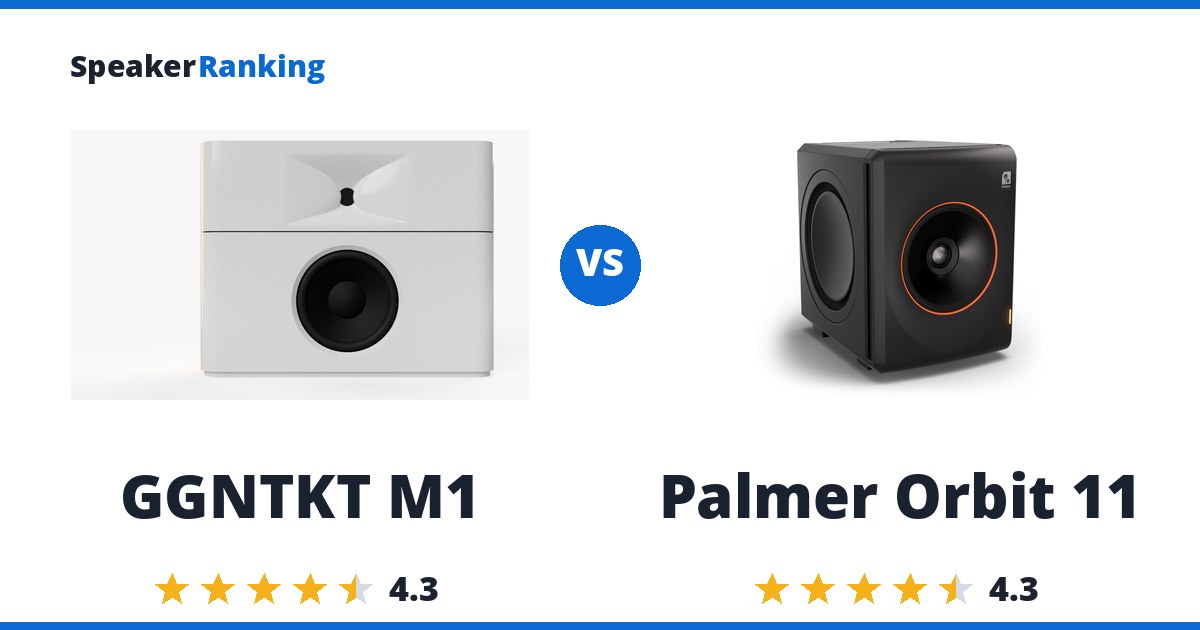
On the GGNTKT M1 side: One front and two rear firing 6.5 inch aluminum woofers cancel each other’s rearward radiation for genuine cardioid bass control, confirmed by a sound power directivity index that climbs steadily through the midrange rather than the erratic pattern typical of non cardioid designs. The catch: On axis deviation measures a comparatively rough 0.475dB average despite the excellent listening window smoothness, meaning a listener sitting dead center may notice more unevenness than the off axis figures suggest.
Buy the GGNTKT M1. It is rated higher for sound quality than the Palmer Orbit 11.
Want more options? Browse the full Powered Home rankings.
Specifications Side By Side
| GGNTKT M1 | Palmer Orbit 11 | |
|---|---|---|
| Price | £7,500 per pair | $1,532 per pair |
| Ranked | #16 of 68 in Large Size Powered Bookshelf Speakers | #36 of 68 in Large Size Powered Bookshelf Speakers |
| Enclosure | sealed | - |
| Drivers | 1.75” titanium ring diaphragm compression tweeter with waveguide, 3x 6.5” aluminum cone woofers (1 front, 2 rear firing, cardioid) | 1” tweeter + 6.5” midrange (coaxial), 2x 8” woofers |
| Dimensions | 12.6”H x 15.9”W x 5.5”D (319 x 405 x 140 mm) | 8.5” x 11.5” x 11.5” (217 x 293 x 292 mm) each |
| Weight | 24.3 lbs (11.0 kg) each | 30.6 lbs (13.9 kg) each |
| Amplifier Power | 560W total (70W tweeter, 210W woofers per channel, Class D) | 1000W peak / 400W RMS total; Tri-amped Class D |
| Frequency Response | 36Hz-20kHz -3dB | 28Hz - 28kHz (-3dB) (Manufacturer specified) |
| Bass Extension (-3dB) | 33.8Hz (measured, spinorama.org vendor data) | 27.8Hz (measured, spinorama.org) |
| Bass Extension (-10dB) | 28.2Hz (measured, spinorama.org vendor data) | 21.5Hz (measured, spinorama.org) |
| Warranty | 3 years (with registration) | - |
| Country | Germany | - |
| Maximum SPL | 112.8dB @ 1m (manufacturer specified) | 116dB peak at 1m |
| Inputs | XLR (balanced analog), XLR AES/EBU (digital), USB (calibration/control only, not an audio input) | XLR (balanced analog), AES3 (digital, via XLR) |
| XLR Input | Yes | Yes |
| RCA Input | No | No |
| TRS Input | No | No |
| Optical Input | No | No |
| Coaxial Input | No | No |
| USB Input | No | No |
| HDMI Input | No | No |
| AES Input | Yes | Yes |
| Aux Input | No | No |
| Bluetooth | No | No |
| Spinorama Preference Score | - | 6.20 |
| Spinorama Preference Score with Perfect Sub | - | 7.10 |
Related Speaker Comparisons
More worthwhile head-to-heads for GGNTKT M1:
- AsciLab C8C vs GGNTKT M1
- Yamaha HS8 vs GGNTKT M1
- GGNTKT M1 vs Kali Audio LP-6 V2
- Palmer Orbit 11 vs AsciLab C8C
- Adam Audio A7V vs Palmer Orbit 11
Prices on this page were last checked October 3, 2026 at 10:26 PM UTC. Product prices and availability are accurate as of that date/time and are subject to change; the price and availability shown on Amazon at the time of purchase will apply to the purchase of this product.
As an eBay Partner, we may be compensated if you make a purchase.
The Two Speakers In Full
 GGNTKT M1: £7,500 per pair Purite Audio (UK) eBay
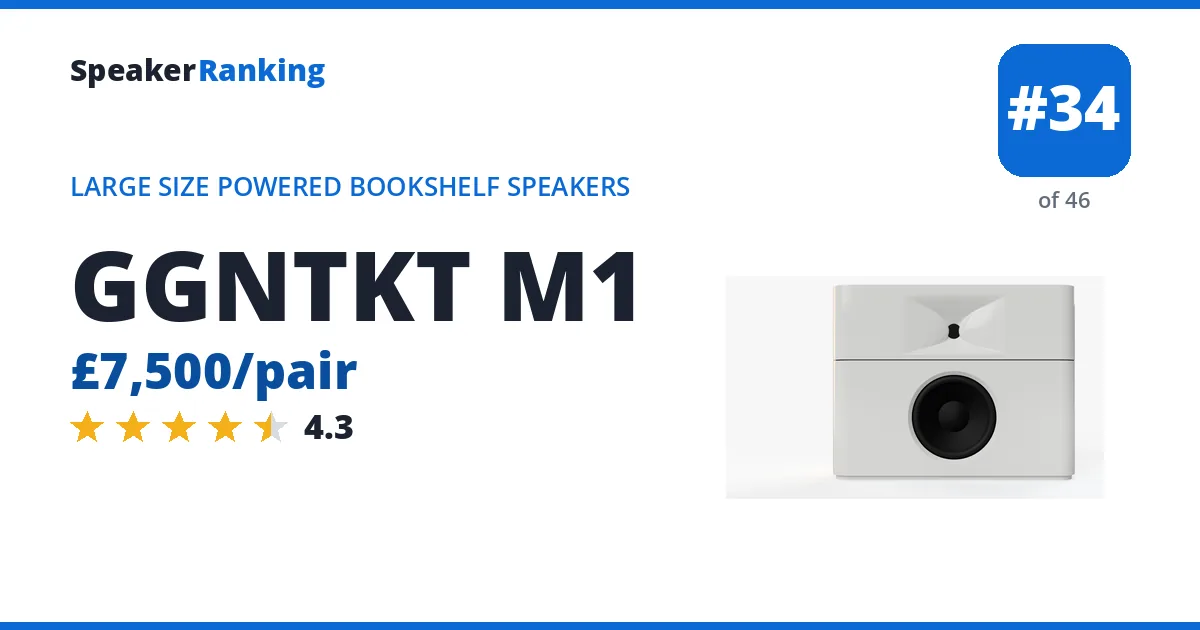
Pros: The manufacturer-supplied monopole measurement shows a 1.6dB response span from 300Hz to 5kHz, 33.8Hz -3dB extension and a 7.03 ideal-subwoofer score. Those results support even midrange balance and useful bass from a relatively shallow cabinet. Measured bass extension of 33.8Hz (-3dB).
Cons: The cited measurement is specifically monopole, so it cannot substantiate claims about cardioid-mode performance. Outboard electronics add cabling and installation complexity; confirm the complete system configuration before purchase. On-axis narrow-band deviation of 0.475dB is rougher than its listening-window smoothness, so a listener dead center may hear more unevenness than the off-axis figures suggest.
Full GGNTKT M1 review and specifications →
| AES Input | Yes |
|---|---|
| Amplifier Power | 560W total (70W tweeter, 210W woofers per channel, Class D) |
| Aux Input | No |
| Bass Extension (-10dB) | 28.2Hz (measured, spinorama.org vendor data) |
| Bass Extension (-3dB) | 33.8Hz (measured, spinorama.org vendor data) |
| Bluetooth | No |
| Coaxial Input | No |
| Country | Germany |
| Dimensions | 12.6”H x 15.9”W x 5.5”D (319 x 405 x 140 mm) |
| Drivers | 1.75” titanium ring diaphragm compression tweeter with waveguide, 3x 6.5” aluminum cone woofers (1 front, 2 rear firing, cardioid) |
| Enclosure | sealed |
| Frequency Response | 36Hz-20kHz -3dB |
| HDMI Input | No |
| Inputs | XLR (balanced analog), XLR AES/EBU (digital), USB (calibration/control only, not an audio input) |
| Maximum SPL | 112.8dB @ 1m (manufacturer specified) |
| Optical Input | No |
| RCA Input | No |
| TRS Input | No |
| USB Input | No |
| Warranty | 3 years (with registration) |
| Weight | 24.3 lbs (11.0 kg) each |
| XLR Input | Yes |
- Links
- Reviews, Comparisons and Sound Samples
- Head-to-Head Comparisons
 Palmer Orbit 11: $1,532 per pair Thomann eBay
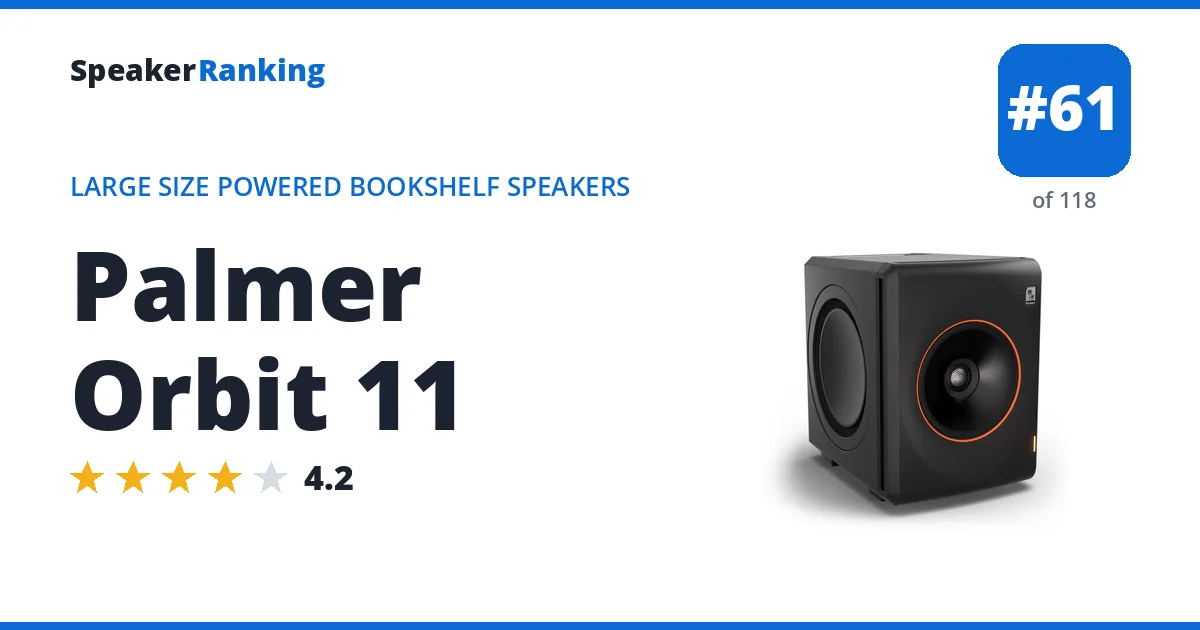
Pros: A 27.8Hz measured -3dB point provides genuinely deep standalone bass. The 1.8dB response span from 300Hz to 5kHz supports even mids, and the coaxial arrangement offers a compact acoustic source for nearfield listening. A cardioid front baffle reduces rear and side room reflections. Measured bass extension of 27.8Hz (-3dB).
Cons: Its 7.10 ideal-subwoofer score is more modest than the narrow midrange span alone suggests; response outside that band and off-axis behavior also matter. Deep-bass extension does not prove high-level headroom. Studio-oriented connections and setup are less convenient than an all-in-one consumer pair. It has XLR analog and AES3 digital connections only, with no RCA or TRS.
Full Palmer Orbit 11 review and specifications →
| AES Input | Yes |
|---|---|
| Amplifier Power | 1000W peak / 400W RMS total; Tri-amped Class D |
| Aux Input | No |
| Bass Extension (-10dB) | 21.5Hz (measured, spinorama.org) |
| Bass Extension (-3dB) | 27.8Hz (measured, spinorama.org) |
| Bluetooth | No |
| Coaxial Input | No |
| Dimensions | 8.5” x 11.5” x 11.5” (217 x 293 x 292 mm) each |
| Drivers | 1” tweeter + 6.5” midrange (coaxial), 2x 8” woofers |
| Frequency Response | 28Hz - 28kHz (-3dB) (Manufacturer specified) |
| HDMI Input | No |
| Inputs | XLR (balanced analog), AES3 (digital, via XLR) |
| Maximum SPL | 116dB peak at 1m |
| Optical Input | No |
| RCA Input | No |
| Spinorama Preference Score | 6.20 |
| Spinorama Preference Score with Perfect Sub | 7.10 |
| TRS Input | No |
| USB Input | No |
| Weight | 30.6 lbs (13.9 kg) each |
| XLR Input | Yes |
- Links
- Reviews, Comparisons and Sound Samples
- Head-to-Head Comparisons
- Palmer Orbit 11 vs Focal Trio6 ST6
- Palmer Orbit 11 vs Kali Audio IN-8 V2
- Palmer Orbit 11 vs Kali Audio LP-6 V2
- Palmer Orbit 11 vs Yamaha HS8
- Palmer Orbit 11 vs Cambridge Audio L/R X
- Palmer Orbit 11 vs JBL 308P MKII
- Palmer Orbit 11 vs Focal Alpha 65 EVO
- Palmer Orbit 11 vs Adam Audio A7V
- See all 19 comparisons