Short answer: the Buchardt A10 on measured sound quality, the Palmer Orbit 11 on price. The Buchardt A10 ranks #11 of 67 powered bookshelf speakers at $4300. The Palmer Orbit 11 ranks #35 at $766, $3534 cheaper.
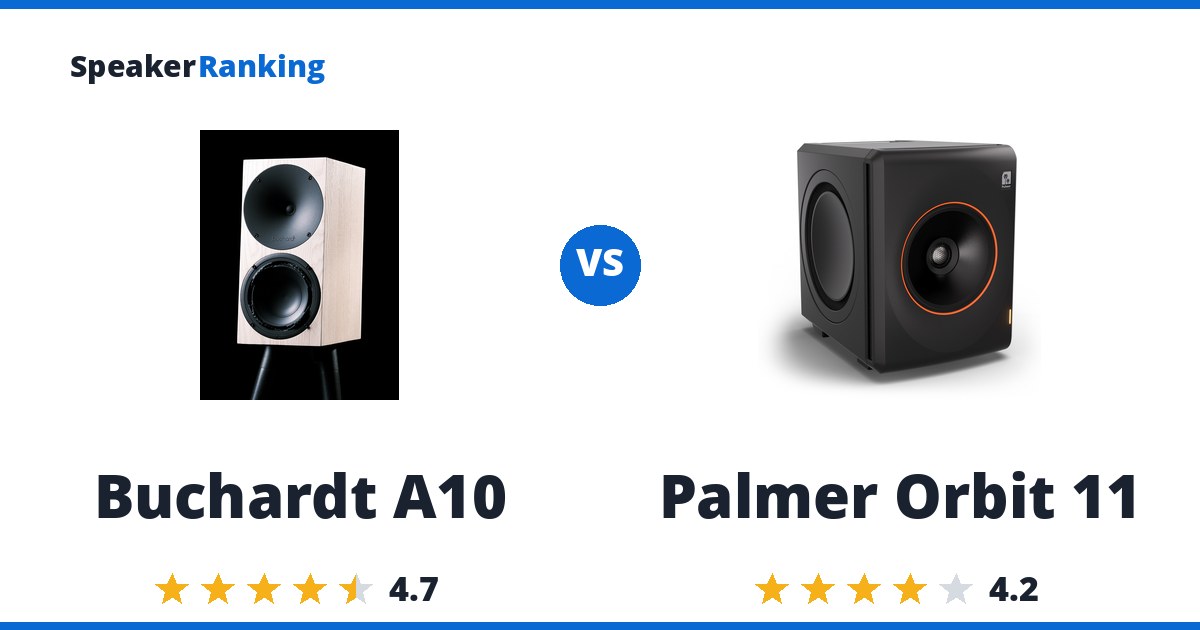
What the Buchardt A10 offers: The measured tuning combines 31.5Hz -3dB bass extension with preference scores of 6.49 standalone and 7.20 with an ideal subwoofer. A 1.9dB response span from 300Hz to 5kHz supports broadly even mids, and selectable DSP tunings offer useful flexibility. Watch for: The rising treble balance can sound brighter on axis; toe-out or a different tuning may suit some rooms. Deep-bass demands cause compression before the largest monitors reach their limits. A subwoofer with appropriate high-pass filtering can improve headroom; alternate presets should not be assumed to share the quoted scores.
What the Palmer Orbit 11 offers: A 27.8Hz measured -3dB point provides genuinely deep standalone bass. The 1.8dB response span from 300Hz to 5kHz supports even mids, and the coaxial arrangement offers a compact acoustic source for nearfield listening. Watch for: Its 6.20 ideal-subwoofer score is more modest than the narrow midrange span alone suggests; response outside that band and off-axis behavior also matter. Deep-bass extension does not prove high-level headroom. Studio-oriented connections and setup are less convenient than an all-in-one consumer pair.
Buy the Buchardt A10 when sound quality outweighs the price for you, and the Palmer Orbit 11 when the price outweighs sound quality instead.
Still deciding? The full Powered Home rankings cover every ranked option.
Specifications Side By Side
| Buchardt A10 | Palmer Orbit 11 | |
|---|---|---|
| Price | $4300 per pair | $1,532 per pair |
| Ranked | #11 of 67 in Large Size Powered Bookshelf Speakers | #35 of 67 in Large Size Powered Bookshelf Speakers |
| Bass Extension (-10dB) | 21Hz (measured, Erin's Audio Corner) | 21.5Hz (measured, spinorama.org) |
| Bass Extension (-3dB) | 30Hz (measured, Erin's Audio Corner) | 27.8Hz (measured, spinorama.org) |
| Dimensions | 14.6"H x 7"W x 9.6"D (370.8 x 177.8 x 243.8 mm) | 8.5" x 11.5" x 11.5" (217 x 293 x 292 mm) each |
| Inputs | XLR | - |
| Drivers | 6.5" PURIFI Extended Stroke Driver with Ultra Low Distortion, Custom made with triple Voice Coil woofer, 19 mm / 0.74" Resonance Free Aluminum dome with CDC aluminum waveguide tweeter | 1" tweeter + 6.5" midrange (coaxial), 2x 8" woofers |
| Weight | 15 lbs (6.8 kg) each | 30.6 lbs (13.9 kg) each |
| Woofer Cabinet | sealed | - |
| App | No | - |
| Bluetooth | No | - |
| EQ | Yes (Room adjustment) | - |
| DSP | No | - |
| Amplifier Power | 200w Per Speaker | 1000W peak / 400W RMS total; Tri-amped Class D |
| Spinorama Preference Score | 6.49 | 5.30 |
| Spinorama Preference Score with Perfect Sub | 7.20 | 6.20 |
| Maximum SPL | - | 116dB peak at 1m |
Related Speaker Comparisons
How Buchardt A10 compares with other leading options:
- AsciLab C8C vs Buchardt A10
- Mesanovic CDM65 vs Buchardt A10
- Kii THREE vs Buchardt A10
- Neumann KH 150 vs Buchardt A10
- Pitt & Giblin Flare vs Buchardt A10
Prices on this page were last checked September 16, 2026 at 12:41 AM UTC. Product prices and availability are accurate as of that date/time and are subject to change; the price and availability shown on Amazon at the time of purchase will apply to the purchase of this product.
As an eBay Partner, we may be compensated if you make a purchase.
The Two Speakers In Full
 Buchardt A10: $4300 per pair Buchardtaudio eBay
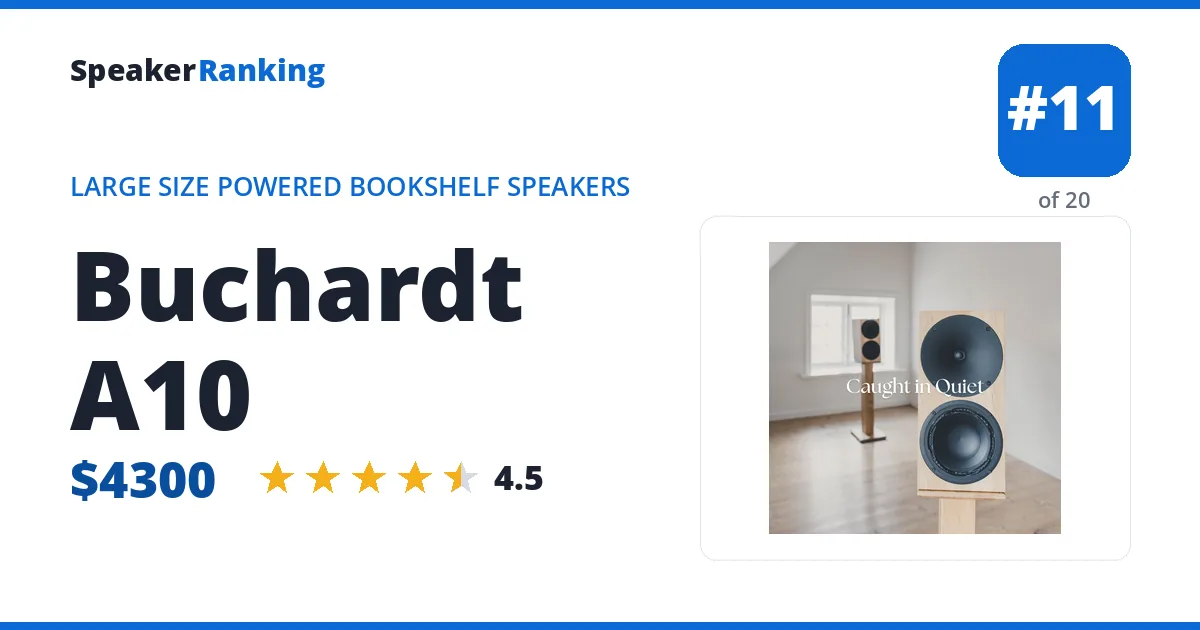
Pros: The measured tuning combines 31.5Hz -3dB bass extension with preference scores of 6.49 standalone and 7.20 with an ideal subwoofer. A 1.9dB response span from 300Hz to 5kHz supports broadly even mids, and selectable DSP tunings offer useful flexibility. Measured bass extension of 30Hz (-3dB).
Cons: The rising treble balance can sound brighter on axis; toe-out or a different tuning may suit some rooms. Deep-bass demands cause compression before the largest monitors reach their limits. A subwoofer with appropriate high-pass filtering can improve headroom; alternate presets should not be assumed to share the quoted scores.
Full Buchardt A10 review and specifications →
| Amplifier Power | 200w Per Speaker |
|---|---|
| App | No |
| Bass Extension (-10dB) | 21Hz (measured, Erin's Audio Corner) |
| Bass Extension (-3dB) | 30Hz (measured, Erin's Audio Corner) |
| Bluetooth | No |
| DSP | No |
| Dimensions | 14.6"H x 7"W x 9.6"D (370.8 x 177.8 x 243.8 mm) |
| Drivers | 6.5" PURIFI Extended Stroke Driver with Ultra Low Distortion, Custom made with triple Voice Coil woofer, 19 mm / 0.74" Resonance Free Aluminum dome with CDC aluminum waveguide tweeter |
| EQ | Yes (Room adjustment) |
| Inputs | XLR |
| Spinorama Preference Score | 6.49 |
| Spinorama Preference Score with Perfect Sub | 7.20 |
| Weight | 15 lbs (6.8 kg) each |
| Woofer Cabinet | sealed |
- Links
- Reviews, Comparisons and Sound Samples
- Head-to-Head Comparisons
 Palmer Orbit 11: $1,532 per pair Thomann eBay
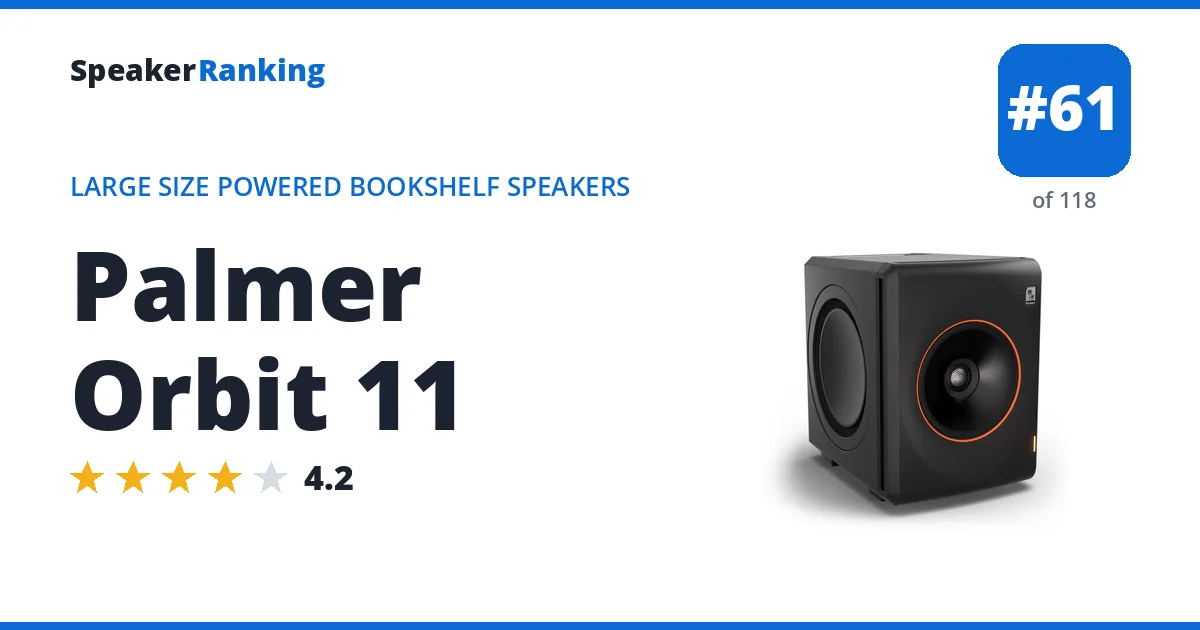
Pros: A 27.8Hz measured -3dB point provides genuinely deep standalone bass. The 1.8dB response span from 300Hz to 5kHz supports even mids, and the coaxial arrangement offers a compact acoustic source for nearfield listening. Measured bass extension of 27.8Hz (-3dB).
Cons: Its 6.20 ideal-subwoofer score is more modest than the narrow midrange span alone suggests; response outside that band and off-axis behavior also matter. Deep-bass extension does not prove high-level headroom. Studio-oriented connections and setup are less convenient than an all-in-one consumer pair.
Full Palmer Orbit 11 review and specifications →
| Amplifier Power | 1000W peak / 400W RMS total; Tri-amped Class D |
|---|---|
| Bass Extension (-10dB) | 21.5Hz (measured, spinorama.org) |
| Bass Extension (-3dB) | 27.8Hz (measured, spinorama.org) |
| Dimensions | 8.5" x 11.5" x 11.5" (217 x 293 x 292 mm) each |
| Drivers | 1" tweeter + 6.5" midrange (coaxial), 2x 8" woofers |
| Maximum SPL | 116dB peak at 1m |
| Spinorama Preference Score | 5.30 |
| Spinorama Preference Score with Perfect Sub | 6.20 |
| Weight | 30.6 lbs (13.9 kg) each |
- Links
- Reviews, Comparisons and Sound Samples
- Head-to-Head Comparisons
- Palmer Orbit 11 vs Focal Trio6 ST6
- Palmer Orbit 11 vs Kali Audio IN-8 V2
- Palmer Orbit 11 vs Kali Audio LP-6 V2
- Palmer Orbit 11 vs Yamaha HS8
- Palmer Orbit 11 vs Cambridge Audio L/R X
- Palmer Orbit 11 vs JBL 308P MKII
- Palmer Orbit 11 vs Focal Alpha 65 EVO
- Palmer Orbit 11 vs HEDD Type 20 MK2
- See all 18 comparisons