Coverage note. Speaker Ranking currently covers 18 Polk models across passive speakers and subwoofers. These are the products in our database, not a complete list of everything Polk makes.
What this page covers. The Polk models ranked here span passive speakers and subwoofers, including Polk Audio DSW PRO 660, Polk Audio PSW 111 and Polk Audio XT15. Use each model’s category position to compare it with alternatives of the same size and use case.
This page lists all 18 Polk speakers ranked on this site across passive speakers and subwoofers. Each model is shown in the category where it competes, with its current rank and the size of that ranking.
Use the category position rather than the brand name alone: speakers from the same manufacturer can perform very differently by size, price and product family.
Prices on this page were last checked September 30, 2026 at 2:57 PM UTC. Product prices and availability are accurate as of that date/time and are subject to change; the price and availability shown on Amazon at the time of purchase will apply to the purchase of this product.
As an eBay Partner, we may be compensated if you make a purchase.
Quick Navigation
- Medium Size Bookshelf Speakers
- Large Size Bookshelf Speakers
- Large Size Floorstanding Speakers
- Discontinued Polk Models
Medium Size Bookshelf Speakers
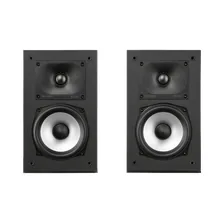 Ranked #29 of 90 in Medium Size Bookshelf Speakers - Polk Audio XT15: $179.00 per pair Amazon B&H Photo Video Crutchfield eBay
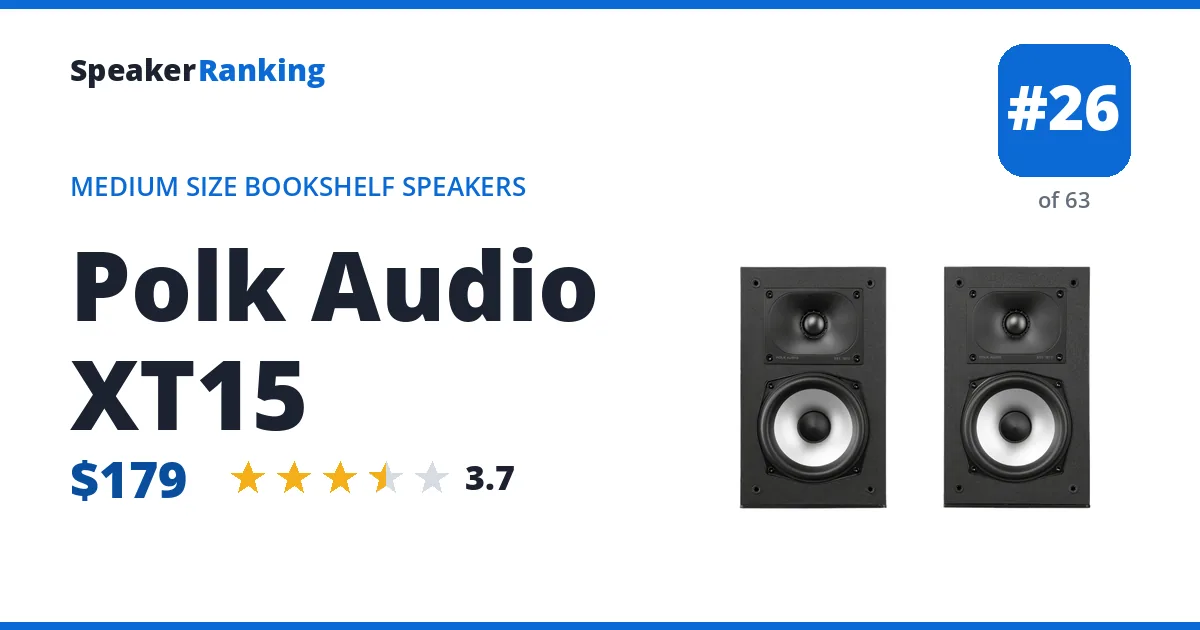
Pros: Very low $179/pair entry price for a Hi-Res Audio Certified 2-way design that’s Dolby Atmos and DTS:X compatible, and works with either 4- or 8-ohm amplifier outputs so it drops into almost any AVR without matching concerns. Off axis sound tracks the on axis response reasonably consistently for the price. Measured bass extension of 77.6Hz (-3dB).
Cons: Bass rolls off early, at 77.6Hz (-3dB) and 54.2Hz (-10dB). On-axis response is relatively uneven, with an average deviation of about 0.45dB, and its listening window is less smooth than pricier speakers. Modest 86dB sensitivity wants a reasonably powered amp channel. The 5.25” bi-laminate paper woofer is Polk’s entry-tier driver, not the polypropylene/Turbine cones used in its pricier Signature Elite/Reserve lines.
Full Polk Audio XT15 review and specifications →
| Bass Extension (-10dB) | 54.2Hz (measured, spinorama.org) |
|---|---|
| Bass Extension (-3dB) | 77.6Hz (measured, spinorama.org) |
| DIY Kit | No |
| Dimensions | 16.51 x 18.24cm (6.5 x 7.18 in), 4.08kg (9 lb) each |
| Drivers | 1” Terylene dome tweeter, 5.25” bi-laminate paper woofer |
| Impedance | 4/8-ohm compatible |
| Sensitivity | 86dB (1W/1m) |
| Spinorama Preference Score | 4.56 |
| Spinorama Preference Score with Perfect Sub | 7.31 |
| Weight | 9 lbs (4.08 kg) each |
| Woofer Cabinet | Ported |
- Links
- Reviews, Comparisons and Sound Samples
- Head-to-Head Comparisons
- Polk Audio XT15 vs Wharfedale Diamond 220
- Polk Audio XT15 vs Neumi Silk 4
- Polk Audio XT15 vs KEF Q150
- Polk Audio XT15 vs Boston Acoustics A25
- Polk Audio XT15 vs Radiant Acoustics Clarity 4.2
- Polk Audio XT15 vs Neumi BS5
- Polk Audio XT15 vs Wharfedale Diamond 12.1
- Polk Audio XT15 vs Wharfedale Super Denton
- See all 43 comparisons
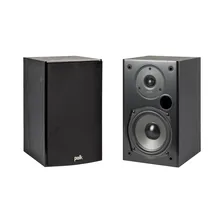 Ranked #81 of 90 in Medium Size Bookshelf Speakers - Polk T15: $149.00 per pair Amazon eBay
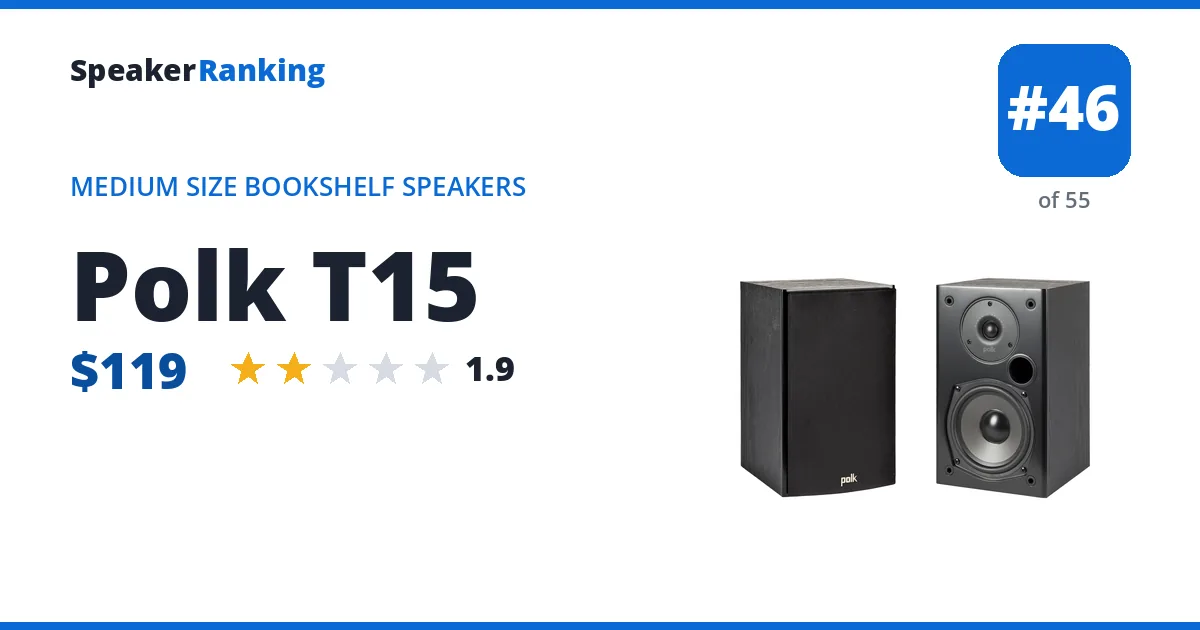
Pros: Extremely affordable 2-way design that actually measured better at +/-20 degrees vertical off-axis than directly on-axis. In near-field desktop use, the reviewer found the T15 “didn’t sound that horrible,” partly because nearby desk reflections mask the frequency response dip. Measured bass extension of 88.6Hz (-3dB), with a measured sensitivity of 89dB.
Cons: Spinorama analysis reveals what Amir called a “horrific drop in upper mids/lower treble region of 3 to 6 kHz,” likely from tweeter-woofer phase cancellation directly on-axis. Measured impedance ranges from 4-8 ohms, contradicting the specified 6-8 ohm range, and there’s a distortion peak around 400Hz. On- and off-axis response “vary a ton,” making listening position unusually important. The reviewer recommends saving up for the Pioneer SP-BS22-LR instead: “I can’t justify recommending the Polk T15 even though subjective performance was not horrible.”
Full Polk T15 review and specifications →
| Bass Extension (-10dB) | 58.1Hz (measured, Audio Science Review) |
|---|---|
| Bass Extension (-3dB) | 88.6Hz (measured, Audio Science Review) |
| DIY Kit | No |
| Dimensions | 10.63H x 6.5W x 7.25D in |
| Drivers | 0.75” tweeter, 5.25” woofer |
| Frequency Response | 60Hz - 24kHz (Manufacturer specified) |
| Impedance | 8 ohms nominal |
| Sensitivity | 89dB (manufacturer specified, 1W/1m); 88.98dB measured, spinorama.org |
| Spinorama Preference Score | 0.34 |
| Spinorama Preference Score with Perfect Sub | 3.39 |
| Weight | 8.2 lbs (3.74 kg) each |
- Links
- Reviews, Comparisons and Sound Samples
- Head-to-Head Comparisons
Large Size Bookshelf Speakers
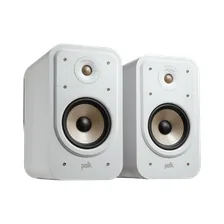 Ranked #71 of 134 in Large Size Bookshelf Speakers - Polk Signature Elite ES20: $399 per pair B&H Photo Video eBay
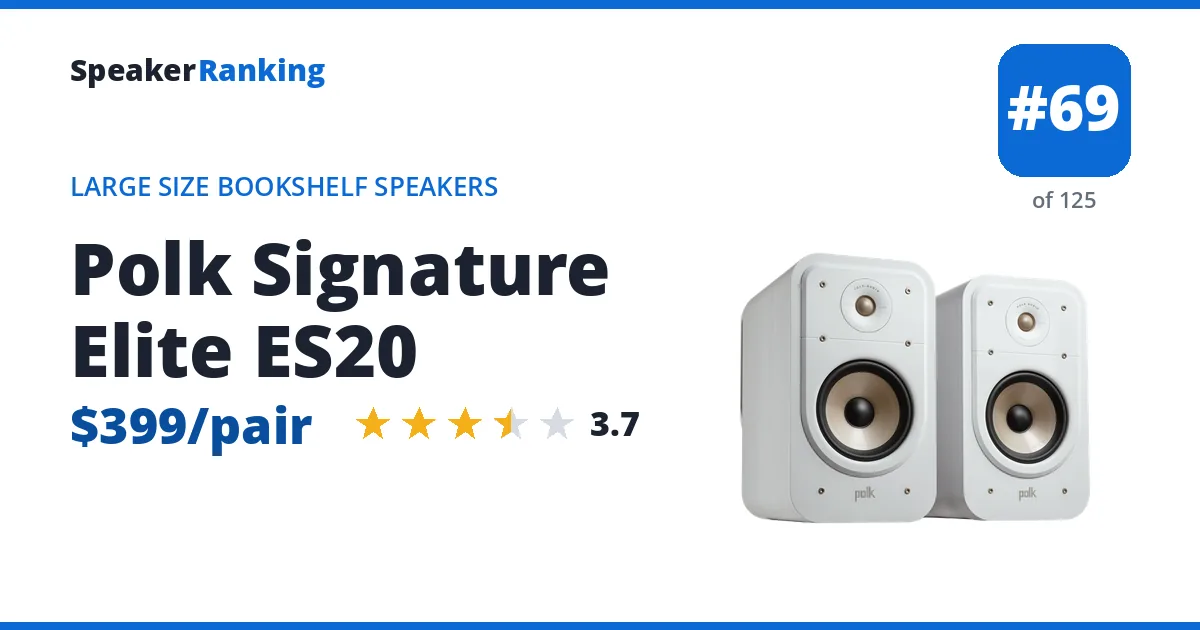
Pros: A full-size, efficient 6.5-inch bookshelf pair with unusually deep bass for the price. ASR measured 41Hz estimated in-room extension, a well-damped Q of 0.66, broad horizontal coverage to roughly +/-60 degrees and a 6.44 preference score with a subwoofer. Measured bass extension of 55.7Hz (-3dB).
Cons: Predicted in-room smoothness of 0.238 and directivity-index consistency of 3.81 are average rather than class-leading. The deep cabinet needs substantial shelf or stand space, and its Power Port still requires rear clearance.
Full Polk Signature Elite ES20 review and specifications →
| Bass Extension (-10dB) | 38.6Hz (derived, log-interpolated between spinorama.org -9dB/-12dB points) |
|---|---|
| Bass Extension (-3dB) | 55.7Hz (measured, ASR via spinorama.org) |
| Country | United States (design) |
| DIY Kit | No |
| Dimensions | 14.8H x 8.5W x 13.8D in |
| Drivers | 1” Terylene dome tweeter, 6.5” polypropylene woofer |
| Enclosure | 2-way, Power Port bass-reflex |
| Impedance | 4/8-ohm compatible |
| Sensitivity | 86dB |
| Spinorama Preference Score | 4.49 |
| Spinorama Preference Score with Perfect Sub | 6.44 |
| Weight | 17 lbs (7.7 kg) each |
- Links
- Reviews, Comparisons and Sound Samples
- Head-to-Head Comparisons
- Polk Signature Elite ES20 vs Ascend CBM-170 SE2
- Polk Signature Elite ES20 vs Klipsch RP-600M II
- Polk Signature Elite ES20 vs Dynaudio Emit 20
- Polk Signature Elite ES20 vs Philharmonic BMR Monitor
- Polk Signature Elite ES20 vs Dynaudio Contour 20i
- Polk Signature Elite ES20 vs Mission LX-3 MKII
- Polk Signature Elite ES20 vs ELAC DBR62
- Polk Signature Elite ES20 vs Parts Express Samba MT
- See all 46 comparisons
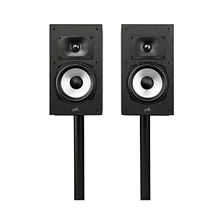 Ranked #93 of 134 in Large Size Bookshelf Speakers - Polk Monitor XT20: $279.00 per pair Amazon Crutchfield eBay
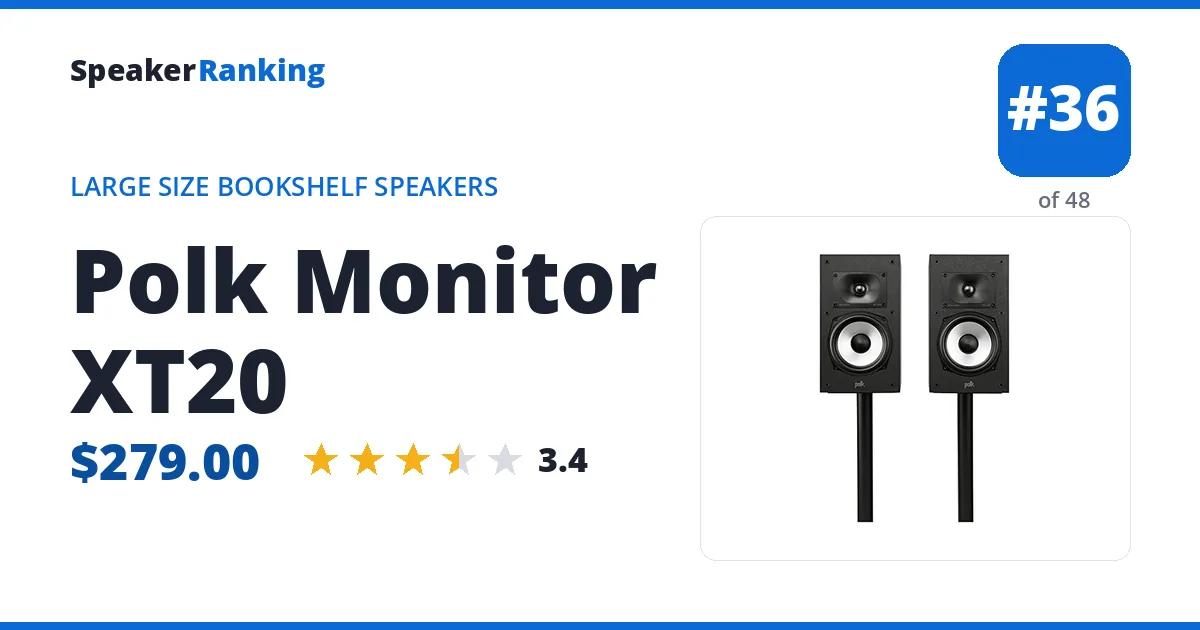
Pros: Two-way bookshelf design with a 1” tweeter and 6.5” woofer, part of Polk’s budget-friendly XT lineup (spanning roughly $200-700 across the series). Measures more linear and has fewer/smaller cabinet resonances than its smaller sibling, the XT15, making it (by the reviewer’s own assessment) probably the better of the two based on data alone. Reasonably good bass output for the price and size, with an F3 of 63Hz. Horizontal radiation of about ±50° gives a respectable, enjoyable soundstage width. Takes well to EQ correction: the early-reflections directivity trend is decently linear, meaning tonal adjustments can meaningfully improve the sound. Provides usable, respectable volume when paired with a subwoofer crossover, even though it isn’t intended to play extremely loud on its own. Measured bass extension of 64.5Hz (-3dB), with a measured sensitivity of 86dB.
Cons: Notably bright treble, elevated roughly 1-5dB above the midrange depending on frequency: a characteristic shared across the whole Polk XT lineup, requiring either EQ or toe-out to tame. Small resonances appear around 300Hz and 800Hz, with some of that energy leaking from the port area. Vertical listening window is narrow: best kept close to the tweeter axis, with only a couple of degrees of tolerance above or below before the sound changes. Still needs a subwoofer for real low-end extension despite the decent F3. Overall linearity isn’t state-of-the-art flat, and while the reviewer found it pleasant, some artificial brightness remains even after basic EQ correction in the crossover region.
Full Polk Monitor XT20 review and specifications →
| Bass Extension (-10dB) | 43.4Hz (derived, log-interpolated between spinorama.org -9dB/-12dB points) |
|---|---|
| Bass Extension (-3dB) | 64.5Hz (measured, Erin’s Audio Corner) |
| DIY Kit | No |
| Dimensions | 13”H x 7.5”W x 11”D (330.2 x 190.5 x 279.4 mm) |
| Drivers | 6.5” bilaminate paper cone woofer, 1” Terylene dome tweeter |
| Impedance | 8 ohms nominal (measured, Erin’s Audio Corner) |
| Sensitivity | 86dB (measured by Erin’s Audio Corner; 87dB manufacturer specified) |
| Spinorama Preference Score | 4.71 |
| Spinorama Preference Score with Perfect Sub | 7.07 |
| Weight | 11.9 lbs (5.4 kg) each |
| Woofer Cabinet | ported |
- Links
- Reviews, Comparisons and Sound Samples
- Erin’s Audio Corner: Polk’s new budget XT Speakers. Reviewed! More from Erin’s Audio Corner →
- Erin’s Audio Corner Website Polk Monitor XT20
- Erin’s Audio Corner: 10 Great (and Terrible) Speakers Under $300!
- Erin’s Audio Corner: Budget Stereo Systems You Will Love
- Erin’s Audio Corner Measurements (spinorama.org)
- Head-to-Head Comparisons
- Polk Monitor XT20 vs KEF Q3 Meta
- Polk Monitor XT20 vs Sonus Faber Lumina II
- Polk Monitor XT20 vs SVS Prime Bookshelf
- Polk Monitor XT20 vs Polk Reserve R100
- Polk Monitor XT20 vs ELAC Debut 2.0 B6.2
- Polk Monitor XT20 vs Focal Aria 906
- Polk Monitor XT20 vs Revel Performa M22
- Polk Monitor XT20 vs Dynaudio Special Forty
- See all 43 comparisons
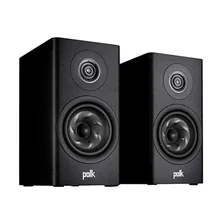 Ranked #96 of 134 in Large Size Bookshelf Speakers - Polk Reserve R100: $699.00 per pair Amazon Polk Audio eBay
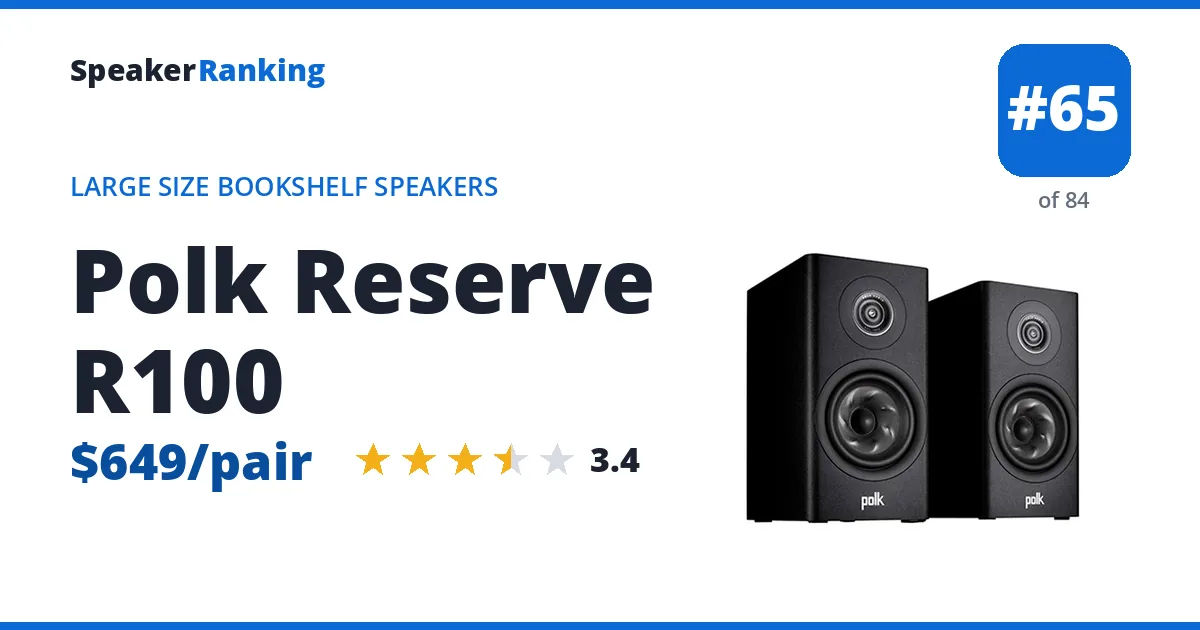
Pros: Compact cabinet, unusually useful bass for its size and well-controlled woofer breakup. Erin measured F3/F10 points of 68Hz/49Hz, and the X-Port vent avoids much of the chuffing and pipe resonance common to budget rear ports. The 5.25-inch Turbine Cone woofer and 1-inch Pinnacle ring-radiator tweeter produce good detail at moderate levels, while listening roughly 20° off-axis reduces part of the elevated top octave. Measured bass extension of 68Hz (-3dB), with a measured sensitivity of 85dB.
Cons: Erin measured only about 85dB sensitivity and the impedance reaches 3.6 ohms, so it is neither efficient nor an entirely benign AVR load. The treble runs roughly 3dB above the midrange and becomes aggressive above about 85dB SPL. A directivity discontinuity through the woofer/tweeter crossover means EQ cannot fully repair the power response, and a 400Hz impedance feature plus 500Hz-1kHz response irregularity suggests a cabinet or system resonance. Substantial low-frequency compression at higher playback levels limits clean dynamics.
Full Polk Reserve R100 review and specifications →
| Bass Extension (-10dB) | 49Hz (measured, Erin’s Audio Corner) |
|---|---|
| Bass Extension (-3dB) | 68Hz (measured, Erin’s Audio Corner) |
| DIY Kit | No |
| Dimensions | 12.8”H x 6.5”W x 10.2”D |
| Drivers | 1” Pinnacle ring-radiator tweeter; 5.25” Turbine Cone midwoofer |
| Impedance | 3.6 ohms minimum (measured, Erin’s Audio Corner) |
| Sensitivity | 85dB/2.83V/1m (measured, Erin’s Audio Corner) |
| Spinorama Preference Score | 5.46 |
| Spinorama Preference Score with Perfect Sub | 7.93 |
| Weight | 12.1 lbs (5.5 kg) each |
| Woofer Cabinet | ported, rear X-Port |
- Links
- Reviews, Comparisons and Sound Samples
- Head-to-Head Comparisons
- Polk Reserve R100 vs Focal Aria 906
- Polk Reserve R100 vs Revel Performa M22
- Polk Reserve R100 vs Sonus Faber Lumina II
- Polk Reserve R100 vs Polk Monitor XT20
- Polk Reserve R100 vs HSU Research MFL-6
- Polk Reserve R100 vs KEF Q3 Meta
- Polk Reserve R100 vs Polk R200
- Polk Reserve R100 vs SVS Prime Bookshelf
- See all 31 comparisons
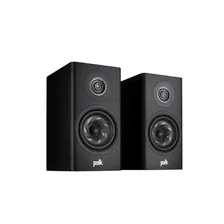 Ranked #102 of 134 in Large Size Bookshelf Speakers - Polk R200: $799.00 per pair Amazon eBay
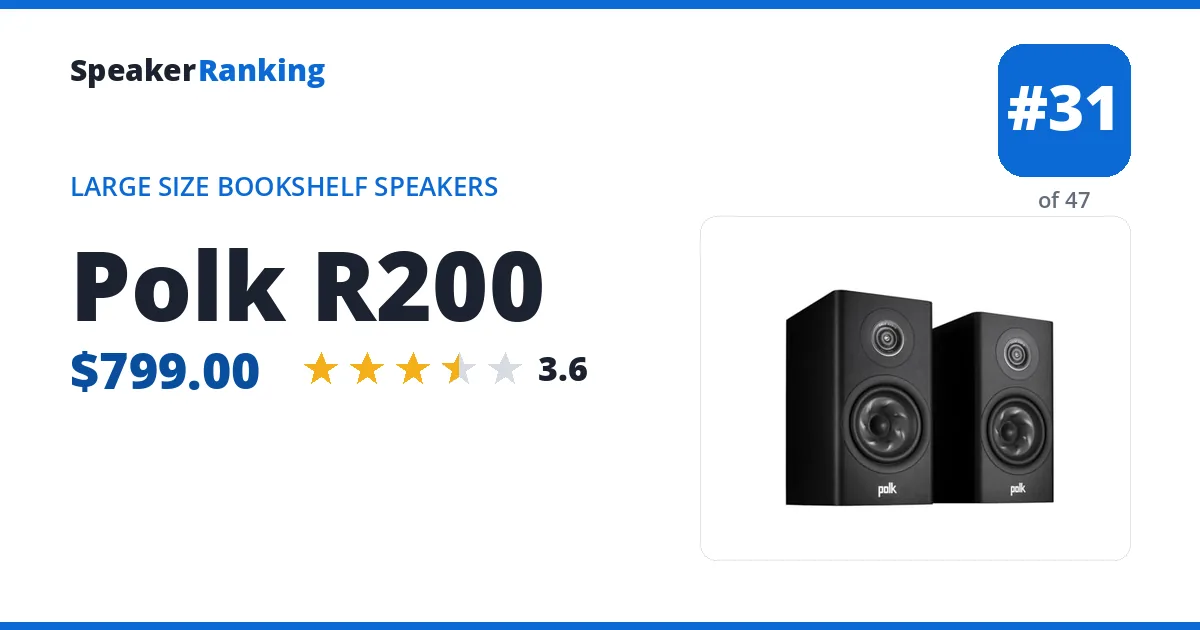
Pros: Two-way design with a 6.5” midwoofer and 1” ring radiator tweeter, giving reasonably tight, well-defined imaging. Neutral through most of the midrange (roughly 200Hz-1kHz). On-axis response holds within about 1.5dB up to 10kHz. About 20dB of usable dynamic range (76dB to 96dB) before more significant compression sets in. Reasonably close to a 4-ohm nominal load, giving some flexibility with amplifier choice, though a dedicated 4-ohm-capable amp is still recommended. Measured bass extension of 74Hz (-3dB).
Cons: A resonance and associated distortion increase around 800Hz-1kHz creates a “tinny,” occasionally glaring quality on certain instruments and vocals, confirmed both by ear and in the frequency-response and distortion measurements. Above about 10kHz, the ring-radiator tweeter takes on an artificial, “digital-esque” quality, then falls off quickly above 16kHz. F3 of 74Hz and F10 of 50Hz mean there’s essentially no meaningful bass “thump” below about 60Hz: a subwoofer is strongly recommended even just to restore basic kick-drum presence. The ring radiator tweeter’s dispersion narrows sharply above about 8kHz, so the speaker should be aimed close to on-axis (no more than 5-10° of toe-out). Vertical listening position is fairly critical: moving more than a few degrees above or below the tweeter line causes a noticeable timbre shift due to a gap in the crossover region. Multitone distortion spikes substantially (to around 10%) in the 600Hz-1kHz region at higher output levels (around 96dB/1m), meaning the glare gets worse the louder it’s played. At the highest tested output (102dB, 26dB of dynamic range), the woofer shows clear signs of struggling; crossing to a subwoofer around 80-100Hz helps prevent bottoming out but doesn’t fully eliminate the compression.
Full Polk R200 review and specifications →
| Bass Extension (-10dB) | 50Hz (measured, Erin’s Audio Corner) |
|---|---|
| Bass Extension (-3dB) | 74Hz (measured, Erin’s Audio Corner) |
| DIY Kit | No |
| Dimensions | 14.1”H x 7.5”W x 13.9”D (359.0 x 190.0 x 353.8 mm) |
| Drivers | 25mm soft dome + 165mm woofer |
| Impedance | 4 ohms nominal, 3.8 ohms minimum (measured, Erin’s Audio Corner) |
| Sensitivity | 85dB |
| Spinorama Preference Score | 5.09 |
| Spinorama Preference Score with Perfect Sub | 7.61 |
| Weight | 31.3 lbs (14.2 kg) |
| Woofer Cabinet | ported, rear |
- Links
- Reviews, Comparisons and Sound Samples
- Head-to-Head Comparisons
Large Size Floorstanding Speakers
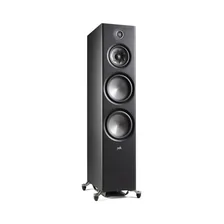 Ranked #33 of 74 in Large Size Floorstanding Speakers - Polk Audio Reserve R700: $2,398 per pair Amazon eBay
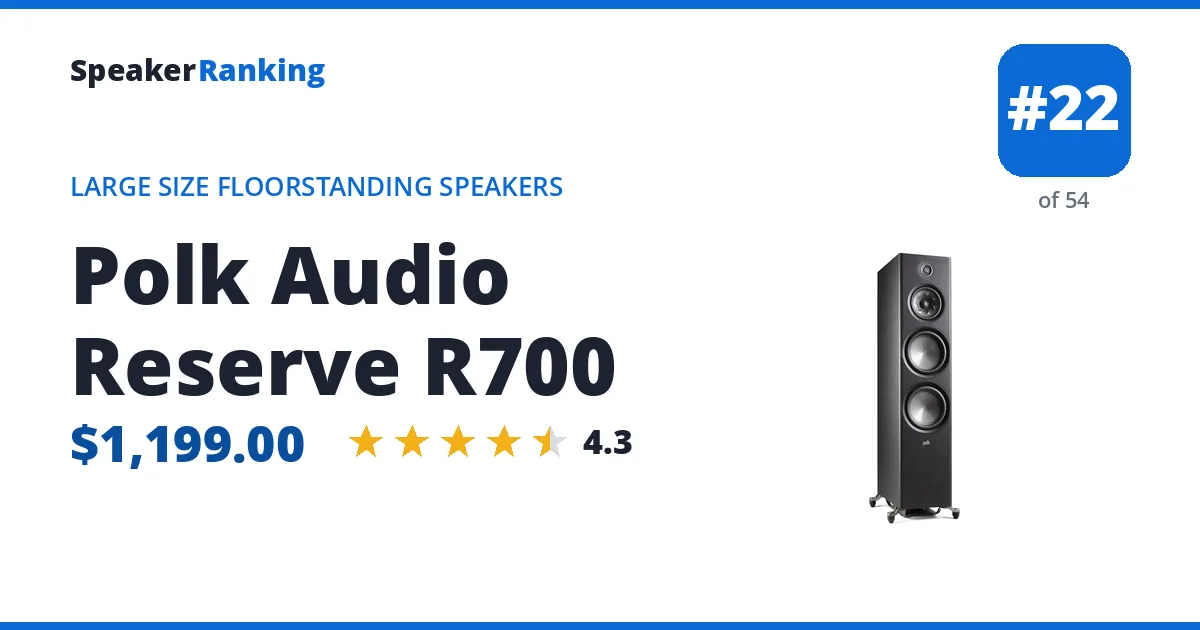
Pros: Three-way design with a 1” ring radiator tweeter, 6.5” mid-range, and dual 8” mid-bass drivers in a ported, down-firing cabinet. On-axis frequency response holds within about ±2dB across most of its range, with genuinely deep bass extension (F3 40Hz) reaching into the mid-30s Hz in-room. Wide horizontal radiation of about ±70°, giving a strong, enveloping stereo width and stage-extension effect on well-recorded tracks. Good low-level dynamics: solid bass thump at quiet listening volumes without over-accentuation. Strong distortion and compression control through the bass and midrange. Real nominal impedance closer to 4 ohms than the marketed 8 ohms, so with the right amplifier it can be driven hard: a $3,000 two-channel integrated brought out significantly more life than a budget $300 unit could. Excellent value at its roughly $1199/pair MSRP, ranking among the reviewer’s top picks under $2,500; outperforms the similarly-priced Klipsch RP-8000F II in bass extension and overall smoothness. Measured bass extension of 40Hz (-3dB), with a measured sensitivity of 87.5dB.
Cons: Compression in the high frequencies rises sharply between 96dB and 102dB output: a real limitation only at very high volumes (around 100dB at 3 meters), but a clear step down from pricier ($5,000+) towers. Horizontal directivity mismatch around 4-5kHz, where the tweeter flares wider than the midrange, can sound a bit forward, especially noticeable when toed out further into the room; sidewall absorption or curtains help tame it. Harmonic distortion crosses the reviewer’s 3% threshold around 7kHz at 96dB output, possibly contributing to that same forward quality at high volume. Narrow vertical sweet spot (about ±15° from the tweeter axis), typical of non-coaxial tower designs: more of a consideration for multi-row home theater seating than single-row listening. The ring-radiator tweeter narrows noticeably above about 7-8kHz, and toeing the speaker out more than about 20° causes the top end to fall off quickly. Needs at least 2 feet of clearance from the rear wall to avoid boomy, exaggerated bass, since it lacks the bass-shelf tuning some rivals use to allow closer wall placement. Compared to the pricier KEF R5 Meta, has narrower horizontal (and much narrower vertical) directivity, so seating flexibility is more limited.
Full Polk Audio Reserve R700 review and specifications →
| Bass Extension (-10dB) | 31Hz (measured, Erin’s Audio Corner) |
|---|---|
| Bass Extension (-3dB) | 40Hz (measured, Erin’s Audio Corner) |
| DIY Kit | No |
| Dimensions | 45”H x 12.6”W x 16.9”D (1143.8 x 320.7 x 428.3 mm) |
| Drivers | 2x 8” polypropylene cone woofers, 1x 6.5” turbine cone midrange, 1x 1” Pinnacle ring radiator tweeter |
| Impedance | 4 ohms nominal, 3.5 ohms minimum (measured above 80Hz, Erin’s Audio Corner) |
| Sensitivity | 87.5dB (measured average 300Hz-3kHz @ 2.83V/1m, Erin’s Audio Corner) |
| Spinorama Preference Score | 6.38 |
| Spinorama Preference Score with Perfect Sub | 7.83 |
| Weight | 102.1 lbs (46.3 kg) |
| Woofer Cabinet | ported, down-firing |
- Links
- Reviews, Comparisons and Sound Samples
- Head-to-Head Comparisons
- Polk Audio Reserve R700 vs PSB Imagine T65
- Polk Audio Reserve R700 vs Emotiva Airmotiv T2+
- Polk Audio Reserve R700 vs JBL HDI-3600
- Polk Audio Reserve R700 vs ELAC Debut 3.0 DF63
- Polk Audio Reserve R700 vs JBL Studio 698
- Polk Audio Reserve R700 vs Polk Reserve R500
- Polk Audio Reserve R700 vs KEF R11 Meta
- Polk Audio Reserve R700 vs Infinity Primus 360
- See all 46 comparisons
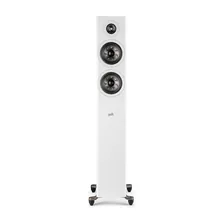 Ranked #37 of 74 in Large Size Floorstanding Speakers - Polk Reserve R500: $1,259.98 per pair Amazon eBay
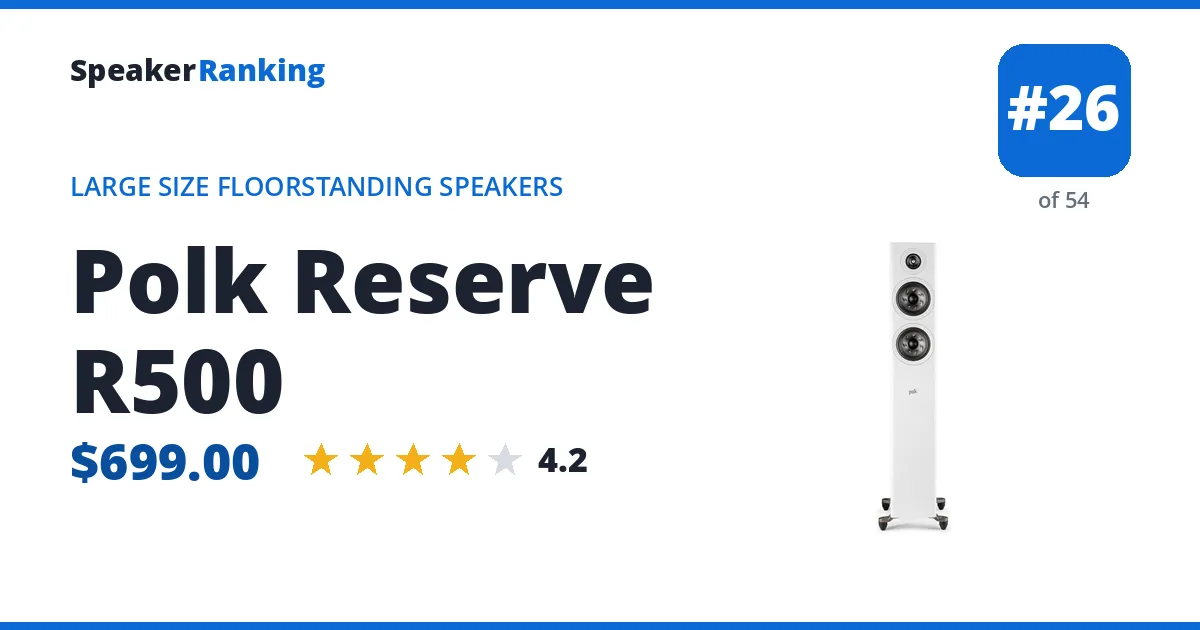
Pros: Dual 5.25” midwoofers paired with a ring radiator tweeter in a floorstanding tower design. Surprisingly neutral overall compared to Polk’s smaller bookshelf models: notably more even-handed than the brighter-sounding R200 the reviewer tested previously. Good linearity on-axis, within about -3/+2dB. Sensitivity close to 86dB, easily driven to adequate levels in a small-to-medium room with a 100W-capable amplifier. Takes very well to EQ: a single band of correction (about a 2dB cut around 4-5kHz) resolves the main tonal issue and transforms the sound. Dynamic range and compression performance is solidly “medium,” holding up fine through about 20dB of level increase before higher-frequency and bass output start to taper at extreme volumes. Measured bass extension of 51Hz (-3dB), with a measured sensitivity of 86.2dB.
Cons: A bump around 4-6kHz gives a “shouty,” mildly sibilant quality in the lower treble. Counterintuitively, toeing the speaker out to reduce brightness makes this worse rather than better, since the ring-radiator tweeter’s directivity narrows rapidly above about 6-7kHz: pointed on-axis retains enough top-end air to balance the bump, but toed away that air drops off and the shoutiness stands out more. Bass is adequate for its 5.25” woofers but lacks real weight below about 40-50Hz; a subwoofer is still needed for movies and bass-heavy music. A cabinet resonance around 160-170Hz subtracts from rather than adds boom to the mid-bass region. Vertical listening window is fairly narrow: sitting more than about 10-20° above or below the tweeter axis causes a suckout in the 2-5kHz range, reducing clarity and attack. Multitone distortion ramps up noticeably around 1kHz, and crossing over to a subwoofer at 80Hz doesn’t meaningfully reduce it: likely a surround-related effect rather than excursion-related. Without applying corrective EQ, the reviewer says the 4-6kHz brightness would make it harder to live with day to day.
Full Polk Reserve R500 review and specifications →
| Bass Extension (-10dB) | 33Hz (measured, Erin’s Audio Corner) |
|---|---|
| Bass Extension (-3dB) | 51Hz (measured, Erin’s Audio Corner) |
| DIY Kit | No |
| Dimensions | 40.3”H x 6.8”W x 12.4”D (1023.6 x 172.7 x 315 mm) |
| Drivers | Two 5.25” Turbine Cone woofer, 1” Pinnacle Ring Radiator tweeter |
| Impedance | 4.1 ohms minimum above 80Hz (measured, Erin’s Audio Corner; 8 ohms nominal per manufacturer) |
| Sensitivity | 86.2dB (measured, Erin’s Audio Corner) |
| Spinorama Preference Score | 5.86 |
| Spinorama Preference Score with Perfect Sub | 7.44 |
| Weight | 39.2 lbs (17.8 kg) each |
| Woofer Cabinet | ported, rear |
- Links
- Reviews, Comparisons and Sound Samples
- Head-to-Head Comparisons
- Polk Reserve R500 vs ELAC Debut 3.0 DF63
- Polk Reserve R500 vs Linkwitz Lab LXmini
- Polk Reserve R500 vs Emotiva Airmotiv T2+
- Polk Reserve R500 vs PSB Imagine T65
- Polk Reserve R500 vs Infinity Primus 360
- Polk Reserve R500 vs Polk Audio Reserve R700
- Polk Reserve R500 vs Q Acoustics 5040
- Polk Reserve R500 vs Klipsch Forte IV
- See all 35 comparisons
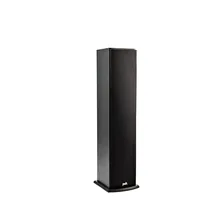 Ranked #54 of 74 in Large Size Floorstanding Speakers - Polk T50: $498 per pair Amazon eBay
Pros: Pretty deep bass for the price. Distortion at 86dB SPL/1m is reasonably controlled outside a narrow spike around 250Hz. The reviewer notes performance is “not too bad for a budget speaker” once the two main tonal issues are addressed with EQ. Measured bass extension of 47Hz (-3dB), with a measured sensitivity of 86.3dB.
Cons: 5dB peak at 1kHz, 4dB bright top end from 11kHz on up. Just okay vertical off axis. Impedance and phase show several resonances between 200Hz-1kHz, with a minimum impedance of 4.2 ohms. Distortion rises substantially at 96dB SPL/1m across the midrange, with repeated peaks between 100Hz-2kHz.
Full Polk T50 review and specifications →
| Bass Extension (-10dB) | 38Hz (measured, Audio Science Review) |
|---|---|
| Bass Extension (-3dB) | 47Hz (measured, Audio Science Review) |
| DIY Kit | No |
| Dimensions | 40.4”H x 9.3”W x 12.5”D (1026.2 x 235.0 x 317.5 mm) |
| Drivers | 2x 6.5” bi-laminate paper cone woofers, 1x 1” Terylene dome tweeter + 2x 8” passive bass radiators |
| Impedance | 4 ohms nominal (4.2 ohms minimum, measured by Audio Science Review) |
| Sensitivity | 86.3dB (2.83V/1m, measured by Audio Science Review) |
| Spinorama Preference Score | 4.14 |
| Spinorama Preference Score with Perfect Sub | 6.15 |
| Weight | 75.4 lbs (34.2 kg) |
| Woofer Cabinet | passive radiator |
- Links
- Reviews, Comparisons and Sound Samples
- Head-to-Head Comparisons
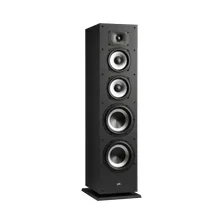 Ranked #58 of 74 in Large Size Floorstanding Speakers - Polk Audio XT70: $698 per pair Amazon eBay
Pros: The flagship tower in Polk’s current Monitor XT lineup, sitting above the XT60 and XT15 in the same series, adding a second 6.5” woofer and dual 8” passive radiators for more low-end output. Rated for both 4 and 8 ohm operation. Measured bass extension of 43.9Hz (-3dB).
Cons: On-axis smoothness (0.274) and listening-window smoothness (0.303) are unremarkable for a tower this size, with a pronounced +0.28dB per octave upward tonal tilt giving it a brighter-leaning balance and a predicted in-room smoothness of just 0.31. Directivity-index standard deviation of 3.33 is unremarkable either way.
Full Polk Audio XT70 review and specifications →
| Bass Extension (-10dB) | 37.7Hz (derived, sustained-crossing interpolation, Erin’s Audio Corner via spinorama.org) |
|---|---|
| Bass Extension (-3dB) | 43.9Hz (measured, Erin’s Audio Corner via spinorama.org) |
| Country | China |
| DIY Kit | No |
| Dimensions | 40.4H x 9.25W x 12.5D in |
| Drivers | 1” Terylene dome tweeter, 2x 6.5” Dynamic Balance woofers, 2x 8” passive radiators |
| Enclosure | Ported, critically-braced MDF |
| Impedance | 4/8 ohm compatible |
| Sensitivity | 89dB @ 1W/1m |
| Spinorama Preference Score | 5.16 |
| Spinorama Preference Score with Perfect Sub | 7.10 |
| Weight | 35.1 lbs (15.9 kg) each |
- Links
- Reviews, Comparisons and Sound Samples
- Head-to-Head Comparisons
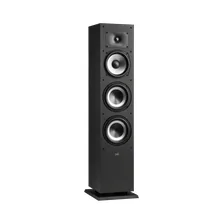 Ranked #59 of 74 in Large Size Floorstanding Speakers - Polk Audio XT60: $458 per pair Amazon B&H Photo Video Crutchfield eBay
Pros: Passive-radiator-loaded design (6.5” woofer plus two 6.5” passive radiators) gives deeper bass than the driver size alone would suggest: 43.9Hz at -3dB / 38.1Hz at -10dB, genuinely competitive extension for a budget tower. Hi-Res Audio certified, Dolby Atmos/DTS:X compatible, and works with either 4- or 8-ohm amplifier outputs. Measured bass extension of 43.9Hz (-3dB).
Cons: Bass alignment Q (lfq 0.96) is the highest, least-controlled figure in this entire batch, consistent with owner reports of a slightly loose, boomy low end at higher volumes. On-axis response is also relatively uneven, with narrow-band deviation of about 0.51dB. The vinyl-wrapped (not wood veneer) cabinet reads as budget up close per owner reviews, and at least one owner reported blowing a driver under sustained heavy bass: some caution is warranted with bass-heavy source material at volume.
Full Polk Audio XT60 review and specifications →
| Bass Extension (-10dB) | 38.1Hz (measured, spinorama.org) |
|---|---|
| Bass Extension (-3dB) | 43.9Hz (measured, spinorama.org) |
| DIY Kit | No |
| Dimensions | 19.05 x 92.5 x 23.09cm (7.5 x 36.4 x 9.09 in) each |
| Drivers | 1” Terylene dome tweeter, 6.5” bilaminate polypropylene woofer, 2x 6.5” passive radiators |
| Impedance | 4/8-ohm compatible |
| Sensitivity | 86dB (1W/1m) |
| Spinorama Preference Score | 5.19 |
| Spinorama Preference Score with Perfect Sub | 7.13 |
| Weight | 20 lbs (9.07 kg) each |
| Woofer Cabinet | Passive radiator-loaded |
- Links
- Reviews, Comparisons and Sound Samples
- Head-to-Head Comparisons
- Polk Audio XT60 vs Polk Audio XT70
- Polk Audio XT60 vs Focal Aria Evo X N°2
- Polk Audio XT60 vs Magnepan LRS+
- Polk Audio XT60 vs Polk Signature Elite ES60
- Polk Audio XT60 vs JBL Stage 2 280F
- Polk Audio XT60 vs Polk T50
- Polk Audio XT60 vs Definitive Technology BP-9020
- Polk Audio XT60 vs Klipsch RP-6000F II
- See all 40 comparisons
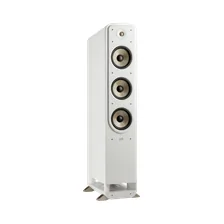 Ranked #62 of 74 in Large Size Floorstanding Speakers - Polk Signature Elite ES60: $599 per pair Crutchfield eBay
Pros: Three 6.5-inch woofers deliver strong output, 39Hz measured extension and about 89.5dB measured sensitivity. Its local Spinorama scores of 3.69 raw and 5.57 with subwoofer are respectable for a large value-oriented tower, with reasonably smooth listening-window behavior. Measured bass extension of 51.3Hz (-3dB), with a measured sensitivity of 90dB.
Cons: The measured data show enough directivity and response unevenness to keep it below the strongest neutral towers, and its large cabinet needs room. Polk’s 32Hz lower-limit claim is optimistic relative to the independent anechoic result.
Full Polk Signature Elite ES60 review and specifications →
| Bass Extension (-10dB) | 37.1Hz (derived, log-interpolated between spinorama.org -9dB/-12dB points) |
|---|---|
| Bass Extension (-3dB) | 51.3Hz (measured, ASR via spinorama.org) |
| DIY Kit | No |
| Dimensions | 44.5H x 8.5W x 15.7D in |
| Drivers | 1” Terylene tweeter, three 6.5” woofers |
| Enclosure | 2-way floorstander with Power Port |
| Frequency Response | 32Hz-40kHz (manufacturer) |
| Impedance | 8 ohms compatible |
| Sensitivity | 90dB specified; 89.5dB measured |
| Spinorama Preference Score | 3.69 |
| Spinorama Preference Score with Perfect Sub | 5.57 |
| Weight | 52 lbs (23.6 kg) each |
- Links
- Reviews, Comparisons and Sound Samples
- Head-to-Head Comparisons
Discontinued Polk Models
Still ranked, and often still worth buying used, but no longer in production. Check availability before planning around one of these.
Small Home Subwoofers (Under 30 lbs)
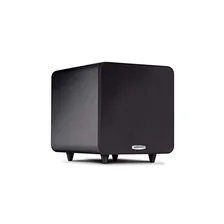 Ranked #11 of 48 in Small Home Subwoofers (Under 30 lbs) - Polk Audio PSW 111: $287.72 Discontinued Amazon eBay
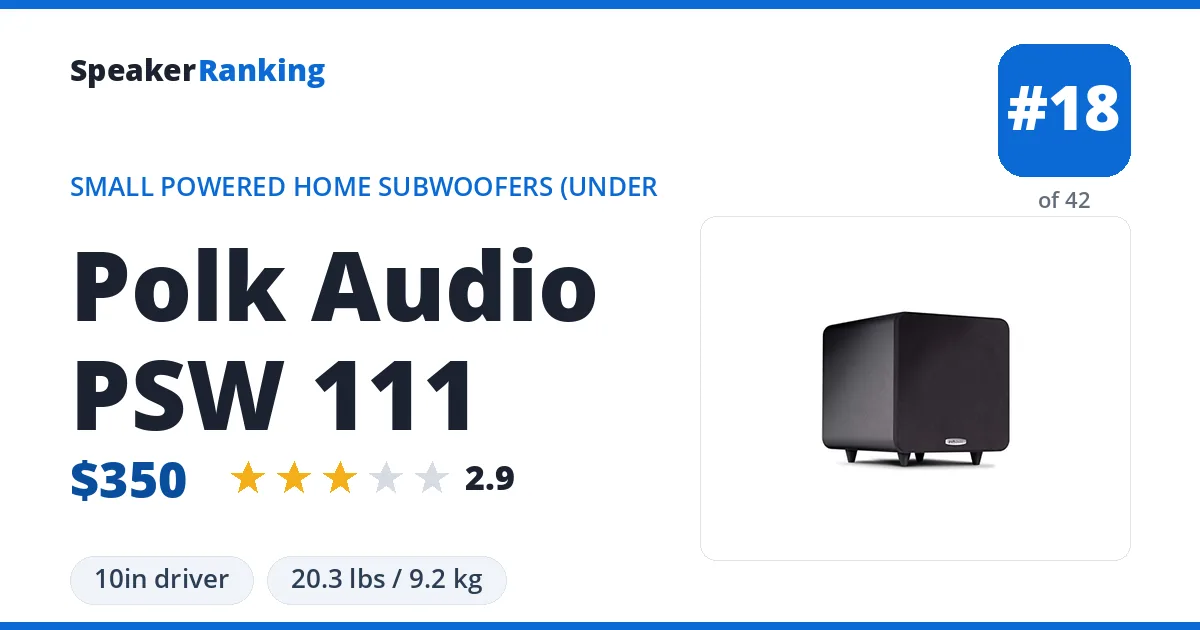
Pros: Independent CEA-2010 testing records 72.6 dB at 20 Hz and 112.2 dB through 40-80 Hz. The ported, bottom enclosure with 8” (203mm) driver is best suited to upper-bass support in a modest room.
Cons: Deep-bass output is limited relative to its midbass result, so it is not the right choice for the lowest movie effects. The 308.1H x 279.4W x 330.2D mm cabinet and 9.2 kg mass still need deliberate placement and calibration. Discontinued.
Full Polk Audio PSW 111 review and specifications →
| CEA-2010-A Average (40-80Hz) | 112.2 dB |
|---|---|
| Cabinet Color | black |
| Country | United States |
| Dimensions | 12.1”H x 11”W x 13”D (308.1 x 279.4 x 330.2 mm) |
| Drivers | 8” (203mm) driver |
| Enclosure | ported, bottom |
| Measurement Source | Brent Butterworth |
| Output SPL at 20 Hz | 72.6 dB |
| Output SPL at 25 Hz | 76.1 dB |
| Output SPL at 31.5 Hz | 91.9 dB |
| Output SPL at 40 Hz | 106.5 dB |
| Output SPL at 50 Hz | 111.0 dB |
| Output SPL at 63 Hz | 115.1 dB |
| Output SPL at 80 Hz | 116.0 dB |
| Warranty | 5/3 |
| Weight | 20.3 lbs (9.2 kg) |
- Links
- Reviews, Comparisons and Sound Samples
- Independently measured by Brent Butterworth; the published figures above come from this ASR subwoofer measurement thread.
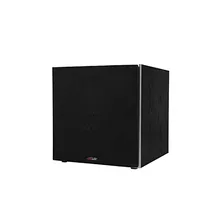 Ranked #17 of 48 in Small Home Subwoofers (Under 30 lbs) - Polk Audio PSW10: $249.00 Discontinued Amazon eBay
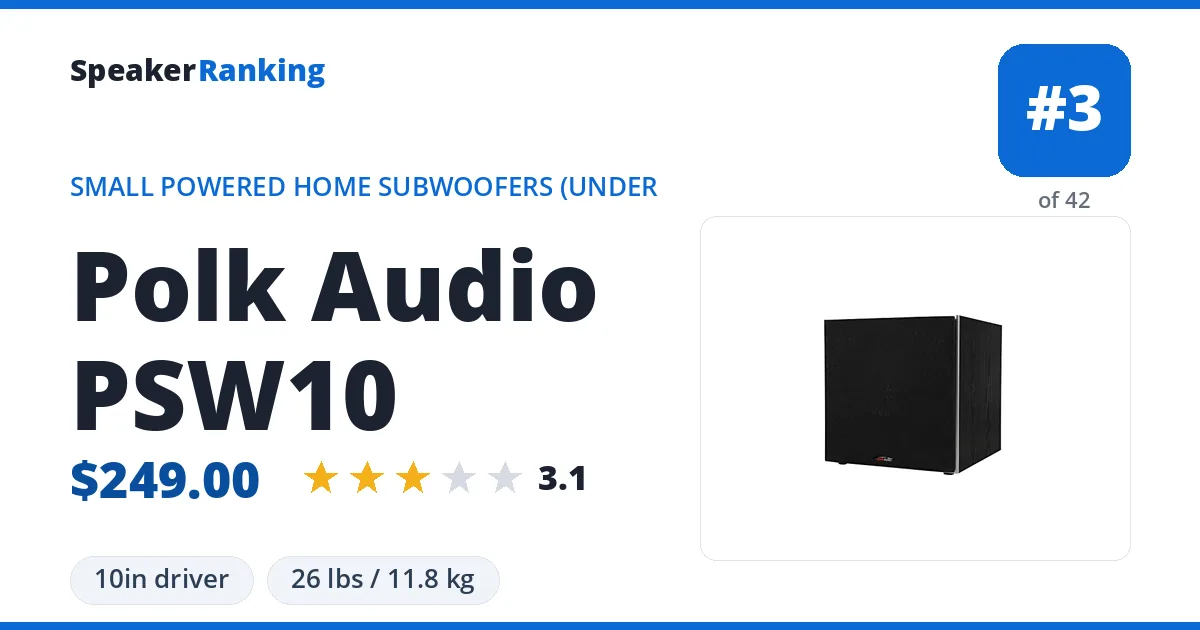
Pros: 10-inch Dynamic Balance polymer composite driver with 100W Peak Class D amp. Deep bass capabilities are impressive with exceptional definition/control per CNet. Reduces distortion (uncommon at this price). Good hard clean bass performs well at higher volumes. Easy setup and affordable price consistently highlighted by thousands of buyers. Polk Power Port channels airflow cleanly for tighter bass without port noise. Best for average/small rooms and apartments.
Cons: Budget-tier construction, ported room dependency, lower 110.3 dB output, and $249 entry-level positioning. Discontinued.
Full Polk Audio PSW10 review and specifications →
| CEA-2010-A Average (40-80Hz) | 110.3 dB |
|---|---|
| Cabinet Color | black |
| Country | United States |
| Dimensions | 14.4”H x 14”W x 16.1”D (365.0 x 355.6 x 409.4 mm) |
| Drivers | 10” (254mm) driver |
| Enclosure | ported, front |
| Measurement Source | ErinsAudioCorner |
| Output SPL at 31.5 Hz | 96.1 dB |
| Output SPL at 40 Hz | 104.7 dB |
| Output SPL at 50 Hz | 109.7 dB |
| Output SPL at 63 Hz | 113.8 dB |
| Output SPL at 80 Hz | 113.1 dB |
| Output SPL at 100 Hz | 112.2 dB |
| Output SPL at 125 Hz | 110.7 dB |
| Warranty | 5/3 |
| Weight | 26 lbs (11.8 kg) |
- Links
- Reviews, Comparisons and Sound Samples
- Head-to-Head Comparisons
- Polk Audio PSW10 vs GoldenEar ForceField 3
- Polk Audio PSW10 vs MartinLogan Dynamo 700w
- Polk Audio PSW10 vs ELAC IW-S10EQ in-wall
- Polk Audio PSW10 vs Velodyne Acoustics SPL-1200 Series II
- Polk Audio PSW10 vs Klipsch HD Theater 600
- Polk Audio PSW10 vs SVS 3000 Micro
- Polk Audio PSW10 vs Definitive Technology SuperCube 2000
- Polk Audio PSW10 vs SVS SB-1000 PRO
- See all 13 comparisons
Medium Home Subwoofers (30-75 lbs)
 Ranked #19 of 146 in Medium Home Subwoofers (30-75 lbs) - Polk Audio DSW PRO 660: $699 Discontinued eBay
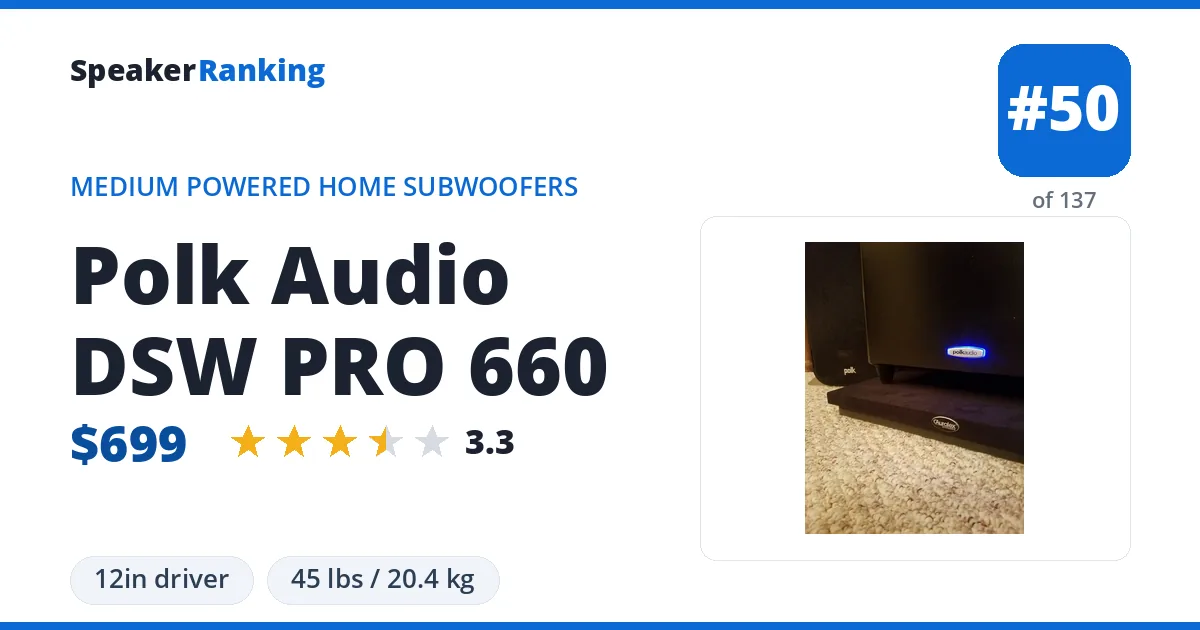
Pros: 12-inch ported with 400W RMS dynamic balance driver delivers impressive deep bass impact with exceptional definition and control. Shakes floors while maintaining clean response. Night-and-day difference in movie/music reproduction.
Cons: Discontinued.
Full Polk Audio DSW PRO 660 review and specifications →
| Amplifier Power | 400W RMS |
|---|---|
| CEA-2010-A Average (40-80Hz) | 119.4 dB |
| Cabinet Color | black |
| Country | United States |
| Dimensions | 17.1”H x 16.5”W x 16.5”D (435.1 x 419.1 x 419.1 mm) |
| Drivers | 12” (305mm) driver |
| Enclosure | ported, bottom |
| Frequency Response | 25-125Hz |
| Measurement Source | Brent Butterworth |
| Output SPL at 20 Hz | 88.0 dB |
| Output SPL at 25 Hz | 98.0 dB |
| Output SPL at 31.5 Hz | 110.7 dB |
| Output SPL at 40 Hz | 115.3 dB |
| Output SPL at 50 Hz | 119.4 dB |
| Output SPL at 63 Hz | 122.0 dB |
| Output SPL at 80 Hz | 120.9 dB |
| Warranty | 5/3 |
| Weight | 45 lbs (20.4 kg) |
- Links
- Reviews, Comparisons and Sound Samples
- Independently measured by Brent Butterworth; the published figures above come from this ASR subwoofer measurement thread.
- Head-to-Head Comparisons
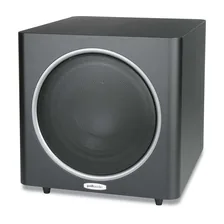 Ranked #53 of 146 in Medium Home Subwoofers (30-75 lbs) - Polk Audio PSW 110: $499 Discontinued eBay
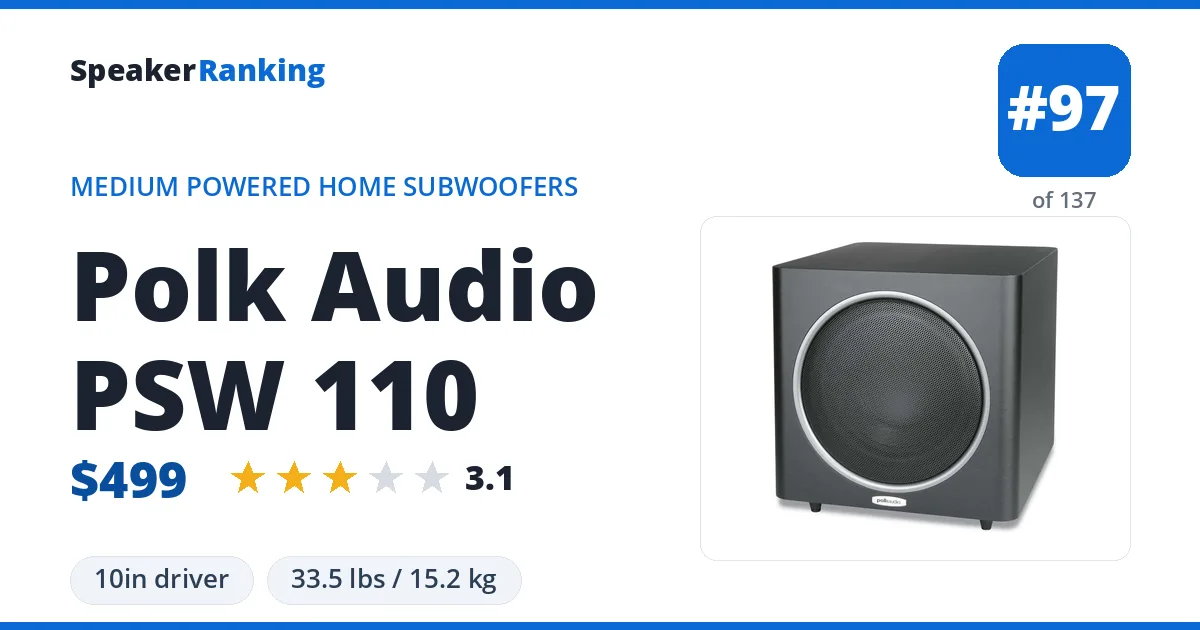
Pros: 10-inch ported with 100W RMS. Johns Hopkins-developed Dynamic Balance technology enables surface vibration analysis for refined response. Excels with music material, not placement sensitive. Good connectivity with LFE and RCA options.
Cons: Discontinued.
Full Polk Audio PSW 110 review and specifications →
| Amplifier Power | 100W RMS |
|---|---|
| CEA-2010-A Average (40-80Hz) | 115.2 dB |
| Cabinet Color | black |
| Country | United States |
| Dimensions | 14.5”H x 14.2”W x 17”D (368.3 x 361.9 x 431.8 mm) |
| Drivers | 10” (254mm) driver |
| Enclosure | ported, bottom |
| Frequency Response | 32-250Hz |
| Measurement Source | Brent Butterworth |
| Output SPL at 20 Hz | 77.6 dB |
| Output SPL at 25 Hz | 87.1 dB |
| Output SPL at 31.5 Hz | 104.2 dB |
| Output SPL at 40 Hz | 110.3 dB |
| Output SPL at 50 Hz | 114.3 dB |
| Output SPL at 63 Hz | 117.9 dB |
| Output SPL at 80 Hz | 118.5 dB |
| Warranty | 5/3 |
| Weight | 33.5 lbs (15.2 kg) |
- Links
- Reviews, Comparisons and Sound Samples
- Independently measured by Brent Butterworth; the published figures above come from this ASR subwoofer measurement thread.
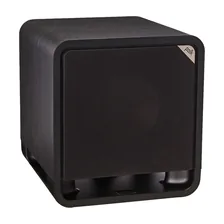 Ranked #57 of 146 in Medium Home Subwoofers (30-75 lbs) - Polk Audio HTS 10: $450 Discontinued eBay
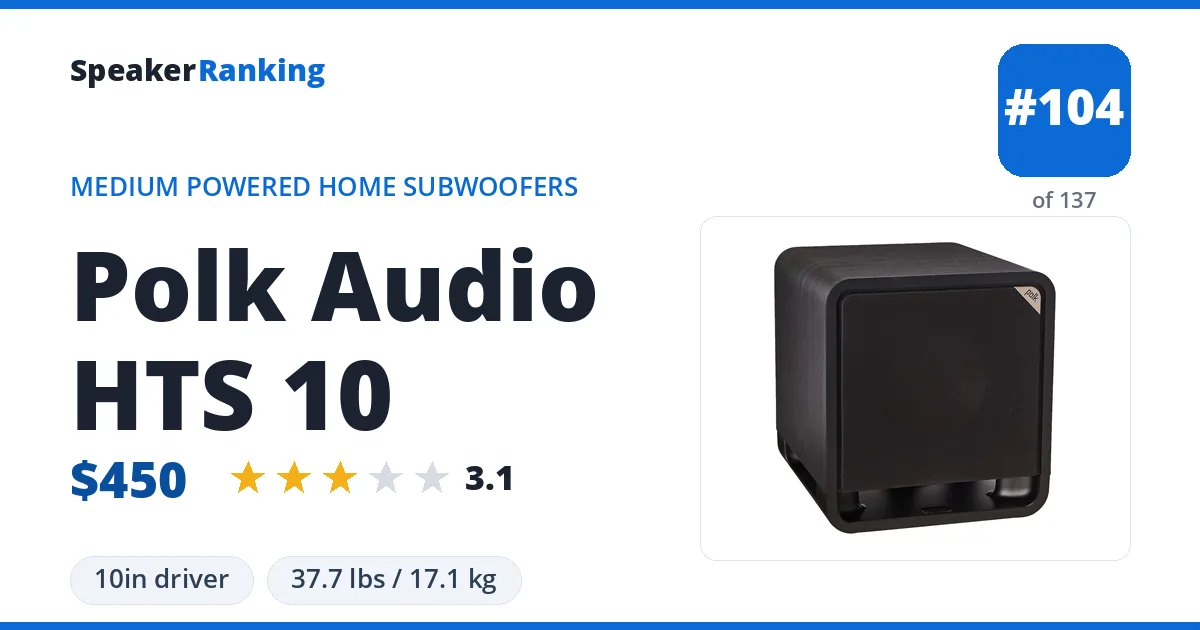
Pros: 10-inch ported with 100W RMS and Polk Power Port maintains relatively clean bass at high volumes. Competent mid-tier option from reliable brand. Good fit for medium rooms without excessive distortion.
Cons: Discontinued.
Full Polk Audio HTS 10 review and specifications →
| Amplifier Power | 100W continuous / 200W peak; Class D |
|---|---|
| CEA-2010-A Average (40-80Hz) | 114.8 dB |
| Cabinet Color | black, wood |
| Country | United States |
| Dimensions | 16.6”H x 15.1”W x 16.1”D (421.9 x 383.8 x 408.9 mm) |
| Drivers | 10” (254mm) driver |
| Enclosure | ported, front |
| Frequency Response | 25-180Hz |
| Inputs | LFE and stereo line level RCA |
| Measurement Source | Brent Butterworth |
| Output SPL at 20 Hz | 86.1 dB |
| Output SPL at 25 Hz | 98.7 dB |
| Output SPL at 31.5 Hz | 109.3 dB |
| Output SPL at 40 Hz | 111.6 dB |
| Output SPL at 50 Hz | 114.4 dB |
| Output SPL at 63 Hz | 116.9 dB |
| Output SPL at 80 Hz | 116.2 dB |
| Warranty | 5/3 |
| Weight | 37.7 lbs (17.1 kg) |
- Links
- Reviews, Comparisons and Sound Samples
- Independently measured by Brent Butterworth; the published figures above come from this ASR subwoofer measurement thread.
- Head-to-Head Comparisons
 Ranked #65 of 146 in Medium Home Subwoofers (30-75 lbs) - Polk Audio HTS 12: $550 Discontinued eBay
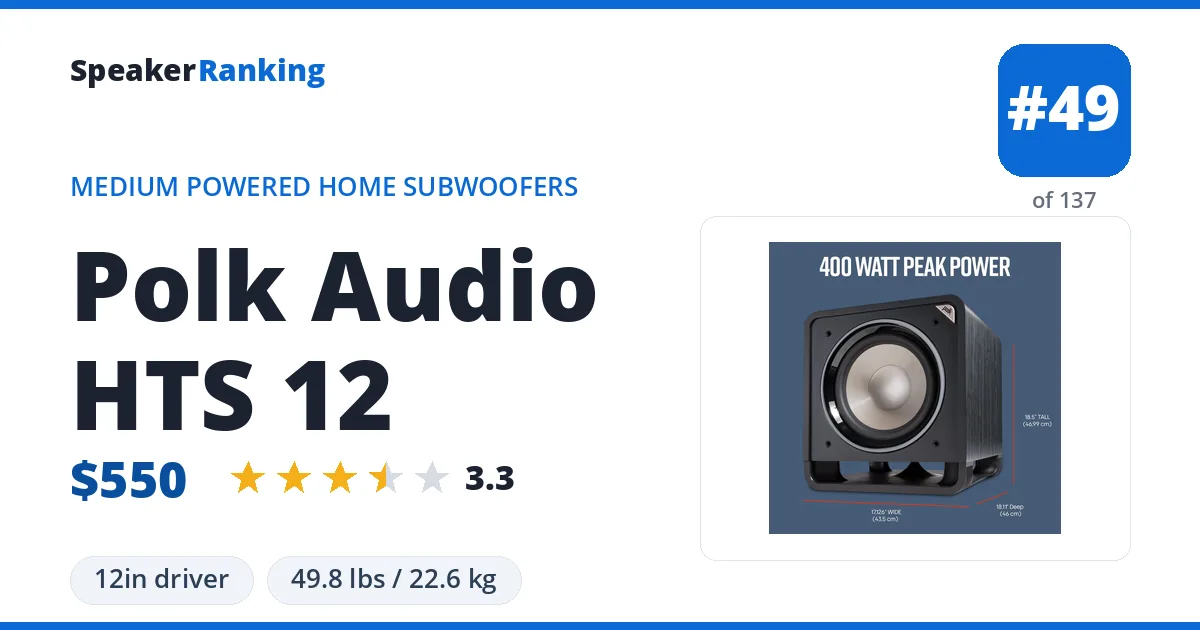
Pros: 12-inch ported with 200W RMS delivers deep bass extension improving over 10-inch model. Handles most home theater content with conviction in medium-sized rooms. Reliable mid-tier performance from trusted brand.
Cons: Discontinued.
Full Polk Audio HTS 12 review and specifications →
| Amplifier Power | 200W RMS |
|---|---|
| CEA-2010-A Average (40-80Hz) | 113.5 dB |
| Cabinet Color | black, wood |
| Country | United States |
| Dimensions | 18.5”H x 17.1”W x 18.1”D (469.9 x 434.8 x 460.0 mm) |
| Drivers | 12” (305mm) driver |
| Enclosure | ported, front |
| Frequency Response | 22-180Hz |
| Measurement Source | Audioholics |
| Output SPL at 25 Hz | 99.1 dB |
| Output SPL at 31.5 Hz | 106.2 dB |
| Output SPL at 40 Hz | 110.6 dB |
| Output SPL at 50 Hz | 114.2 dB |
| Output SPL at 63 Hz | 115.1 dB |
| Output SPL at 80 Hz | 114.3 dB |
| Output SPL at 100 Hz | 113.6 dB |
| Output SPL at 125 Hz | 112.4 dB |
| Warranty | 5/3 |
| Weight | 49.8 lbs (22.6 kg) |
- Links
- Reviews, Comparisons and Sound Samples
- Independently measured by Audioholics; the published figures above come from this ASR subwoofer measurement thread.
- Head-to-Head Comparisons