26 powered speakers in our rankings have a USB digital audio input, letting the speaker act as a USB DAC and amplifier for a computer. The digital signal goes straight in, skipping the computer’s own sound card and any analog cabling between them.
A speaker’s rank here reflects its measured audio performance, not the presence of this input. If you want a USB input specifically weighed against sound quality rather than just listed, see our curated best powered speakers with a USB input picks instead. For background on this and other connector types, see powered speaker inputs explained.
This is every match, grouped by size and sorted by measured sound quality.
The Speakers
Prices on this page were last checked September 17, 2026 at 12:43 AM UTC. Product prices and availability are accurate as of that date/time and are subject to change; the price and availability shown on Amazon at the time of purchase will apply to the purchase of this product.
As an eBay Partner, we may be compensated if you make a purchase.
Quick Navigation
- Medium Size Powered Desktop Speakers
- Large Size Powered Desktop Speakers
- Small Size Powered Bookshelf Speakers
- Medium Size Powered Bookshelf Speakers
- Large Size Powered Bookshelf Speakers
| Select to compare | |||||||
|---|---|---|---|---|---|---|---|
| 2 | JBL Authentics 200 | $380 each | 90W | 50Hz - 20kHz | - | 9.3 lbs | |
| 12 | Klipsch The Three II | $400 each | 60W | 45Hz - 20kHz | - | 10.4 lbs | |
| 13 | Klipsch The One II | $129.95 each | 50W | 50Hz - 20kHz | - | 8.6 lbs | |
| 3 | JBL Authentics 500 | $600 each | 270W | 40Hz - 20kHz | - | 17.2 lbs | |
| 3 | Adam Audio D3v | $344.99 per pair | 50W | 50Hz - 50kHz | No | 3.7 lbs | |
| 4 | Cambridge Audio L/R S | $549.00 per pair | 100W total | 55Hz - 24kHz | - | 6.6 lbs | |
| 6 | Edifier M60 | $199.99 per pair | 66W total | 55Hz - 40kHz | Yes | 6.6 lbs | |
| 11 | Audioengine A2+ | $279.00 per pair | 15W RMS / 30W peak pe… | 65Hz - 22kHz | - | 3.5 lbs | |
| 14 | Klipsch ProMedia Lumina | $299.99 per pair | 100W RMS, 200W peak | 40Hz - 20kHz | - | Satellite: 2.1 lbs | |
| 12 | Klipsch The Fives | $699 per pair | - | - | - | - | |
| 15 | Vanatoo Transparent One Encore Plus | $699.99 per pair | 240W total | 48Hz - 20kHz ±3dB | - | 10.8 lbs | |
| 25 | Airpulse A100 | $999.99 per pair | 100W total | 52Hz - 40kHz | Yes | 24.3 lbs | |
| 26 | KEF LSX II LT | $429.99 per pair | 100w RMS Per Speaker | - | No | 15 lbs | |
| 32 | Kali LP-UNF | $349.00 per pair | - | - | No | 17.2 lbs | |
| 33 | Vanatoo Transparent Zero Plus | $499.99 per pair | 120W total | - | - | 7.1 lbs | |
| 34 | Neumi BS5P-ARC | $219.99 per pair | 75W total | - | - | - | |
| 37 | Dayton Audio M4 | $249.98 per pair | 75W RMS | 40Hz - 20kHz | - | 6.2 lbs | |
| 38 | Onkyo GX-30ARC | $349 per pair | Class D amplification | - | - | - | |
| 55 | Kali Audio IN-UNF | $699 per pair | 100W LF + 60W mid/HF… | 47Hz - 21kHz +/-3dB | No | - | |
| 10 | Aalto Speakers Aalto 3 Active Pro | $5,930 per pair | 4x 245W | 31-23,500Hz | - | 19.8 lbs | |
| 28 | JBL 4305P | $2,200 per pair | 300W system: 125W LF… | - | - | - | |
| 39 | Klipsch The Nines | $999.99 per pair | 240W total | 34Hz - 25kHz +/-3dB | - | 28.4 lbs | |
| 44 | JBL 4329P | $4,500 per pair | - | 30Hz - 20kHz | - | 34.4 lbs | |
| 47 | Cambridge Audio L/R X | $2,399.00 per pair | 800W total | 35Hz - 24kHz | - | 22.9 lbs | |
| 59 | Edifier S3000Pro | $900 per pair | 78w RMS Per Speaker | 38Hz-20KHz | Yes, 5.0 | 29.8 lbs | |
| 64 | Klipsch The Sevens | $999.99 per pair | 200W total | - | - | 22.3 lbs |
Medium Size Powered Desktop Speakers
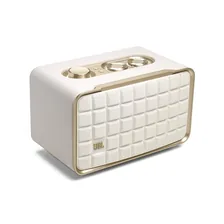 Ranked #2 of 13 in Medium Size Powered Desktop Speakers - JBL Authentics 200: $380 each Amazon eBay
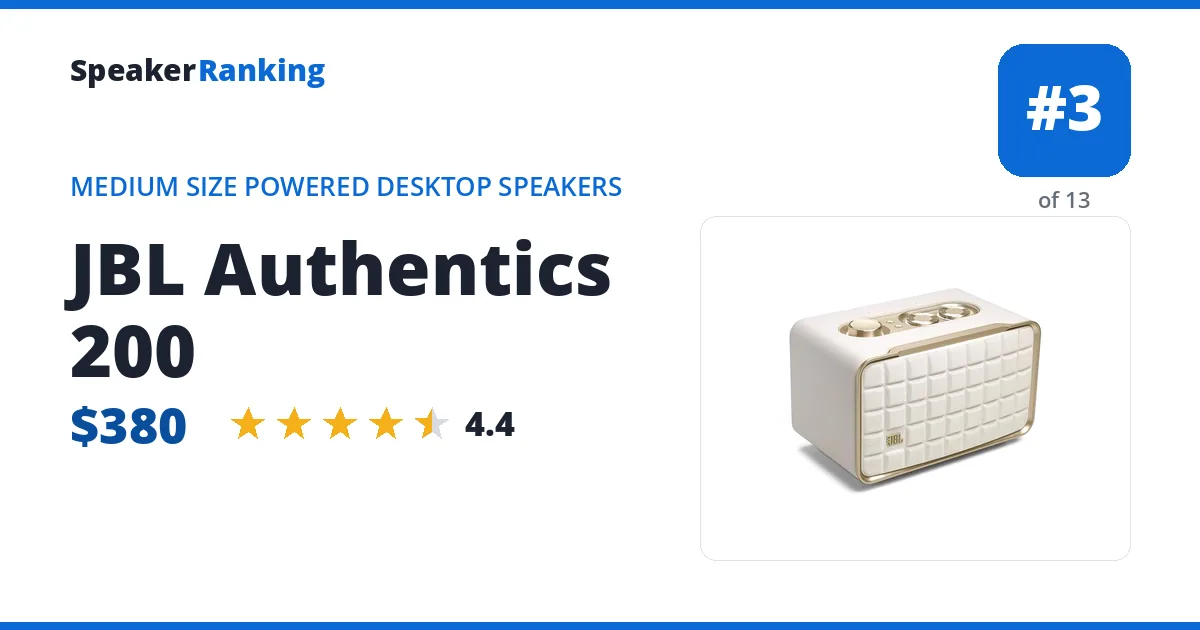
Pros: Wi-Fi streaming with simultaneous Alexa and Google Assistant support, rare at this size. Well balanced sound that reviewers rate close to the pricier Authentics 300. Measured about 113dB at 1kHz on max volume, matching the bigger 300 despite the smaller cabinet. Measured bass extension of ~50Hz (-10dB).
Cons: Bass not as deep as others. No TWS. No IP rating. Not as loud as others. Not much battery life.
Full JBL Authentics 200 review and specifications →
| AES Input | No |
|---|---|
| Amplifier Power | 90W |
| App | Yes |
| Aux Input | Yes |
| Bass Extension (-10dB) | ~50Hz |
| Battery Life | No Battery |
| Bluetooth Codecs | SBC |
| Bluetooth Version | 5.3 |
| Coaxial Input | No |
| Dimensions | 10.5" x 6.8" x 6.6" (266.3 x 171.7 x 167.4 mm) |
| Drivers | 5" full-range woofer, 2x 25mm tweeters; 6-inch down-firing passive radiator; 6-inch down-firing passive radiator; 6-inch down-firing passive radiator; 6-inch down-firing passive radiator |
| EQ | Yes |
| Frequency Response | 50Hz - 20kHz (-6dB) (Manufacturer specified) |
| HDMI Input | No |
| IP Rating | None |
| Inputs | Bluetooth, Wifi, Aux, USB (US only) |
| Optical Input | No |
| Party Mode | Yes (Wi-Fi multi-room) |
| Power Input | AC Power Cable (100-240V) |
| RCA Input | No |
| Stereo | Partially (1 woofer) |
| Streaming Services | AirPlay, Chromecast, Spotify Connect, Alexa MRM |
| TRS Input | No |
| TWS | No |
| USB Input | Yes |
| Voice Assistants | Amazon Alexa & Google Assistant (simultaneous) |
| Weight | 9.3 lbs (4.2 kg) |
| Wi-Fi | Yes (IEEE 802.11 a/b/g/n/ac/ax (2.4GHz/5GHz)) |
| Woofer Cabinet | ported |
| XLR Input | No |
- Links
- Reviews, Comparisons and Sound Samples
- Head-to-Head Comparisons
- JBL Authentics 200 vs Audio Pro C5 MkII
- JBL Authentics 200 vs Marshall Woburn III
- JBL Authentics 200 vs Marshall Woburn II
- JBL Authentics 200 vs Marshall Woburn I
- JBL Authentics 200 vs Marshall Stanmore III
- JBL Authentics 200 vs Edifier D12
- JBL Authentics 200 vs Marshall Acton III
- JBL Authentics 200 vs Marshall Stanmore II
- See all 14 comparisons
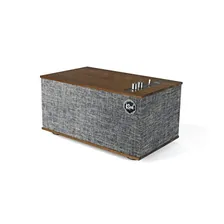 Ranked #12 of 13 in Medium Size Powered Desktop Speakers - Klipsch The Three II: $400 each Discontinued eBay
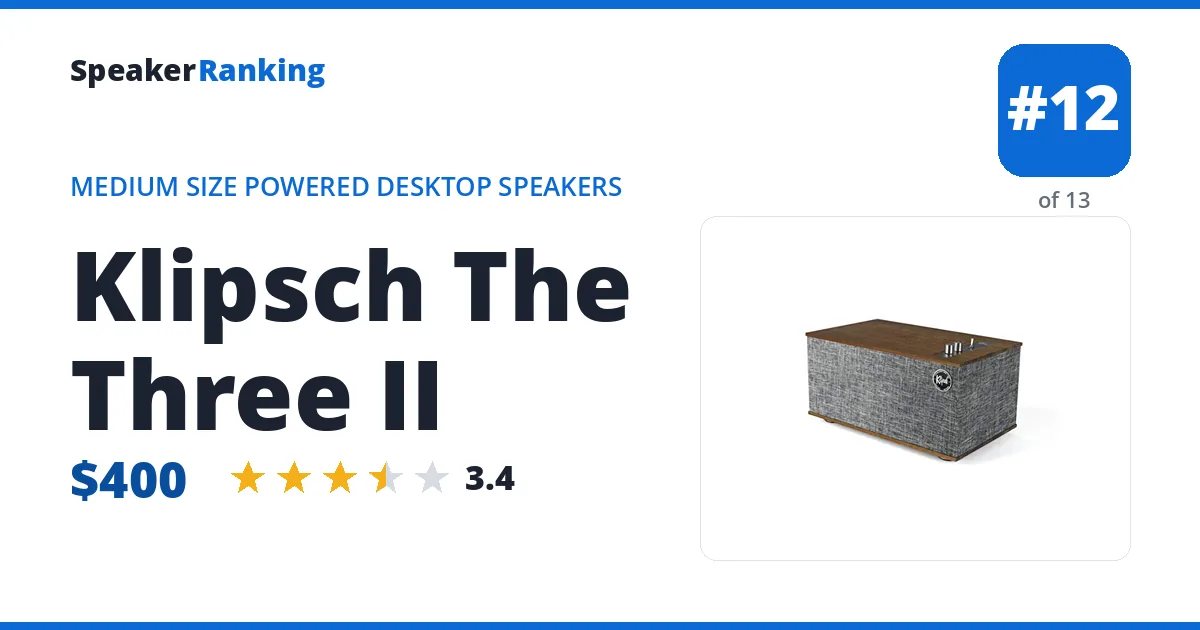
Pros: Klipsch The Three II uses 4.5” woofer, 2x 2.25” full-range midranges. Its 4.7 kg, aux input and limited-stereo playback make it a practical option for its intended room or portable use.
Cons: Its 45Hz - 20kHz (Manufacturer specified) specification points to limited deep-bass reach for the cabinet size. There is no companion app. Discontinued.
Full Klipsch The Three II review and specifications →
| AES Input | No |
|---|---|
| Amplifier Power | 60W (Woofer: 30W, Full-range: 2x15W) |
| App | No |
| Aux Input | Yes |
| Battery Life | No Battery |
| Bluetooth Codecs | SBC, aptX |
| Bluetooth Version | 4.2 |
| Coaxial Input | No |
| Dimensions | 11" x 7.3" x 7.3" (280 x 186 x 186 mm) |
| Discontinued | Yes |
| Drivers | 4.5" woofer, 2x 2.25" full-range midranges |
| EQ | Yes (Bass/Treble) |
| Frequency Response | 45Hz - 20kHz (Manufacturer specified) |
| HDMI Input | No |
| Inputs | Bluetooth, Aux, RCA, Optical, USB |
| Optical Input | Yes |
| Party Mode | No |
| RCA Input | Yes |
| Stereo | Partially (1 woofer) |
| TRS Input | No |
| TWS | No |
| USB Input | Yes |
| Weight | 10.4 lbs (4.7 kg) |
| Wi-Fi | No |
| Woofer Cabinet | ported |
| XLR Input | No |
- Links
- Reviews, Comparisons and Sound Samples
- Head-to-Head Comparisons
- Klipsch The Three II vs Klipsch The One II
- Klipsch The Three II vs Marshall Acton II
- Klipsch The Three II vs Marshall Stanmore II
- Klipsch The Three II vs Marshall Acton III
- Klipsch The Three II vs Edifier D12
- Klipsch The Three II vs Marshall Stanmore III
- Klipsch The Three II vs JBL Authentics 200
- Klipsch The Three II vs Audio Pro C5 MkII
- See all 9 comparisons
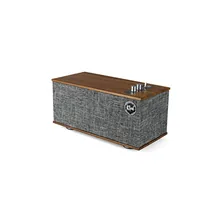 Ranked #13 of 13 in Medium Size Powered Desktop Speakers - Klipsch The One II: $129.95 each Amazon eBay
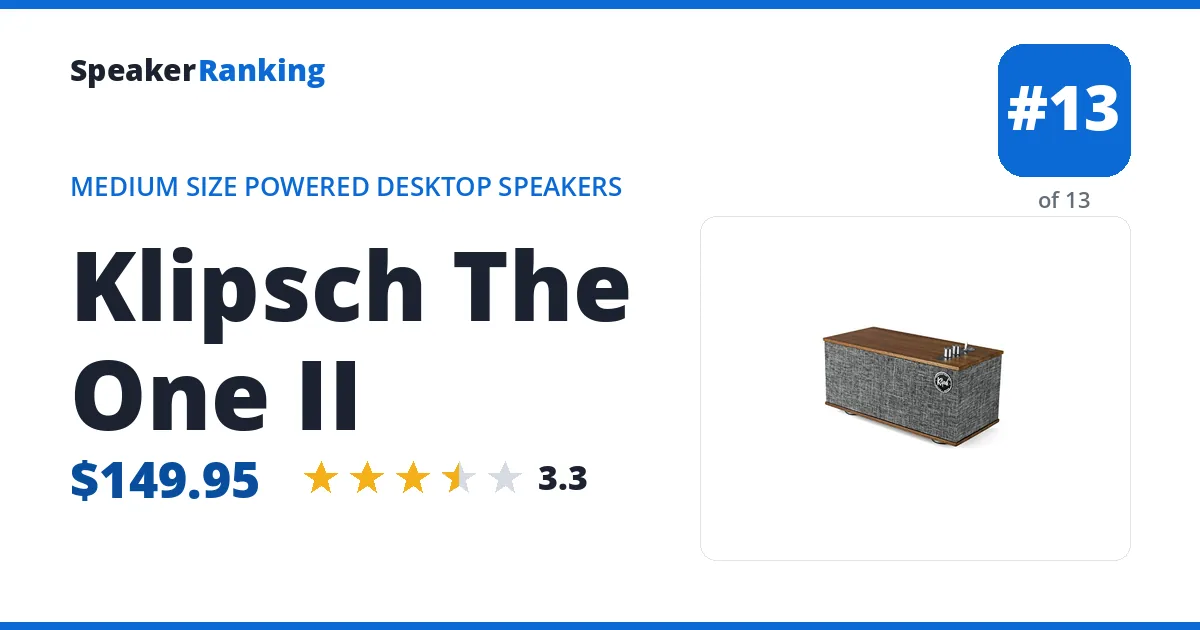
Pros: At 3.9 kg, Klipsch The One II combines 4.5” woofer, 2x 2.25” full-range midranges with Bluetooth, Aux, RCA, Optical, USB. Ac-powered operation and limited-stereo playback make its feature set practical for its intended room or portable use.
Cons: Bass is limited by its 50Hz - 20kHz (Manufacturer specified) specification. There is no companion app.
Full Klipsch The One II review and specifications →
| AES Input | No |
|---|---|
| Amplifier Power | 50W (Woofer: 30W, Full-range: 2x10W) |
| App | No |
| Aux Input | Yes |
| Battery Life | No Battery |
| Bluetooth Codecs | SBC, aptX |
| Bluetooth Version | 4.2 |
| Coaxial Input | No |
| Dimensions | 9.1" x 5.9" x 5.9" (231 x 150 x 150 mm) |
| Drivers | 4.5" woofer, 2x 2.25" full-range midranges |
| EQ | Yes (Bass/Treble) |
| Frequency Response | 50Hz - 20kHz (Manufacturer specified) |
| HDMI Input | No |
| Inputs | Bluetooth, Aux, RCA, Optical, USB |
| Optical Input | Yes |
| Party Mode | No |
| RCA Input | Yes |
| Stereo | Partially (1 woofer) |
| TRS Input | No |
| TWS | No |
| USB Input | Yes |
| Weight | 8.6 lbs (3.9 kg) |
| Wi-Fi | No |
| Woofer Cabinet | ported |
| XLR Input | No |
- Links
- Reviews, Comparisons and Sound Samples
- Head-to-Head Comparisons
- Klipsch The One II vs Klipsch The Three II
- Klipsch The One II vs Marshall Acton II
- Klipsch The One II vs Marshall Stanmore II
- Klipsch The One II vs Marshall Acton III
- Klipsch The One II vs Edifier D12
- Klipsch The One II vs Marshall Stanmore III
- Klipsch The One II vs Marshall Woburn I
- Klipsch The One II vs Marshall Woburn II
- See all 11 comparisons
Large Size Powered Desktop Speakers
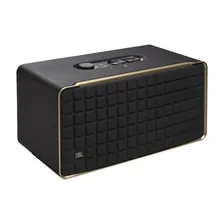 Ranked #3 of 4 in Large Size Powered Desktop Speakers - JBL Authentics 500: $600 each Amazon eBay
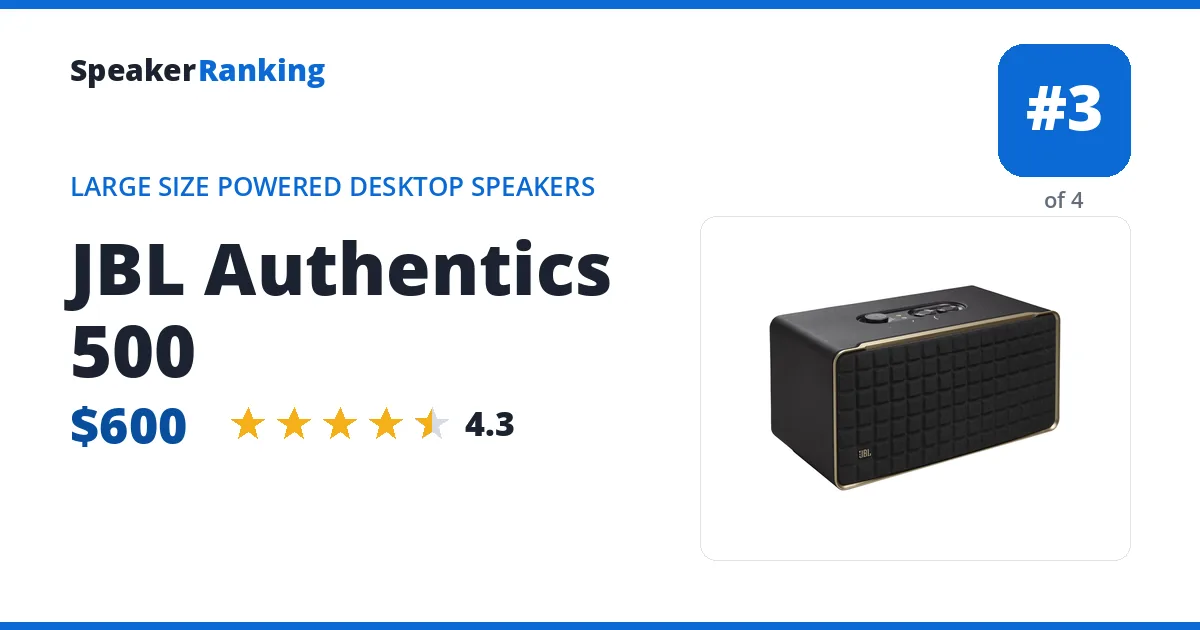
Pros: JBL Authentics 500 uses 6.5” (down-firing subwoofer), 3x 2.75” midranges, 3x 1” (25mm aluminum dome) tweeters. Its 7.8 kg, aux input and stereo playback make it a practical option for its intended room or portable use.
Cons: Its 40Hz - 20kHz (-6dB) (Manufacturer specified) specification points to limited deep-bass reach for the cabinet size.
Full JBL Authentics 500 review and specifications →
| AES Input | No |
|---|---|
| Amplifier Power | 270W (Max @ THD 1%) |
| App | Yes |
| Aux Input | Yes |
| Battery Life | No Battery |
| Bluetooth Codecs | SBC |
| Bluetooth Version | 5.3 |
| Coaxial Input | No |
| Configuration | 3.1 channel |
| Dimensions | 17.6" x 9.4" x 10.1" (447 x 240 x 255.7 mm) |
| Dolby Atmos | Yes (virtual) |
| Drivers | 6.5" (down-firing subwoofer), 3x 2.75" midranges, 3x 1" (25mm aluminum dome) tweeters |
| EQ | Yes |
| Ethernet | Yes |
| Frequency Response | 40Hz - 20kHz (-6dB) (Manufacturer specified) |
| HDMI Input | No |
| IP Rating | None |
| Inputs | USB-C (USB playback, US only) |
| Optical Input | No |
| Party Mode | Yes (Wi-Fi multi-room) |
| Power Input | 100 - 240V AC, ~ 50/60Hz |
| RCA Input | No |
| Stereo | Yes |
| Streaming Services | AirPlay 2, Chromecast, Spotify Connect, Tidal Connect, Alexa MRM |
| TRS Input | No |
| USB Input | Yes |
| Voice Assistants | Amazon Alexa & Google Assistant (simultaneous) |
| Weight | 17.2 lbs (7.8 kg) |
| Wi-Fi | Yes (IEEE 802.11 a/b/g/n/ac/ax, 2.4GHz/5GHz) |
| XLR Input | No |
- Links
- Reviews, Comparisons and Sound Samples
- Head-to-Head Comparisons
Small Size Powered Bookshelf Speakers
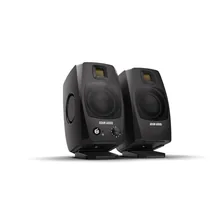 Ranked #3 of 23 in Small Size Powered Bookshelf Speakers - Adam Audio D3v: $344.99 per pair Amazon eBay
Pros: Excellent midrange linearity for a tiny desktop speaker: Erin’s Klippel data spans just 1.7dB from 300Hz to 5kHz. Side passive radiators help bass reach -3dB at about 51Hz, substantially deeper than the Genelec 8010A or Audio Smile LBM. Predicted preference scores of 4.47 standalone and 6.70 with an ideal subwoofer support it as a particularly useful compact system without a sub. USB-C, analog inputs and placement filters simplify desk setup. Measured bass extension of 50Hz (-3dB), with a measured sensitivity of 86.5dB.
Cons: A rising upper-frequency balance and vertical crossover interference keep it from being uniformly neutral at every angle; aim the tweeters toward ear height. The limiter reduces bass and midrange output as volume rises, with the existing review’s compression tests putting usable maximum output around 89-90dB at 1m. Deep bass at moderate volume should not be confused with high output capability.
Full Adam Audio D3v review and specifications →
| AES Input | No |
|---|---|
| Amplifier Power | 50W (30W woofer + 20W tweeter) |
| App | No |
| Aux Input | No |
| Bass Extension (-10dB) | 45Hz (measured, Erin's Audio Corner) |
| Bass Extension (-3dB) | 50Hz (measured, Erin's Audio Corner) |
| Bluetooth | No |
| Coaxial Input | No |
| Dimensions | 6.7"H x 4.3"W x 5.9"D (170.2 x 109.2 x 149.9 mm) |
| Drivers | 3.5" woofer, U-ART accelerated ribbon tweeter |
| EQ | Yes (Room adjustment filters) |
| Frequency Response | 50Hz - 50kHz (Manufacturer specified) |
| HDMI Input | No |
| Inputs | USB-C, balanced 1/4-inch TRS |
| Maximum SPL | 102dB @ 1m (manufacturer specified) |
| Optical Input | No |
| RCA Input | No |
| Sensitivity | 86.5dB (measured at 0.3V/1m, Erin's Audio Corner) |
| Spinorama Preference Score | 4.47 |
| Spinorama Preference Score with Perfect Sub | 6.70 |
| TRS Input | Yes |
| USB Input | Yes |
| Weight | 3.7 lbs (1.7 kg) |
| XLR Input | No |
- Links
- Reviews, Comparisons and Sound Samples
- Erin’s Audio Corner: ADAM Audio D3V: Mighty Small But Mighty Awesome Desktop Speaker More from Erin’s Audio Corner →
- Erin’s Audio Review Adam Audio D3v
- Erin’s Audio Corner Measurements (spinorama.org)
- Jasper Tech: Best Desktop Computer Speakers for Every Budget – 2026 More from Jasper Tech →
- Jasper Tech: Are the D3V The Best Studio Monitors For The Money?
- Erin’s Audio Corner: The Best Budget Desktop Speakers, Tested & Rated
- Head-to-Head Comparisons
- Adam Audio D3v vs Genelec 8010A
- Adam Audio D3v vs Cambridge Audio L/R S
- Adam Audio D3v vs IK Multimedia iLoud Micro Monitor
- Adam Audio D3v vs Audio Smile Little British Monitor
- Adam Audio D3v vs Edifier M60
- Adam Audio D3v vs HiVi Swan X3
- Adam Audio D3v vs Edifier MR3
- Adam Audio D3v vs Audioengine A2+
- See all 15 comparisons
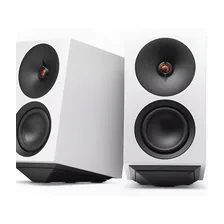 Ranked #4 of 23 in Small Size Powered Bookshelf Speakers - Cambridge Audio L/R S: $549.00 per pair Amazon eBay
Pros: A 2-way active bookshelf pair built for near-field desktop use, with a 21mm aluminum tweeter and a 3-inch long-throw woofer on each speaker. Erin’s Audio Corner measured a very neutral on-axis response with good directivity control up through the 2-3kHz handoff to the tweeter, an F3 of about 57Hz and F10 of about 50Hz, and output held within roughly plus or minus 2.5dB from 80Hz to 20kHz. Horizontal dispersion of about plus or minus 60 degrees and a vertical window of about plus 30 to minus 20 degrees make it forgiving of off-center desktop seating. Two rear switches (a desktop-placement compensation switch and a near-wall/free-space switch) plus in-app DSP for room size, wall distance, and reflective surface type let you tune the in-room response rather than just hoping placement works out, and the reviewer noted an audible tightening of the bass moving between room-size settings. Rear connectivity includes RCA, optical digital, USB-C, and a dedicated subwoofer output. Measured bass extension of 57Hz (-3dB).
Cons: Maximum clean output is limited: Erin’s Audio Corner measured about 86dB before the onboard limiter engages around 96dB to protect the drivers, so this is a near-field or small-room speaker rather than one built to fill a living room. Each speaker’s Class D amplifier splits only 50W to the woofer and 50W to the tweeter, modest for the class. The DSP room-correction options are preset-based rather than a true microphone-measured calibration at the listening position, so results depend on picking settings that match your actual room.
Full Cambridge Audio L/R S review and specifications →
| AES Input | No |
|---|---|
| Amplifier Power | 100W total (50W to woofer, 50W to tweeter, per speaker) |
| App | Yes |
| Aux Input | No |
| Bass Extension (-10dB) | 50Hz (measured, Erin's Audio Corner) |
| Bass Extension (-3dB) | 57Hz (measured, Erin's Audio Corner) |
| Bluetooth Codecs | SBC, AAC, aptX, aptX HD |
| Coaxial Input | No |
| DSP | Yes, room size, wall distance, and reflective surface correction; desktop-placement and near-wall/free-space switches |
| Dimensions | 5.3" (134 mm) W x 226mm H x 180mm D (each) |
| Drivers | 21mm aluminum dome tweeter, 3" long-throw woofer |
| Frequency Response | 55Hz - 24kHz (±3dB, manufacturer specified) |
| HDMI Input | No |
| Inputs | RCA, optical digital, USB-C |
| Optical Input | Yes |
| Outputs | Subwoofer, wired speaker-to-speaker link |
| RCA Input | Yes |
| Subwoofer Output | Yes |
| TRS Input | No |
| USB Input | Yes |
| Weight | 6.6 lbs (3.0kg) primary speaker, 5.7 lbs (2.6kg) secondary speaker |
| XLR Input | No |
- Links
- Reviews, Comparisons and Sound Samples
- Head-to-Head Comparisons
- Cambridge Audio L/R S vs Adam Audio D3v
- Cambridge Audio L/R S vs IK Multimedia iLoud Micro Monitor
- Cambridge Audio L/R S vs Edifier M60
- Cambridge Audio L/R S vs Genelec 8010A
- Cambridge Audio L/R S vs HiVi Swan X3
- Cambridge Audio L/R S vs Edifier MR3
- Cambridge Audio L/R S vs Klipsch ProMedia Lumina
- Cambridge Audio L/R S vs Mackie CR3-X
- See all 10 comparisons
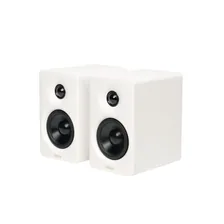 Ranked #6 of 23 in Small Size Powered Bookshelf Speakers - Edifier M60: $199.99 per pair Amazon eBay
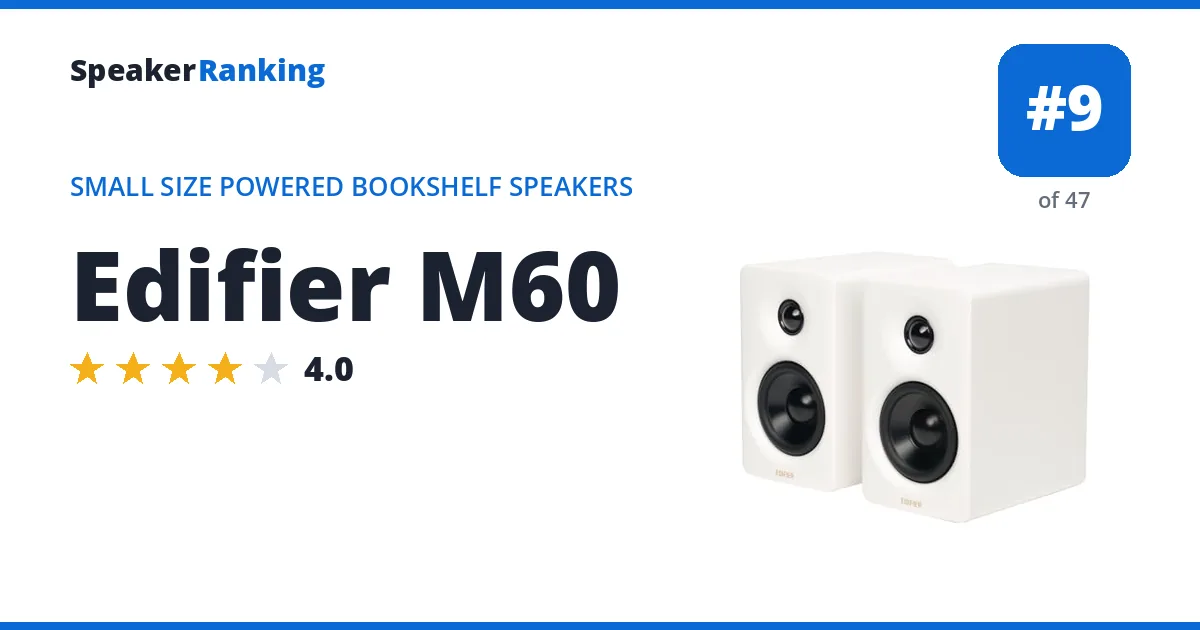
Pros: Erin’s Klippel data shows a reasonably even midrange, spanning 2.8dB from 300Hz to 5kHz, with broad horizontal coverage for desktop listening. Predicted preference scores are 3.69 standalone and 6.42 with an ideal subwoofer, a comparatively strong result in this compact category. USB-C, auxiliary input, Bluetooth and included angled stands make it easy to integrate into a small desk setup. Measured bass extension of 67Hz (-3dB), with a measured sensitivity of 87.5dB.
Cons: The on-axis response rises by about 0.57dB per octave, so the tonal balance becomes brighter toward the treble. Measured -3dB bass extension is about 70Hz; it cannot reproduce deep bass at full level. Sitting below the tweeter axis worsens the crossover-region response. Limiting and compression constrain louder playback, so use it nearfield rather than expecting room-filling output.
Full Edifier M60 review and specifications →
| AES Input | No |
|---|---|
| Amplifier Power | 66W total (33W per speaker) |
| App | Yes |
| Aux Input | Yes |
| Bass Extension (-10dB) | 57Hz (measured, Erin's Audio Corner) |
| Bass Extension (-3dB) | 67Hz (measured, Erin's Audio Corner) |
| Bluetooth | Yes |
| Bluetooth Codecs | SBC, LDAC |
| Bluetooth Version | 5.3 |
| Coaxial Input | No |
| Dimensions | 6.6"H x 3.9"W x 5.8"D (167.6 x 99.1 x 147.3 mm) |
| Drivers | 3" woofer, 1" silk dome tweeter |
| EQ | Yes |
| Frequency Response | 55Hz - 40kHz (Manufacturer specified) |
| HDMI Input | No |
| Inputs | Bluetooth, Aux, USB-C |
| Maximum SPL | 96dB @ 1m (manufacturer specified) |
| Optical Input | No |
| RCA Input | No |
| Sensitivity | 87.5dB (measured at 0.3V/1m, Erin's Audio Corner) |
| Spinorama Preference Score | 3.69 |
| Spinorama Preference Score with Perfect Sub | 6.42 |
| TRS Input | No |
| USB Input | Yes |
| Weight | 6.6 lbs (3 kg) |
| XLR Input | No |
- Links
- Reviews, Comparisons and Sound Samples
- Erin’s Audio Corner: Edifier M60 Desktop Speaker Delivers Big Fun! More from Erin’s Audio Corner →
- Erin’s Audio Corner: The Best Budget Desktop Speakers, Tested & Rated
- Erin’s Audio Corner Website: Edifier M60
- Erin’s Audio Corner Measurements (spinorama.org)
- Jasper Tech: Best Desktop Computer Speakers for Every Budget – 2026 More from Jasper Tech →
- Head-to-Head Comparisons
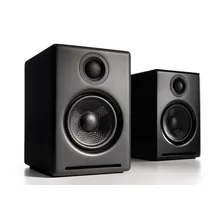 Ranked #11 of 23 in Small Size Powered Bookshelf Speakers - Audioengine A2+: $279.00 per pair Amazon Audioengine eBay
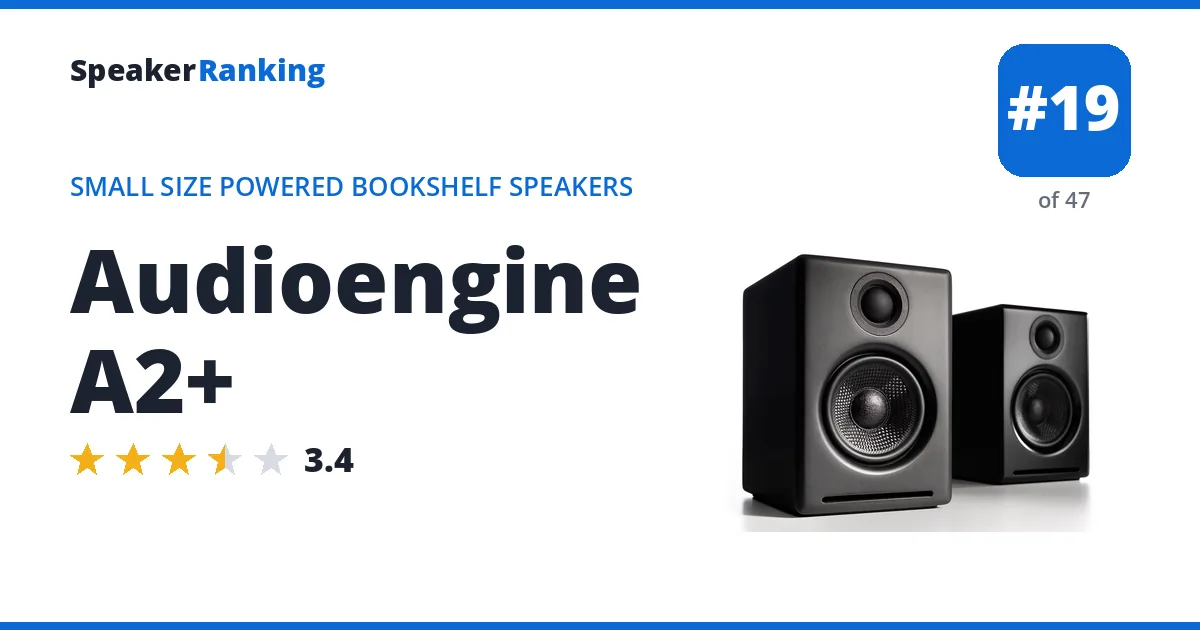
Pros: Erin’s Klippel measurements give a 5.39 predicted preference score with an ideal subwoofer. The tiny footprint, multiple inputs and variable RCA output are useful for desktop listening. The existing review found desk placement more forgiving than free-space placement, with no major port-chuffing problem in its tests. Measured bass extension of 105.5Hz (-3dB).
Cons: The 2.07 standalone score and roughly 106Hz measured -3dB point reveal how much bass is missing without reinforcement or a subwoofer. Midrange and crossover-region dips remain; desk gain is placement-dependent and cannot be assumed to correct them. Compression becomes substantial above roughly 87dB at 1m in the review, so this is a quiet nearfield option rather than a high-output monitor.
Full Audioengine A2+ review and specifications →
| AES Input | No |
|---|---|
| Amplifier Power | 15W RMS / 30W peak per channel |
| App | No |
| Aux Input | Yes |
| Bass Extension (-10dB) | 58.9Hz (measured, Erin's Audio Corner) |
| Bass Extension (-3dB) | 105.5Hz (measured, Erin's Audio Corner) |
| Bluetooth Version | 5.0 |
| Coaxial Input | No |
| Dimensions | 6" x 4" x 5.2" (152 x 102 x 133 mm) |
| Drivers | 0.75" silk dome tweeter, 2.75" fiber woofer |
| EQ | No (fixed volume knob only) |
| Frequency Response | 65Hz - 22kHz (+-2dB, Manufacturer specified) |
| HDMI Input | No |
| Inputs | RCA, 3.5mm, USB, Bluetooth 5.0 |
| Optical Input | No |
| Outputs | RCA variable output (subwoofer) |
| RCA Input | Yes |
| Spinorama Preference Score | 1.56 |
| Spinorama Preference Score with Perfect Sub | 4.81 |
| Subwoofer Output | Yes |
| TRS Input | No |
| USB Input | Yes |
| Weight | 3.5 lbs (1.6 kg) left / 3.1 lbs (1.4 kg) right |
| XLR Input | No |
- Links
- Reviews, Comparisons and Sound Samples
- Head-to-Head Comparisons
- Audioengine A2+ vs Monacor SOUND-4BT
- Audioengine A2+ vs Klipsch ProMedia Lumina
- Audioengine A2+ vs Edifier MR3
- Audioengine A2+ vs Edifier M60
- Audioengine A2+ vs Mackie CR3-X
- Audioengine A2+ vs IK Multimedia iLoud Micro Monitor
- Audioengine A2+ vs Fiio SP3
- Audioengine A2+ vs Adam Audio D3v
- See all 10 comparisons
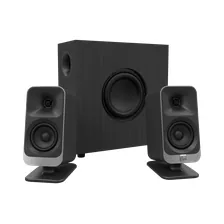 Ranked #14 of 23 in Small Size Powered Bookshelf Speakers - Klipsch ProMedia Lumina: $299.99 per pair Amazon eBay
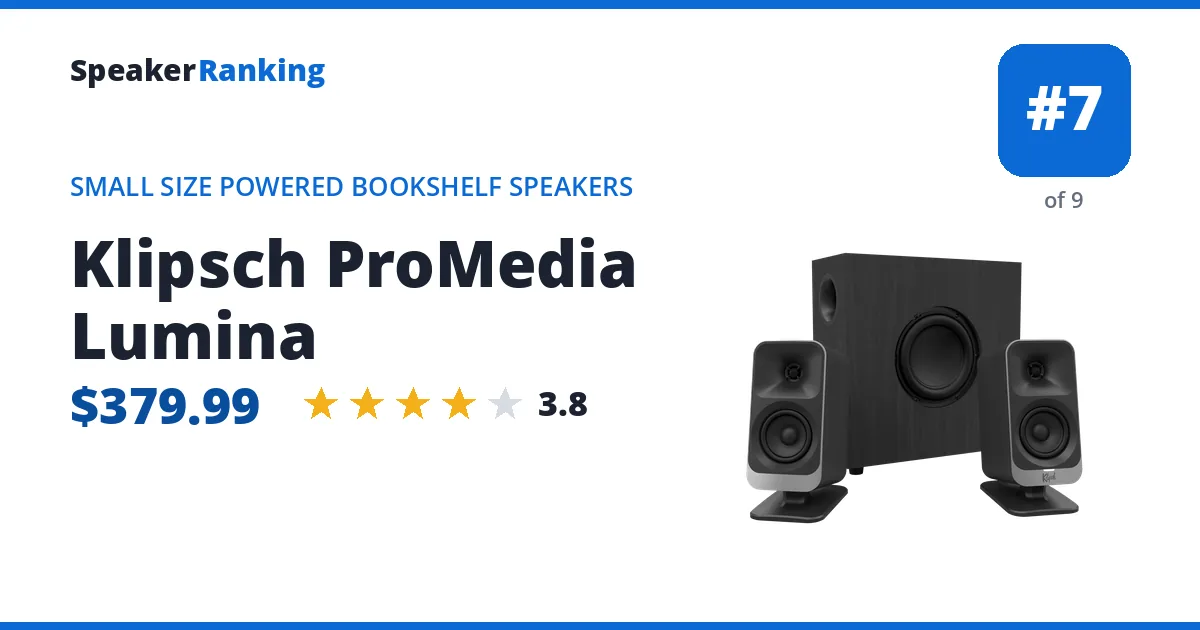
Pros: The included powered subwoofer gives this compact desktop system a real low-bass advantage: the linked review reports F3 around 46Hz and F10 around 38Hz. Tiltable stands, app control and lighting add practical desktop features. The existing review reports reasonable distortion for the system’s size. Measured bass extension of 46Hz (-3dB).
Cons: The review reports treble elevated about 3-5dB when aimed straight at the listener; some toe-out can reduce the brightness. Fixed-band app EQ is less flexible than parametric correction. Its separate subwoofer also means the system occupies more space than the satellites alone suggest.
Full Klipsch ProMedia Lumina review and specifications →
| AES Input | No |
|---|---|
| Amplifier Power | 100W RMS, 200W peak |
| App | Klipsch Control app - EQ (fixed bands), RGB lighting control, night mode, music-reactive mode |
| Aux Input | Yes |
| Bass Extension (-10dB) | 38Hz (measured, Erin's Audio Corner) |
| Bass Extension (-3dB) | 46Hz (measured, Erin's Audio Corner) |
| Bluetooth Codecs | SBC |
| Bluetooth Version | 5.3 |
| Coaxial Input | No |
| Crossover Frequency | Satellite: 3.5kHz, Subwoofer: 150Hz |
| Dimensions | Satellite: 248 x 165 x 102 mm, Subwoofer: 356 x 152 x 352 mm |
| Drivers | 1" tractrix horn tweeter, 3.5" mid, 6.5" powered subwoofer |
| EQ | Fixed-band EQ via app (not parametric) |
| Frequency Response | 40Hz - 20kHz (-6dB, Manufacturer specified) |
| HDMI Input | No |
| Inputs | USB-C, 3.5mm Aux, Bluetooth 5.3 |
| Maximum SPL | 98dB (manufacturer specified) |
| Optical Input | No |
| RCA Input | No |
| TRS Input | No |
| USB Input | Yes |
| Weight | Satellite: 2.1 lbs (0.95 kg) each, Subwoofer: 11 lbs (4.99 kg) |
| XLR Input | No |
- Links
- Reviews, Comparisons and Sound Samples
- Head-to-Head Comparisons
- Klipsch ProMedia Lumina vs Monoprice Monolith MM-3
- Klipsch ProMedia Lumina vs Audioengine A2+
- Klipsch ProMedia Lumina vs Mackie CR3-X
- Klipsch ProMedia Lumina vs Fiio SP3
- Klipsch ProMedia Lumina vs Edifier MR3
- Klipsch ProMedia Lumina vs Presonus Eris E3.5 2nd Gen
- Klipsch ProMedia Lumina vs HiVi Swan X3
- Klipsch ProMedia Lumina vs Edifier M60
- See all 12 comparisons
Medium Size Powered Bookshelf Speakers
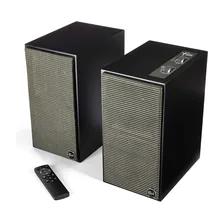 Ranked #12 of 65 in Medium Size Powered Bookshelf Speakers - Klipsch The Fives: $699 per pair Amazon eBay
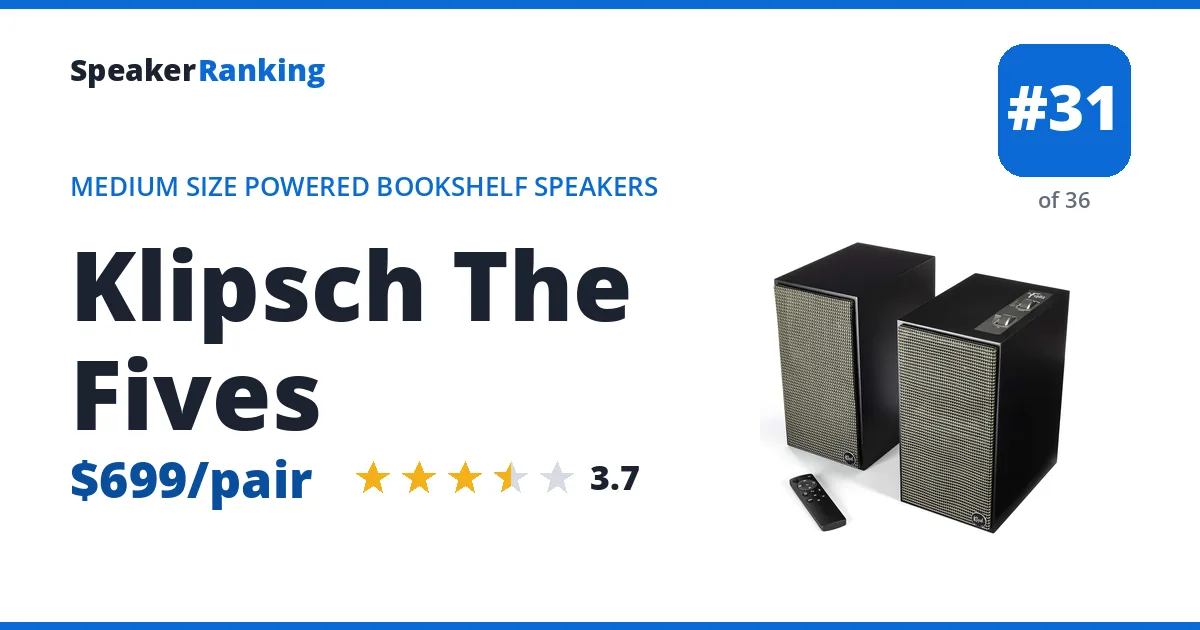
Pros: In the tested Bass Cut mode, Erin’s Klippel data gives preference scores of 4.62 standalone and 6.98 with an ideal subwoofer, with a 2.7dB midrange response span. That mode offers considerably better tonal balance than the bass-heavy default behavior. HDMI ARC, phono/line input, digital inputs and subwoofer output make it a versatile stereo alternative to a soundbar. Measured bass extension of 57Hz (-3dB).
Cons: The favorable score specifically requires Bass Cut mode; it does not describe every firmware or bass setting. Bass reaches -3dB around 59Hz in that configuration. The review reports increasing compression around 200Hz and below 80Hz as volume rises, reducing bass dynamics. Careful placement and a subwoofer remain useful, and the horn/woofer transition is not perfectly uniform off-axis.
Full Klipsch The Fives review and specifications →
| AES Input | No |
|---|---|
| Aux Input | No |
| Bass Extension (-10dB) | 47.3Hz (measured, Erin's Audio Corner) |
| Bass Extension (-3dB) | 57Hz (measured, Erin's Audio Corner) |
| Bluetooth Codecs | SBC, AAC, aptX, aptX HD |
| Coaxial Input | No |
| DSP | Dynamic Bass, Flat and Bass Cut profiles |
| Drivers | 1" horn-loaded tweeter; 4.5" woofer |
| HDMI Input | Yes |
| Inputs | HDMI ARC, USB, optical, Bluetooth, phono/line RCA |
| Optical Input | Yes |
| Outputs | Subwoofer |
| RCA Input | Yes |
| Sensitivity | Not applicable (active DSP loudspeaker) |
| Spinorama Preference Score | 4.62 |
| Spinorama Preference Score with Perfect Sub | 6.98 |
| Subwoofer Output | Yes |
| TRS Input | No |
| USB Input | Yes |
| XLR Input | No |
- Links
- Reviews, Comparisons and Sound Samples
- Erin’s Audio Corner: Klipsch The Fives Review More from Erin’s Audio Corner →
- Erin’s Audio Corner Website: Klipsch The Fives
- Erin’s Audio Corner Measurements (spinorama.org)
- Jasper Tech: Best Bookshelf Speakers For TV & Gaming - 2025 More from Jasper Tech →
- Jasper Tech: Best Powered Bookshelf Speakers for Every Budget - 2025
- Head-to-Head Comparisons
- Klipsch The Fives vs JBL 305P MKII
- Klipsch The Fives vs Genelec 8020D
- Klipsch The Fives vs Topping MA4
- Klipsch The Fives vs KEF LS50 Wireless II
- Klipsch The Fives vs Vanatoo Transparent One Encore Plus
- Klipsch The Fives vs Devialet Phantom II 98 dB
- Klipsch The Fives vs IK Multimedia iLoud MTM MKII
- Klipsch The Fives vs Genelec 8320A
- See all 51 comparisons
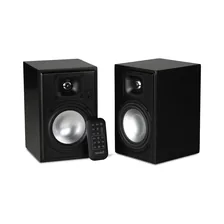 Ranked #15 of 65 in Medium Size Powered Bookshelf Speakers - Vanatoo Transparent One Encore Plus: $699.99 per pair Amazon eBay
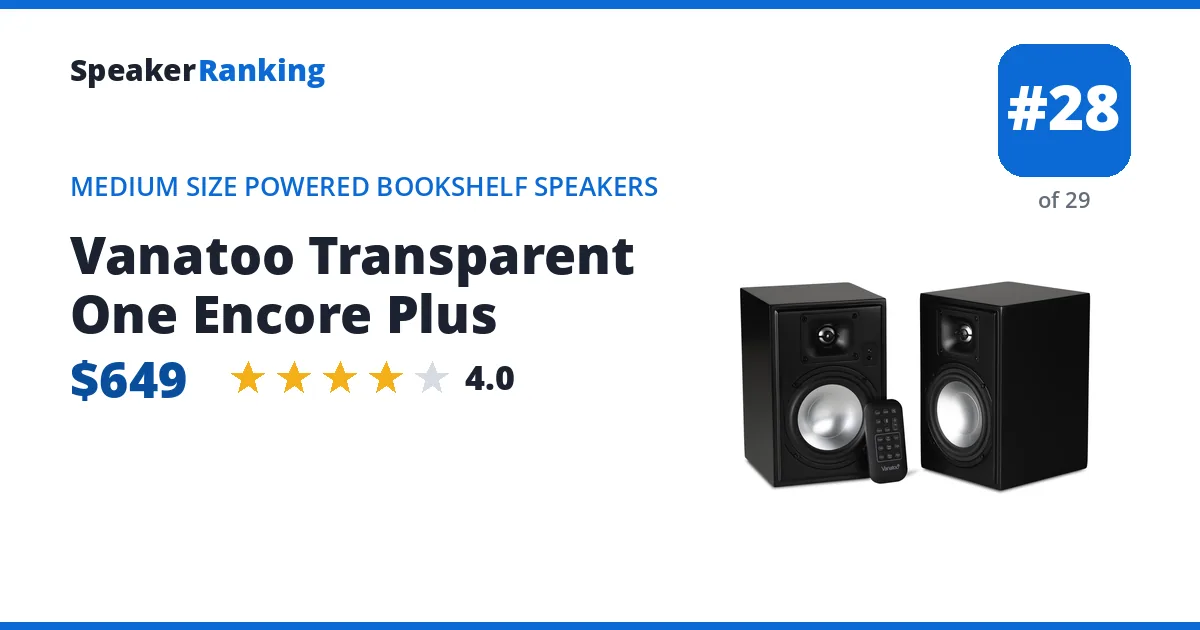
Pros: Erin’s Klippel data combines a small 1.7dB midrange response span with a -3dB point around 44Hz. Scores of 4.68 standalone and 6.49 with an ideal subwoofer make it an attractive standalone system as well as a subwoofer partner. Remote tone controls, multiple digital and analog inputs, and automatic subwoofer crossover engagement simplify setup. Measured bass extension of 42Hz (-3dB).
Cons: A mild 4-6kHz edge and a smaller 1-2kHz recession were audible in the review, so its smooth midrange summary does not mean there is nothing to improve with EQ. No HDMI ARC. Deep bass and louder playback still benefit from a subwoofer; amplifier wattage alone does not establish clean room-filling output.
Full Vanatoo Transparent One Encore Plus review and specifications →
| AES Input | No |
|---|---|
| Amplifier Power | 240W total (100W + 20W Class D amplifiers per enclosure) |
| Aux Input | No |
| Bass Extension (-10dB) | 34Hz (measured, Erin's Audio Corner) |
| Bass Extension (-3dB) | 42Hz (measured, Erin's Audio Corner) |
| Bluetooth Codecs | SBC, AAC, aptX, aptX HD |
| Coaxial Input | Yes |
| Dimensions | 10" x 6.5" x 8" (254 x 165 x 203 mm) |
| Drivers | 5.25" aluminum-cone woofer with XBL motor, 5.25" passive radiator (rear), 1" aluminum dome tweeter with waveguide and phase plug |
| Frequency Response | 48Hz - 20kHz ±3dB (manufacturer specified, Flat mode) |
| HDMI Input | No |
| Inputs | USB, Optical, Coax, Analog, Bluetooth |
| Optical Input | Yes |
| Outputs | RCA subwoofer |
| RCA Input | No |
| Spinorama Preference Score | 4.68 |
| Spinorama Preference Score with Perfect Sub | 6.49 |
| Subwoofer Output | Yes |
| TRS Input | No |
| USB Input | Yes |
| Weight | 10.8 lbs (4.9 kg) (passive unit), 12.1 lbs (5.5 kg) (active unit) |
| XLR Input | No |
- Links
- Reviews, Comparisons and Sound Samples
- Head-to-Head Comparisons
- Vanatoo Transparent One Encore Plus vs IK Multimedia iLoud MTM MKII
- Vanatoo Transparent One Encore Plus vs KEF LS50 Wireless II
- Vanatoo Transparent One Encore Plus vs JBL 305P MKII
- Vanatoo Transparent One Encore Plus vs Klipsch The Fives
- Vanatoo Transparent One Encore Plus vs Genelec 8020D
- Vanatoo Transparent One Encore Plus vs Kali Audio SM-5
- Vanatoo Transparent One Encore Plus vs Kali Audio IN-5
- Vanatoo Transparent One Encore Plus vs Topping MA4
- See all 51 comparisons
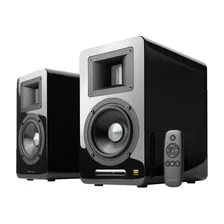 Ranked #25 of 65 in Medium Size Powered Bookshelf Speakers - Airpulse A100: $999.99 per pair Amazon B&H Photo Video eBay
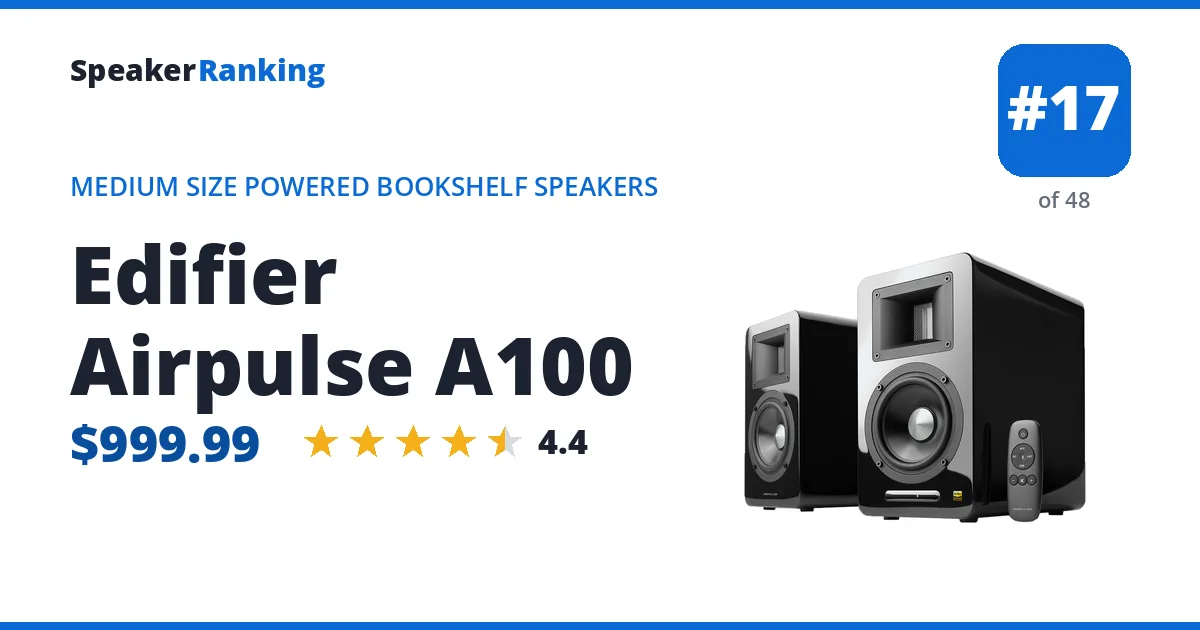
Pros: ASR’s Klippel data gives a 2.9dB midrange span and scores of 3.66 standalone and 6.18 with an ideal subwoofer. The ribbon tweeter and five-inch woofer provide a distinctive compact powered system, with remote control and a subwoofer output simplifying everyday use. Measured bass extension of 63.0Hz (-3dB).
Cons: Bass reaches -3dB around 63Hz, so lower notes need a subwoofer for full weight. Listening-window narrow-band deviation of 0.419 shows more local tonal variation than the leading monitors. Rear tone controls are less flexible than parametric EQ or room correction. Neither the ribbon tweeter nor a directivity-index summary establishes uniquely wide or perfectly controlled dispersion.
Full Airpulse A100 review and specifications →
| AES Input | No |
|---|---|
| Amplifier Power | 100W total (40W+40W woofer, 10W+10W tweeter) |
| App | None (physical bass/treble knobs, IR remote) |
| Aux Input | Yes |
| Bass Extension (-10dB) | 53.2Hz (measured, spinorama.org) |
| Bass Extension (-3dB) | 63.0Hz (measured, spinorama.org) |
| Bluetooth | Yes (SBC, aptX) |
| Bluetooth Codecs | SBC, aptX |
| Coaxial Input | Yes |
| Dimensions | 6.3" x 11.1" x 10" (160 x 283 x 255 mm) each |
| Drivers | Horn-loaded ribbon tweeter, 5" hard-anodized aluminum cone woofer |
| EQ | Yes, rear-panel bass/treble trim knobs |
| Frequency Response | 52Hz - 40kHz |
| HDMI Input | No |
| Inputs | RCA (aux), USB, optical, coaxial, Bluetooth aptX |
| Optical Input | Yes |
| RCA Input | Yes |
| Spinorama Preference Score | 3.66 |
| Spinorama Preference Score with Perfect Sub | 6.18 |
| TRS Input | No |
| USB Input | Yes |
| Weight | 24.3 lbs (11 kg) each |
| XLR Input | No |
- Links
- Reviews, Comparisons and Sound Samples
- Head-to-Head Comparisons
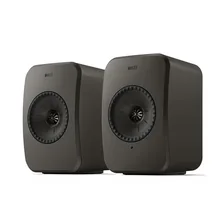 Ranked #26 of 65 in Medium Size Powered Bookshelf Speakers - KEF LSX II LT: $429.99 per pair Amazon eBay
Pros: The coincident driver provides useful consistency across listening positions, and the app offers placement and subwoofer adjustments. Erin’s measurements give preference scores of 3.93 standalone and 6.16 with an ideal subwoofer, with -3dB bass around 56Hz. HDMI and USB connectivity make it convenient for a small TV or desktop system. Measured bass extension of 55Hz (-3dB), with a measured sensitivity of 84dB.
Cons: The 3.4dB midrange response span and treble-region dips keep it below more neutral monitors. The existing review finds bass compression around 88-92dB/1m and rising distortion at higher levels, so the small drivers suit close listening rather than a large room. This LT version has no analog input; a turntable cannot plug straight into it.
Full KEF LSX II LT review and specifications →
| AES Input | No |
|---|---|
| Amplifier Power | 100w RMS Per Speaker |
| App | No |
| Aux Input | No |
| Bass Extension (-10dB) | 46Hz (measured, Erin's Audio Corner) |
| Bass Extension (-3dB) | 55Hz (measured, Erin's Audio Corner) |
| Bluetooth | No |
| Coaxial Input | No |
| Dimensions | 9.5"H x 6.1"W x 7.1"D (241.3 x 154.9 x 180.3 mm) |
| Drivers | 115mm (4.5in.) magnesium/aluminium alloy cone woofer, 19mm (0.75in.) aluminium dome tweeter |
| EQ | No |
| HDMI Input | Yes |
| Inputs | Wifi, USB-C, HDMI, Optical, Bluetooth |
| Optical Input | Yes |
| Outputs | RCA Subwoofer |
| RCA Input | No |
| Sensitivity | 84dB (measured at 0.3V/1m, Erin's Audio Corner) |
| Spinorama Preference Score | 3.26 |
| Spinorama Preference Score with Perfect Sub | 5.62 |
| Subwoofer Output | Yes |
| TRS Input | No |
| USB Input | Yes |
| Weight | 15 lbs (6.8 kg) |
| XLR Input | No |
- Links
- Reviews, Comparisons and Sound Samples
- Erin’s Audio Corner: Transform Your Sound System with the KEF LSX II LT Speaker More from Erin’s Audio Corner →
- Erin’s Audio Corner Website: KEF LSX II LT
- Erin’s Audio Corner Measurements (spinorama.org)
- Jasper Tech: Best Desktop Computer Speakers for Every Budget – 2026 More from Jasper Tech →
- Jasper Tech: Best Bookshelf Speakers For TV & Gaming - 2025
- Jasper Tech: Best Powered Bookshelf Speakers for Every Budget - 2025
- Head-to-Head Comparisons
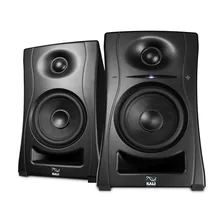 Ranked #32 of 65 in Medium Size Powered Bookshelf Speakers - Kali LP-UNF: $349.00 per pair Amazon eBay
Pros: A practical compact desktop system with USB-C, analog inputs and Bluetooth, plus extensive placement switches. Erin’s Klippel data gives -3dB bass around 54Hz and scores of 3.68 standalone and 5.76 with an ideal subwoofer. The low crossover and waveguide provide useful freedom of listening height for a two-way design, and moderate-level distortion is well controlled in the review. Measured bass extension of 54Hz (-3dB), with a measured sensitivity of 88.1dB.
Cons: The 2.9dB midrange span masks local response ripples; listening-window narrow-band deviation of 0.467 is behind the best monitors. The review finds limiting around 91dB/1m per speaker. No dedicated subwoofer output means integration requires suitable external routing or bass management. Its strength is affordable close listening, not top-tier tonal accuracy or high-output room playback.
Full Kali LP-UNF review and specifications →
| AES Input | No |
|---|---|
| App | No |
| Aux Input | No |
| Bass Extension (-10dB) | 39Hz (measured, Erin's Audio Corner) |
| Bass Extension (-3dB) | 54Hz (measured, Erin's Audio Corner) |
| Bluetooth | No |
| Coaxial Input | No |
| Drivers | 4.5" woofer, 1" Textile Dome tweeter |
| EQ | No |
| HDMI Input | No |
| Inputs | Bluetooth, USB-C (digital), RCA, TRS |
| Optical Input | No |
| RCA Input | Yes |
| Sensitivity | 88.1dB (measured at 0.3V/1m, Erin's Audio Corner) |
| Spinorama Preference Score | 3.68 |
| Spinorama Preference Score with Perfect Sub | 5.76 |
| TRS Input | Yes |
| USB Input | Yes |
| Weight | 17.2 lbs (7.8 kg) |
| XLR Input | No |
- Links
- Reviews, Comparisons and Sound Samples
- Erin’s Audio Corner Review Measurements More from Erin’s Audio Corner →
- Erin’s Audio Corner: The Perfect Desktop Speaker? Kali LP-UNF.
- Erin’s Audio Corner: The Best Budget Desktop Speakers, Tested & Rated
- Erin’s Audio Corner: My Absolute Favorite Products of 2024 Revealed
- Erin’s Audio Corner: 10 Great (and Terrible) Speakers Under $300!
- Erin’s Audio Corner Measurements (spinorama.org)
- Jasper Tech: Best Desktop Computer Speakers for Every Budget – 2026 More from Jasper Tech →
- Jasper Tech: Are the iLoud Micro Monitor Pro the Best Studio Monitor Speakers for your Home Studio?
- Head-to-Head Comparisons
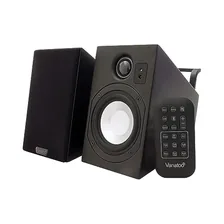 Ranked #33 of 65 in Medium Size Powered Bookshelf Speakers - Vanatoo Transparent Zero Plus: $499.99 per pair Amazon eBay
Pros: Erin’s data shows a small 1.7dB span from 300Hz to 5kHz and a broadly level midrange trend. Scores of 3.18 standalone and 5.84 with an ideal subwoofer support it as a useful compact desktop option. Flexible cabinet orientation, multiple inputs and automatic subwoofer crossover behavior help with setup. Measured bass extension of 92Hz (-3dB), with a measured sensitivity of 88.5dB.
Cons: The measured -3dB point is around 95Hz, with a much lower F10 in the original review; this is not flat bass to the low-50Hz region. Vertical listening angle changes the upper-midrange response. The review finds cleaner results at moderate levels than near maximum output, where multitone distortion increases. A subwoofer is particularly valuable here.
Full Vanatoo Transparent Zero Plus review and specifications →
| AES Input | No |
|---|---|
| Amplifier Power | 120W total (Class D) |
| Aux Input | Yes |
| Bass Extension (-10dB) | 53Hz (measured, Erin's Audio Corner) |
| Bass Extension (-3dB) | 92Hz (measured, Erin's Audio Corner) |
| Bluetooth Codecs | SBC, AAC, aptX, aptX HD |
| Coaxial Input | No |
| DSP | Yes (8th-order Butterworth high-pass at 58Hz) |
| Dimensions | 8.5"H x 5.5"W x 6"D |
| Drivers | 4" aluminum cone woofer, 4" long-throw passive radiator, 1" soft dome tweeter |
| HDMI Input | No |
| Inputs | Bluetooth (aptX HD), USB (24-bit/96kHz), Toslink Optical (24-bit/96kHz), 3.5mm Analog |
| Optical Input | Yes |
| Outputs | RCA subwoofer |
| RCA Input | No |
| Sensitivity | 88.5dB (measured at 0.3V/1m, Erin's Audio Corner) |
| Spinorama Preference Score | 3.18 |
| Spinorama Preference Score with Perfect Sub | 5.84 |
| Subwoofer Output | Yes |
| TRS Input | No |
| USB Input | Yes |
| Weight | 7.1 lbs (3.2 kg) each |
| XLR Input | No |
- Links
- Reviews, Comparisons and Sound Samples
- Erin’s Audio Corner: Vanatoo Transparent Zero Plus Review. More from Erin’s Audio Corner →
- Erin’s Audio Corner Website: Vanatoo Transparent Zero Plus
- Erin’s Audio Corner Measurements (spinorama.org)
- Jasper Tech: Best Desktop Computer Speakers for Every Budget – 2026 More from Jasper Tech →
- Jasper Tech: Are the D3V The Best Studio Monitors For The Money?
- Jasper Tech: Best Powered Bookshelf Speakers for Every Budget - 2025
- Jasper Tech: Best Premium Computer Speakers: Kanto ORA4 Review & Comparison
- Jasper Tech: Are the iLoud Micro Monitor Pro the Best Studio Monitor Speakers for your Home Studio?
- Jasper Tech: Best Desktop Computer Speakers for Every Budget
- Head-to-Head Comparisons
- Vanatoo Transparent Zero Plus vs Kali LP-UNF
- Vanatoo Transparent Zero Plus vs Neumi BS5P
- Vanatoo Transparent Zero Plus vs JBL 705P
- Vanatoo Transparent Zero Plus vs Focal Alpha 50 EVO
- Vanatoo Transparent Zero Plus vs M-Audio BX5 D3
- Vanatoo Transparent Zero Plus vs Dayton Audio M4
- Vanatoo Transparent Zero Plus vs Kanto YU6
- Vanatoo Transparent Zero Plus vs Adam Audio T5V
- See all 52 comparisons
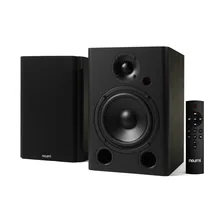 Ranked #34 of 65 in Medium Size Powered Bookshelf Speakers - Neumi BS5P-ARC: $219.99 per pair Amazon eBay
Pros: Erin’s selected measurements give a 2.6dB midrange span and a 6.13 ideal-subwoofer preference score, indicating better tonal performance above the bass than its former near-bottom position suggested. HDMI ARC makes it a convenient low-cost TV stereo system.
Cons: The standalone score drops to 2.94. The published response reaches -3dB around 113Hz and -6dB around 83Hz, so bass balance is a significant limitation in that measured configuration. It is not the same model or dataset as the original BS5P. The score alone cannot establish clean output, and a subwoofer should not be assumed to solve crossover or room-integration issues automatically.
Full Neumi BS5P-ARC review and specifications →
| AES Input | No |
|---|---|
| Amplifier Power | 75W total (37.5W per channel) |
| Aux Input | No |
| Coaxial Input | Yes |
| Country | China |
| Dimensions | 10.6H x 7.2W x 8.5D in each |
| Drivers | 1" silk dome tweeter with integrated waveguide, 5" poly-cone woofer |
| Enclosure | 2-way active |
| HDMI Input | Yes |
| Inputs | HDMI ARC, Bluetooth, USB-C, optical, coaxial, RCA analog |
| Optical Input | Yes |
| RCA Input | Yes |
| Spinorama Preference Score | 2.94 |
| Spinorama Preference Score with Perfect Sub | 6.13 |
| TRS Input | No |
| USB Input | Yes |
| XLR Input | No |
- Links
- Reviews, Comparisons and Sound Samples
- Head-to-Head Comparisons
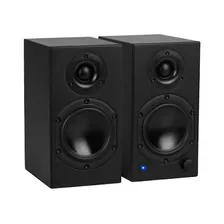 Ranked #37 of 65 in Medium Size Powered Bookshelf Speakers - Dayton Audio M4: $249.98 per pair Parts Express eBay
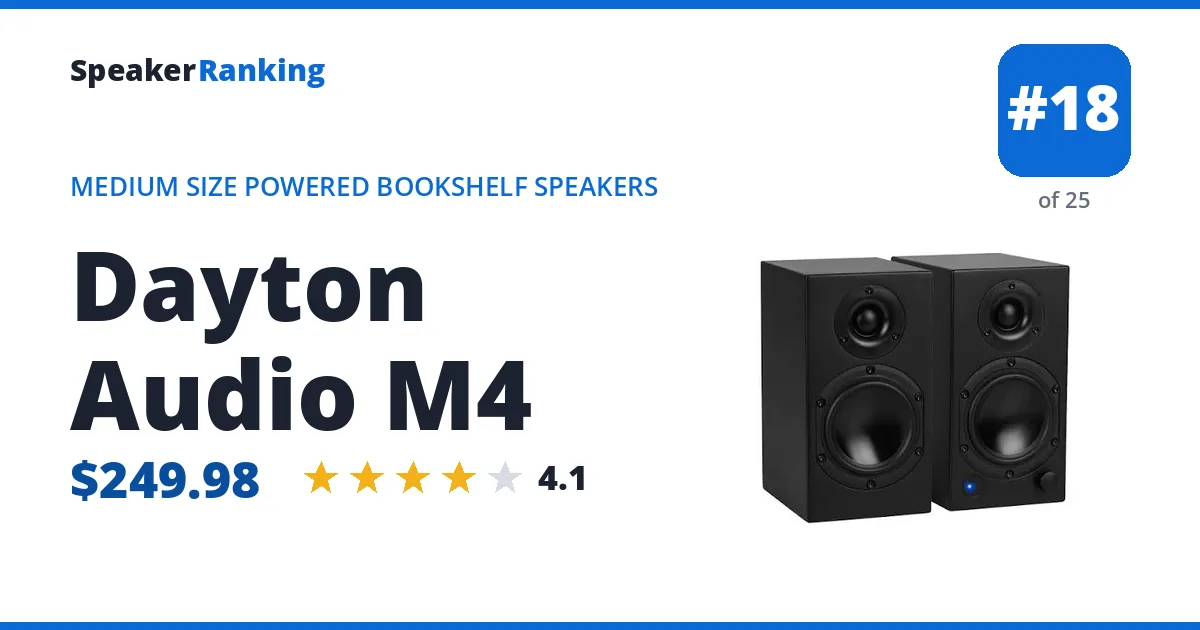
Pros: A compact powered pair with a subwoofer output, useful source connections and a solid cabinet. The existing review describes reasonable linearity for the price and a subdued upper treble that avoids an aggressively bright presentation. It is best considered for a close desktop setup. Measured bass extension of 121Hz (-3dB).
Cons: Existing listening and output notes describe limited bass, a balance that changes with distance, and distortion rising above roughly 93dB. The soft treble is a tonal preference, not evidence of reference neutrality; a subwoofer does not establish greater midrange headroom.
Full Dayton Audio M4 review and specifications →
| AES Input | No |
|---|---|
| Amplifier Power | 75W RMS (150W peak) |
| App | No |
| Aux Input | Yes (RCA) |
| Bass Extension (-10dB) | 60Hz (measured, Erin's Audio Corner) |
| Bass Extension (-3dB) | 121Hz (measured, Erin's Audio Corner) |
| Bluetooth Codecs | SBC, aptX |
| Bluetooth Version | 5.0 |
| Coaxial Input | No |
| Digital Aux Input | Yes (USB-C DAC, up to 192kHz/32-bit) |
| Dimensions | 5" x 6.5" x 9.5" (127 x 165 x 241 mm) (W x D x H) |
| Discontinued | No |
| Drivers | 4" aluminum woofer, 1" silk dome tweeter |
| Frequency Response | 40Hz - 20kHz (Manufacturer specified) |
| HDMI Input | No |
| Inputs | RCA, USB-C, Bluetooth |
| Optical Input | No |
| Outputs | Subwoofer (20Hz-200Hz) |
| Power Input | AC Power cord |
| RCA Input | Yes |
| Stereo | Yes |
| Subwoofer Output | Yes |
| TRS Input | No |
| USB Input | Yes |
| Weight | 6.2 lbs (2.81 kg) (active), 5.1 lbs (2.31 kg) (passive) |
| XLR Input | No |
- Links
- Reviews, Comparisons and Sound Samples
- Head-to-Head Comparisons
- Dayton Audio M4 vs Focal Alpha 50 EVO
- Dayton Audio M4 vs KRK Rokit 5 G4
- Dayton Audio M4 vs Yamaha HS5
- Dayton Audio M4 vs Vanatoo Transparent Zero Plus
- Dayton Audio M4 vs Kali LP-UNF
- Dayton Audio M4 vs JBL 705P
- Dayton Audio M4 vs Presonus Eris E5 XT
- Dayton Audio M4 vs Edifier S2000MKIII
- See all 41 comparisons
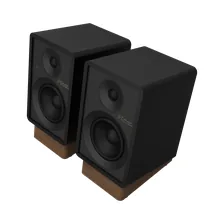 Ranked #38 of 65 in Medium Size Powered Bookshelf Speakers - Onkyo GX-30ARC: $349 per pair Onkyo eBay
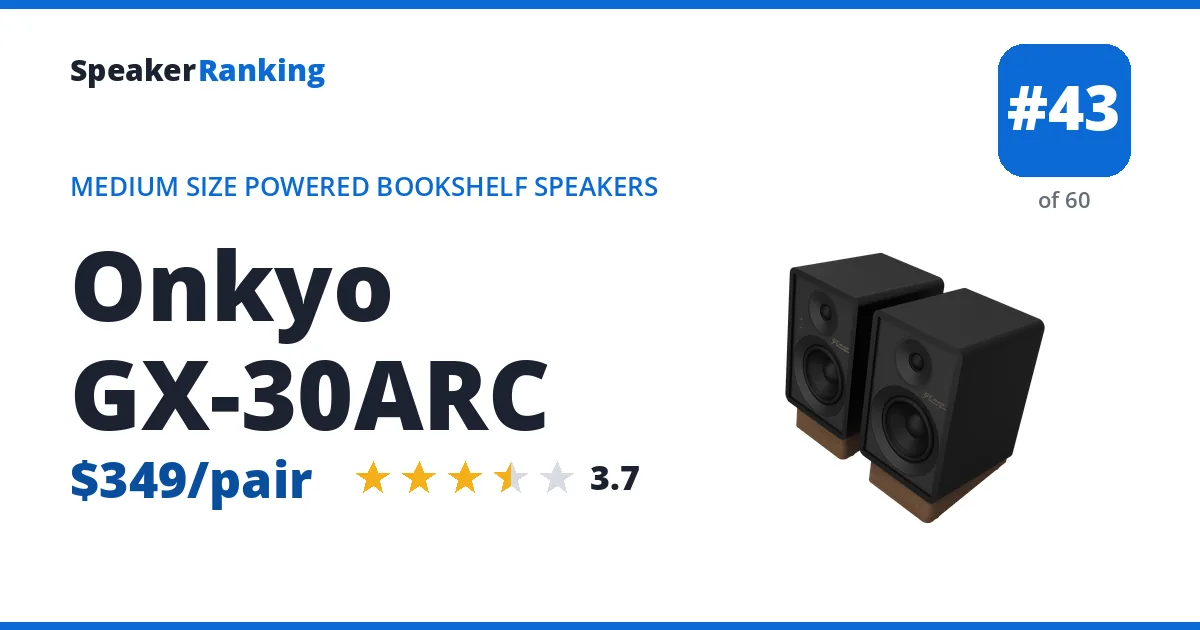
Pros: HDMI ARC, USB-C, optical and analog inputs make it a convenient compact system for a desk or TV. Erin’s Klippel data gives a 2.82 standalone preference score and 5.55 with an ideal subwoofer. The midrange response spans 3.8dB, offering usable but not reference-level tonal performance.
Cons: The response rises toward the treble by about 0.48dB per octave. Bass reaches -3dB around 74Hz, not the lower LFX value used inside the preference model. Vertical listening position affects crossover balance. Its extensive connectivity does not compensate for response irregularities, and the published tonal data alone does not establish maximum clean output.
Full Onkyo GX-30ARC review and specifications →
| AES Input | No |
|---|---|
| Amplifier Power | Class D amplification |
| Aux Input | Yes |
| Coaxial Input | No |
| Country | Japan (design) |
| Dimensions | approx. 8.7H x 5.8W x 7.9D in each |
| Drivers | 1" tweeter, 4" woofer |
| Enclosure | 2-way powered, rear-ported |
| HDMI Input | Yes |
| Inputs | HDMI ARC, USB-C, optical, phono/line, 3.5mm aux, Bluetooth 5.3 |
| Optical Input | Yes |
| Outputs | Subwoofer |
| RCA Input | No |
| Spinorama Preference Score | 2.82 |
| Spinorama Preference Score with Perfect Sub | 5.55 |
| Subwoofer Output | Yes |
| TRS Input | No |
| USB Input | Yes |
| XLR Input | No |
- Links
- Reviews, Comparisons and Sound Samples
- Head-to-Head Comparisons
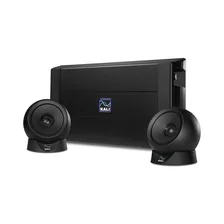 Ranked #55 of 65 in Medium Size Powered Bookshelf Speakers - Kali Audio IN-UNF: $699 per pair Kali Audio eBay
Pros: A specialized ultra-nearfield system with coaxial satellites and an opposed-woofer bass module designed to sit on the desk. Erin found it worked much better when positioned using Kali’s placement template, with useful agreement between the intended response and close-range moving-microphone measurements. DSP placement controls and varied inputs make it a thoughtful solution for the right desk.
Cons: The intended desk geometry is part of the acoustic design. The bass module and prescribed spacing occupy considerable desk space and may conflict with large monitors. It is not designed for arbitrary room placement.
Full Kali Audio IN-UNF review and specifications →
| AES Input | No |
|---|---|
| Amplifier Power | 100W LF + 60W mid/HF per channel (continuous) |
| Aux Input | Yes |
| Bass Extension (-10dB) | 39Hz (manufacturer specified; Erin did not publish an anechoic F10) |
| Bass Extension (-3dB) | 47Hz (manufacturer specified; Erin did not publish an anechoic F3) |
| Bluetooth | No |
| Coaxial Input | No |
| Crossover Frequency | 280Hz LF-to-midrange; 2.8kHz midrange-to-HF |
| DSP | Yes (placement/boundary and tonal trims) |
| Dimensions | Bass module: 11.6"H x 19.4"W x 5.25"D; satellites: 6.25" diameter |
| Drivers | Bass module: two opposed 4.5" woofers; satellites: 4" coincident midrange with 1" textile-dome tweeter |
| Frequency Response | 47Hz - 21kHz +/-3dB (manufacturer specified) |
| HDMI Input | No |
| Inputs | USB-C, optical, 3.5mm, balanced TRS |
| Maximum SPL | 103dB peak at 1m (manufacturer specified) |
| Optical Input | Yes |
| RCA Input | No |
| TRS Input | Yes |
| USB Input | Yes |
| XLR Input | No |
- Links
- Reviews, Comparisons and Sound Samples
- Head-to-Head Comparisons
- Kali Audio IN-UNF vs Edifier S1000MKII
- Kali Audio IN-UNF vs Audioengine HD4
- Kali Audio IN-UNF vs Edifier S1000W
- Kali Audio IN-UNF vs Edifier R1700BT
- Kali Audio IN-UNF vs Edifier R2000DB
- Kali Audio IN-UNF vs Edifier R1280DB
- Kali Audio IN-UNF vs Audioengine HD6
- Kali Audio IN-UNF vs Edifier R1280T
- See all 51 comparisons
Large Size Powered Bookshelf Speakers
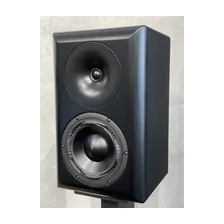 Ranked #10 of 67 in Large Size Powered Bookshelf Speakers - Aalto Speakers Aalto 3 Active Pro: $5,930 per pair Aalto Speakers eBay
Pros: The manufacturer dataset reports a remarkably even 0.7dB response span from 300Hz to 5kHz, 34.6Hz -3dB extension and an 8.55 ideal-subwoofer preference score. If representative of the delivered system, this promises exceptionally neutral balance with useful bass reach.
Cons: External amplification and system setup make this less straightforward than a self-contained desktop pair.
Full Aalto Speakers Aalto 3 Active Pro review and specifications →
| AES Input | Yes |
|---|---|
| Amplifier Power | 4x 245W (external amplifier module, Speakon connection) |
| Aux Input | No |
| Coaxial Input | No |
| Country | Finland |
| DSP | FourAudio System Software (Windows/macOS) |
| Dimensions | 9.4"W x 15.7"H x 9.8"D (240 x 400 x 250 mm) |
| Drivers | 26mm aluminum dome tweeter, 6.5" long-stroke bass-midrange, 8" passive radiator |
| Enclosure | 2-way active, passive-radiator loaded, MDF |
| Frequency Response | 31-23,500Hz (-6dB) |
| HDMI Input | No |
| Inputs | Analogue XLR, AES/EBU XLR, USB Type B |
| Optical Input | No |
| RCA Input | No |
| Spinorama Preference Score | 7.14 |
| Spinorama Preference Score with Perfect Sub | 8.55 |
| TRS Input | No |
| USB Input | Yes |
| Weight | 19.8 lbs (9 kg) each |
| XLR Input | Yes |
- Links
- Reviews, Comparisons and Sound Samples
- Head-to-Head Comparisons
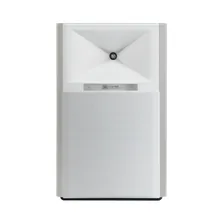 Ranked #28 of 67 in Large Size Powered Bookshelf Speakers - JBL 4305P: $2,200 per pair Amazon JBL eBay
Pros: The measured 1.5dB response span from 300Hz to 5kHz supports even mids, with a 6.54 ideal-subwoofer score and 45.4Hz -3dB bass extension. Integrated consumer connectivity makes this a more convenient living-room system than many studio monitors. Measured bass extension of 45Hz (-3dB).
Cons: Crossover-region directivity changes mean the narrow on-axis span does not describe every listening angle. Limiting becomes relevant at high output, particularly with bass-heavy music. It suits near- to midfield listening better than the largest high-output systems here.
Full JBL 4305P review and specifications →
| AES Input | No |
|---|---|
| Amplifier Power | 300W system: 125W LF + 25W HF per speaker |
| Aux Input | Yes |
| Bass Extension (-10dB) | 40.5Hz (measured, Erin's Audio Corner) |
| Bass Extension (-3dB) | 45Hz (measured, Erin's Audio Corner) |
| Coaxial Input | No |
| Dimensions | 13.2H x 8.3W x 8.8D inches |
| Drivers | 5.25-inch pulp woofer; 1-inch annular compression driver |
| HDMI Input | No |
| Inputs | XLR/TRS combo, 3.5mm Aux, Optical, USB-B, Ethernet |
| Maximum SPL | ~93dB at 2m in-room before limiting (measured, Erin's Audio Corner) |
| Optical Input | Yes |
| RCA Input | No |
| Sensitivity | Not applicable (active DSP loudspeaker) |
| Spinorama Preference Score | 4.53 |
| Spinorama Preference Score with Perfect Sub | 6.54 |
| TRS Input | Yes |
| USB Input | Yes |
| XLR Input | Yes |
- Links
- Reviews, Comparisons and Sound Samples
- Head-to-Head Comparisons
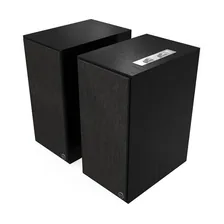 Ranked #39 of 67 in Large Size Powered Bookshelf Speakers - Klipsch The Nines: $999.99 per pair Crutchfield eBay
Pros: The 1.7dB response span from 300Hz to 5kHz supports even mids, and measured -3dB extension is 42.5Hz. Extensive consumer connections and app adjustment make it convenient for TV and music, while the horn provides a focused listening presentation. Measured bass extension of 41Hz (-3dB), with a measured sensitivity of 82.5dB.
Cons: The 5.99 ideal-subwoofer score reflects limitations beyond the narrow midband span. Horizontal coverage is relatively focused, so placement matters for multiple seats. The reviewer preferred reduced treble, and bass limiting at higher playback levels means the large woofer is not a guarantee of unlimited output.
Full Klipsch The Nines review and specifications →
| AES Input | No |
|---|---|
| Amplifier Power | 240W total (480W peak; 100W LF + 20W HF per powered speaker) |
| App | Klipsch Connect (bass/mid/treble EQ) |
| Aux Input | Yes |
| Bass Extension (-10dB) | 31Hz (measured, Erin's Audio Corner) |
| Bass Extension (-3dB) | 41Hz (measured, Erin's Audio Corner) |
| Bluetooth Codecs | SBC, AAC, aptX, aptX HD |
| Coaxial Input | No |
| Dimensions | 19.13"H x 9.5"W x 13.38"D |
| Drivers | 8" high-excursion fiber-composite woofer, 1" titanium LTS vented tweeter with Tractrix horn |
| Frequency Response | 34Hz - 25kHz +/-3dB (manufacturer specified) |
| HDMI Input | Yes |
| Inputs | HDMI ARC, Bluetooth 5.0, phono/line RCA, 3.5mm, USB, optical |
| Maximum SPL | 115dB at 1m (stereo pair, manufacturer specified) |
| Optical Input | Yes |
| Outputs | Subwoofer |
| RCA Input | Yes |
| Sensitivity | 82.5dB (measured at 0.30V/1m, Erin's Audio Corner) |
| Spinorama Preference Score | 4.42 |
| Spinorama Preference Score with Perfect Sub | 5.99 |
| Subwoofer Output | Yes |
| TRS Input | No |
| USB Input | Yes |
| Weight | 28.4 lbs (12.9 kg) primary, 26.9 lbs (12.2 kg) secondary |
| Woofer Cabinet | rear-ported bass reflex |
| XLR Input | No |
- Links
- Reviews, Comparisons and Sound Samples
- Head-to-Head Comparisons
- Klipsch The Nines vs JBL 306P MKII
- Klipsch The Nines vs JBL 708P
- Klipsch The Nines vs JBL 4329P
- Klipsch The Nines vs JBL M2 Master Reference Monitor
- Klipsch The Nines vs APS Klasik 2020
- Klipsch The Nines vs Genelec 8040B
- Klipsch The Nines vs Kali Audio LP-6
- Klipsch The Nines vs Emotiva Airmotiv 6s
- See all 32 comparisons
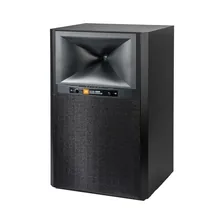 Ranked #44 of 67 in Large Size Powered Bookshelf Speakers - JBL 4329P: $4,500 per pair Amazon eBay
Pros: Measured -3dB extension of 32.2Hz provides deeper native bass than the smaller 4305P. Integrated amplification and streaming make it convenient for a full-range living-room system, and its larger format is useful when scale matters. Measured bass extension of 31Hz (-3dB), with a measured sensitivity of 102.2dB.
Cons: The measured 4.5dB response span from 300Hz to 5kHz includes a notable midrange dip, so it is not as neutral as its size and price might suggest. Its 5.83 ideal-subwoofer score trails the 4305P. There is no HDMI connection for the simplest TV hookup.
Full JBL 4329P review and specifications →
| AES Input | No |
|---|---|
| Aux Input | Yes |
| Bass Extension (-10dB) | 27Hz (measured, Erin's Audio Corner) |
| Bass Extension (-3dB) | 31Hz (measured, Erin's Audio Corner) |
| Bluetooth Codecs | SBC, aptX Adaptive |
| Coaxial Input | No |
| Dimensions | 20.3"H x 12.6"W x 12.7"D |
| Drivers | 8" midwoofer, 1" compression driver with JBL High-Definition Imaging horn |
| Frequency Response | 30Hz - 20kHz (anechoic, manufacturer specified) |
| HDMI Input | No |
| Inputs | USB, Optical, Bluetooth, Analog, 3.5mm, AirPlay 2 |
| Optical Input | Yes |
| RCA Input | No |
| Sensitivity | 102.2dB (measured at 0.3V/1m, Erin's Audio Corner) |
| Spinorama Preference Score | 4.51 |
| Spinorama Preference Score with Perfect Sub | 5.83 |
| TRS Input | No |
| USB Input | Yes |
| Weight | 34.4 lbs (15.6 kg) (primary), 34.4 lbs (15.6 kg) (secondary) |
| Woofer Cabinet | ported |
| XLR Input | No |
- Links
- Reviews, Comparisons and Sound Samples
- Head-to-Head Comparisons
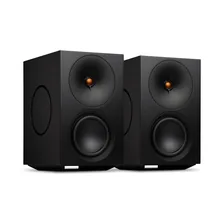 Ranked #47 of 67 in Large Size Powered Bookshelf Speakers - Cambridge Audio L/R X: $2,399.00 per pair Amazon eBay
Pros: A 2.5-way active design with a 28mm aluminum tweeter, a front-facing 5-inch mid-woofer, a second 5-inch woofer at the base whose passband overlaps the first (the source of the “.5”), and dual 6-inch side-firing passive radiators per speaker. Erin’s Audio Corner measured wide, even horizontal dispersion (a broad flare out to about the -6dB point around 1.5 to 3kHz) and deeper extension than the smaller L/R S, with an F3 of about 43Hz and F10 of about 37Hz. In-app DSP for room size, speaker distance from the front wall, and reflective surface type gave an audible change in bass tightness in testing. Connectivity covers HDMI eARC, RCA aux, a moving-magnet phono input, optical digital, USB-C, USB-A, Wi-Fi streaming, and a subwoofer output, making it a full living-room hub rather than just a stereo pair. Measured bass extension of 43Hz (-3dB).
Cons: On-axis response is less linear than the L/R S, with dips in the bass, a peak around 1-2kHz, and a dip spanning the upper mid-range into the lower treble; Cambridge confirmed the dip is a deliberate DSP notch for a tweeter breakup resonance rather than a driver flaw, but it was audible as a mild suck-out in an AB pink-noise comparison. Vertical dispersion is narrower and asymmetric than the L/R S, at about plus 20 to minus 10 degrees, because the greater distance between the tweeter and mid-woofer creates more lobing, so listening height and stand placement matter more. Multitone distortion rides close to the 3% threshold at 96dB measured at 1 meter in the far field, limiting headroom for loud, wide-band material. Output falls off quickly below about 50Hz, so home-theater use with deep bass content benefits from an added subwoofer.
Full Cambridge Audio L/R X review and specifications →
| AES Input | No |
|---|---|
| Amplifier Power | 800W total (400W per speaker) |
| App | Yes |
| Aux Input | No |
| Bass Extension (-10dB) | 37Hz (measured, Erin's Audio Corner) |
| Bass Extension (-3dB) | 43Hz (measured, Erin's Audio Corner) |
| Bluetooth Codecs | SBC, AAC |
| Coaxial Input | No |
| DSP | Yes, room size, wall distance, and reflective surface correction |
| Dimensions | 7.9" (200 mm) W x 330mm H x 260mm D (each) |
| Drivers | 28mm aluminum tweeter, 2x 5" mid-woofers, 2x 6" side-firing passive radiators |
| Frequency Response | 35Hz - 24kHz (±3dB, manufacturer specified) |
| HDMI Input | Yes |
| Inputs | HDMI eARC, RCA aux, RCA phono (MM), optical digital, USB-C, USB-A, Ethernet, Wi-Fi |
| Optical Input | Yes |
| Outputs | Subwoofer |
| RCA Input | Yes |
| Subwoofer Output | Yes |
| TRS Input | No |
| USB Input | Yes |
| Weight | 22.9 lbs (10.4kg) each |
| XLR Input | No |
- Links
- Reviews, Comparisons and Sound Samples
- Head-to-Head Comparisons
- Cambridge Audio L/R X vs Focal Alpha 65 EVO
- Cambridge Audio L/R X vs Adam Audio T8V
- Cambridge Audio L/R X vs Adam Audio T7V
- Cambridge Audio L/R X vs Presonus Eris Studio 8
- Cambridge Audio L/R X vs Palmer Orbit 11
- Cambridge Audio L/R X vs Edifier R2850DB
- Cambridge Audio L/R X vs Klipsch The Sevens
- Cambridge Audio L/R X vs Kali Audio IN-8 V2
- See all 17 comparisons
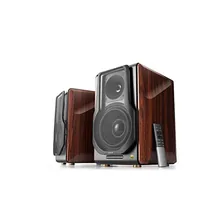 Ranked #59 of 67 in Large Size Powered Bookshelf Speakers - Edifier S3000Pro: $900 per pair Discontinued eBay
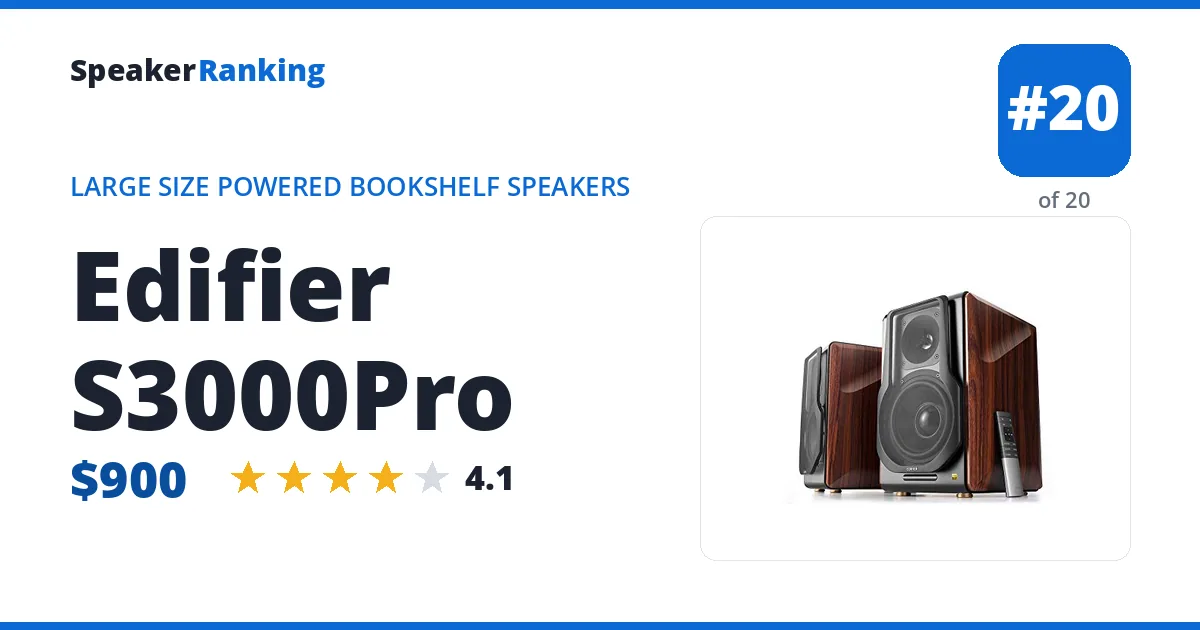
Pros: A convenient home-listening system with digital and analog input options, avoiding the need for a separate power amplifier. Its large cabinets and tone adjustments offer flexibility for a music-focused setup.
Cons: The substantial cabinet size requires more space than a typical desktop pair. High-resolution digital input support does not itself guarantee better sound. Discontinued.
Full Edifier S3000Pro review and specifications →
| AES Input | No |
|---|---|
| Amplifier Power | 78w RMS Per Speaker |
| App | No |
| Aux Input | No |
| Bluetooth | Yes, 5.0 |
| Bluetooth Codecs | SBC, aptX HD |
| Coaxial Input | Yes |
| DSP | No |
| Dimensions | 14.5"H x 9.1"W x 14"D (368.3 x 231.1 x 355.6 mm) |
| Discontinued | Yes |
| Drivers | 6.5" (165mm) woofer |
| EQ | Yes (Room adjustment) |
| Frequency Response | 38Hz-20KHz (-3dB) (Manufacturer specified) |
| HDMI Input | No |
| Inputs | Bluetooth, XLR, RCA Input, Digital Optical, Digital Coax, USB |
| Optical Input | Yes |
| Outputs | None |
| RCA Input | Yes |
| TRS Input | No |
| USB Input | Yes |
| Weight | 29.8 lbs (13.5 kg) |
| XLR Input | Yes |
- Links
- Reviews, Comparisons and Sound Samples
- Head-to-Head Comparisons
- Edifier S3000Pro vs KRK Rokit 7 G4
- Edifier S3000Pro vs KRK Rokit 8 G4
- Edifier S3000Pro vs Kali Audio LP-8
- Edifier S3000Pro vs Klipsch The Sevens
- Edifier S3000Pro vs Adam Audio T8V
- Edifier S3000Pro vs Focal Alpha 65 EVO
- Edifier S3000Pro vs JBL 4329P
- Edifier S3000Pro vs Thomann Swissonic A306
- See all 11 comparisons
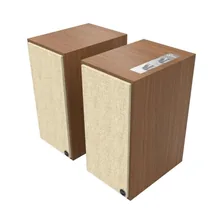 Ranked #64 of 67 in Large Size Powered Bookshelf Speakers - Klipsch The Sevens: $999.99 per pair Amazon eBay

Pros: Erin reported 49Hz -3dB extension, with useful bass for ordinary music listening. HDMI, phono, USB, optical and Bluetooth connections make the system convenient for TV and music, while app controls and a subwoofer output provide adjustment options. Measured bass extension of 49Hz (-3dB).
Cons: The review found a recessed 2-4kHz region and upper-treble emphasis, producing a scooped balance that a simple treble reduction did not fully fix. Relatively narrow horizontal coverage limits consistency across seats.
Full Klipsch The Sevens review and specifications →
| AES Input | No |
|---|---|
| Amplifier Power | 200W total (400W peak) |
| App | Yes (treble/mid/bass EQ, subwoofer output, dynamic bass mode) |
| Aux Input | Yes |
| Bass Extension (-10dB) | 36Hz (measured, Erin's Audio Corner) |
| Bass Extension (-3dB) | 49Hz (measured, Erin's Audio Corner) |
| Bluetooth Codecs | SBC, AAC, aptX, aptX HD |
| Coaxial Input | No |
| Dimensions | 16.375"H x 8.125"W x 13.1875"D |
| Drivers | 6.5" high-excursion woofer, 1" titanium tweeter on Tractrix horn |
| HDMI Input | Yes |
| Inputs | HDMI, Phono, 3.5mm, USB, Optical, Bluetooth |
| Optical Input | Yes |
| Outputs | Subwoofer |
| RCA Input | No |
| Subwoofer Output | Yes |
| TRS Input | No |
| USB Input | Yes |
| Weight | 22.3 lbs (10.1 kg) (primary), 19.8 lbs (9 kg) (secondary) |
| Woofer Cabinet | ported, rear flared port |
| XLR Input | No |
- Links
- Reviews, Comparisons and Sound Samples
- Head-to-Head Comparisons
- Klipsch The Sevens vs EVE Audio SC305
- Klipsch The Sevens vs Focal Twin6 Be
- Klipsch The Sevens vs Edifier R2850DB
- Klipsch The Sevens vs Edifier S3000Pro
- Klipsch The Sevens vs Presonus Eris Studio 8
- Klipsch The Sevens vs Kali Audio LP-8
- Klipsch The Sevens vs Adam Audio T7V
- Klipsch The Sevens vs Adam Audio T8V
- See all 36 comparisons