The FiiO FD3 ranks #1023 out of 1398 total In-Ear Headphones for sound quality. See all Headphones rankings for every top pick.
Brand: Fiio
Prices on this page were last checked October 19, 2026 at 10:32 PM UTC. Product prices and availability are accurate as of that date/time and are subject to change; the price and availability shown on Amazon at the time of purchase will apply to the purchase of this product.
As an eBay Partner, we may be compensated if you make a purchase.
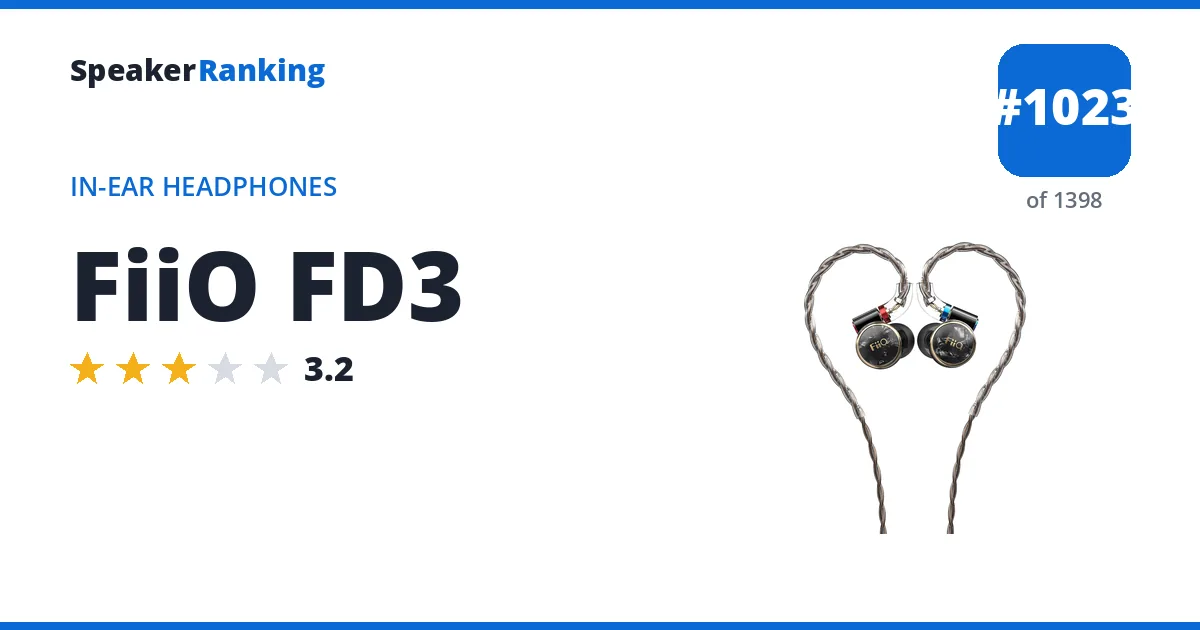
#1023 FiiO FD3: $109.99 Amazon $109.99 eBay
Pros: A 12 mm DLC dynamic driver earphone with a semi-open back whose response stays close to target, with sub bass reaching fully to 20 Hz and bass about 3 dB above target for a full but controlled low end. 109 dB/mW sensitivity and 32 ohm impedance run easily from a phone, and the MMCX cable is replaceable.
Cons: Upper bass is about 4.5 dB above target, which thickens the sound, and presence sits about 2.5 dB low with a dip near 3.7 kHz, so vocals are slightly recessed. Treble has narrow dips near 7.1 and 11.2 kHz, and the Truthear Zero Blue 2 scores much higher for less.
Is the FiiO FD3 right for you?
Buy it if
- you want sub-bass rumble that reaches down to 20 Hz.
- you are happy to use EQ: our preset lifts its Harman match by about 29 points.
Skip it if
- you want the best value: the higher-rated EPZ G10 costs about $86 less.
| Released | 2021 (5 years ago) |
|---|---|
| Back | Semi-open |
| Connection | Wired |
| Deviation From Target | 2.57 dB standard deviation |
| Driver Type | Dynamic |
| Drivers | 1 x 12mm dynamic (DLC diaphragm) |
| Form Factor | In-ear |
| Harman Preference Score | 63 (median of 5 squig.link measurements, calibrated to AutoEQ) |
| Impedance | 32 ohms |
| Sensitivity | 109 dB/mW |
| Sub-bass Extension | Within 6 dB of target down to 20 Hz (+0.1 dB at 30 Hz) |
| Tonal Tilt | -0.83 (negative is warmer, positive brighter) |
EQ Presets
Harman target
Set a preamp of -5.1 dB, then add these filters in any parametric equalizer (Wavelet, Equalizer APO, Peace, or a player with parametric EQ). Calculated by Speaker Ranking from the median of 5 squig.link measurements, in the filter layout AutoEQ uses. Predicted Harman match with this EQ: 92 out of 100, up from 63.
| Filter | Frequency | Gain | Q |
|---|---|---|---|
| Low shelf | 105 Hz | -1.7 dB | 0.70 |
| Peak | 23 Hz | +1.3 dB | 1.21 |
| Peak | 82 Hz | -0.7 dB | 2.69 |
| Peak | 177 Hz | -5.6 dB | 0.75 |
| Peak | 821 Hz | +1.3 dB | 2.75 |
| Peak | 2,088 Hz | -0.7 dB | 2.96 |
| Peak | 3,666 Hz | +5.1 dB | 3.13 |
| Peak | 5,312 Hz | -1.7 dB | 6.00 |
| Peak | 7,184 Hz | +2.0 dB | 3.27 |
Neutral target
Set a preamp of -5.1 dB, then add these filters in any parametric equalizer (Wavelet, Equalizer APO, Peace, or a player with parametric EQ). Calculated by Speaker Ranking from the median of 5 squig.link measurements, in the filter layout AutoEQ uses. Predicted Neutral match with this EQ: 92 out of 100, up from 28.
| Filter | Frequency | Gain | Q |
|---|---|---|---|
| Low shelf | 105 Hz | -10.2 dB | 0.70 |
| Peak | 77 Hz | -0.9 dB | 3.15 |
| Peak | 174 Hz | -5.5 dB | 0.67 |
| Peak | 806 Hz | +1.4 dB | 2.42 |
| Peak | 3,665 Hz | +5.1 dB | 3.11 |
| Peak | 5,312 Hz | -1.7 dB | 6.00 |
| Peak | 7,184 Hz | +2.0 dB | 3.27 |
Studio flat target
Set a preamp of -6.0 dB, then add these filters in any parametric equalizer (Wavelet, Equalizer APO, Peace, or a player with parametric EQ). Calculated by Speaker Ranking from the median of 5 squig.link measurements, in the filter layout AutoEQ uses. Predicted Studio flat match with this EQ: 93 out of 100, up from 8.
| Filter | Frequency | Gain | Q |
|---|---|---|---|
| Low shelf | 105 Hz | -12.0 dB | 0.70 |
| High shelf | 10,000 Hz | +2.0 dB | 0.70 |
| Peak | 174 Hz | -7.5 dB | 0.72 |
| Peak | 353 Hz | -0.9 dB | 2.70 |
| Peak | 847 Hz | +1.3 dB | 2.46 |
| Peak | 3,276 Hz | +5.9 dB | 2.46 |
| Peak | 3,955 Hz | +1.3 dB | 6.00 |
| Peak | 5,366 Hz | -3.9 dB | 6.00 |
| Peak | 7,211 Hz | +1.9 dB | 4.04 |
Warm target
Set a preamp of -3.4 dB, then add these filters in any parametric equalizer (Wavelet, Equalizer APO, Peace, or a player with parametric EQ). Calculated by Speaker Ranking from the median of 5 squig.link measurements, in the filter layout AutoEQ uses. Predicted Warm match with this EQ: 92 out of 100, up from 72.
| Filter | Frequency | Gain | Q |
|---|---|---|---|
| Low shelf | 105 Hz | -1.5 dB | 0.70 |
| High shelf | 10,000 Hz | -3.8 dB | 0.70 |
| Peak | 23 Hz | +1.4 dB | 1.21 |
| Peak | 175 Hz | -5.4 dB | 0.76 |
| Peak | 814 Hz | +1.6 dB | 2.79 |
| Peak | 2,103 Hz | -1.4 dB | 2.60 |
| Peak | 3,689 Hz | +3.7 dB | 4.47 |
| Peak | 5,442 Hz | -3.4 dB | 6.00 |
Bass target
Set a preamp of -5.1 dB, then add these filters in any parametric equalizer (Wavelet, Equalizer APO, Peace, or a player with parametric EQ). Calculated by Speaker Ranking from the median of 5 squig.link measurements, in the filter layout AutoEQ uses. Predicted Bass match with this EQ: 93 out of 100, up from 70.
| Filter | Frequency | Gain | Q |
|---|---|---|---|
| Low shelf | 105 Hz | +2.1 dB | 0.70 |
| Peak | 23 Hz | +1.5 dB | 1.12 |
| Peak | 85 Hz | -0.8 dB | 2.55 |
| Peak | 180 Hz | -5.6 dB | 0.77 |
| Peak | 823 Hz | +1.3 dB | 2.82 |
| Peak | 2,086 Hz | -0.7 dB | 2.96 |
| Peak | 3,666 Hz | +5.1 dB | 3.14 |
| Peak | 5,313 Hz | -1.7 dB | 6.00 |
| Peak | 7,184 Hz | +2.0 dB | 3.27 |
Bright target
Set a preamp of -6.1 dB, then add these filters in any parametric equalizer (Wavelet, Equalizer APO, Peace, or a player with parametric EQ). Calculated by Speaker Ranking from the median of 5 squig.link measurements, in the filter layout AutoEQ uses. Predicted Bright match with this EQ: 87 out of 100, up from 17.
| Filter | Frequency | Gain | Q |
|---|---|---|---|
| Low shelf | 105 Hz | -10.3 dB | 0.70 |
| High shelf | 10,000 Hz | +2.0 dB | 0.70 |
| Peak | 174 Hz | -5.5 dB | 0.65 |
| Peak | 797 Hz | +1.3 dB | 2.62 |
| Peak | 2,083 Hz | -1.0 dB | 2.90 |
| Peak | 3,893 Hz | +6.0 dB | 1.91 |
| Peak | 6,127 Hz | +1.7 dB | 6.00 |
V-shaped target
Set a preamp of -6.1 dB, then add these filters in any parametric equalizer (Wavelet, Equalizer APO, Peace, or a player with parametric EQ). Calculated by Speaker Ranking from the median of 5 squig.link measurements, in the filter layout AutoEQ uses. Predicted V-shaped match with this EQ: 83 out of 100, up from 62.
| Filter | Frequency | Gain | Q |
|---|---|---|---|
| Low shelf | 105 Hz | +2.7 dB | 0.70 |
| High shelf | 10,000 Hz | +2.0 dB | 0.70 |
| Peak | 23 Hz | +1.5 dB | 1.16 |
| Peak | 175 Hz | -4.2 dB | 0.76 |
| Peak | 3,930 Hz | +6.0 dB | 1.56 |
| Peak | 6,054 Hz | +1.7 dB | 6.00 |
- Links
- Reviews, Comparisons and Sound Samples
Frequency Response
How the FiiO FD3 measures across the audible range, against the Harman in-ear target that most listeners prefer in blind tests. Where the line sits above the target that range sounds louder (more bass, brighter treble), below it quieter. The curve is the median of 5 independent measurements, so one odd sample or rig cannot skew it, and both lines are shifted so their 500 Hz to 2 kHz average sits at 0 dB.
Measurement data: median of 5 measurements from the squig.link databases of ekaudio, hbb, precog, superreview and vsg. Thanks to each of them for publishing their work.