Short answer: the Revel M126Be, if you accept the price. Its 6.5” midwoofer and 1” beryllium dome make it a smaller sibling to the reviewer’s favorite F226Be, but the reviewer doesn’t consider it a strong value next to Revel’s less expensive models. The Concerta2 M16 is essentially flat on-axis from 200Hz to 10kHz, yet harmonic distortion shows a notable peak around 80Hz and a sharp spike around 350Hz.
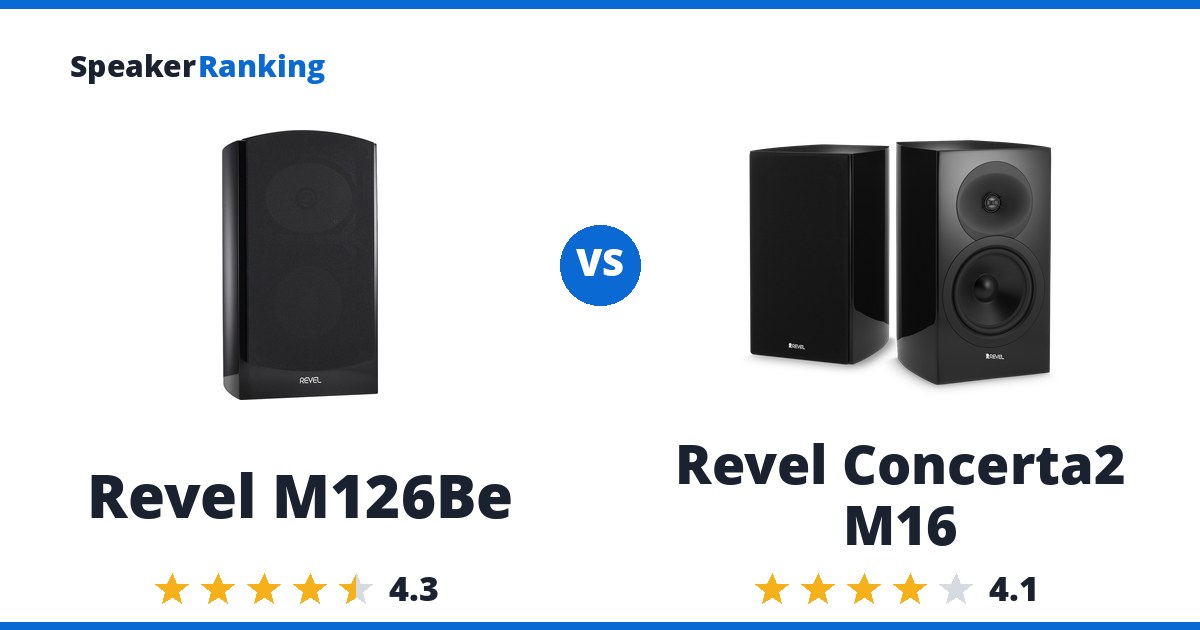
Buy the Revel M126Be. It is rated higher for sound quality and still sold new, while the Revel Concerta2 M16 is discontinued.
Still deciding? The full Passive Home rankings cover every ranked option.
Specifications Side By Side
| Revel M126Be | Revel Concerta2 M16 | |
|---|---|---|
| Price | $4,400 per pair | $600 per pair used (about), Discontinued |
| Ranked | #34 of 134 in Large Size Bookshelf Speakers | #51 of 134 in Large Size Bookshelf Speakers |
| Bass Extension (-10dB) | 44Hz (measured, Erin’s Audio Corner) | 41.6Hz (measured, Audio Science Review) |
| Bass Extension (-3dB) | 103Hz (measured, Erin’s Audio Corner) | 60.1Hz (measured, Audio Science Review) |
| Dimensions | 15.2”H x 8.3”W x 10.3”D (386.1 x 210.8 x 261.6 mm) | 14.8”H x 8.6”W x 10.8”D (374.7 x 218.4 x 273.3 mm) |
| Impedance | 6 ohms nominal (4.9 ohms minimum, measured, Erin’s Audio Corner) | 6 ohms |
| Sensitivity | 86.1dB (measured, Erin’s Audio Corner) | 86dB |
| Drivers | 6.5” Deep Ceramic Composite (DCC) Aluminum Cone with cast frame woofer, 1” Beryllium dome with acoustic lens waveguide tweeter | 25mm tweeter + 165mm woofer |
| Weight | 22 lbs (10.0 kg) each | 32 lbs (14.5 kg) |
| Woofer Cabinet | ported, rear | ported, rear |
| Spinorama Preference Score | 5.08 | 5.06 |
| Spinorama Preference Score with Perfect Sub | 7.34 | 7.28 |
| DIY Kit | No | No |
Related Speaker Comparisons
More top alternatives to Revel M126Be:
- AsciLab C6B vs Revel M126Be
- KEF R3 Meta vs Revel M126Be
- KEF Q Concerto Meta vs Revel M126Be
- Wharfedale Aura 2 vs Revel M126Be
- KEF R3 vs Revel M126Be
Prices on this page were last checked October 3, 2026 at 10:26 PM UTC. Product prices and availability are accurate as of that date/time and are subject to change; the price and availability shown on Amazon at the time of purchase will apply to the purchase of this product.
As an eBay Partner, we may be compensated if you make a purchase.
The Two Speakers In Full
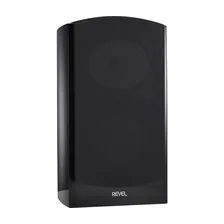 Revel M126Be: $4,400 per pair Crutchfield eBay
Older model: the Revel M106 (ranked higher, rated 4.6/5).
Pros: Two-way design pairing a 6.5” midwoofer with a 1” beryllium dome tweeter, the smaller sibling to the reviewer’s favorite Revel F226Be. Wide, immersive stereo imaging: hard-panned sounds in test tracks localized 2-3 feet outside the physical speaker positions without losing pinpoint precision. Horizontal radiation of about 60-70°, landing right in the reviewer’s preferred range for an enveloping yet still well-focused soundstage. Extended bass-shelf tuning (similar in concept to the KEF R3 Meta) combines with in-room gain for a more linear low end rather than a boomy hump. Diffraction dips visible on-axis around 3kHz and 7kHz largely disappear in the estimated in-room response, since they fill in as you move off-axis. Distortion stays within 3% down to about 100Hz at both 86dB and 96dB output: strong performance for a 6.5” bookshelf woofer. Can be driven by a standard AVR thanks to a manageable 4.9-ohm minimum impedance. Measured bass extension of 103Hz (-3dB), with a measured sensitivity of 86.1dB.
Cons: At $2200/pair, the reviewer doesn’t consider it a strong value: an improvement over Revel’s less expensive M106 and Performa3 models, but not proportional to the price jump. Bass tops out around 50Hz in-room; a subwoofer is still needed for real low-end extension. Vertical placement is fairly critical: there’s a notable hole in the response around the 1.7kHz crossover if you sit above the tweeter axis. Toeing the speaker out to a full 30° introduces a roughly 1dB discontinuity in the midrange along with high-frequency rolloff; the reviewer recommends staying close to on-axis or within about 10°. An unexplained jump in distortion appears right at the 1.7kHz crossover point under compression testing, which may be linked to an occasional “glaring” quality the reviewer noticed in the 2-3kHz region at very high volumes (92-93dB from 2 meters). A mild 2-3kHz forwardness occasionally stood out on some tracks, correctable with about 1dB of EQ, though the reviewer considers it minor.
Full Revel M126Be review and specifications →
| Bass Extension (-10dB) | 44Hz (measured, Erin’s Audio Corner) |
|---|---|
| Bass Extension (-3dB) | 103Hz (measured, Erin’s Audio Corner) |
| DIY Kit | No |
| Dimensions | 15.2”H x 8.3”W x 10.3”D (386.1 x 210.8 x 261.6 mm) |
| Drivers | 6.5” Deep Ceramic Composite (DCC) Aluminum Cone with cast frame woofer, 1” Beryllium dome with acoustic lens waveguide tweeter |
| Impedance | 6 ohms nominal (4.9 ohms minimum, measured, Erin’s Audio Corner) |
| Sensitivity | 86.1dB (measured, Erin’s Audio Corner) |
| Spinorama Preference Score | 5.08 |
| Spinorama Preference Score with Perfect Sub | 7.34 |
| Weight | 22 lbs (10.0 kg) each |
| Woofer Cabinet | ported, rear |
- Links
- Reviews, Comparisons and Sound Samples
- Head-to-Head Comparisons
- Revel M126Be vs ELAC VELA BS 403
- Revel M126Be vs Ascend Acoustics Sierra-LX
- Revel M126Be vs Wharfedale Linton 85
- Revel M126Be vs Selah Audio Purezza
- Revel M126Be vs Ascend Acoustics Sierra-2EX V2
- Revel M126Be vs JTR Noesis 210HT
- Revel M126Be vs Dynaudio Heritage Special
- Revel M126Be vs Radiant Acoustics Clarity 6.2
- See all 23 comparisons
 Revel Concerta2 M16: $600 per pair used (about) Discontinued eBay
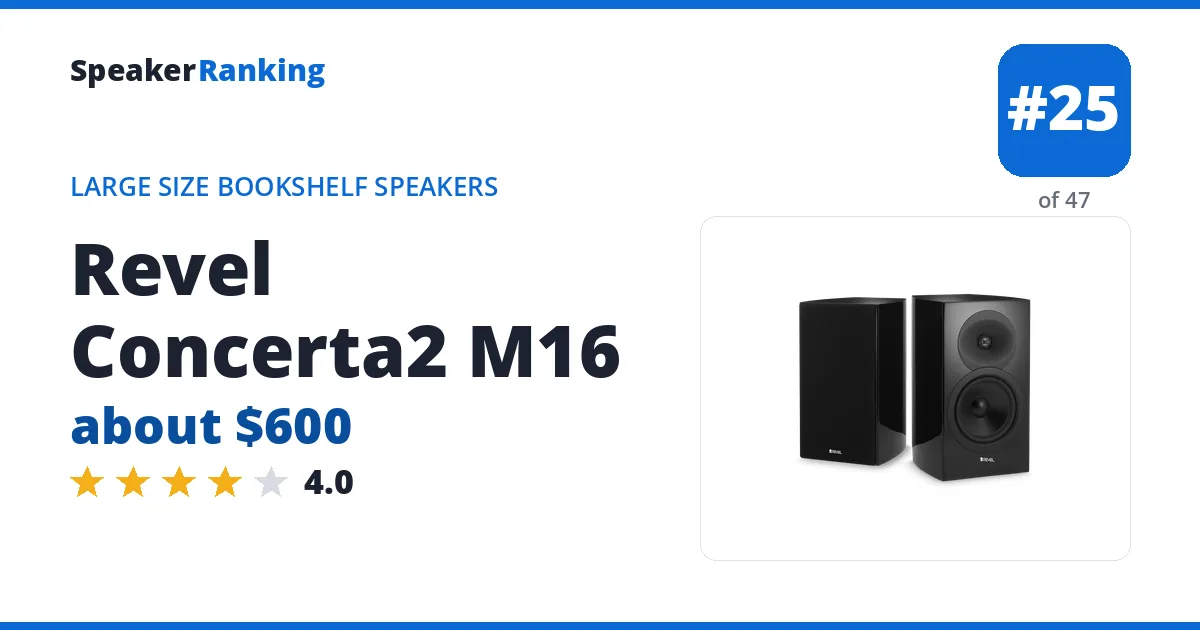
Pros: CEA2034 spinorama shows an on-axis response that’s essentially flat from 200Hz to 10kHz, with some bass boost around 100Hz. Predicted in-room response is very nice, with just extra bass and a bit of roll-off above 20kHz: the reviewer calls it “nice!” Distortion is well controlled through most of the range at both test levels. Measured bass extension of 60.1Hz (-3dB).
Cons: Harmonic distortion shows a notable peak around 80Hz and a sharp spike around 350Hz, plus the woofer appears to get a bit unhappy right before handing off to the tweeter. Cumulative spectral decay (waterfall) shows some lingering resonances in the 300Hz-1kHz region. The reviewer cautions not to over-cover the cabinet/grille area with thin fabric, as it can audibly affect the top-end response. Discontinued.
Full Revel Concerta2 M16 review and specifications →
| Bass Extension (-10dB) | 41.6Hz (measured, Audio Science Review) |
|---|---|
| Bass Extension (-3dB) | 60.1Hz (measured, Audio Science Review) |
| DIY Kit | No |
| Dimensions | 14.8”H x 8.6”W x 10.8”D (374.7 x 218.4 x 273.3 mm) |
| Drivers | 25mm tweeter + 165mm woofer |
| Impedance | 6 ohms |
| Sensitivity | 86dB |
| Spinorama Preference Score | 5.06 |
| Spinorama Preference Score with Perfect Sub | 7.28 |
| Weight | 32 lbs (14.5 kg) |
| Woofer Cabinet | ported, rear |
- Links
- Reviews, Comparisons and Sound Samples
- Head-to-Head Comparisons
- Revel Concerta2 M16 vs ELAC Uni-Fi Reference UBR62
- Revel Concerta2 M16 vs JBL HDI-1600
- Revel Concerta2 M16 vs ELAC DBR62
- Revel Concerta2 M16 vs Yamaha NS-800A
- Revel Concerta2 M16 vs Definitive Technology Demand D11
- Revel Concerta2 M16 vs ELAC Debut 3.0 DB63
- Revel Concerta2 M16 vs Technics SB-C700
- Revel Concerta2 M16 vs Emotiva Airmotiv XB2
- See all 26 comparisons