Short answer: the PreSonus Eris Studio 5. It ranks #63 of 100 powered bookshelf speakers by sound quality, rated 3.6/5, at $299.98. The PreSonus Eris Studio 4 ranks #74, rated 3.4/5, at $259.98, $40 cheaper, not enough of a saving to outweigh the sound-quality gap.
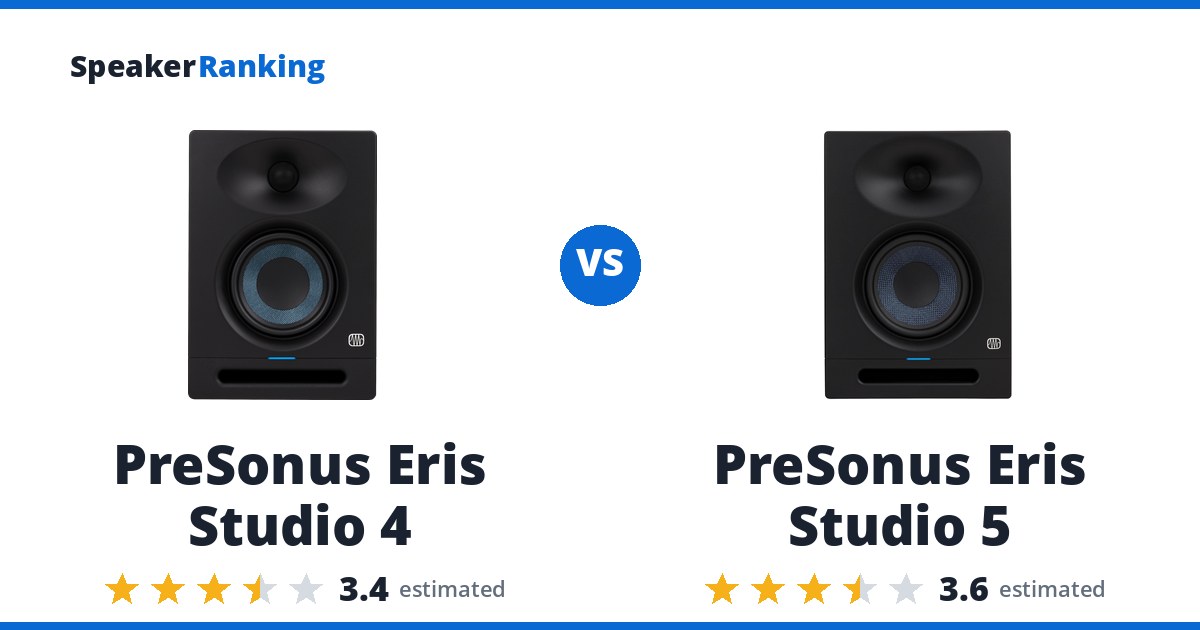
Why pick the PreSonus Eris Studio 4: The smallest Eris Studio monitor, with a 4.5” woven composite woofer and 1” silk-dome tweeter in an elliptical waveguide that spreads sound wide horizontally while limiting reflections off the desk below. The catch: No independent measurements yet, so its tonal balance and directivity can’t be compared directly with measured speakers; the rating is estimated from the larger Eris Studio 5 and the measured Eris Studio 8.
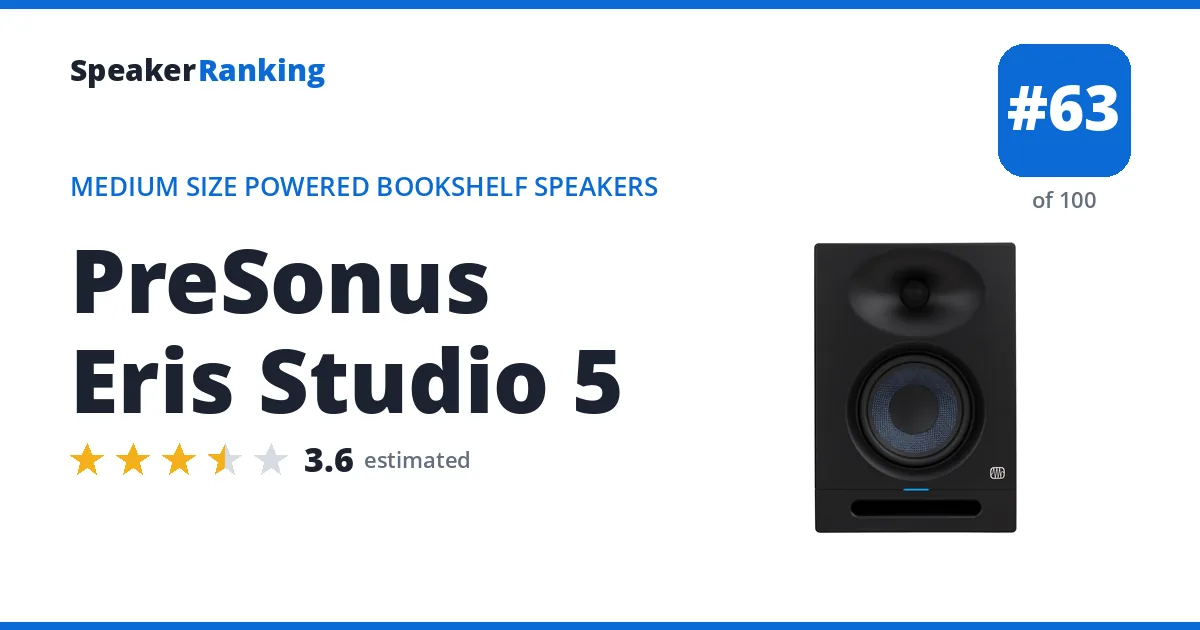
The case for the PreSonus Eris Studio 5: A 5.25” woven composite woofer and 1” silk dome tweeter on a 120° x 60° EBM waveguide for a wide sweet spot. Watch for: No independent measurements yet, so its tonal balance and directivity can’t be compared with ranked speakers.
Buy the PreSonus Eris Studio 5. It is rated higher for sound quality, and the $40 you would save on the PreSonus Eris Studio 4 does not close the gap.
About the ratings: neither speaker has been measured yet, so both ratings are estimated from measured siblings and predecessors (likely ranges: PreSonus Eris Studio 4 3.0 to 3.7; PreSonus Eris Studio 5 3.4 to 3.8). Treat this verdict as provisional.
Still deciding? The full Powered Home rankings cover every ranked option.
Specifications Side By Side
| PreSonus Eris Studio 4 | PreSonus Eris Studio 5 | |
|---|---|---|
| Price | $259.98 per pair | $299.98 per pair |
| Ranked | #74 of 100 in Medium Size Powered Bookshelf Speakers Estimated | #63 of 100 in Medium Size Powered Bookshelf Speakers Estimated |
| Drivers | 4.5” woven composite woofer, 1” silk-dome tweeter | 5.25” woven composite woofer, 1” silk dome tweeter |
| Inputs | Balanced TRS, RCA | TRS, XLR, RCA |
| Amplifier Power | 50W bi-amplified (Class AB) | 80w Per Speaker (Class AB) |
| Frequency Response | 55Hz - 20kHz (manufacturer specified) | 48Hz - 20kHz (Manufacturer specified) |
| Maximum SPL | 100dB peak @ 1m (manufacturer specified) | - |
| XLR Input | No | Yes |
| RCA Input | Yes | Yes |
| TRS Input | Yes | Yes |
| Optical Input | No | No |
| Coaxial Input | No | No |
| USB Input | No | No |
| HDMI Input | No | No |
| AES Input | No | No |
| Aux Input | No | No |
| Bluetooth | No | No |
| EQ | Yes (Acoustic Space, high-pass, mid and high controls) | Yes (Low-cut, Mid and High controls, 3-way acoustic space tuning) |
Related Speaker Comparisons
How PreSonus Eris Studio 5 compares with other leading options:
- Yamaha HS5 vs Midiplus MI5 II
- Yamaha HS5 vs Edifier R1700BT
- Yamaha HS5 vs Neumi BS5P
- JBL 305P MKII vs M-Audio BX4 D3
- Edifier MR4.5 vs Yamaha HS5
Prices on this page were last checked October 7, 2026 at 9:25 PM UTC. Product prices and availability are accurate as of that date/time and are subject to change; the price and availability shown on Amazon at the time of purchase will apply to the purchase of this product.
As an eBay Partner, we may be compensated if you make a purchase.
The Two Speakers In Full
 PreSonus Eris Studio 4: $259.98 per pair Estimated B&H Photo Video eBay
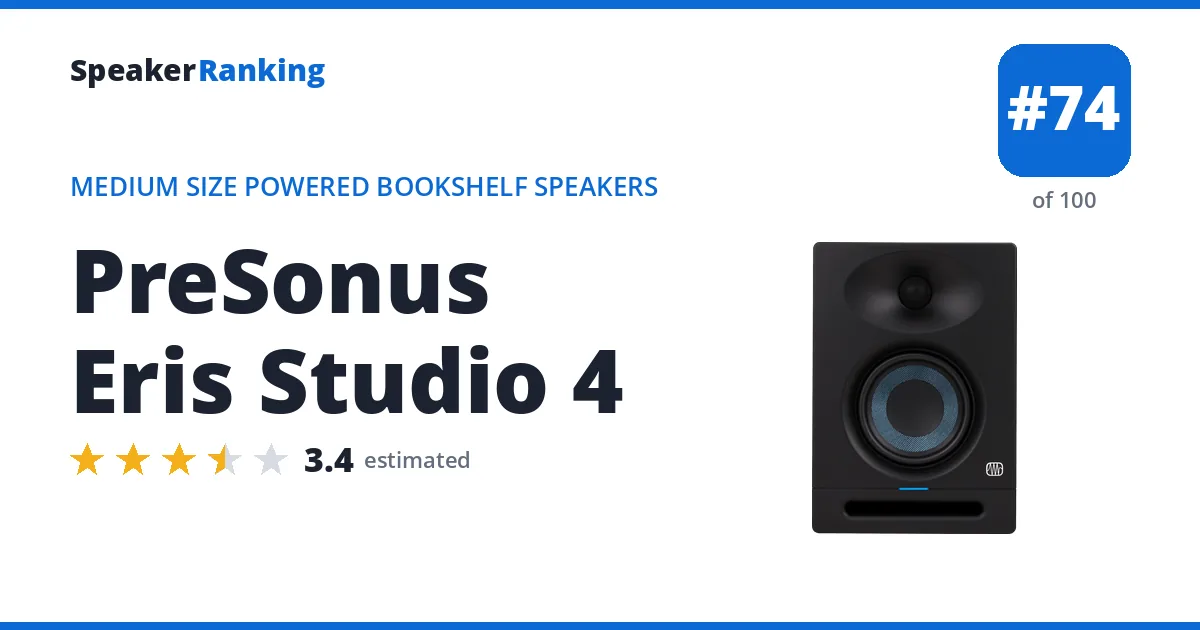
Same family: the PreSonus Eris Studio 5 (larger bookshelf, ranked higher, estimated 3.6/5) and the Presonus Eris Studio 8 (larger bookshelf, rated 3.9/5).
Pros: The smallest Eris Studio monitor, with a 4.5” woven composite woofer and 1” silk-dome tweeter in an elliptical waveguide that spreads sound wide horizontally while limiting reflections off the desk below. It is bi-amplified with 50W and accepts balanced TRS and RCA. Acoustic Space settings for wall or corner placement plus high-pass, midrange and treble controls help it fit a small desk.
Cons: No independent measurements yet, so its tonal balance and directivity can’t be compared directly with measured speakers; the rating is estimated from the larger Eris Studio 5 and the measured Eris Studio 8. Bass stops around 55Hz and output peaks near 100dB, so it suits near-field desk listening more than filling a room.
Full PreSonus Eris Studio 4 review and specifications →
| AES Input | No |
|---|---|
| Amplifier Power | 50W bi-amplified (Class AB) |
| Aux Input | No |
| Bluetooth | No |
| Coaxial Input | No |
| Drivers | 4.5” woven composite woofer, 1” silk-dome tweeter |
| EQ | Yes (Acoustic Space, high-pass, mid and high controls) |
| Frequency Response | 55Hz - 20kHz (manufacturer specified) |
| HDMI Input | No |
| Inputs | Balanced TRS, RCA |
| Maximum SPL | 100dB peak @ 1m (manufacturer specified) |
| Optical Input | No |
| RCA Input | Yes |
| TRS Input | Yes |
| USB Input | No |
| XLR Input | No |
- Links
- Reviews, Comparisons and Sound Samples
- No independent measurement review is linked for this model; it is ranked from hands-on listening and comparison against similarly priced speakers.
 PreSonus Eris Studio 5: $299.98 per pair Estimated Amazon eBay
Older model: the Presonus Eris E5 XT (ranked lower, rated 3.5/5).
Same family: the PreSonus Eris Studio 4 (smaller bookshelf, ranked lower, estimated 3.4/5) and the Presonus Eris Studio 8 (larger bookshelf, rated 3.9/5).
Pros: A 5.25” woven composite woofer and 1” silk dome tweeter on a 120° x 60° EBM waveguide for a wide sweet spot. 80W Class AB bi-amplification rated to 102dB peak, a front-firing port, and balanced XLR and TRS plus unbalanced RCA inputs. PreSonus rates response at 48Hz to 20kHz.
Cons: No independent measurements yet, so its tonal balance and directivity can’t be compared with ranked speakers. Sold individually, so a stereo pair costs twice the listed price.
Full PreSonus Eris Studio 5 review and specifications →
| AES Input | No |
|---|---|
| Amplifier Power | 80w Per Speaker (Class AB) |
| Aux Input | No |
| Bluetooth | No |
| Coaxial Input | No |
| Drivers | 5.25” woven composite woofer, 1” silk dome tweeter |
| EQ | Yes (Low-cut, Mid and High controls, 3-way acoustic space tuning) |
| Frequency Response | 48Hz - 20kHz (Manufacturer specified) |
| HDMI Input | No |
| Inputs | TRS, XLR, RCA |
| Optical Input | No |
| RCA Input | Yes |
| TRS Input | Yes |
| USB Input | No |
| XLR Input | Yes |
- Links
- Reviews, Comparisons and Sound Samples
- No independent measurement review is linked for this model; it is ranked from hands-on listening and comparison against similarly priced speakers.