Short answer: the Pioneer DJ VM-50 is the proven choice, measured and ranked among powered bookshelf speakers, while the newer PreSonus Eris Studio 5 has no independent measurements yet and can only be compared on specs.
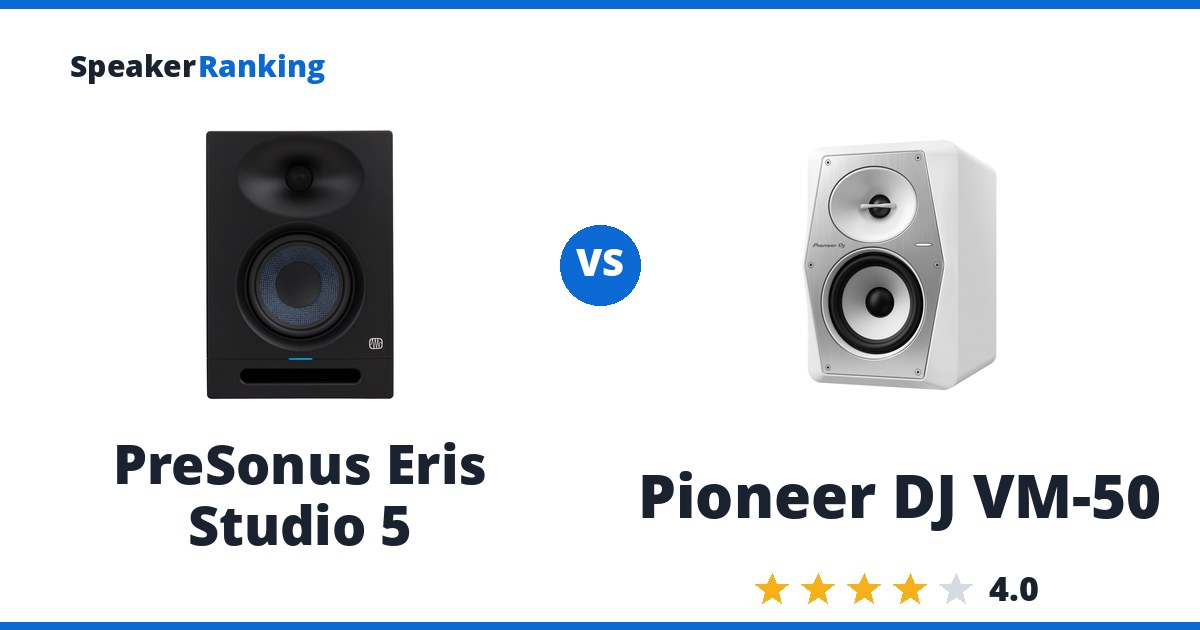
The case for the PreSonus Eris Studio 5: A 5.25” woven composite woofer and 1” silk dome tweeter on a 120° x 60° EBM waveguide for a wide sweet spot.
On the Pioneer DJ VM-50 side: Erin’s Klippel measurements give scores of 4.64 standalone and 7.00 with an ideal subwoofer, with a -3dB point around 60Hz.
On paper: The Pioneer DJ VM-50 is rated down to 40Hz against 48Hz, though makers quote these at different tolerances.
Price: the PreSonus Eris Studio 5 lists at $299.98 and the Pioneer DJ VM-50 at $338.
Buy the Pioneer DJ VM-50 if you want a speaker whose sound quality has been measured and ranked. It also has deeper rated bass.
Buy the PreSonus Eris Studio 5 if you prefer its design or features, and you can wait for measurements to confirm how it sounds.
Still deciding? The full Powered Home rankings cover every ranked option.
Specifications Side By Side
| PreSonus Eris Studio 5 | Pioneer DJ VM-50 | |
|---|---|---|
| Price | $299.98 per pair | $338 per pair |
| Ranked | - | #24 of 67 in Medium Size Powered Bookshelf Speakers |
| Drivers | 5.25” woven composite woofer, 1” silk dome tweeter | 1” tweeter in horn; 5.25” aramid-fiber woofer |
| Amplifier Power | 80w Per Speaker (Class AB) | 30W LF + 30W HF; Class D |
| Frequency Response | 48Hz - 20kHz (Manufacturer specified) | 40Hz - 36kHz (Manufacturer specified) |
| Inputs | TRS, XLR, RCA | XLR/TRS combo and RCA |
| RCA Input | Yes | Yes |
| XLR Input | Yes | Yes |
| TRS Input | Yes | Yes |
| Optical Input | No | No |
| Coaxial Input | No | No |
| USB Input | No | No |
| HDMI Input | No | No |
| AES Input | No | No |
| Aux Input | No | No |
| Bluetooth | No | No |
| EQ | Yes (Low-cut, Mid and High controls, 3-way acoustic space tuning) | - |
| Bass Extension (-3dB) | - | 61Hz (measured, Erin’s Audio Corner) |
| Bass Extension (-10dB) | - | 47.3Hz (measured, Erin’s Audio Corner) |
| DSP | - | Four LF and four HF EQ settings |
| Spinorama Preference Score | - | 4.64 |
| Spinorama Preference Score with Perfect Sub | - | 7.00 |
| Dimensions | - | 7.8” x 11.8” x 10.1” (198 x 300 x 256 mm) (W x H x D) |
| Weight | - | 12.1 lbs (5.5 kg) |
Prices on this page were last checked September 29, 2026 at 3:43 PM UTC. Product prices and availability are accurate as of that date/time and are subject to change; the price and availability shown on Amazon at the time of purchase will apply to the purchase of this product.
As an eBay Partner, we may be compensated if you make a purchase.
The Two Speakers In Full
 PreSonus Eris Studio 5: $299.98 per pair Amazon eBay
Older model: the Presonus Eris E5 XT (rated 3.5/5).
Pros: A 5.25” woven composite woofer and 1” silk dome tweeter on a 120° x 60° EBM waveguide for a wide sweet spot. 80W Class AB bi-amplification rated to 102dB peak, a front-firing port, and balanced XLR and TRS plus unbalanced RCA inputs. PreSonus rates response at 48Hz to 20kHz.
Cons: No independent measurements yet, so its tonal balance and directivity can’t be compared with ranked speakers. Sold individually, so a stereo pair costs twice the listed price.
Full PreSonus Eris Studio 5 review and specifications →
| AES Input | No |
|---|---|
| Amplifier Power | 80w Per Speaker (Class AB) |
| Aux Input | No |
| Bluetooth | No |
| Coaxial Input | No |
| Drivers | 5.25” woven composite woofer, 1” silk dome tweeter |
| EQ | Yes (Low-cut, Mid and High controls, 3-way acoustic space tuning) |
| Frequency Response | 48Hz - 20kHz (Manufacturer specified) |
| HDMI Input | No |
| Inputs | TRS, XLR, RCA |
| Optical Input | No |
| RCA Input | Yes |
| TRS Input | Yes |
| USB Input | No |
| XLR Input | Yes |
- Links
- Reviews, Comparisons and Sound Samples
- These figures are manufacturer-specified rather than independently measured.
- Head-to-Head Comparisons
 Pioneer DJ VM-50: $338 per pair Amazon eBay
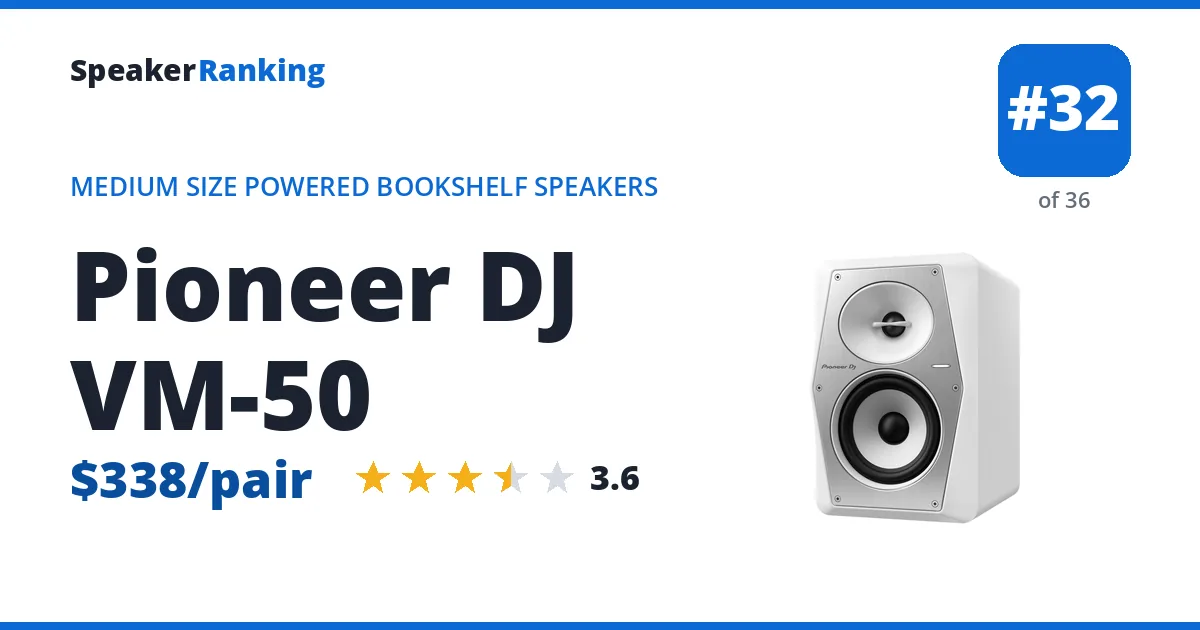
Pros: Erin’s Klippel measurements give scores of 4.64 standalone and 7.00 with an ideal subwoofer, with a -3dB point around 60Hz. The existing review reports low distortion and little sustained compression, supporting practical clean playback beyond what the tonal score alone captures. Separate bass and treble voicings and balanced inputs make adjustment straightforward. Measured bass extension of 61Hz (-3dB).
Cons: The default response spans 3.5dB from 300Hz to 5kHz, and the upper-midrange/treble balance varies with angle. EQ-switch selection and aiming therefore matter. Bass below about 50Hz is reduced, so it is not a full-range substitute for a monitor-and-subwoofer system. Its output evidence supports nearfield use, not unrestricted home-theater levels.
Full Pioneer DJ VM-50 review and specifications →
| AES Input | No |
|---|---|
| Amplifier Power | 30W LF + 30W HF; Class D |
| Aux Input | No |
| Bass Extension (-10dB) | 47.3Hz (measured, Erin’s Audio Corner) |
| Bass Extension (-3dB) | 61Hz (measured, Erin’s Audio Corner) |
| Bluetooth | No |
| Coaxial Input | No |
| DSP | Four LF and four HF EQ settings |
| Dimensions | 7.8” x 11.8” x 10.1” (198 x 300 x 256 mm) (W x H x D) |
| Drivers | 1” tweeter in horn; 5.25” aramid-fiber woofer |
| Frequency Response | 40Hz - 36kHz (Manufacturer specified) |
| HDMI Input | No |
| Inputs | XLR/TRS combo and RCA |
| Optical Input | No |
| RCA Input | Yes |
| Spinorama Preference Score | 4.64 |
| Spinorama Preference Score with Perfect Sub | 7.00 |
| TRS Input | Yes |
| USB Input | No |
| Weight | 12.1 lbs (5.5 kg) |
| XLR Input | Yes |
- Links
- Reviews, Comparisons and Sound Samples
- Head-to-Head Comparisons
- Pioneer DJ VM-50 vs Airpulse A100
- Pioneer DJ VM-50 vs KEF LSX II LT
- Pioneer DJ VM-50 vs Audioengine A5+ Classic
- Pioneer DJ VM-50 vs IK Multimedia iLoud MTM
- Pioneer DJ VM-50 vs Kali Audio IN-5
- Pioneer DJ VM-50 vs Adam Audio T5V
- Pioneer DJ VM-50 vs Kali Audio SM-5
- Pioneer DJ VM-50 vs Kanto YU6
- See all 53 comparisons