Short answer: the Genelec 8331A if sound quality matters most, the Pioneer DJ VM-50 if price matters most. The Genelec 8331A ranks #1 of 100 powered bookshelf speakers, rated 4.8/5, at $5,750. The Pioneer DJ VM-50 ranks #33, rated 4.0/5, at $418, $5,332 cheaper.
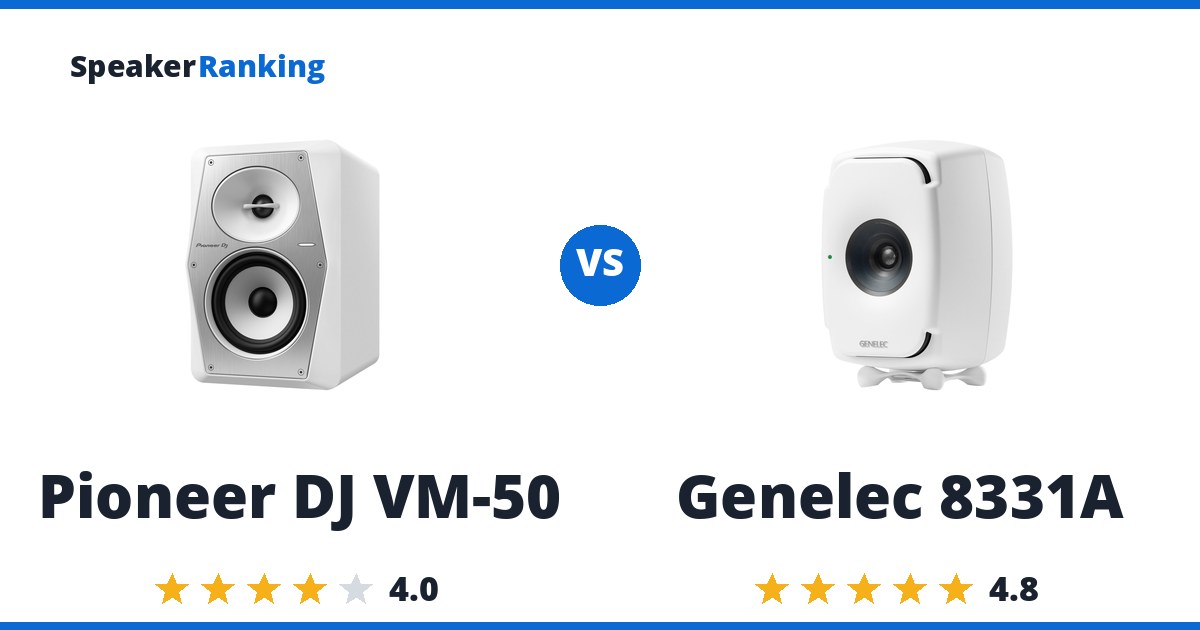
The case for the Pioneer DJ VM-50: Erin’s Klippel measurements give scores of 4.64 standalone and 7.00 with an ideal subwoofer, with a -3dB point around 60Hz. The catch: The default response spans 3.5dB from 300Hz to 5kHz, and the upper-midrange/treble balance varies with angle.
The Genelec 8331A is the more accurate, deeper-bass option. Erin’s Klippel measurements support its reference-monitor credentials: a 1.4dB response span from 300Hz to 5kHz, low listening-window and predicted-room irregularity, and preference scores of 6.57 standalone and 8.51 with an ideal subwoofer. Its measured preference score, a predictor of how neutral it sounds, is 6.57 against 4.64 for the Pioneer DJ VM-50. Its bass reaches about 49Hz before falling 3dB, against 61Hz for the Pioneer DJ VM-50. The catch: Expensive, with studio-oriented XLR connectivity rather than consumer streaming.
Buy the Pioneer DJ VM-50 if the price is the priority over sound quality, or the Genelec 8331A if sound quality is the priority over the price.
Still deciding? The full Powered Home rankings cover every ranked option.
Specifications Side By Side
| Pioneer DJ VM-50 | Genelec 8331A | |
|---|---|---|
| Price | $418 per pair | $5,750 per pair |
| Ranked | #33 of 100 in Medium Size Powered Bookshelf Speakers | #1 of 100 in Medium Size Powered Bookshelf Speakers |
| Bass Extension (-3dB) | 61Hz (measured, Erin’s Audio Corner) | 49Hz (measured, Erin’s Audio Corner) |
| Bass Extension (-10dB) | 47.3Hz (measured, Erin’s Audio Corner) | 39Hz (measured, Erin’s Audio Corner) |
| Drivers | 1” tweeter in horn; 5.25” aramid-fiber woofer | Dual 130x65mm woofers; 90mm coaxial mid; 19mm tweeter |
| Amplifier Power | 30W LF + 30W HF; Class D | 72W LF + 36W MF + 36W HF |
| Inputs | XLR/TRS combo and RCA | XLR, AES/EBU |
| DSP | Four LF and four HF EQ settings | - |
| Spinorama Preference Score | 4.64 | 6.57 |
| Spinorama Preference Score with Perfect Sub | 7.00 | 8.51 |
| XLR Input | Yes | Yes |
| RCA Input | Yes | No |
| TRS Input | Yes | No |
| Optical Input | No | No |
| Coaxial Input | No | No |
| USB Input | No | No |
| HDMI Input | No | No |
| AES Input | No | Yes |
| Aux Input | No | No |
| Bluetooth | No | No |
| Dimensions | 7.8” x 11.8” x 10.1” (198 x 300 x 256 mm) (W x H x D) | 12”H x 7.4”W x 8.3”D (305 x 189 x 212 mm) |
| Frequency Response | 40Hz - 36kHz (Manufacturer specified) | 45Hz - 37kHz (-6dB) (Manufacturer specified) |
| Weight | 12.1 lbs (5.5 kg) | 14.8 lbs (6.7kg) each |
| Maximum SPL | - | 100dB at 3m before protection (measured, Erin’s Audio Corner) |
Related Speaker Comparisons
How Genelec 8331A compares with other leading options:
- Genelec 8331A vs Neumann KH120 MKII
- Genelec 8331A vs Genelec 8030C
- Genelec 8331A vs Neumann KH80 DSP
- Dynaudio LYD 5 vs Genelec 8331A
- Genelec 8331A vs Genelec 8330A
Prices on this page were last checked October 9, 2026 at 8:01 AM UTC. Product prices and availability are accurate as of that date/time and are subject to change; the price and availability shown on Amazon at the time of purchase will apply to the purchase of this product.
As an eBay Partner, we may be compensated if you make a purchase.
The Two Speakers In Full
 Pioneer DJ VM-50: $418 per pair Amazon B&H Photo Video eBay
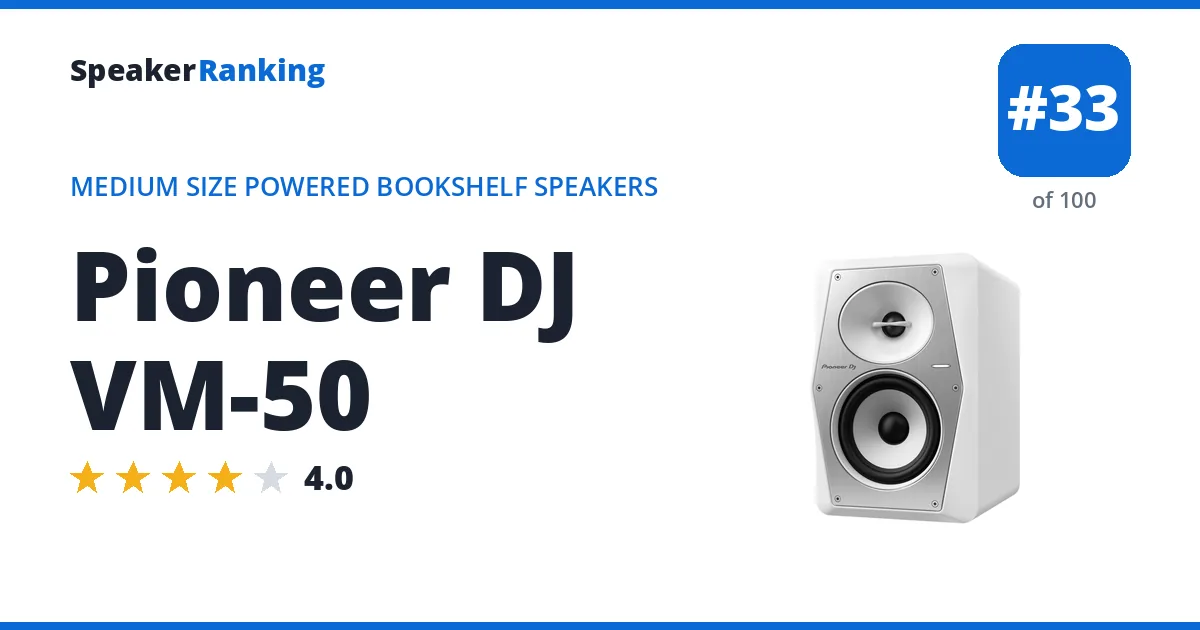
Same family: the Pioneer DJ VM-70 (larger bookshelf, estimated 4/5) and the Pioneer DJ VM-80 (larger bookshelf, estimated 4/5).
Pros: Erin’s Klippel measurements give scores of 4.64 standalone and 7.00 with an ideal subwoofer, with a -3dB point around 60Hz. The existing review reports low distortion and little sustained compression, supporting practical clean playback beyond what the tonal score alone captures. Separate bass and treble voicings and balanced inputs make adjustment straightforward. Measured bass extension of 61Hz (-3dB).
Cons: The default response spans 3.5dB from 300Hz to 5kHz, and the upper-midrange/treble balance varies with angle. EQ-switch selection and aiming therefore matter. Bass below about 50Hz is reduced, so it is not a full-range substitute for a monitor-and-subwoofer system. Its output evidence supports nearfield use, not unrestricted home-theater levels.
Full Pioneer DJ VM-50 review and specifications →
| AES Input | No |
|---|---|
| Amplifier Power | 30W LF + 30W HF; Class D |
| Aux Input | No |
| Bass Extension (-10dB) | 47.3Hz (measured, Erin’s Audio Corner) |
| Bass Extension (-3dB) | 61Hz (measured, Erin’s Audio Corner) |
| Bluetooth | No |
| Coaxial Input | No |
| DSP | Four LF and four HF EQ settings |
| Dimensions | 7.8” x 11.8” x 10.1” (198 x 300 x 256 mm) (W x H x D) |
| Drivers | 1” tweeter in horn; 5.25” aramid-fiber woofer |
| Frequency Response | 40Hz - 36kHz (Manufacturer specified) |
| HDMI Input | No |
| Inputs | XLR/TRS combo and RCA |
| Optical Input | No |
| RCA Input | Yes |
| Spinorama Preference Score | 4.64 |
| Spinorama Preference Score with Perfect Sub | 7.00 |
| TRS Input | Yes |
| USB Input | No |
| Weight | 12.1 lbs (5.5 kg) |
| XLR Input | Yes |
- Links
- Reviews, Comparisons and Sound Samples
- Head-to-Head Comparisons
- Pioneer DJ VM-50 vs Airpulse A100
- Pioneer DJ VM-50 vs KEF LSX II LT
- Pioneer DJ VM-50 vs Audioengine A5+ Classic
- Pioneer DJ VM-50 vs IK Multimedia iLoud MTM
- Pioneer DJ VM-50 vs Adam Audio T5V
- Pioneer DJ VM-50 vs Kali Audio IN-5
- Pioneer DJ VM-50 vs Kanto YU6
- Pioneer DJ VM-50 vs Kali Audio SM-5
- See all 53 comparisons
 Genelec 8331A: $5,750 per pair B&H Photo Video eBay
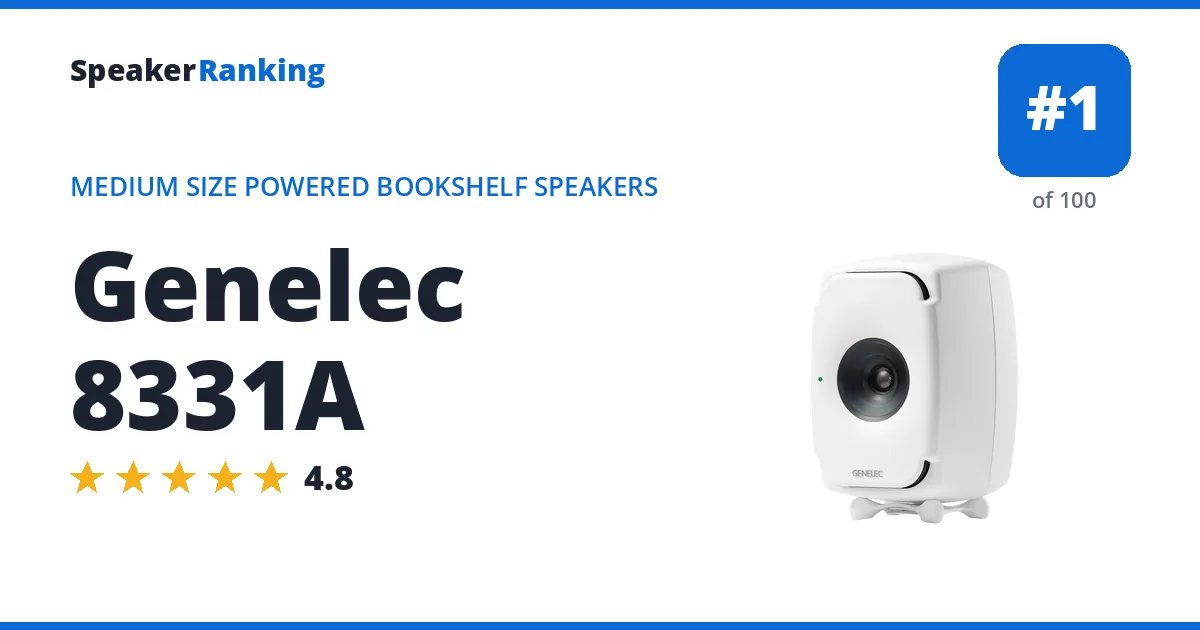
Same family: the Genelec 8341A (larger bookshelf, rated 4.8/5), the Genelec 8351B (larger bookshelf, rated 4.8/5), the Genelec 8361A (larger bookshelf, rated 4.8/5) and the Genelec 8381A (floorstanding, estimated 4.9/5).
Pros: Erin’s Klippel measurements support its reference-monitor credentials: a 1.4dB response span from 300Hz to 5kHz, low listening-window and predicted-room irregularity, and preference scores of 6.57 standalone and 8.51 with an ideal subwoofer. The coaxial mid/tweeter and concealed woofers maintain coherent radiation as listening position changes. Bass reaches -3dB around 48Hz, and GLM adds level, delay and room-response calibration. Measured bass extension of 49Hz (-3dB).
Cons: Expensive, with studio-oriented XLR connectivity rather than consumer streaming. The compact woofers still limit deep-bass output, and the review reports protection muting when pushed beyond its operating range. GLM calibration hardware is an additional purchase. Its excellent tonal score does not remove the need for a subwoofer or larger monitor at demanding levels.
Full Genelec 8331A review and specifications →
| AES Input | Yes |
|---|---|
| Amplifier Power | 72W LF + 36W MF + 36W HF |
| Aux Input | No |
| Bass Extension (-10dB) | 39Hz (measured, Erin’s Audio Corner) |
| Bass Extension (-3dB) | 49Hz (measured, Erin’s Audio Corner) |
| Bluetooth | No |
| Coaxial Input | No |
| Dimensions | 12”H x 7.4”W x 8.3”D (305 x 189 x 212 mm) |
| Drivers | Dual 130x65mm woofers; 90mm coaxial mid; 19mm tweeter |
| Frequency Response | 45Hz - 37kHz (-6dB) (Manufacturer specified) |
| HDMI Input | No |
| Inputs | XLR, AES/EBU |
| Maximum SPL | 100dB at 3m before protection (measured, Erin’s Audio Corner) |
| Optical Input | No |
| RCA Input | No |
| Spinorama Preference Score | 6.57 |
| Spinorama Preference Score with Perfect Sub | 8.51 |
| TRS Input | No |
| USB Input | No |
| Weight | 14.8 lbs (6.7kg) each |
| XLR Input | Yes |
- Links
- Reviews, Comparisons and Sound Samples
- Head-to-Head Comparisons