Short answer: pick the Kali LP-UNF if you want sound quality that has been measured and ranked; the PreSonus Eris Studio 5 is unmeasured so far, so its case rests on features and price.
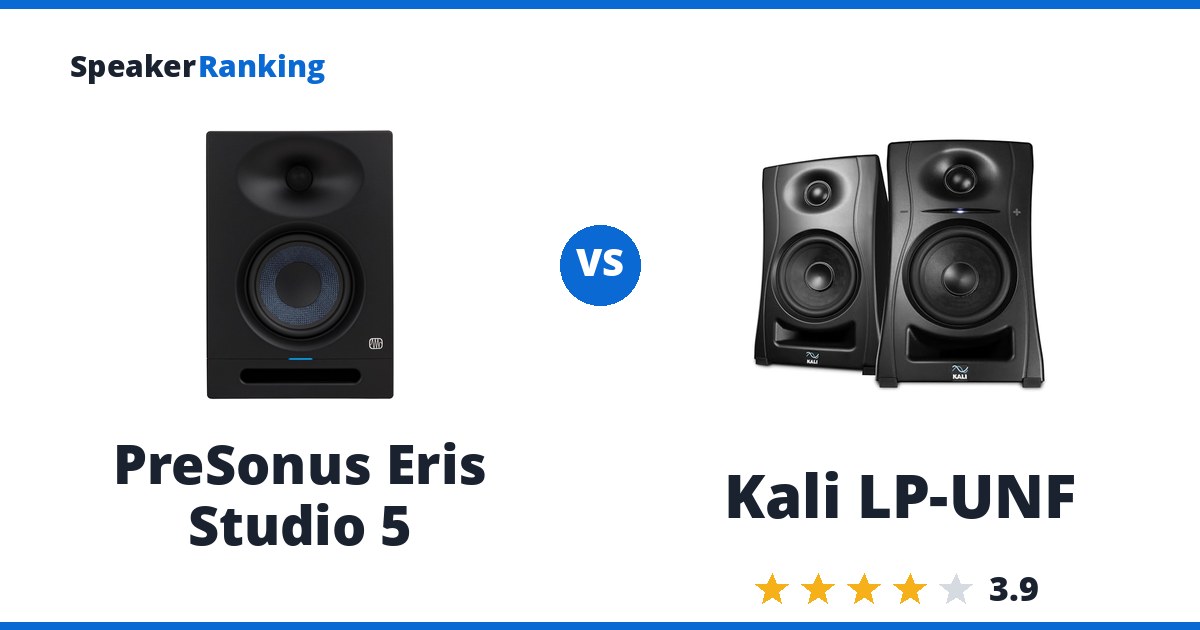
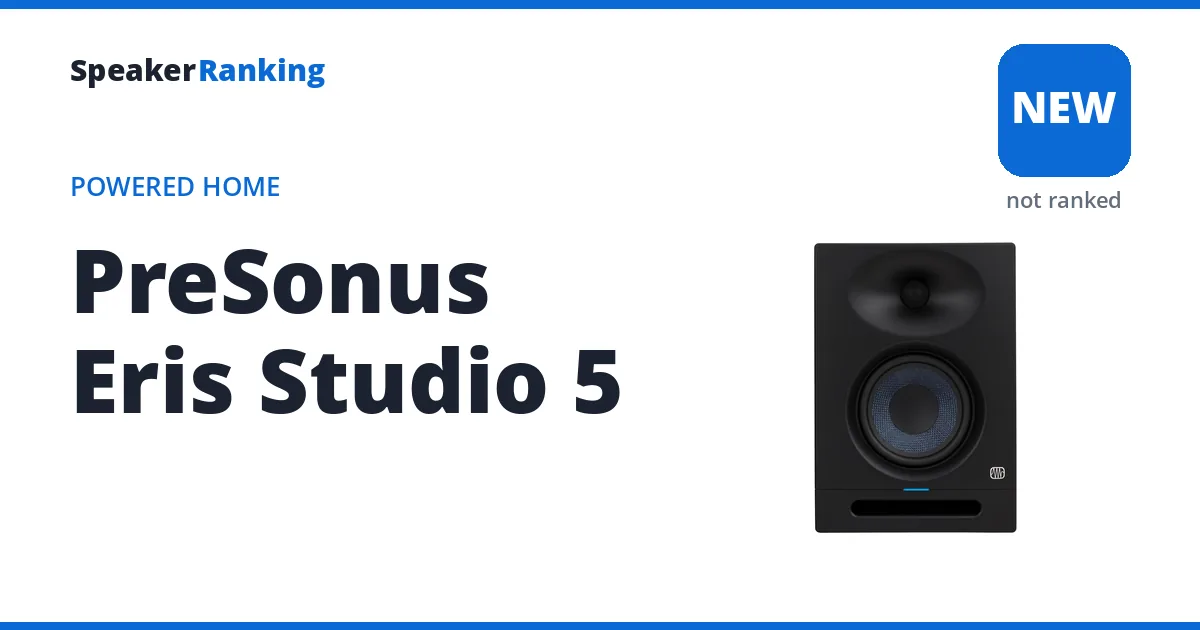
What the PreSonus Eris Studio 5 offers: A 5.25” woven composite woofer and 1” silk dome tweeter on a 120° x 60° EBM waveguide for a wide sweet spot.
What the Kali LP-UNF brings: A practical compact desktop system with USB-C, analog inputs and Bluetooth, plus extensive placement switches.
On paper: The Kali LP-UNF is rated down to 39Hz against 48Hz, though makers quote these at different tolerances.
Price: the PreSonus Eris Studio 5 lists at $299.98 and the Kali LP-UNF at $349.
Buy the Kali LP-UNF if you want a speaker whose sound quality has been measured and ranked. It also has deeper rated bass and Bluetooth.
Buy the PreSonus Eris Studio 5 if you want XLR inputs, and you can wait for measurements to confirm how it sounds.
Want more options? Browse the full Powered Home rankings.
Specifications Side By Side
| PreSonus Eris Studio 5 | Kali LP-UNF | |
|---|---|---|
| Price | $299.98 per pair | $349.00 per pair |
| Ranked | - | #33 of 67 in Medium Size Powered Bookshelf Speakers |
| Drivers | 5.25” woven composite woofer, 1” silk dome tweeter | 4.5” woofer, 1” Textile Dome tweeter |
| Amplifier Power | 80w Per Speaker (Class AB) | 160W total (Class D, 2-channel bi-amped) |
| Frequency Response | 48Hz - 20kHz (Manufacturer specified) | 39Hz - 25kHz (-10dB) (Manufacturer specified) |
| Inputs | TRS, XLR, RCA | Bluetooth, USB-C (digital), RCA, TRS |
| RCA Input | Yes | Yes |
| XLR Input | Yes | No |
| TRS Input | Yes | Yes |
| Optical Input | No | No |
| Coaxial Input | No | No |
| USB Input | No | Yes |
| HDMI Input | No | No |
| AES Input | No | No |
| Aux Input | No | No |
| Bluetooth | No | Yes |
| EQ | Yes (Low-cut, Mid and High controls, 3-way acoustic space tuning) | No |
| Bass Extension (-10dB) | - | 39Hz (measured, Erin’s Audio Corner) |
| Bass Extension (-3dB) | - | 54Hz (measured, Erin’s Audio Corner) |
| App | - | No |
| Weight | - | 17.2 lbs (7.8 kg) |
| Sensitivity | - | 88.1dB (measured at 0.3V/1m, Erin’s Audio Corner) |
| Spinorama Preference Score | - | 4.60 |
| Spinorama Preference Score with Perfect Sub | - | 6.67 |
| Dimensions | - | 10”H x 6.5”W x 7.4”D (254 x 165 x 188 mm) |
Prices on this page were last checked September 29, 2026 at 3:43 PM UTC. Product prices and availability are accurate as of that date/time and are subject to change; the price and availability shown on Amazon at the time of purchase will apply to the purchase of this product.
As an eBay Partner, we may be compensated if you make a purchase.
The Two Speakers In Full
 PreSonus Eris Studio 5: $299.98 per pair Amazon eBay
Older model: the Presonus Eris E5 XT (rated 3.5/5).
Pros: A 5.25” woven composite woofer and 1” silk dome tweeter on a 120° x 60° EBM waveguide for a wide sweet spot. 80W Class AB bi-amplification rated to 102dB peak, a front-firing port, and balanced XLR and TRS plus unbalanced RCA inputs. PreSonus rates response at 48Hz to 20kHz.
Cons: No independent measurements yet, so its tonal balance and directivity can’t be compared with ranked speakers. Sold individually, so a stereo pair costs twice the listed price.
Full PreSonus Eris Studio 5 review and specifications →
| AES Input | No |
|---|---|
| Amplifier Power | 80w Per Speaker (Class AB) |
| Aux Input | No |
| Bluetooth | No |
| Coaxial Input | No |
| Drivers | 5.25” woven composite woofer, 1” silk dome tweeter |
| EQ | Yes (Low-cut, Mid and High controls, 3-way acoustic space tuning) |
| Frequency Response | 48Hz - 20kHz (Manufacturer specified) |
| HDMI Input | No |
| Inputs | TRS, XLR, RCA |
| Optical Input | No |
| RCA Input | Yes |
| TRS Input | Yes |
| USB Input | No |
| XLR Input | Yes |
- Links
- Reviews, Comparisons and Sound Samples
- These figures are manufacturer-specified rather than independently measured.
- Head-to-Head Comparisons
 Kali LP-UNF: $349.00 per pair Amazon eBay

Pros: A practical compact desktop system with USB-C, analog inputs and Bluetooth, plus extensive placement switches. Erin’s Klippel data gives -3dB bass around 54Hz and scores of 4.60 standalone and 6.67 with an ideal subwoofer. The low crossover and waveguide provide useful freedom of listening height for a two-way design, and moderate-level distortion is well controlled in the review. The 1.9kHz crossover gives vertical coverage of about ±30 to 40°, well beyond the typical ±10 to 15° of a two-way. Measured bass extension of 54Hz (-3dB), with a measured sensitivity of 88.1dB.
Cons: The 2.9dB midrange span masks local response ripples; listening-window narrow-band deviation of 0.467 is behind the best monitors. The review finds limiting around 91dB/1m per speaker. No dedicated subwoofer output means integration requires suitable external routing or bass management. Its strength is affordable close listening, not top-tier tonal accuracy or high-output room playback.
Full Kali LP-UNF review and specifications →
| AES Input | No |
|---|---|
| Amplifier Power | 160W total (Class D, 2-channel bi-amped) |
| App | No |
| Aux Input | No |
| Bass Extension (-10dB) | 39Hz (measured, Erin’s Audio Corner) |
| Bass Extension (-3dB) | 54Hz (measured, Erin’s Audio Corner) |
| Bluetooth | Yes |
| Coaxial Input | No |
| Dimensions | 10”H x 6.5”W x 7.4”D (254 x 165 x 188 mm) |
| Drivers | 4.5” woofer, 1” Textile Dome tweeter |
| EQ | No |
| Frequency Response | 39Hz - 25kHz (-10dB) (Manufacturer specified) |
| HDMI Input | No |
| Inputs | Bluetooth, USB-C (digital), RCA, TRS |
| Optical Input | No |
| RCA Input | Yes |
| Sensitivity | 88.1dB (measured at 0.3V/1m, Erin’s Audio Corner) |
| Spinorama Preference Score | 4.60 |
| Spinorama Preference Score with Perfect Sub | 6.67 |
| TRS Input | Yes |
| USB Input | Yes |
| Weight | 17.2 lbs (7.8 kg) |
| XLR Input | No |
- Links
- Reviews, Comparisons and Sound Samples
- Erin’s Audio Corner Review Measurements More from Erin’s Audio Corner →
- Erin’s Audio Corner: The Perfect Desktop Speaker? Kali LP-UNF.
- Erin’s Audio Corner: The Best Budget Desktop Speakers, Tested & Rated
- Erin’s Audio Corner: My Absolute Favorite Products of 2024 Revealed
- Erin’s Audio Corner: 10 Great (and Terrible) Speakers Under $300!
- Erin’s Audio Corner Measurements (spinorama.org)
- Jasper Tech: Best Desktop Computer Speakers for Every Budget – 2026 More from Jasper Tech →
- Jasper Tech: Are the iLoud Micro Monitor Pro the Best Studio Monitor Speakers for your Home Studio?
- Head-to-Head Comparisons