Short answer: the Parts Express Copperhead Desktop Kit, if you are buying new, though neither ranks well in its class. The JBL Stage A120 measures as well as it (#67 vs #66 of 88 bookshelf speakers, 2.5/5 vs 2.5/5) but is discontinued, so only consider it used; the Parts Express Copperhead Desktop Kit is still sold new at $119.98. Both are rated below 3.0/5 among the 88 bookshelf speakers, so if sound quality matters, consider the Ascend Acoustics HTM-200SE2 instead, ranked #7 at $368.
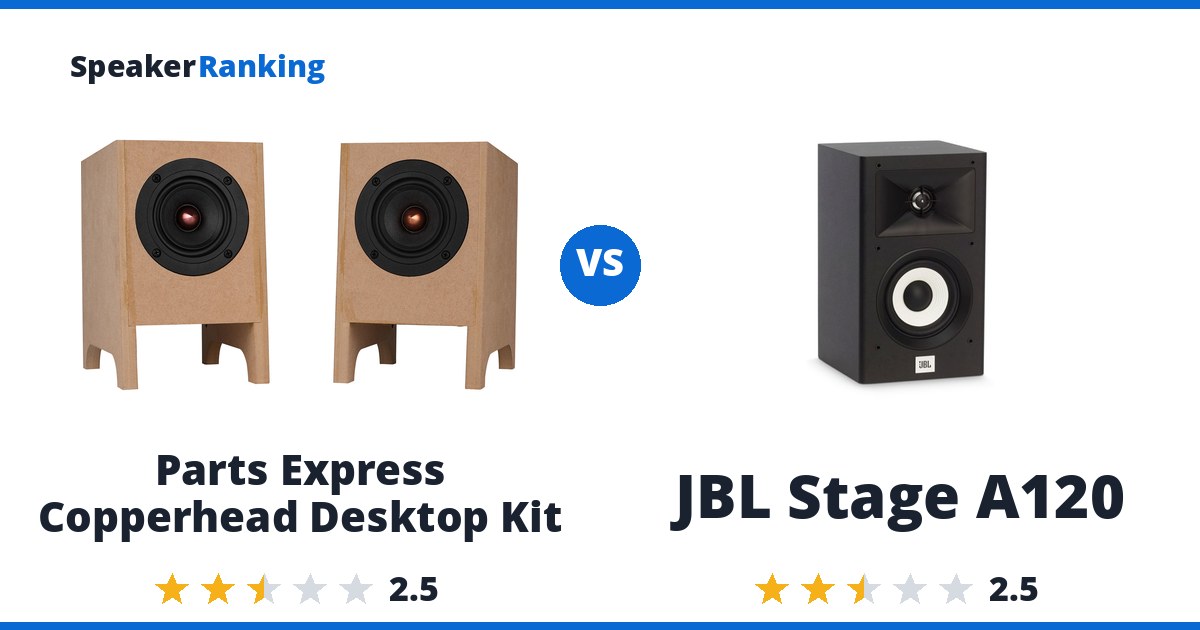
The case for the Parts Express Copperhead Desktop Kit: Inexpensive, beginner-friendly CNC flat-pack kit with a compact 8 x 5-inch desktop footprint and only one 3.5-inch full-range driver per channel. The tradeoff: Despite the ‘full-range’ label, output rolls off around 120-150Hz and a subwoofer with an unusually high 100-200Hz crossover is effectively mandatory.
Why pick the JBL Stage A120: Comes with a port bung, letting you experiment between ported and sealed configurations: the reviewer found the sound improved somewhat with the port sealed. Watch for: A pronounced “Batman”-shaped frequency response: boosted bass, a scooped midrange, and elevated treble (about 3-4dB above the midrange), driven partly by confirmed cabinet panel resonance around 800Hz-1.7kHz.
Buy the Parts Express Copperhead Desktop Kit, since the JBL Stage A120 is discontinued and only worth hunting down used.
Want more options? Browse the full Passive Home rankings.
Specifications Side By Side
| Parts Express Copperhead Desktop Kit | JBL Stage A120 | |
|---|---|---|
| Price | $119.98 per pair | $299 per pair Discontinued |
| Ranked | #66 of 88 in Medium Size Bookshelf Speakers | #67 of 88 in Medium Size Bookshelf Speakers |
| Frequency Response | 120Hz-20kHz +/-3dB (manufacturer specified) | - |
| Bass Extension (-3dB) | 98.1Hz (measured, Erin’s Audio Corner) | 71Hz (measured, Erin’s Audio Corner) |
| Bass Extension (-10dB) | 69.3Hz (measured, Erin’s Audio Corner) | 53Hz (measured, Erin’s Audio Corner) |
| Dimensions | 8”H x 5”W x 6.5”D (203 x 127 x 165 mm) | 11.3”H x 6.8”W x 7.4”D (285.8 x 171.5 x 188.9 mm) |
| Impedance | 8 ohms (manufacturer specified) | 6 ohms |
| Sensitivity | 81dB @ 1W/1m (measured by Erin’s Audio Corner and manufacturer specified) | 83dB (measured, Erin’s Audio Corner) |
| Drivers | 3.5” Dayton Audio PS95-8 full-range driver | 0.75” tweeter + 5” woofer |
| Power Handling | 10W RMS / 20W maximum; 25W RMS with 50Hz high-pass | - |
| Woofer Cabinet | ported, bottom | ported |
| Spinorama Preference Score | 2.11 (spinorama.org) | 3.50 |
| Spinorama Preference Score with Perfect Sub | 5.35 (spinorama.org) | 6.24 |
| DIY Kit | Yes | No |
| Weight | - | 10.6 lbs (4.8 kg) |
Related Speaker Comparisons
More top alternatives to Parts Express Copperhead Desktop Kit:
- KEF LS50 Meta vs Parts Express Copperhead Desktop Kit
- Arendal 1961 Monitor vs Parts Express Copperhead Desktop Kit
- Neumi BS5 vs Parts Express Copperhead Desktop Kit
- KEF Q150 vs Parts Express Copperhead Desktop Kit
- JBL Studio 530 vs Parts Express Copperhead Desktop Kit
Prices on this page were last checked September 29, 2026 at 3:43 PM UTC. Product prices and availability are accurate as of that date/time and are subject to change; the price and availability shown on Amazon at the time of purchase will apply to the purchase of this product.
As an eBay Partner, we may be compensated if you make a purchase.
The Two Speakers In Full
 Parts Express Copperhead Desktop Kit: $119.98 per pair Parts Express eBay
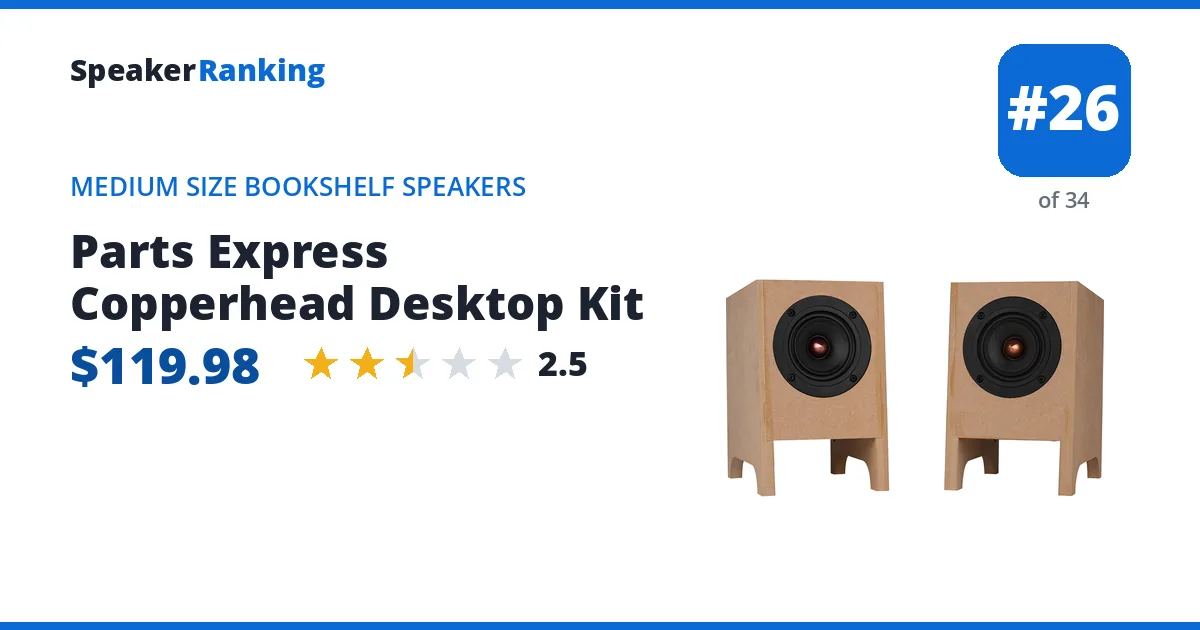
Pros: Inexpensive, beginner-friendly CNC flat-pack kit with a compact 8 x 5-inch desktop footprint and only one 3.5-inch full-range driver per channel. The point-source layout avoids a conventional woofer/tweeter crossover and, when listened to around 20 degrees above the driver as intended, can produce precise near-field imaging. Erin measured roughly 81dB sensitivity, consistent with Parts Express’s specification. The included baffle-step network improves lower-midrange balance, while the optional series inductor reduces the driver’s rising top end; Erin recommends retaining it. Several remaining narrow peaks can be corrected with desktop software EQ. Bottom porting conserves desk space, and unfinished MDF invites custom finishing. Measured bass extension of 98.1Hz (-3dB), with a measured sensitivity of 81dB.
Cons: Despite the ‘full-range’ label, output rolls off around 120-150Hz and a subwoofer with an unusually high 100-200Hz crossover is effectively mandatory. Native response has resonances near roughly 2.1kHz and 8kHz plus a broad 14-20kHz rise of 5-8dB, so it is not smooth without the supplied network and additional EQ. Distortion already exceeds 3% in places at 86dB/1m and becomes extreme at 96dB. Erin’s multitone test approached -10dB distortion (roughly 30%) full-range at the highest level, accompanied by 3-4dB compression; even a 200Hz high-pass leaves roughly 3-5% distortion and 2-3dB compression. The angled cabinet demands a specific near-field ear height, and its very low sensitivity plus 10W RMS power rating leave almost no clean-output headroom for room listening.
Full Parts Express Copperhead Desktop Kit review and specifications →
| Bass Extension (-10dB) | 69.3Hz (measured, Erin’s Audio Corner) |
|---|---|
| Bass Extension (-3dB) | 98.1Hz (measured, Erin’s Audio Corner) |
| DIY Kit | Yes |
| Dimensions | 8”H x 5”W x 6.5”D (203 x 127 x 165 mm) |
| Drivers | 3.5” Dayton Audio PS95-8 full-range driver |
| Frequency Response | 120Hz-20kHz +/-3dB (manufacturer specified) |
| Impedance | 8 ohms (manufacturer specified) |
| Power Handling | 10W RMS / 20W maximum; 25W RMS with 50Hz high-pass |
| Sensitivity | 81dB @ 1W/1m (measured by Erin’s Audio Corner and manufacturer specified) |
| Spinorama Preference Score | 2.11 (spinorama.org) |
| Spinorama Preference Score with Perfect Sub | 5.35 (spinorama.org) |
| Woofer Cabinet | ported, bottom |
- Links
- Reviews, Comparisons and Sound Samples
- Head-to-Head Comparisons
- Parts Express Copperhead Desktop Kit vs Pioneer SP-BS22-LR (Philharmonic AAM Mod)
- Parts Express Copperhead Desktop Kit vs Jamo S 803
- Parts Express Copperhead Desktop Kit vs JBL Studio 530
- Parts Express Copperhead Desktop Kit vs KEF Q150
- Parts Express Copperhead Desktop Kit vs Neumi BS5
- Parts Express Copperhead Desktop Kit vs Arendal 1961 Monitor
- Parts Express Copperhead Desktop Kit vs KEF LS50 Meta
 JBL Stage A120: $299 per pair Discontinued eBay
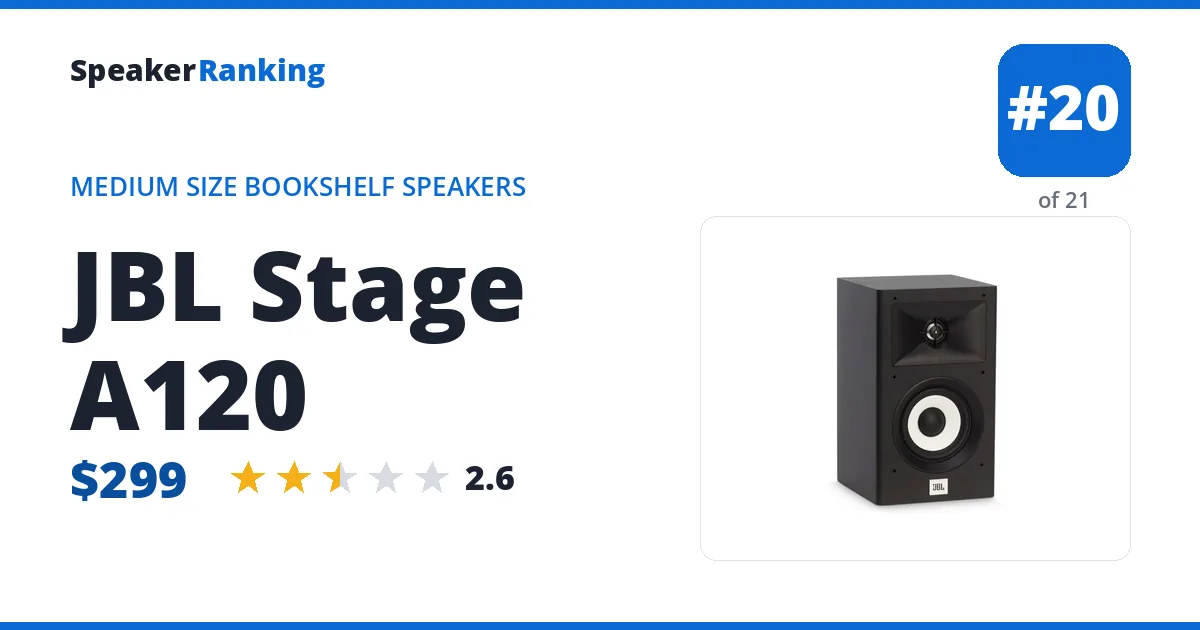
Newer model: the JBL Stage 2 240B. It’s likely to perform similarly, though we don’t have measurements to confirm that yet.
Pros: Comes with a port bung, letting you experiment between ported and sealed configurations: the reviewer found the sound improved somewhat with the port sealed. Distortion at 96dB is broadly comparable to competitors in this price range outside of some elevated low-end THD. Wide horizontal radiation pattern for a compact bookshelf speaker in the low-to-midrange. Measured bass extension of 71Hz (-3dB), with a measured sensitivity of 83dB.
Cons: A pronounced “Batman”-shaped frequency response: boosted bass, a scooped midrange, and elevated treble (about 3-4dB above the midrange), driven partly by confirmed cabinet panel resonance around 800Hz-1.7kHz. Directivity shows significant back-to-back peaks and dips, making the speaker harder to correct with EQ since the off-axis sound doesn’t track the direct sound cleanly. Elevated treble that some might call “detailed” reads as an unwelcome boost to the reviewer rather than genuine resolution. Compression testing shows the low end degrading substantially at high output (102dB). Overall considered one of the weaker speakers the reviewer has tested in this class, with a competing model (Emotiva Airmotiv B1+) recommended instead at a similar price. Discontinued.
Full JBL Stage A120 review and specifications →
| Bass Extension (-10dB) | 53Hz (measured, Erin’s Audio Corner) |
|---|---|
| Bass Extension (-3dB) | 71Hz (measured, Erin’s Audio Corner) |
| DIY Kit | No |
| Dimensions | 11.3”H x 6.8”W x 7.4”D (285.8 x 171.5 x 188.9 mm) |
| Drivers | 0.75” tweeter + 5” woofer |
| Impedance | 6 ohms |
| Sensitivity | 83dB (measured, Erin’s Audio Corner) |
| Spinorama Preference Score | 3.50 |
| Spinorama Preference Score with Perfect Sub | 6.24 |
| Weight | 10.6 lbs (4.8 kg) |
| Woofer Cabinet | ported |
- Reviews, Comparisons and Sound Samples
- Head-to-Head Comparisons
- JBL Stage A120 vs ELAC Uni-Fi 2.0 UB52
- JBL Stage A120 vs KEF Q100
- JBL Stage A120 vs JBL L52 Classic
- JBL Stage A120 vs Q Acoustics 3020i
- JBL Stage A120 vs Pioneer SP-BS22-LR (Philharmonic AAM Mod)
- JBL Stage A120 vs Micca RB42
- JBL Stage A120 vs Dynaudio X14
- JBL Stage A120 vs Q Acoustics 5020
- See all 36 comparisons