Short answer: the MoFi SourcePoint V10 Master Edition if sound quality matters most, the Klipsch Heresy IV if price matters most. The MoFi SourcePoint V10 Master Edition ranks #3 of 71 floorstanding speakers at $7995. The Klipsch Heresy IV ranks #44 at $3198, $4797 cheaper.
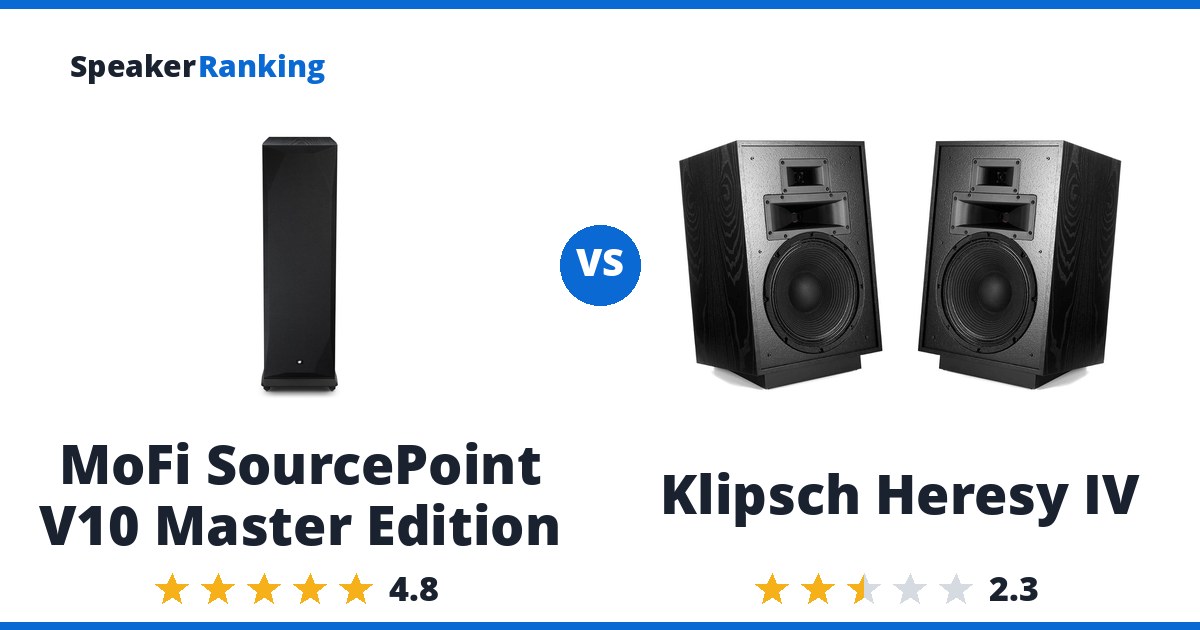
What the MoFi SourcePoint V10 Master Edition offers: Extended bass to approximately 30 Hz in-room without subwoofer; images with excellent precision indicating tight frequency response matching between speakers. Integrated bass management with three-way treble attenuation switches for room tuning. New design from Andrew Jones represents reviewer personal second choice (behind only KEF Blade 2 Meta at 29k) among hundreds of systems auditioned; ranks above Dutch & Dutch 8C, JBL 4367, and JBL M2. Watch for: Moderate sensitivity (~89 dB) means amplifier power requirements higher than many alternatives. Deep bass extension ends above subsonic frequencies (pipe organ territory below 17 Hz requires subwoofer).
What the Klipsch Heresy IV offers: Very high 94.5dB/2.83V/1m sensitivity in Erin’s anechoic measurement (well below Klipsch’s 99dB in-room claim, but still excellent) and strong short-term output from a 12-inch woofer plus horn-loaded midrange and tweeter. The compact, furniture-grade Heritage cabinet is easier to place than most high-efficiency designs, and dynamics at moderate levels can sound lively. A stable four-ohm-capable amplifier can produce substantial SPL with relatively little voltage. Watch for: Erin measured a 77Hz F3 and response rolling away near 100Hz in-room, so a subwoofer is required for modern full-range reproduction. The impedance dips to about 4 ohms, reducing the practical amplifier advantage implied by its sensitivity. Pronounced directivity mismatch at the driver transitions, impedance/response resonances and elevated distortion spikes around the crossover remain audible concerns that EQ cannot fully solve. At 102dB Erin measured roughly 1.5dB midband compression; at 96dB distortion rises around crossover. Performance is difficult to justify at the price, and Erin explicitly did not recommend it.
Buy the MoFi SourcePoint V10 Master Edition if sound quality matters more than the price. Buy the Klipsch Heresy IV if the price matters more than sound quality.
Want more options? Browse the full Passive Home rankings.
Specifications Side By Side
| MoFi SourcePoint V10 Master Edition | Klipsch Heresy IV | |
|---|---|---|
| Price | $7995 per pair | $3,198 per pair |
| Ranked | #3 of 71 in Large Size Floorstanding Speakers | #44 of 71 in Large Size Floorstanding Speakers |
| Bass Extension (-10dB) | 25Hz (measured, Erin's Audio Corner) | 50.0Hz (measured, Erin's Audio Corner) |
| Bass Extension (-3dB) | 38Hz (measured, Erin's Audio Corner) | 77Hz (measured, Erin's Audio Corner) |
| Dimensions | 48.8"H x 15.5"W x 19.9"D (1239.5 x 393.7 x 505.5 mm) | 24.8"H x 15.6"W x 13.3"D |
| Impedance | 6 ohms nominal, 5.3 ohms minimum (measured, Erin's Audio Corner) | Approximately 4 ohms minimum (measured, Erin's Audio Corner) |
| Drivers | 10" woofer, 10" paper‑cone concentric midrange, 1.25" soft‑dome concentric tweeter | 1" horn-loaded tweeter; 1.75" horn-loaded midrange; 12" woofer |
| Sensitivity | 88.8dB (measured, Erin's Audio Corner) | 94.5dB/2.83V/1m (measured, Erin's Audio Corner) |
| Weight | 160.9 lbs (73 kg) | 45 lbs (20.4 kg) each |
| Woofer Cabinet | passive radiator | ported, rear |
| Spinorama Preference Score | 4.09 | 1.48 |
| Spinorama Preference Score with Perfect Sub | 5.40 | 4.23 |
Related Speaker Comparisons
More worthwhile head-to-heads for MoFi SourcePoint V10 Master Edition:
- GR-Research NX-Treme vs MoFi SourcePoint V10 Master Edition
- KEF Blade Two Meta vs MoFi SourcePoint V10 Master Edition
- MoFi SourcePoint 888 vs MoFi SourcePoint V10 Master Edition
- Radiant Acoustics Clarity 66 vs MoFi SourcePoint V10 Master Edition
- MoFi SourcePoint V10 Master Edition vs Ascend Acoustics ELX Ribbon Tower
Prices on this page were last checked September 16, 2026 at 12:41 AM UTC. Product prices and availability are accurate as of that date/time and are subject to change; the price and availability shown on Amazon at the time of purchase will apply to the purchase of this product.
As an eBay Partner, we may be compensated if you make a purchase.
The Two Speakers In Full
 MoFi SourcePoint V10 Master Edition: $7995 per pair Crutchfield eBay
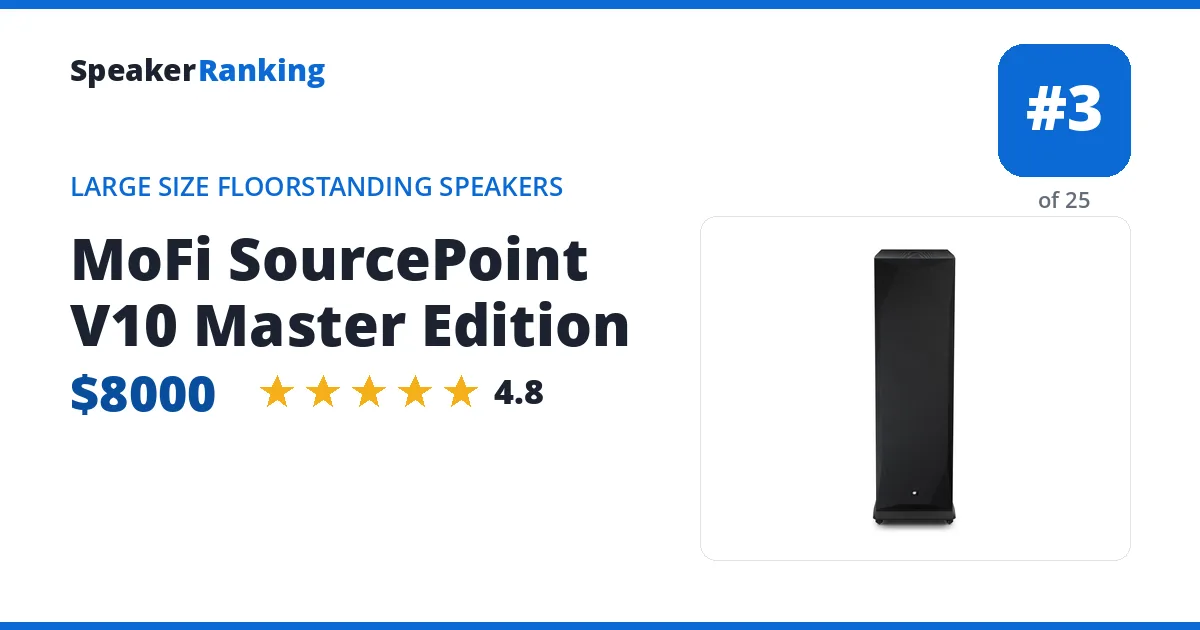
Pros: Extended bass to approximately 30 Hz in-room without subwoofer; images with excellent precision indicating tight frequency response matching between speakers. Integrated bass management with three-way treble attenuation switches for room tuning. New design from Andrew Jones represents reviewer personal second choice (behind only KEF Blade 2 Meta at 29k) among hundreds of systems auditioned; ranks above Dutch & Dutch 8C, JBL 4367, and JBL M2. Measured bass extension of 38Hz (-3dB), with a measured sensitivity of 88.8dB.
Cons: Moderate sensitivity (~89 dB) means amplifier power requirements higher than many alternatives. Deep bass extension ends above subsonic frequencies (pipe organ territory below 17 Hz requires subwoofer).
Full MoFi SourcePoint V10 Master Edition review and specifications →
| Bass Extension (-10dB) | 25Hz (measured, Erin's Audio Corner) |
|---|---|
| Bass Extension (-3dB) | 38Hz (measured, Erin's Audio Corner) |
| Dimensions | 48.8"H x 15.5"W x 19.9"D (1239.5 x 393.7 x 505.5 mm) |
| Drivers | 10" woofer, 10" paper‑cone concentric midrange, 1.25" soft‑dome concentric tweeter |
| Impedance | 6 ohms nominal, 5.3 ohms minimum (measured, Erin's Audio Corner) |
| Sensitivity | 88.8dB (measured, Erin's Audio Corner) |
| Spinorama Preference Score | 4.09 |
| Spinorama Preference Score with Perfect Sub | 5.40 |
| Weight | 160.9 lbs (73 kg) |
| Woofer Cabinet | passive radiator |
- Links
- Reviews, Comparisons and Sound Samples
- Head-to-Head Comparisons
- MoFi SourcePoint V10 Master Edition vs KEF Blade Two Meta
- MoFi SourcePoint V10 Master Edition vs MoFi SourcePoint 888
- MoFi SourcePoint V10 Master Edition vs GR-Research NX-Treme
- MoFi SourcePoint V10 Master Edition vs Radiant Acoustics Clarity 66
- MoFi SourcePoint V10 Master Edition vs Ascend Acoustics ELX Ribbon Tower
- MoFi SourcePoint V10 Master Edition vs JBL HDI-3800
- MoFi SourcePoint V10 Master Edition vs Revel F328Be
- MoFi SourcePoint V10 Master Edition vs Revel F226Be
- See all 28 comparisons
 Klipsch Heresy IV: $3,198 per pair Amazon Crutchfield eBay
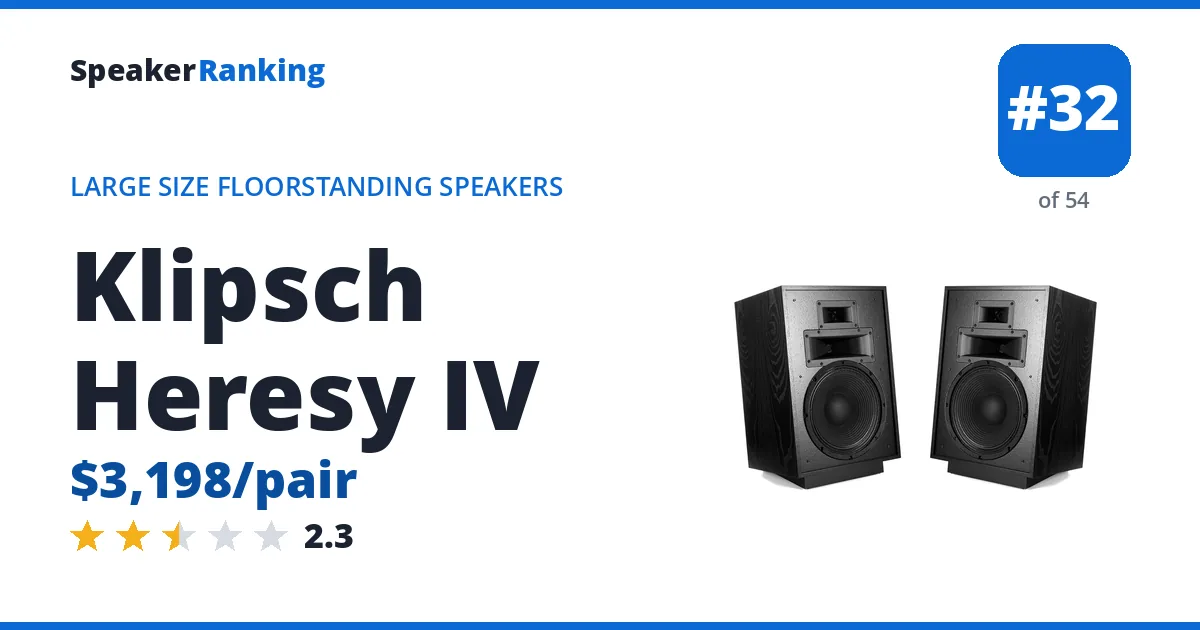
Pros: Very high 94.5dB/2.83V/1m sensitivity in Erin’s anechoic measurement (well below Klipsch’s 99dB in-room claim, but still excellent) and strong short-term output from a 12-inch woofer plus horn-loaded midrange and tweeter. The compact, furniture-grade Heritage cabinet is easier to place than most high-efficiency designs, and dynamics at moderate levels can sound lively. A stable four-ohm-capable amplifier can produce substantial SPL with relatively little voltage. Measured bass extension of 77Hz (-3dB), with a measured sensitivity of 94.5dB.
Cons: Erin measured a 77Hz F3 and response rolling away near 100Hz in-room, so a subwoofer is required for modern full-range reproduction. The impedance dips to about 4 ohms, reducing the practical amplifier advantage implied by its sensitivity. Pronounced directivity mismatch at the driver transitions, impedance/response resonances and elevated distortion spikes around the crossover remain audible concerns that EQ cannot fully solve. At 102dB Erin measured roughly 1.5dB midband compression; at 96dB distortion rises around crossover. Performance is difficult to justify at the price, and Erin explicitly did not recommend it.
Full Klipsch Heresy IV review and specifications →
| Bass Extension (-10dB) | 50.0Hz (measured, Erin's Audio Corner) |
|---|---|
| Bass Extension (-3dB) | 77Hz (measured, Erin's Audio Corner) |
| Dimensions | 24.8"H x 15.6"W x 13.3"D |
| Drivers | 1" horn-loaded tweeter; 1.75" horn-loaded midrange; 12" woofer |
| Impedance | Approximately 4 ohms minimum (measured, Erin's Audio Corner) |
| Sensitivity | 94.5dB/2.83V/1m (measured, Erin's Audio Corner) |
| Spinorama Preference Score | 1.48 |
| Spinorama Preference Score with Perfect Sub | 4.23 |
| Weight | 45 lbs (20.4 kg) each |
| Woofer Cabinet | ported, rear |
- Links
- Reviews, Comparisons and Sound Samples
- Head-to-Head Comparisons
- Klipsch Heresy IV vs Polk Audio XT60
- Klipsch Heresy IV vs KEF Q11 Meta
- Klipsch Heresy IV vs Klipsch Forte IV
- Klipsch Heresy IV vs Infinity Primus 360
- Klipsch Heresy IV vs Klipsch RP-5000F II
- Klipsch Heresy IV vs SVS Ultra Evolution Pinnacle
- Klipsch Heresy IV vs Definitive Technology BP-9020
- Klipsch Heresy IV vs Polk Reserve R500
- See all 41 comparisons