Short answer: the Marshall Stockwell II favors natural midrange sound in a compact format, while the Bose SoundLink Max is built for louder, tougher portable use. The Stockwell II is one of Marshall’s more natural-tuned speakers, though it is mono. Bose adds IP67 protection, a carry handle, USB-C power-bank use, and far greater real-world endurance.
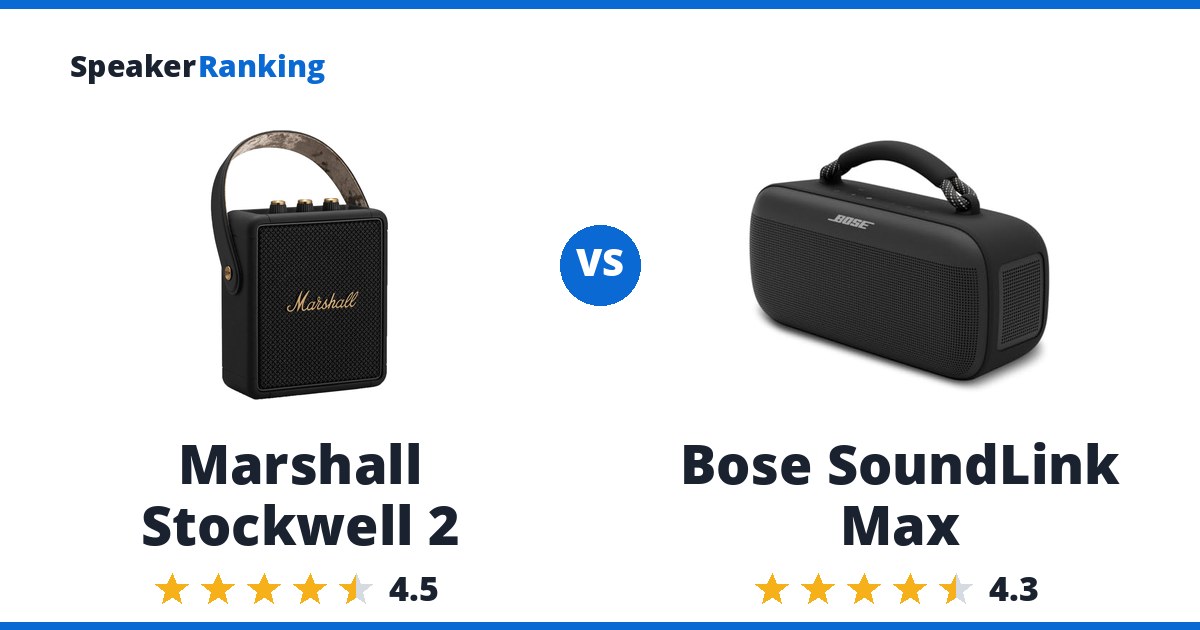
The Bose is not automatically the more accurate speaker: its upper-bass peak, recessed midrange, and uneven treble need EQ attention, and distortion rises at high volume. The Stockwell’s key limitation is scale, not stereo imaging. Pick it for smaller, relaxed listening; pick Bose for outdoor utility and output.
Buy the Marshall Stockwell II if natural-sounding casual listening matters more than stereo or ruggedness.
Buy the Bose SoundLink Max if you need IP67 protection, long battery life, and a larger portable speaker.
There is a real gap in water resistance: the Bose SoundLink Max at IP67 (brief submersion) against the Marshall Stockwell II, which has IPX4 (splashing).
Want more options? Browse the full Portable Bluetooth rankings.
Specifications Side By Side
| Marshall Stockwell II | Bose SoundLink Max | |
|---|---|---|
| Price | $229.99 | $279.00 |
| Ranked | #11 of 93 in Large Size Portable Bluetooth Speakers | #17 of 93 in Large Size Portable Bluetooth Speakers |
| Aux Input | Yes | Yes |
| Bass Extension (-10dB) | 44Hz | 48Hz |
| Battery Life | 20 hours (Manufacturer specified) | 20 hours (Manufacturer specified) |
| Bluetooth | Yes | Yes |
| Bluetooth Codecs | SBC | SBC |
| IP Rating | IPX4 | IP67 |
| Bluetooth Latency | 50ms | 116ms |
| Maximum SPL | 96dB (measured by Alan Ross Reviews) | - |
| Party Mode | No | No |
| Power Input | USB-C | USB-C |
| Stereo | No | Partially (1 tweeter) |
| Omnidirectional | Yes | No |
| TWS | No | Yes |
| Weight | 3.1 lbs (1.4 kg) | 4.9 lbs (2.2 kg) |
| App | No | Yes |
| Built-in Microphone | Yes | No |
| EQ | No | No |
| Power Bank | No | Yes (USB-C) |
| Bluetooth Version | 5.0 | 5.3 |
| Dimensions | 7.1” x 6.3” x 2.8” (180 x 161 x 70 mm) | 10.4” x 4.7” x 4.1” (264.7 x 120.1 x 104.9 mm) |
| Drivers | 3” woofer, 2x 2” fullrange tweeters | 2x 2.5” (63.5mm) midrange drivers + 1x 0.79” (20mm) tweeter |
| Frequency Response | 60Hz - 20kHz (Manufacturer specified) | - |
| Amplifier Power | 20W | - |
| Digital Aux Input | No | No |
| Strap | Yes (built-in strap) | No |
| Aux Latency | - | 33ms |
Related Speaker Comparisons
How Marshall Stockwell II compares with other leading options:
- Marshall Stockwell II vs Vifa Helsinki
- JBL Xtreme 5 vs Marshall Stockwell II
- Marshall Stockwell II vs Tribit Stormbox Lava
- Brane X vs Marshall Stockwell II
- Marshall Stockwell II vs Minirig 4 with subwoofer
Prices on this page were last checked October 2, 2026 at 10:18 PM UTC. Product prices and availability are accurate as of that date/time and are subject to change; the price and availability shown on Amazon at the time of purchase will apply to the purchase of this product.
As an eBay Partner, we may be compensated if you make a purchase.
The Two Speakers In Full
 Marshall Stockwell II: $229.99 Amazon eBay
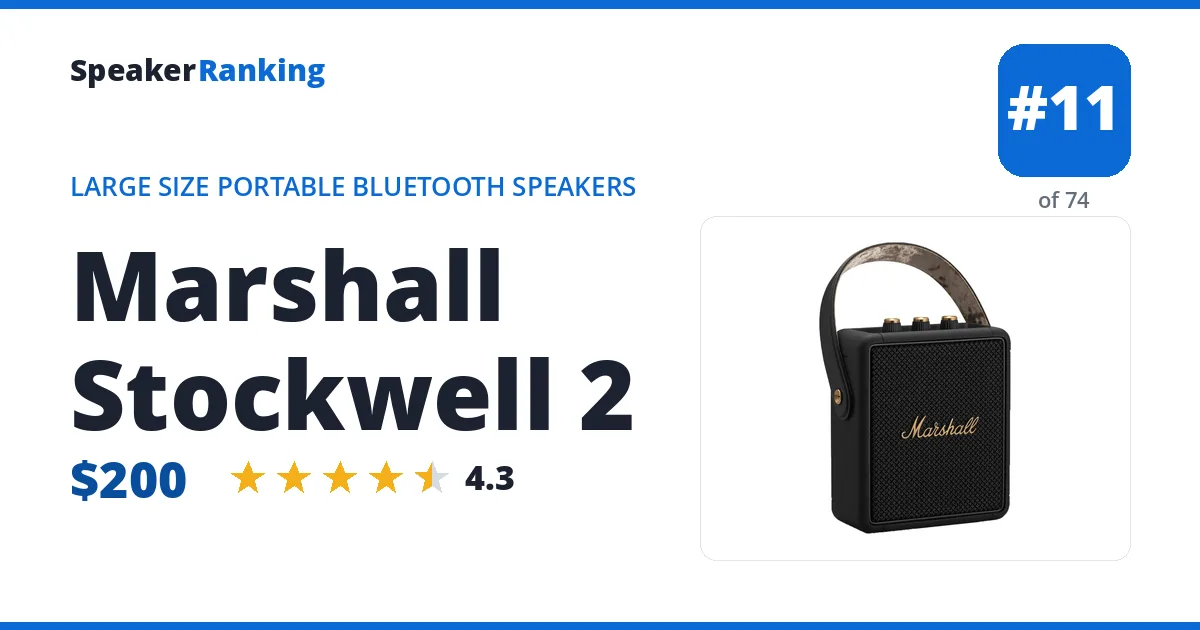
Newer model: the Marshall Stockwell III, ranked lower, rated 3/5.
Pros: Marshall Stockwell II uses 3” woofer, 2x 2” fullrange tweeters. Its 1.4 kg, claimed 20 hours (Manufacturer specified) battery life, IPX4 protection, aux input, up to 96dB and mono playback make it a practical option for its intended room or portable use. Possibly the most natural sounding Marshall speaker, with excellent off-axis sound. Measured bass extension of 44Hz (-10dB).
Cons: Bass is limited by its 44Hz specification. There is no companion app. No EQ adjustment. Not very loud, and the added DSP reverb may annoy purists.
Full Marshall Stockwell II review and specifications →
| Amplifier Power | 20W |
|---|---|
| App | No |
| Aux Input | Yes |
| Bass Extension (-10dB) | 44Hz |
| Battery Life | 20 hours (Manufacturer specified) |
| Bluetooth | Yes |
| Bluetooth Codecs | SBC |
| Bluetooth Latency | 50ms |
| Bluetooth Version | 5.0 |
| Built-in Microphone | Yes |
| Digital Aux Input | No |
| Dimensions | 7.1” x 6.3” x 2.8” (180 x 161 x 70 mm) |
| Drivers | 3” woofer, 2x 2” fullrange tweeters |
| EQ | No |
| Frequency Response | 60Hz - 20kHz (Manufacturer specified) |
| IP Rating | IPX4 |
| Maximum SPL | 96dB (measured by Alan Ross Reviews) |
| Omnidirectional | Yes |
| Party Mode | No |
| Power Bank | No |
| Power Input | USB-C |
| Stereo | No |
| Strap | Yes (built-in strap) |
| TWS | No |
| Weight | 3.1 lbs (1.4 kg) |
- Links
- Reviews, Comparisons and Sound Samples
- Alan Ross Reviews: Marshall Stockwell 2 vs Soundcore Motion Boom and Motion Plus! expensive is better? More from alanrossreviews →
- Alan Ross Reviews: Marshall Stockwell 2 vs Denon 250bt - little and large? 🙈
- Alan Ross Reviews: Marshall Stockwell 2 Review and huge sound test! - vs JBL Charge 5! 💯
- Alan Ross Reviews: Marshall Emberton vs Marshall Stockwell 2 - little guy goes louder?? 🤓
- Oluv Patreon: Marshall Stockwell III vs Stockwell II More from Oluv’Sone →
- Joy & Oluv’Sone: Marshall Stockwell III vs II - sound test
- Head-to-Head Comparisons
- Marshall Stockwell II vs B&O Beosound A5
- Marshall Stockwell II vs Soundcore Boom 2
- Marshall Stockwell II vs Mifa Wildbox
- Marshall Stockwell II vs Harman Kardon Citation 200
- Marshall Stockwell II vs Soundcore Motion Boom
- Marshall Stockwell II vs Soundcore Select Pro
- Marshall Stockwell II vs B&O Beoplay A2 active
- Marshall Stockwell II vs Minirig 4 with subwoofer
- See all 68 comparisons
 Bose SoundLink Max: $279.00 Amazon eBay
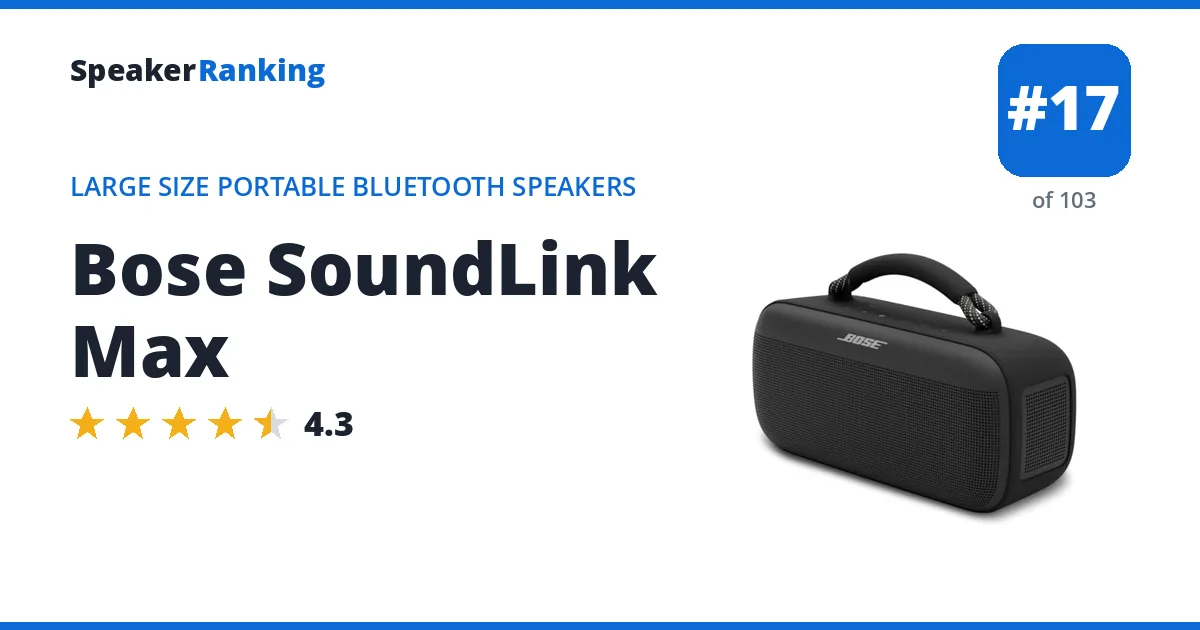
Pros: IP67 rated: dustproof and waterproof to 1m. Up to 20 hour battery; real-world testing found 43+ hours. Deep, rich bass with neutral tuning, app EQ. USB-C doubles as device charger. Sturdy carry handle. The aux input has lower latency (about 33ms) than most Bluetooth connections. Measured bass extension of 48Hz (-10dB).
Cons: Big peak in the upper bass, dipped midrange and lots of peaks and dips above the midrange. Bass not as deep as a Boom 2. Gets distorted above 80%. Self drains the battery about 20% a week.
Full Bose SoundLink Max review and specifications →
| App | Yes |
|---|---|
| Aux Input | Yes |
| Aux Latency | 33ms |
| Bass Extension (-10dB) | 48Hz |
| Battery Life | 20 hours (Manufacturer specified) |
| Bluetooth | Yes |
| Bluetooth Codecs | SBC |
| Bluetooth Latency | 116ms |
| Bluetooth Version | 5.3 |
| Built-in Microphone | No |
| Digital Aux Input | No |
| Dimensions | 10.4” x 4.7” x 4.1” (264.7 x 120.1 x 104.9 mm) |
| Drivers | 2x 2.5” (63.5mm) midrange drivers + 1x 0.79” (20mm) tweeter |
| EQ | No |
| IP Rating | IP67 |
| Omnidirectional | No |
| Party Mode | No |
| Power Bank | Yes (USB-C) |
| Power Input | USB-C |
| Stereo | Partially (1 tweeter) |
| Strap | No |
| TWS | Yes |
| Weight | 4.9 lbs (2.2 kg) |
- Links
- Reviews, Comparisons and Sound Samples
- Joy & Oluv’Sone: Bose SoundLink Max & SoundCore Boom 2 - indoor soundtest More from Oluv’Sone →
- Joy & Oluv’Sone: Bose SoundLink Max & SoundCore Boom 2 - outdoor soundtest
- Alan Ross Reviews: Bose Max, the worlds most overpriced speaker? its a shocker! More from alanrossreviews →
- Oluv Patreon: Marshall Middleton II - first impressions
- Jay’s Straight Up Reviews & More: Bose SoundLink Max vs. Ultimate Ears EpicBoom 🤑Big Bucks No Whammies? 💣 Let’s Find Out 😧 More from JaysStraightUpReviews →
- Jay’s Straight Up Reviews & More: Bose SoundLink Max vs Tribit XSound Mega 😲 Can the Budget Priced Speaker Hang With the Big $ One?
- Scott’s Reviews: Bose SoundLink Max First Impressions, Unboxing, and Sound Test. More from ScottsReviews →
- Mateusz Cholewa: BOGASING S8 Pro Max 100W vs BOSE Soundlink MAX More from Mateusz Cholewa →
- Head-to-Head Comparisons
- Bose SoundLink Max vs B&O Beoplay A2 active
- Bose SoundLink Max vs JBL Xtreme 3
- Bose SoundLink Max vs Soundcore Motion X600
- Bose SoundLink Max vs Soundcore Select Pro
- Bose SoundLink Max vs Soundcore Motion Boom
- Bose SoundLink Max vs Loewe We. Hear Pro
- Bose SoundLink Max vs Soundcore Rave Neo 2
- Bose SoundLink Max vs Harman Kardon Citation 200
- See all 85 comparisons