Short answer: the Klipsch The Nines. It ranks #40 of 68 powered bookshelf speakers by sound quality, rated 4.2/5, at $999.99; the Klipsch The Sevens ranks #65, rated 3.7/5, at $999.99. The price gap is small enough that the sound-quality ranking should decide it.
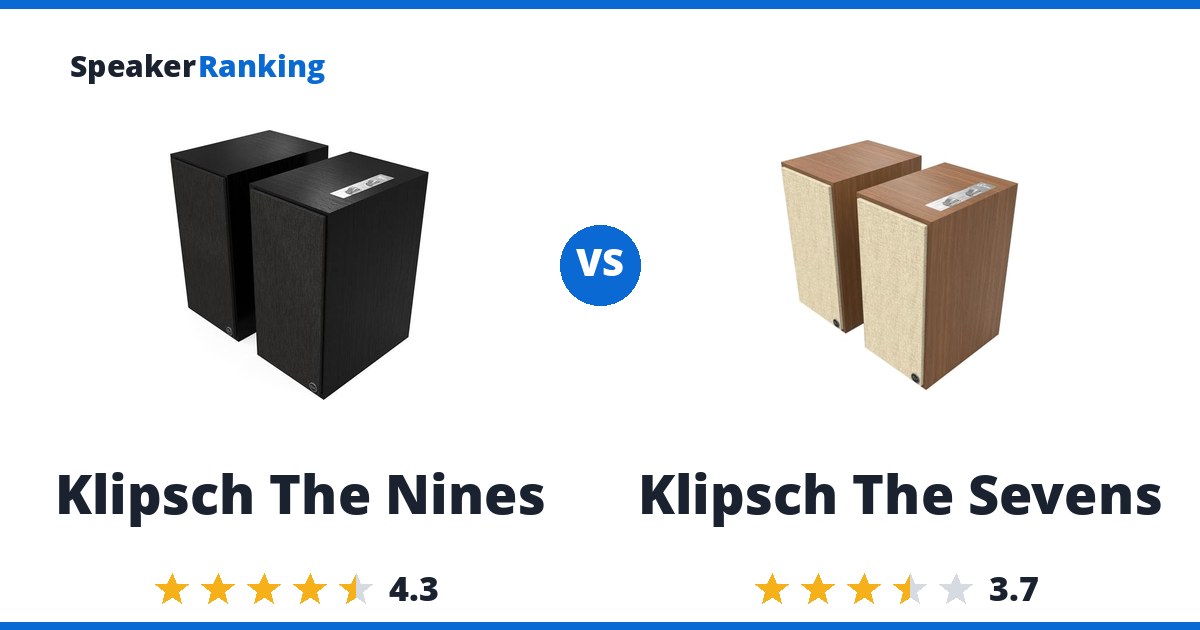
Why pick the Klipsch The Nines: The 1.7dB response span from 300Hz to 5kHz supports even mids, and measured -3dB extension is 42.5Hz. The tradeoff: The 6.90 ideal-subwoofer score reflects limitations beyond the narrow midband span.
What the Klipsch The Sevens does well: Erin reported 49Hz -3dB extension, with useful bass for ordinary music listening. The tradeoff: The review found a recessed 2-4kHz region and upper-treble emphasis, producing a scooped balance that a simple treble reduction did not fully fix.
Buy the Klipsch The Nines. It is rated higher for sound quality than the Klipsch The Sevens at the same price, so it is the default pick unless a specific strength of the other one matters more to you.
Looking for alternatives? See the complete Powered Home rankings.
Specifications Side By Side
| Klipsch The Nines | Klipsch The Sevens | |
|---|---|---|
| Price | $999.99 per pair | $999.99 per pair |
| Ranked | #40 of 68 in Large Size Powered Bookshelf Speakers | #65 of 68 in Large Size Powered Bookshelf Speakers |
| Drivers | 8” high-excursion fiber-composite woofer, 1” titanium LTS vented tweeter with Tractrix horn | 6.5” high-excursion woofer, 1” titanium tweeter on Tractrix horn |
| Amplifier Power | 240W total (480W peak; 100W LF + 20W HF per powered speaker) | 200W total (400W peak) |
| Inputs | HDMI ARC, Bluetooth 5.0, phono/line RCA, 3.5mm, USB, optical | HDMI, Phono, 3.5mm, USB, Optical, Bluetooth |
| Bluetooth Codecs | SBC, AAC, aptX, aptX HD | SBC, AAC, aptX, aptX HD |
| Dimensions | 19.13”H x 9.5”W x 13.38”D | 16.375”H x 8.125”W x 13.1875”D |
| Weight | 28.4 lbs (12.9 kg) primary, 26.9 lbs (12.2 kg) secondary | 22.3 lbs (10.1 kg) (primary), 19.8 lbs (9 kg) (secondary) |
| Sensitivity | 82.5dB (measured at 0.30V/1m, Erin’s Audio Corner) | - |
| Bass Extension (-3dB) | 42.5Hz (measured, Erin’s Audio Corner) | 49Hz (measured, Erin’s Audio Corner) |
| Bass Extension (-10dB) | 31Hz (measured, Erin’s Audio Corner) | 36Hz (measured, Erin’s Audio Corner) |
| Frequency Response | 34Hz - 25kHz +/-3dB (manufacturer specified) | 39Hz - 25kHz (+/-3dB) (Manufacturer specified) |
| App | Klipsch Connect (bass/mid/treble EQ) | Yes (treble/mid/bass EQ, subwoofer output, dynamic bass mode) |
| Woofer Cabinet | rear-ported bass reflex | ported, rear flared port |
| Maximum SPL | 115dB at 1m (stereo pair, manufacturer specified) | - |
| Spinorama Preference Score | 5.32 | - |
| Spinorama Preference Score with Perfect Sub | 6.90 | - |
| Subwoofer Output | Yes | Yes |
| Outputs | Subwoofer | Subwoofer |
| XLR Input | No | No |
| RCA Input | Yes | No |
| TRS Input | No | No |
| Optical Input | Yes | Yes |
| Coaxial Input | No | No |
| USB Input | Yes | Yes |
| HDMI Input | Yes | Yes |
| AES Input | No | No |
| Aux Input | Yes | Yes |
| Bluetooth | Yes, 5.0 | Yes, 5.0 |
Related Speaker Comparisons
More top alternatives to Klipsch The Nines:
- Klipsch The Nines vs Genelec 8351B
- Klipsch The Nines vs Neumann KH420
- Klipsch The Nines vs Genelec 8361A
- Klipsch The Nines vs Genelec 8341A
- Klipsch The Nines vs Neumann KH 150
Prices on this page were last checked September 30, 2026 at 2:57 PM UTC. Product prices and availability are accurate as of that date/time and are subject to change; the price and availability shown on Amazon at the time of purchase will apply to the purchase of this product.
As an eBay Partner, we may be compensated if you make a purchase.
The Two Speakers In Full
 Klipsch The Nines: $999.99 per pair Crutchfield eBay
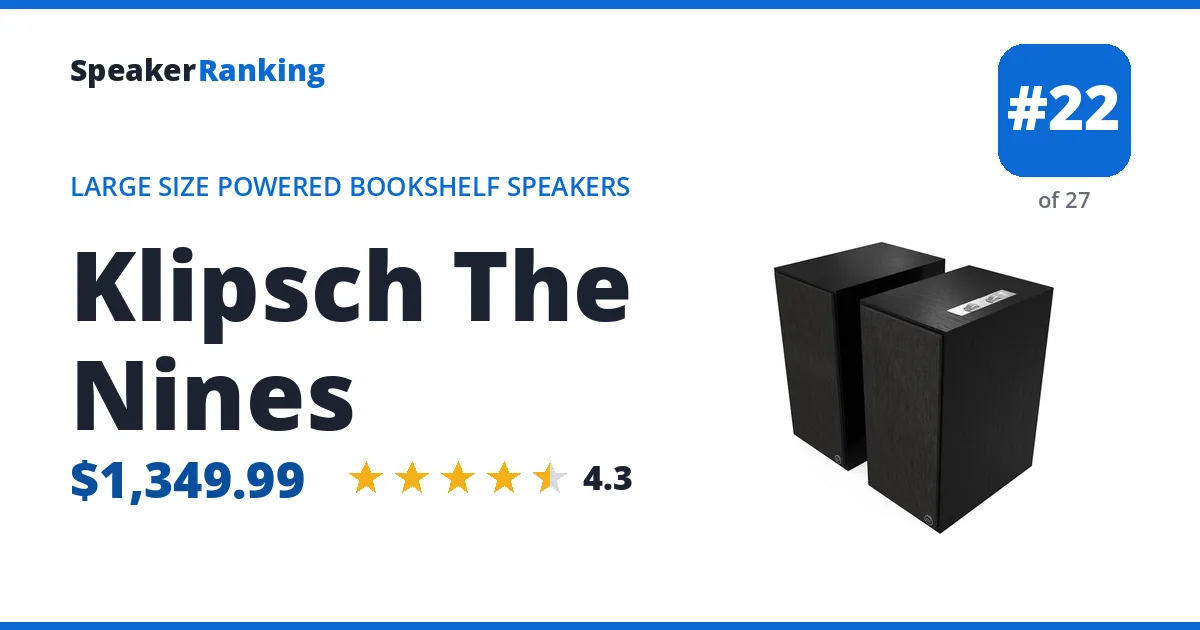
Pros: The 1.7dB response span from 300Hz to 5kHz supports even mids, and measured -3dB extension is 42.5Hz. Extensive consumer connections and app adjustment make it convenient for TV and music, while the horn provides a focused listening presentation. Erin called it his favorite Klipsch speaker. Measured bass extension of 42.5Hz (-3dB), with a measured sensitivity of 82.5dB.
Cons: The 6.90 ideal-subwoofer score reflects limitations beyond the narrow midband span. Horizontal coverage is relatively focused, so placement matters for multiple seats. The reviewer preferred reduced treble, and bass limiting at higher playback levels means the large woofer is not a guarantee of unlimited output. The app’s flat setting leaves treble elevated; Erin preferred a -2dB tweeter trim.
Full Klipsch The Nines review and specifications →
| AES Input | No |
|---|---|
| Amplifier Power | 240W total (480W peak; 100W LF + 20W HF per powered speaker) |
| App | Klipsch Connect (bass/mid/treble EQ) |
| Aux Input | Yes |
| Bass Extension (-10dB) | 31Hz (measured, Erin’s Audio Corner) |
| Bass Extension (-3dB) | 42.5Hz (measured, Erin’s Audio Corner) |
| Bluetooth | Yes, 5.0 |
| Bluetooth Codecs | SBC, AAC, aptX, aptX HD |
| Coaxial Input | No |
| Dimensions | 19.13”H x 9.5”W x 13.38”D |
| Drivers | 8” high-excursion fiber-composite woofer, 1” titanium LTS vented tweeter with Tractrix horn |
| Frequency Response | 34Hz - 25kHz +/-3dB (manufacturer specified) |
| HDMI Input | Yes |
| Inputs | HDMI ARC, Bluetooth 5.0, phono/line RCA, 3.5mm, USB, optical |
| Maximum SPL | 115dB at 1m (stereo pair, manufacturer specified) |
| Optical Input | Yes |
| Outputs | Subwoofer |
| RCA Input | Yes |
| Sensitivity | 82.5dB (measured at 0.30V/1m, Erin’s Audio Corner) |
| Spinorama Preference Score | 5.32 |
| Spinorama Preference Score with Perfect Sub | 6.90 |
| Subwoofer Output | Yes |
| TRS Input | No |
| USB Input | Yes |
| Weight | 28.4 lbs (12.9 kg) primary, 26.9 lbs (12.2 kg) secondary |
| Woofer Cabinet | rear-ported bass reflex |
| XLR Input | No |
- Links
- Reviews, Comparisons and Sound Samples
- Head-to-Head Comparisons
- Klipsch The Nines vs JBL 306P MKII
- Klipsch The Nines vs JBL 708P
- Klipsch The Nines vs JBL 4329P
- Klipsch The Nines vs JBL M2 Master Reference Monitor
- Klipsch The Nines vs APS Klasik 2020
- Klipsch The Nines vs Genelec 8040B
- Klipsch The Nines vs Kali Audio LP-6
- Klipsch The Nines vs Emotiva Airmotiv 6s
- See all 32 comparisons
 Klipsch The Sevens: $999.99 per pair Amazon eBay
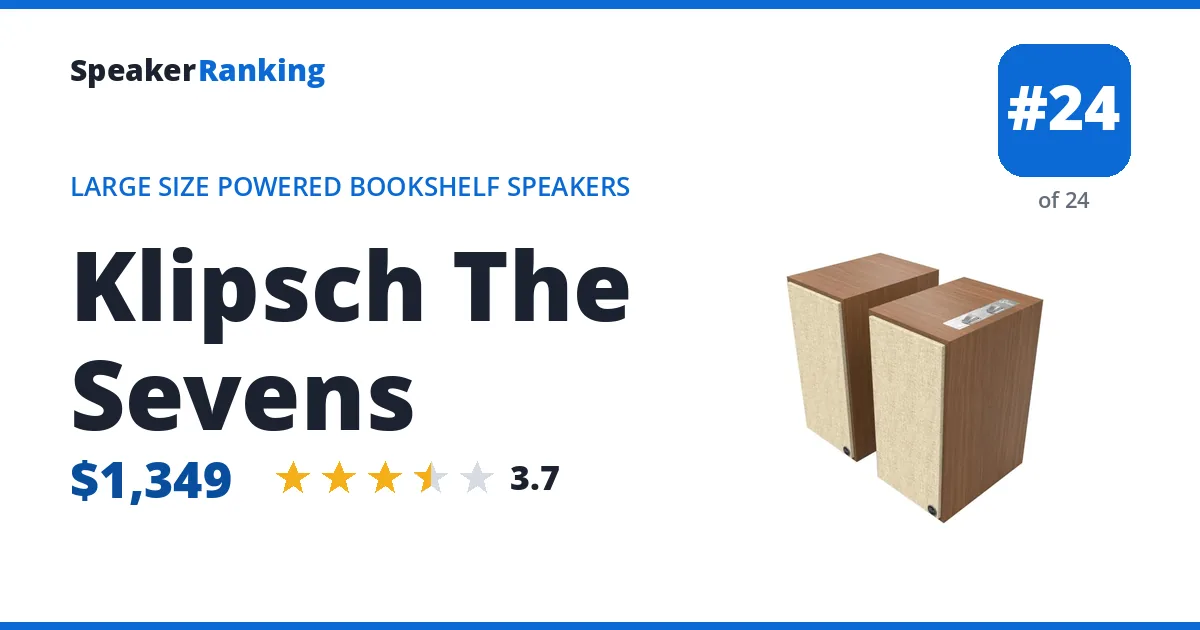
Pros: Erin reported 49Hz -3dB extension, with useful bass for ordinary music listening. HDMI, phono, USB, optical and Bluetooth connections make the system convenient for TV and music, while app controls and a subwoofer output provide adjustment options. Bass reaches about 36Hz at -10dB, delivering a controlled thump near 40Hz in-room without strain. Measured bass extension of 49Hz (-3dB).
Cons: The review found a recessed 2-4kHz region and upper-treble emphasis, producing a scooped balance that a simple treble reduction did not fully fix. Relatively narrow horizontal coverage limits consistency across seats.
Full Klipsch The Sevens review and specifications →
| AES Input | No |
|---|---|
| Amplifier Power | 200W total (400W peak) |
| App | Yes (treble/mid/bass EQ, subwoofer output, dynamic bass mode) |
| Aux Input | Yes |
| Bass Extension (-10dB) | 36Hz (measured, Erin’s Audio Corner) |
| Bass Extension (-3dB) | 49Hz (measured, Erin’s Audio Corner) |
| Bluetooth | Yes, 5.0 |
| Bluetooth Codecs | SBC, AAC, aptX, aptX HD |
| Coaxial Input | No |
| Dimensions | 16.375”H x 8.125”W x 13.1875”D |
| Drivers | 6.5” high-excursion woofer, 1” titanium tweeter on Tractrix horn |
| Frequency Response | 39Hz - 25kHz (+/-3dB) (Manufacturer specified) |
| HDMI Input | Yes |
| Inputs | HDMI, Phono, 3.5mm, USB, Optical, Bluetooth |
| Optical Input | Yes |
| Outputs | Subwoofer |
| RCA Input | No |
| Subwoofer Output | Yes |
| TRS Input | No |
| USB Input | Yes |
| Weight | 22.3 lbs (10.1 kg) (primary), 19.8 lbs (9 kg) (secondary) |
| Woofer Cabinet | ported, rear flared port |
| XLR Input | No |
- Links
- Reviews, Comparisons and Sound Samples
- Head-to-Head Comparisons
- Klipsch The Sevens vs EVE Audio SC305
- Klipsch The Sevens vs Focal Twin6 Be
- Klipsch The Sevens vs Edifier R2850DB
- Klipsch The Sevens vs Edifier S3000Pro
- Klipsch The Sevens vs Presonus Eris Studio 8
- Klipsch The Sevens vs Kali Audio LP-8
- Klipsch The Sevens vs Adam Audio T7V
- Klipsch The Sevens vs Adam Audio T8V
- See all 35 comparisons