Short answer: the Genelec 8361A on measured sound quality, the Klipsch The Nines on price. The Genelec 8361A ranks #6 of 113 powered bookshelf speakers, rated 4.8/5, at $11,700. The Klipsch The Nines ranks #63, rated 4.2/5, at $999.99, $10,700.01 cheaper.
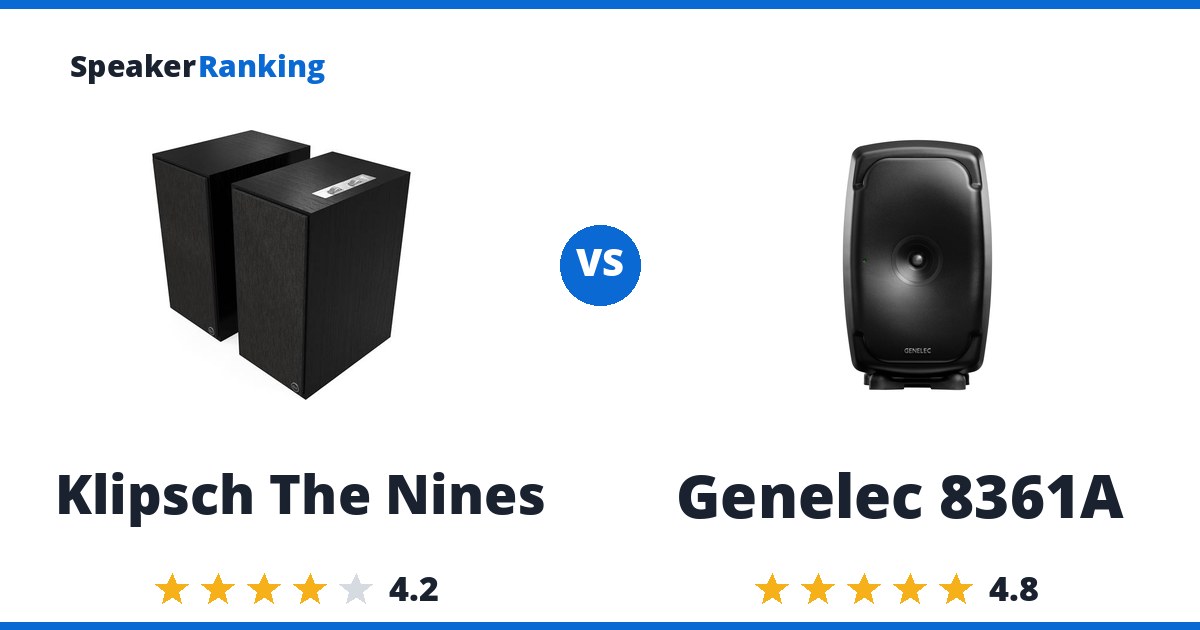
Why pick the Klipsch The Nines: The 1.7dB response span from 300Hz to 5kHz supports even mids, and measured -3dB extension is 42.5Hz. It keeps a wired aux input, which the Genelec 8361A lacks. Watch for: The 6.90 ideal-subwoofer score reflects limitations beyond the narrow midband span.
The Genelec 8361A is the more accurate, deeper-bass pick. The coaxial design combines consistent imaging with substantial output capability. Its measured preference score, a predictor of how neutral it sounds, is 6.76 against 5.32 for the Klipsch The Nines. Its bass reaches about 34Hz before falling 3dB, against 42.5Hz for the Klipsch The Nines. The tradeoff: Its larger size buys headroom, not uniformly better tonality than the smaller Ones models.
Buy the Klipsch The Nines if the price is the priority over sound quality, or the Genelec 8361A if sound quality is the priority over the price.
Want more options? Browse the full Powered Home rankings.
Specifications Side By Side
| Klipsch The Nines | Genelec 8361A | |
|---|---|---|
| Price | $999.99 per pair | $11,700 per pair |
| Ranked | #63 of 113 in Large Size Powered Bookshelf Speakers | #6 of 113 in Large Size Powered Bookshelf Speakers |
| Drivers | 8” high-excursion fiber-composite woofer, 1” titanium LTS vented tweeter with Tractrix horn | Dual 263 x 137 mm woofers, 5.1” coaxial with tweeter midrange, 1” (25mm) coaxial tweeter |
| Amplifier Power | 240W total (480W peak; 100W LF + 20W HF per powered speaker) | 1000w Per Speaker |
| Inputs | HDMI ARC, Bluetooth 5.0, phono/line RCA, 3.5mm, USB, optical | XLR |
| Bluetooth Codecs | SBC, AAC, aptX, aptX HD | - |
| Dimensions | 19.13”H x 9.5”W x 13.38”D | 22.5”H x 14”W x 13.6”D (571.5 x 355.6 x 345.4 mm) |
| Weight | 28.4 lbs (12.9 kg) primary, 26.9 lbs (12.2 kg) secondary | 70.3 lbs (31.9 kg) each |
| Sensitivity | 82.5dB (measured at 0.30V/1m, Erin’s Audio Corner) | - |
| Bass Extension (-3dB) | 42.5Hz (measured, Erin’s Audio Corner) | 34Hz (measured, Erin’s Audio Corner) |
| Bass Extension (-10dB) | 31Hz (measured, Erin’s Audio Corner) | 29Hz (measured, Erin’s Audio Corner) |
| Frequency Response | 34Hz - 25kHz +/-3dB (manufacturer specified) | 30Hz - 43kHz (±2dB) (Manufacturer specified) |
| App | Klipsch Connect (bass/mid/treble EQ) | Yes (GLM) |
| Woofer Cabinet | rear-ported bass reflex | - |
| Maximum SPL | 115dB at 1m (stereo pair, manufacturer specified) | 118dB @ 1m (manufacturer specified) |
| Spinorama Preference Score | 5.32 | 6.76 |
| Spinorama Preference Score with Perfect Sub | 6.90 | 8.08 |
| Subwoofer Output | Yes | - |
| Outputs | Subwoofer | - |
| XLR Input | No | Yes |
| RCA Input | Yes | No |
| TRS Input | No | No |
| Optical Input | Yes | No |
| Coaxial Input | No | No |
| USB Input | Yes | No |
| HDMI Input | Yes | No |
| AES Input | No | No |
| Aux Input | Yes | No |
| Bluetooth | Yes | No |
| Bluetooth Version | 5.0 | - |
| DSP | - | Yes |
| EQ | - | Yes (via GLM software) |
Related Speaker Comparisons
More worthwhile head-to-heads for Genelec 8361A:
- Genelec 8351B vs Genelec 8361A
- Genelec 8361A vs Neumann KH420
- Genelec 8361A vs Neumann KH 150
- Dutch & Dutch 8C vs Genelec 8361A
- Genelec 8361A vs Aalto Speakers Aalto 3 Active Pro
Prices on this page were last checked October 7, 2026 at 9:25 PM UTC. Product prices and availability are accurate as of that date/time and are subject to change; the price and availability shown on Amazon at the time of purchase will apply to the purchase of this product.
As an eBay Partner, we may be compensated if you make a purchase.
The Two Speakers In Full
 Klipsch The Nines: $999.99 per pair Crutchfield eBay
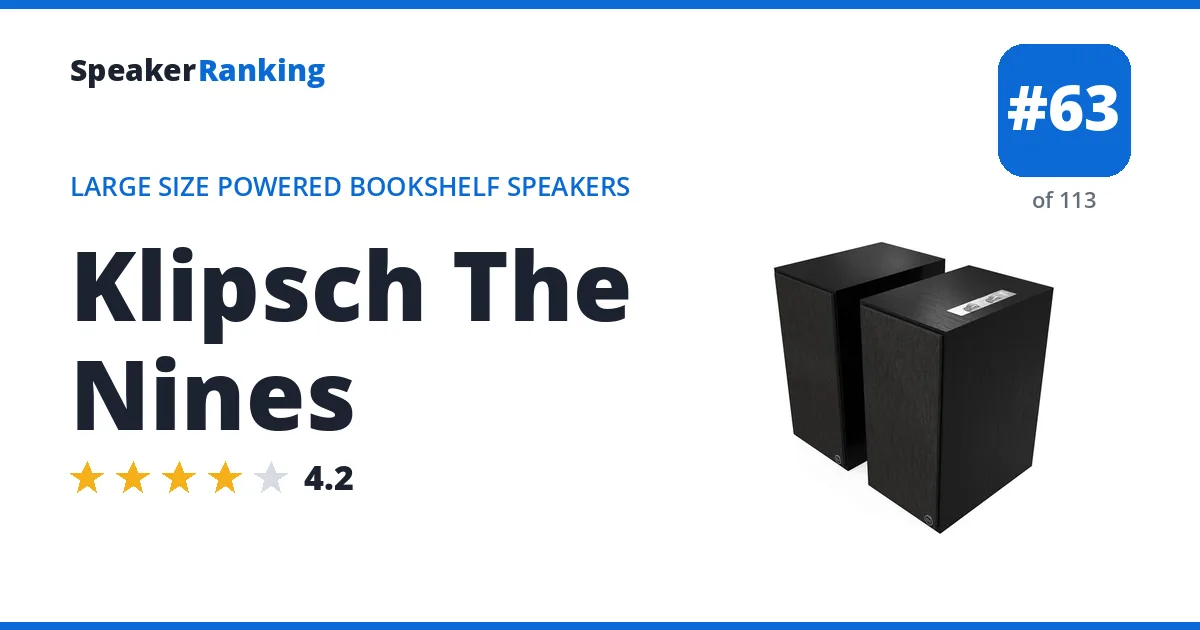
Newer model: the Klipsch The Nines II, ranked higher, estimated 4.3/5.
Same family: the Klipsch The Fives (smaller bookshelf, rated 4.3/5) and the Klipsch The Sevens (smaller bookshelf, ranked lower, rated 3.7/5).
Pros: The 1.7dB response span from 300Hz to 5kHz supports even mids, and measured -3dB extension is 42.5Hz. Extensive consumer connections and app adjustment make it convenient for TV and music, while the horn provides a focused listening presentation. Erin called it his favorite Klipsch speaker. Measured bass extension of 42.5Hz (-3dB), with a measured sensitivity of 82.5dB.
Cons: The 6.90 ideal-subwoofer score reflects limitations beyond the narrow midband span. Horizontal coverage is relatively focused, so placement matters for multiple seats. The reviewer preferred reduced treble, and bass limiting at higher playback levels means the large woofer is not a guarantee of unlimited output. The app’s flat setting leaves treble elevated; Erin preferred a -2dB tweeter trim.
Full Klipsch The Nines review and specifications →
| AES Input | No |
|---|---|
| Amplifier Power | 240W total (480W peak; 100W LF + 20W HF per powered speaker) |
| App | Klipsch Connect (bass/mid/treble EQ) |
| Aux Input | Yes |
| Bass Extension (-10dB) | 31Hz (measured, Erin’s Audio Corner) |
| Bass Extension (-3dB) | 42.5Hz (measured, Erin’s Audio Corner) |
| Bluetooth | Yes |
| Bluetooth Codecs | SBC, AAC, aptX, aptX HD |
| Bluetooth Version | 5.0 |
| Coaxial Input | No |
| Dimensions | 19.13”H x 9.5”W x 13.38”D |
| Drivers | 8” high-excursion fiber-composite woofer, 1” titanium LTS vented tweeter with Tractrix horn |
| Frequency Response | 34Hz - 25kHz +/-3dB (manufacturer specified) |
| HDMI Input | Yes |
| Inputs | HDMI ARC, Bluetooth 5.0, phono/line RCA, 3.5mm, USB, optical |
| Maximum SPL | 115dB at 1m (stereo pair, manufacturer specified) |
| Optical Input | Yes |
| Outputs | Subwoofer |
| RCA Input | Yes |
| Sensitivity | 82.5dB (measured at 0.30V/1m, Erin’s Audio Corner) |
| Spinorama Preference Score | 5.32 |
| Spinorama Preference Score with Perfect Sub | 6.90 |
| Subwoofer Output | Yes |
| TRS Input | No |
| USB Input | Yes |
| Weight | 28.4 lbs (12.9 kg) primary, 26.9 lbs (12.2 kg) secondary |
| Woofer Cabinet | rear-ported bass reflex |
| XLR Input | No |
- Links
- Reviews, Comparisons and Sound Samples
- Head-to-Head Comparisons
- Klipsch The Nines vs JBL 708P
- Klipsch The Nines vs JBL 306P MKII
- Klipsch The Nines vs Klipsch The Nines II
- Klipsch The Nines vs JBL M2 Master Reference Monitor
- Klipsch The Nines vs JBL 4329P
- Klipsch The Nines vs APS Klasik 2020
- Klipsch The Nines vs Genelec 8040B
- Klipsch The Nines vs Kali Audio LP-6
- See all 32 comparisons
 Genelec 8361A: $11,700 per pair B&H Photo Video eBay
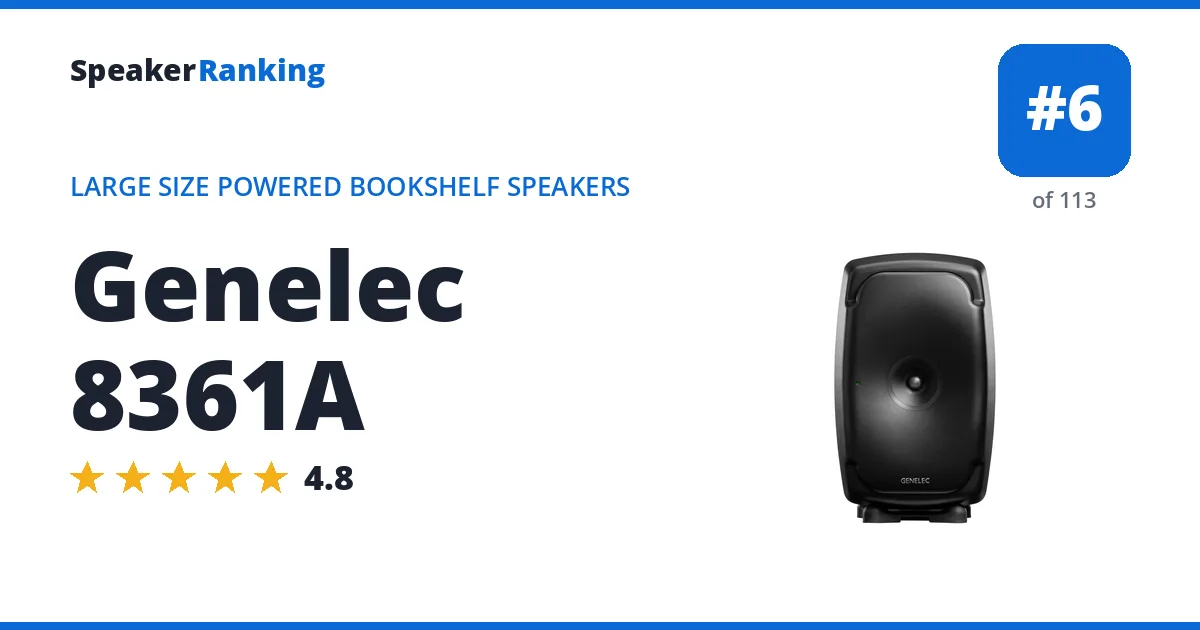
Same family: the Genelec 8331A (smaller bookshelf, rated 4.8/5), the Genelec 8341A (smaller bookshelf, ranked lower, rated 4.8/5), the Genelec 8351B (smaller bookshelf, ranked higher, rated 4.8/5) and the Genelec 8381A (floorstanding, estimated 4.9/5).
Pros: The coaxial design combines consistent imaging with substantial output capability. ASR measured a 1.8dB response span from 300Hz to 5kHz, 33.7Hz -3dB extension and a 8.08 ideal-subwoofer score. Low distortion and restrained compression support its use at greater distances than smaller nearfield monitors. Woofers above and below the coaxial driver give nearly identical vertical response whether you sit or stand. Measured bass extension of 34Hz (-3dB).
Cons: Its larger size buys headroom, not uniformly better tonality than the smaller Ones models. Some lower-midrange unevenness remains, and listening angle can affect perceived treble balance. The cabinets are very heavy and expensive; GLM setup and suitable stands need to be budgeted separately.
Full Genelec 8361A review and specifications →
| AES Input | No |
|---|---|
| Amplifier Power | 1000w Per Speaker |
| App | Yes (GLM) |
| Aux Input | No |
| Bass Extension (-10dB) | 29Hz (measured, Erin’s Audio Corner) |
| Bass Extension (-3dB) | 34Hz (measured, Erin’s Audio Corner) |
| Bluetooth | No |
| Coaxial Input | No |
| DSP | Yes |
| Dimensions | 22.5”H x 14”W x 13.6”D (571.5 x 355.6 x 345.4 mm) |
| Drivers | Dual 263 x 137 mm woofers, 5.1” coaxial with tweeter midrange, 1” (25mm) coaxial tweeter |
| EQ | Yes (via GLM software) |
| Frequency Response | 30Hz - 43kHz (±2dB) (Manufacturer specified) |
| HDMI Input | No |
| Inputs | XLR |
| Maximum SPL | 118dB @ 1m (manufacturer specified) |
| Optical Input | No |
| RCA Input | No |
| Spinorama Preference Score | 6.76 |
| Spinorama Preference Score with Perfect Sub | 8.08 |
| TRS Input | No |
| USB Input | No |
| Weight | 70.3 lbs (31.9 kg) each |
| XLR Input | Yes |
- Links
- Reviews, Comparisons and Sound Samples
- Head-to-Head Comparisons
- Genelec 8361A vs Neumann KH420
- Genelec 8361A vs Genelec 8351B
- Genelec 8361A vs Neumann KH 150
- Genelec 8361A vs Dutch & Dutch 8C
- Genelec 8361A vs Aalto Speakers Aalto 3 Active Pro
- Genelec 8361A vs Buchardt A500
- Genelec 8361A vs Neumann KH 310 A
- Genelec 8361A vs HEDD Type 20 MK2
- See all 28 comparisons