Short answer: the KEF R3. Both are rated 4.5/5 for sound quality (#15 and #19 of 131 bookshelf speakers), and the KEF R3 costs $2,200 against $3,750 for the Epos ES14N, with sound quality a draw, the lower price decides it.
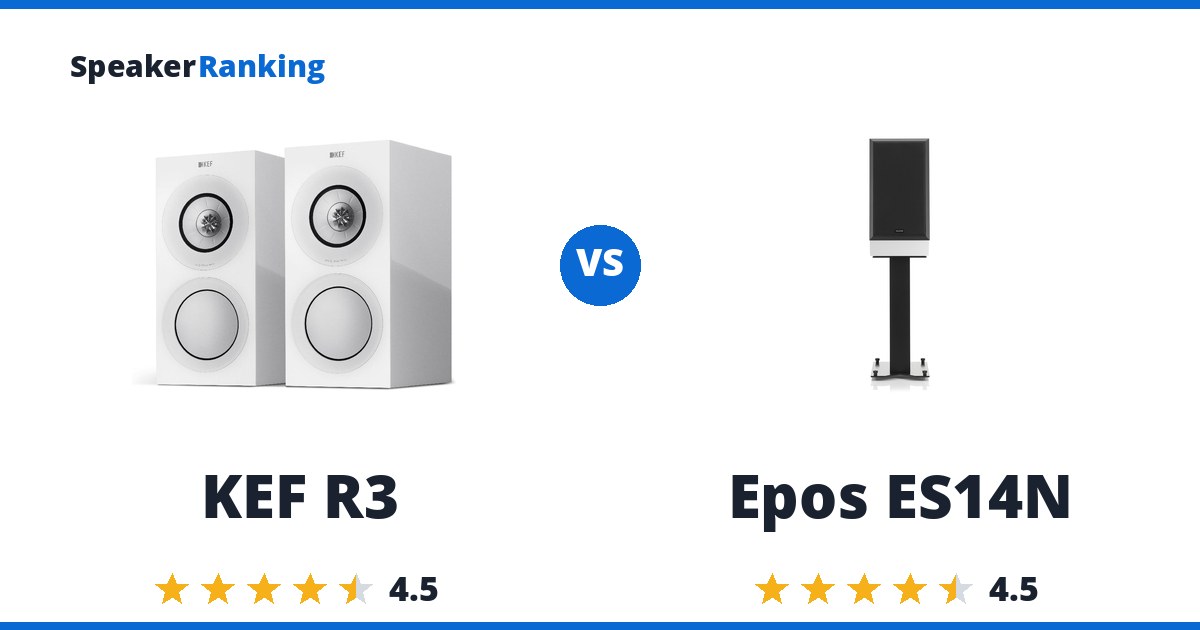
What the KEF R3 does well: True three-way stand-mount with a 6.5-inch woofer below KEF’s 5-inch Uni-Q midrange/1-inch tweeter. The tradeoff: The low-frequency alignment rolls gradually rather than delivering high-output sub-bass; KEF specifies 58Hz +/-3dB and Erin’s high-level data supports using an 80Hz subwoofer crossover.
What the Epos ES14N does well: A revival of Epos’s classic 1980s ES-14, re-engineered by Karl-Heinz Fink’s FinkTeam with a chamfered, backward sloping baffle to time align a 28mm ceramic coated dome tweeter with a 7 inch mica filled polypropylene woofer. The catch: Off axis sound tracks the on axis response less consistently than most measured speakers as frequency rises, so the room’s reflected sound differs more from what you hear directly.
Buy the KEF R3. Both are rated the same for sound quality, and it costs $1,550 less than the Epos ES14N.
Still deciding? The full Passive Home rankings cover every ranked option.
Specifications Side By Side
| KEF R3 | Epos ES14N | |
|---|---|---|
| Price | $2,200 per pair | £3,750 per pair |
| Ranked | #15 of 131 in Large Size Bookshelf Speakers | #19 of 131 in Large Size Bookshelf Speakers |
| Bass Extension (-3dB) | Approximately 58Hz (manufacturer specified; consistent with Erin’s measured roll-off) | 51.2Hz (measured, spinorama.org data) |
| Bass Extension (-10dB) | 35.2Hz (measured, Audio Science Review) | 35.3Hz (measured, spinorama.org data) |
| Sensitivity | Approximately 86-87dB/2.83V/1m (measured, Erin’s Audio Corner) | 87dB @ 2.823V/1m |
| Impedance | 8 ohms nominal; suitable for Erin’s 4/8-ohm-rated amplifier | 6 ohms nominal, 4.3 ohms minimum |
| Drivers | 1” tweeter coaxial with 5” midrange; 6.5” woofer | 28mm aluminum/ceramic compound dome tweeter, 7” mica filled polypropylene cone woofer |
| Dimensions | 16.6”H x 7.9”W x 13.2”D | 19.3”H x 9.8”W x 15.2”D (491 x 250 x 385 mm) |
| Woofer Cabinet | ported, rear Flexible Port | - |
| Weight | 29.9 lbs (13.55 kg) each | 35.3 lbs (16 kg) each |
| Spinorama Preference Score | 6.2 (spinorama.org) | 6.22 |
| Spinorama Preference Score with Perfect Sub | 7.97 (spinorama.org) | 7.82 |
| DIY Kit | No | No |
| Enclosure | - | ported |
| Crossover Frequency | - | 2.7kHz |
| Country | - | Germany |
Related Speaker Comparisons
More worthwhile head-to-heads for KEF R3:
- TAD Compact Reference One (CR1TX) vs KEF R3
- KEF R3 vs Perlisten S4b
- KEF Reference 1 Meta vs KEF R3
- KEF R3 vs GR-Research NX-Studio
- March Audio Sointuva AWG vs KEF R3
Prices on this page were last checked September 30, 2026 at 2:57 PM UTC. Product prices and availability are accurate as of that date/time and are subject to change; the price and availability shown on Amazon at the time of purchase will apply to the purchase of this product.
As an eBay Partner, we may be compensated if you make a purchase.
The Two Speakers In Full
 KEF R3: $2,200 per pair Amazon eBay
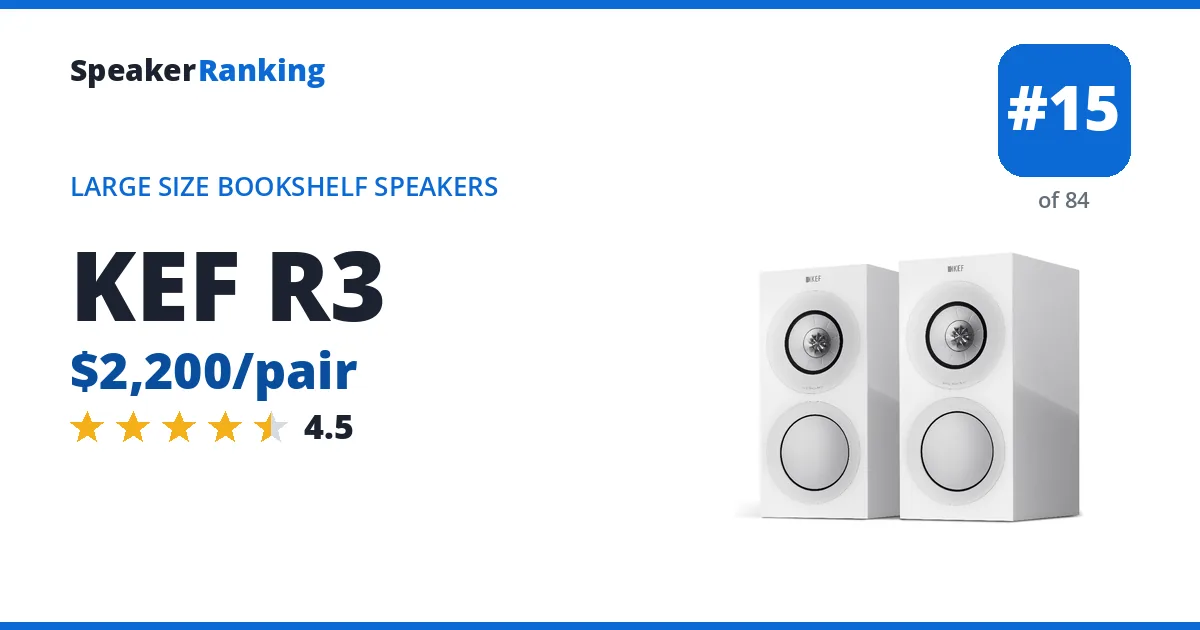
Pros: True three-way stand-mount with a 6.5-inch woofer below KEF’s 5-inch Uni-Q midrange/1-inch tweeter. Erin measured approximately 86-87dB/2.83V/1m sensitivity, exceptionally low sub-1% distortion at 86dB and orderly directivity in both planes. The coaxial geometry maintains image stability across seats, while Flexible Port Technology avoids the strong midrange port resonance common to rear-vented competitors. A 110W Parasound drove it successfully in Erin’s listening. Measured bass extension of 35.2Hz (-10dB), with a measured sensitivity of 87dB.
Cons: The low-frequency alignment rolls gradually rather than delivering high-output sub-bass; KEF specifies 58Hz +/-3dB and Erin’s high-level data supports using an 80Hz subwoofer crossover. Narrow high-frequency features and natural Uni-Q narrowing toward the top octave make toe angle audible, although off-axis tracking remains smooth. Sensitivity is moderate, the cabinet weighs almost 30 lb, and this original R3 lacks the Meta successor’s MAT absorber.
Full KEF R3 review and specifications →
| Bass Extension (-10dB) | 35.2Hz (measured, Audio Science Review) |
|---|---|
| Bass Extension (-3dB) | Approximately 58Hz (manufacturer specified; consistent with Erin’s measured roll-off) |
| DIY Kit | No |
| Dimensions | 16.6”H x 7.9”W x 13.2”D |
| Drivers | 1” tweeter coaxial with 5” midrange; 6.5” woofer |
| Impedance | 8 ohms nominal; suitable for Erin’s 4/8-ohm-rated amplifier |
| Sensitivity | Approximately 86-87dB/2.83V/1m (measured, Erin’s Audio Corner) |
| Spinorama Preference Score | 6.2 (spinorama.org) |
| Spinorama Preference Score with Perfect Sub | 7.97 (spinorama.org) |
| Weight | 29.9 lbs (13.55 kg) each |
| Woofer Cabinet | ported, rear Flexible Port |
- Links
- Reviews, Comparisons and Sound Samples
- Head-to-Head Comparisons
 Epos ES14N: £3,750 per pair Audio Venue (UK) eBay
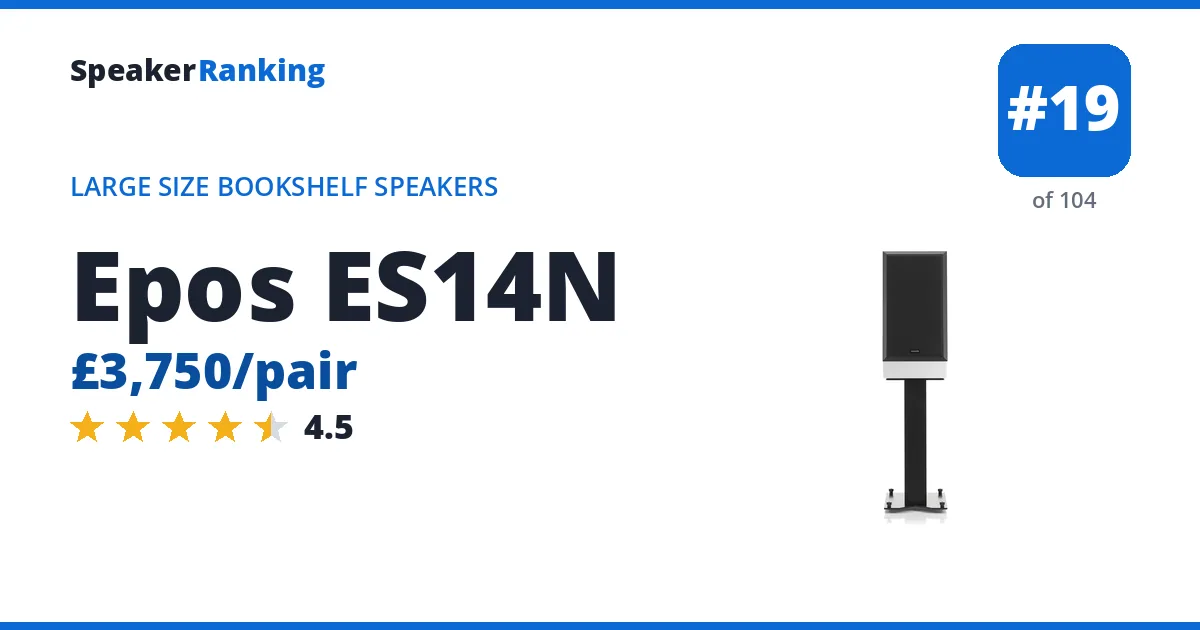
Pros: A revival of Epos’s classic 1980s ES-14, re-engineered by Karl-Heinz Fink’s FinkTeam with a chamfered, backward sloping baffle to time align a 28mm ceramic coated dome tweeter with a 7 inch mica filled polypropylene woofer. On axis deviation measures a clean 0.22dB average and the listening window response is smooth, and the larger woofer reaches a measured 51.2Hz at -3dB with a low 0.2% THD at 1W. Measured bass extension of 51.2Hz (-3dB).
Cons: Off axis sound tracks the on axis response less consistently than most measured speakers as frequency rises, so the room’s reflected sound differs more from what you hear directly. The bass alignment also measures a higher Q of 1.10, hinting at a mild bump near the port tuning frequency. At £3,750 to £4,400/pair depending on finish it is a serious investment, and dealer availability is limited outside the UK and Canada.
Full Epos ES14N review and specifications →
| Bass Extension (-10dB) | 35.3Hz (measured, spinorama.org data) |
|---|---|
| Bass Extension (-3dB) | 51.2Hz (measured, spinorama.org data) |
| Country | Germany |
| Crossover Frequency | 2.7kHz |
| DIY Kit | No |
| Dimensions | 19.3”H x 9.8”W x 15.2”D (491 x 250 x 385 mm) |
| Drivers | 28mm aluminum/ceramic compound dome tweeter, 7” mica filled polypropylene cone woofer |
| Enclosure | ported |
| Impedance | 6 ohms nominal, 4.3 ohms minimum |
| Sensitivity | 87dB @ 2.823V/1m |
| Spinorama Preference Score | 6.22 |
| Spinorama Preference Score with Perfect Sub | 7.82 |
| Weight | 35.3 lbs (16 kg) each |
- Links
- Reviews, Comparisons and Sound Samples
- Head-to-Head Comparisons