Short answer: the KEF R3. It ranks #15 of 130 bookshelf speakers by sound quality at $2200; the Dynaudio Special Forty ranks #86 and costs $3600, so there is not much of a tradeoff to weigh.
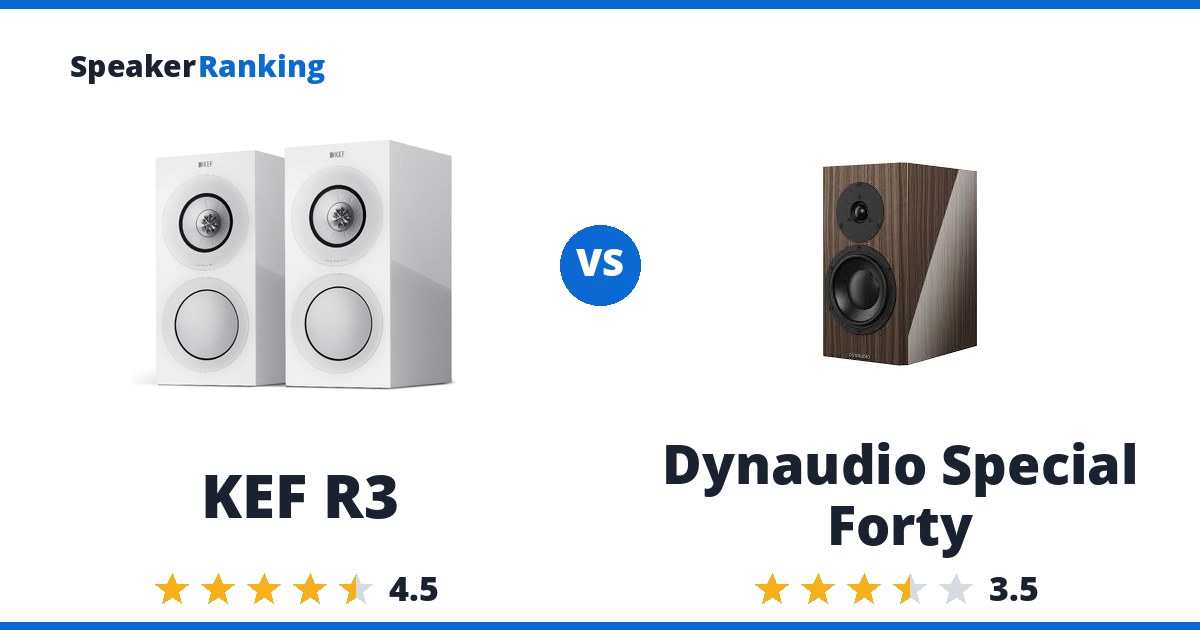
What the KEF R3 offers: True three-way stand-mount with a 6.5-inch woofer below KEF’s 5-inch Uni-Q midrange/1-inch tweeter. Erin measured approximately 86-87dB/2.83V/1m sensitivity, exceptionally low sub-1% distortion at 86dB and orderly directivity in both planes. The coaxial geometry maintains image stability across seats, while Flexible Port Technology avoids the strong midrange port resonance common to rear-vented competitors. A 110W Parasound drove it successfully in Erin’s listening. Watch for: The low-frequency alignment rolls gradually rather than delivering high-output sub-bass; KEF specifies 58Hz +/-3dB and Erin’s high-level data supports using an 80Hz subwoofer crossover. Narrow high-frequency features and natural Uni-Q narrowing toward the top octave make toe angle audible, although off-axis tracking remains smooth. Sensitivity is moderate, the cabinet weighs almost 30 lb, and this original R3 lacks the Meta successor’s MAT absorber.
What the Dynaudio Special Forty offers: Smooth, “buttery” overall tonal character consistent with Dynaudio’s house sound. Surprisingly precise, focused imaging despite wide horizontal radiation (about ±70°) - atypical, since wide-radiating speakers usually sacrifice some image precision in reflective rooms. Strong output capability: reached 100-101dB average at 3.5 meters with no audible distortion or woofer distress, and compression testing at 102dB shows the cabinet holding up mechanically well at extreme output. Bass reaches a genuine 50Hz (potentially 40Hz) in most rooms from a rear-ported design. Distortion stays below 1% at 86dB and doesn’t cross 3% THD until about 50Hz even at 96dB. Extra weight and impact on snares and percussion around 700-800Hz that the reviewer found appealing on many tracks. Watch for: A glaring, sometimes sibilant quality around 3-4kHz was the most noticeable issue in listening, the one thing the reviewer would want notched out with EQ. Multiple enclosure resonances appear between 500Hz-1kHz across on-axis, listening window, early-reflections, and sound-power measurements, corroborated by independent third-party CSD data showing similar 500-800Hz cabinet resonances. A dip around 1.2kHz traces to a cone-edge-to-surround compliance mismatch in the driver itself (confirmed by testing the bare driver’s impedance) - a known artifact common to many similarly-sized drivers across several manufacturers, contributing to elevated second-order distortion in that region. A somewhat laid-back, recessed 1-2kHz character (sometimes described as a “BBC dip”) gives an overall subdued quality that isn’t overtly problematic but shapes the tonal balance. Impedance drops below 3 ohms in the 100-200Hz region, requiring a genuinely 4-ohm-stable amplifier rather than an AVR. Rear port means it can’t be placed directly against a wall.
Buy the KEF R3. It ranks higher for sound quality than the Dynaudio Special Forty and costs less, so there is no real case for the other one.
Looking for alternatives? See the complete Passive Home rankings.
Specifications Side By Side
| KEF R3 | Dynaudio Special Forty | |
|---|---|---|
| Price | $2,200 per pair | $3600 per pair |
| Ranked | #15 of 130 in Large Size Bookshelf Speakers | #86 of 130 in Large Size Bookshelf Speakers |
| Bass Extension (-3dB) | Approximately 58Hz (manufacturer specified; consistent with Erin's measured roll-off) | 54Hz (measured, Erin's Audio Corner) |
| Bass Extension (-10dB) | 35.2Hz (measured, Audio Science Review) | 39Hz (measured, Erin's Audio Corner) |
| Sensitivity | Approximately 86-87dB/2.83V/1m (measured, Erin's Audio Corner) | 83.5dB (measured, Erin's Audio Corner; 86dB manufacturer specified) |
| Impedance | 8 ohms nominal; suitable for Erin's 4/8-ohm-rated amplifier | 6 ohms nominal (4.9 ohms minimum above 80Hz, measured, Erin's Audio Corner) |
| Drivers | 1" tweeter coaxial with 5" midrange; 6.5" woofer | 5.9" MSP (Magnesium Silicate Polymer) cone woofer, 1" Esotar soft dome tweeter |
| Dimensions | 16.6"H x 7.9"W x 13.2"D | 14.1"H x 7.7"W x 12.1"D (358.1 x 195.6 x 307.3 mm) |
| Woofer Cabinet | ported, rear Flexible Port | ported |
| Weight | - | 17.9 lbs (8.1 kg) each |
| Spinorama Preference Score | - | 3.85 |
| Spinorama Preference Score with Perfect Sub | - | 5.86 |
Related Speaker Comparisons
More worthwhile head-to-heads for KEF R3:
- KEF R3 vs Perlisten S4b
- KEF Reference 1 Meta vs KEF R3
- KEF R3 vs GR-Research NX-Studio
- AsciLab C6B vs KEF R3
- KEF R3 vs Audio First Cadentia 3
Prices on this page were last checked September 16, 2026 at 12:41 AM UTC. Product prices and availability are accurate as of that date/time and are subject to change; the price and availability shown on Amazon at the time of purchase will apply to the purchase of this product.
As an eBay Partner, we may be compensated if you make a purchase.
The Two Speakers In Full
 KEF R3: $2,200 per pair Amazon eBay
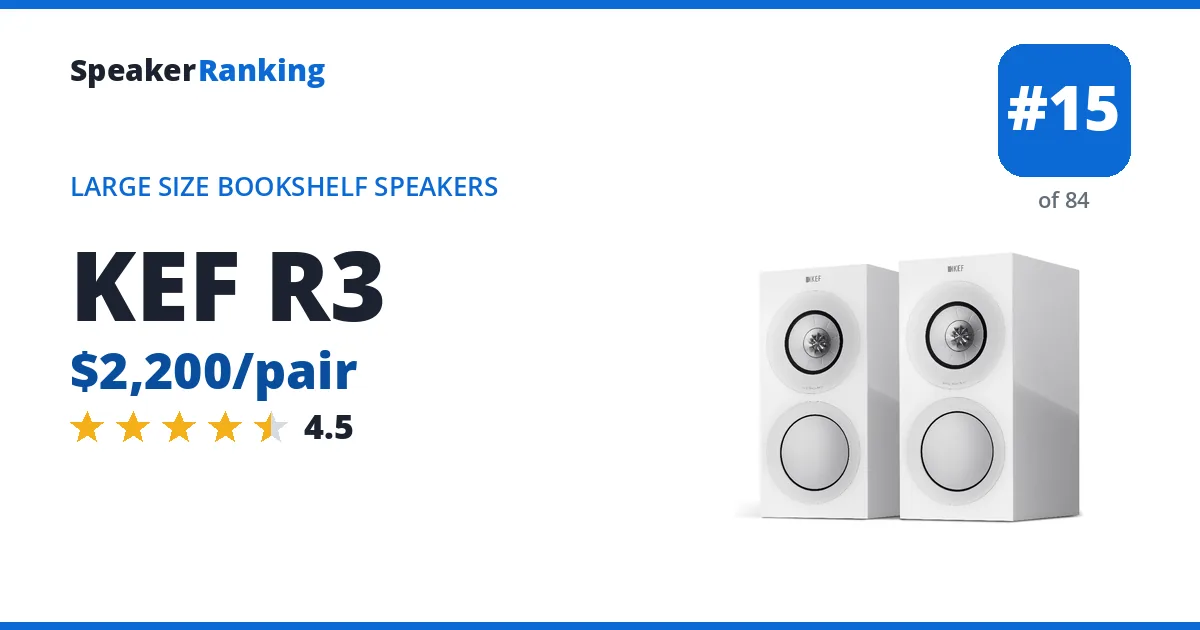
Pros: True three-way stand-mount with a 6.5-inch woofer below KEF’s 5-inch Uni-Q midrange/1-inch tweeter. Erin measured approximately 86-87dB/2.83V/1m sensitivity, exceptionally low sub-1% distortion at 86dB and orderly directivity in both planes. The coaxial geometry maintains image stability across seats, while Flexible Port Technology avoids the strong midrange port resonance common to rear-vented competitors. A 110W Parasound drove it successfully in Erin’s listening. Measured bass extension of 35.2Hz (-10dB), with a measured sensitivity of 87dB.
Cons: The low-frequency alignment rolls gradually rather than delivering high-output sub-bass; KEF specifies 58Hz +/-3dB and Erin’s high-level data supports using an 80Hz subwoofer crossover. Narrow high-frequency features and natural Uni-Q narrowing toward the top octave make toe angle audible, although off-axis tracking remains smooth. Sensitivity is moderate, the cabinet weighs almost 30 lb, and this original R3 lacks the Meta successor’s MAT absorber.
Full KEF R3 review and specifications →
| Bass Extension (-10dB) | 35.2Hz (measured, Audio Science Review) |
|---|---|
| Bass Extension (-3dB) | Approximately 58Hz (manufacturer specified; consistent with Erin's measured roll-off) |
| Dimensions | 16.6"H x 7.9"W x 13.2"D |
| Drivers | 1" tweeter coaxial with 5" midrange; 6.5" woofer |
| Impedance | 8 ohms nominal; suitable for Erin's 4/8-ohm-rated amplifier |
| Sensitivity | Approximately 86-87dB/2.83V/1m (measured, Erin's Audio Corner) |
| Woofer Cabinet | ported, rear Flexible Port |
- Links
- Reviews, Comparisons and Sound Samples
- Head-to-Head Comparisons
 Dynaudio Special Forty: $3600 per pair Safeandsoundhq eBay
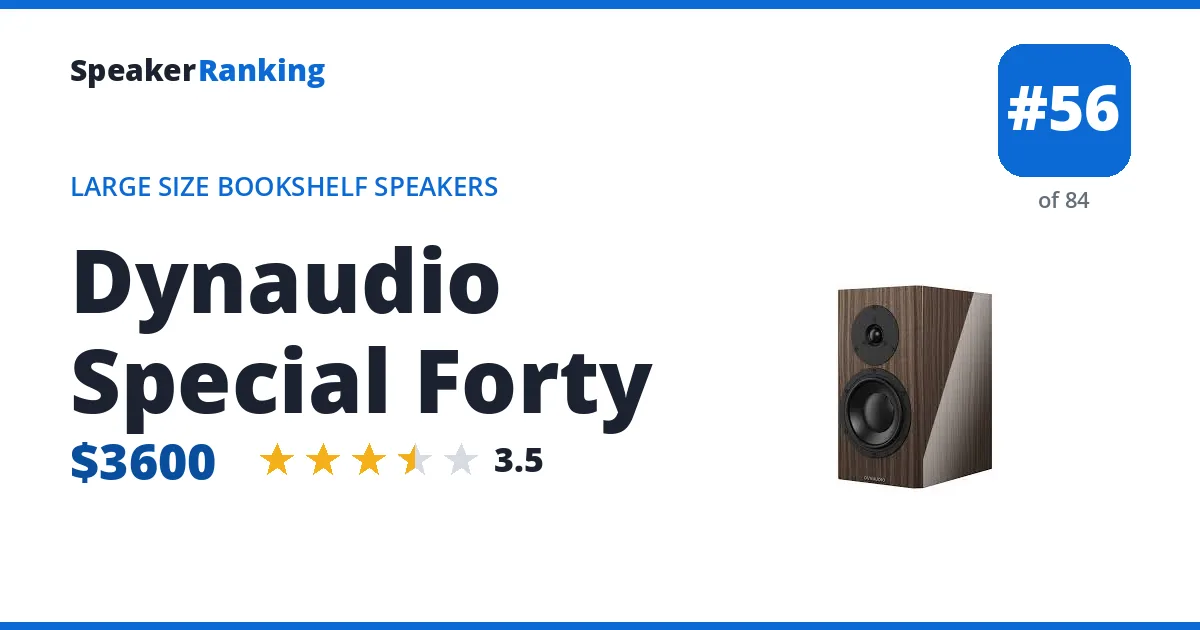
Pros: Smooth, “buttery” overall tonal character consistent with Dynaudio’s house sound. Surprisingly precise, focused imaging despite wide horizontal radiation (about ±70°) - atypical, since wide-radiating speakers usually sacrifice some image precision in reflective rooms. Strong output capability: reached 100-101dB average at 3.5 meters with no audible distortion or woofer distress, and compression testing at 102dB shows the cabinet holding up mechanically well at extreme output. Bass reaches a genuine 50Hz (potentially 40Hz) in most rooms from a rear-ported design. Distortion stays below 1% at 86dB and doesn’t cross 3% THD until about 50Hz even at 96dB. Extra weight and impact on snares and percussion around 700-800Hz that the reviewer found appealing on many tracks. Measured bass extension of 54Hz (-3dB), with a measured sensitivity of 83.5dB.
Cons: A glaring, sometimes sibilant quality around 3-4kHz was the most noticeable issue in listening, the one thing the reviewer would want notched out with EQ. Multiple enclosure resonances appear between 500Hz-1kHz across on-axis, listening window, early-reflections, and sound-power measurements, corroborated by independent third-party CSD data showing similar 500-800Hz cabinet resonances. A dip around 1.2kHz traces to a cone-edge-to-surround compliance mismatch in the driver itself (confirmed by testing the bare driver’s impedance) - a known artifact common to many similarly-sized drivers across several manufacturers, contributing to elevated second-order distortion in that region. A somewhat laid-back, recessed 1-2kHz character (sometimes described as a “BBC dip”) gives an overall subdued quality that isn’t overtly problematic but shapes the tonal balance. Impedance drops below 3 ohms in the 100-200Hz region, requiring a genuinely 4-ohm-stable amplifier rather than an AVR. Rear port means it can’t be placed directly against a wall.
Full Dynaudio Special Forty review and specifications →
| Bass Extension (-10dB) | 39Hz (measured, Erin's Audio Corner) |
|---|---|
| Bass Extension (-3dB) | 54Hz (measured, Erin's Audio Corner) |
| Dimensions | 14.1"H x 7.7"W x 12.1"D (358.1 x 195.6 x 307.3 mm) |
| Drivers | 5.9" MSP (Magnesium Silicate Polymer) cone woofer, 1" Esotar soft dome tweeter |
| Impedance | 6 ohms nominal (4.9 ohms minimum above 80Hz, measured, Erin's Audio Corner) |
| Sensitivity | 83.5dB (measured, Erin's Audio Corner; 86dB manufacturer specified) |
| Spinorama Preference Score | 3.85 |
| Spinorama Preference Score with Perfect Sub | 5.86 |
| Weight | 17.9 lbs (8.1 kg) each |
| Woofer Cabinet | ported |
- Links
- Reviews, Comparisons and Sound Samples
- Head-to-Head Comparisons
- Dynaudio Special Forty vs ELAC Debut 2.0 B6.2
- Dynaudio Special Forty vs SVS Prime Bookshelf
- Dynaudio Special Forty vs Infinity IL10
- Dynaudio Special Forty vs KEF Q3 Meta
- Dynaudio Special Forty vs GR-Research X-LS Encore
- Dynaudio Special Forty vs Polk Monitor XT20
- Dynaudio Special Forty vs Sonus Faber Lumina II
- Dynaudio Special Forty vs XTZ Spirit 4
- See all 54 comparisons