Short answer: the KEF R3 for predictable subwoofer integration; the Dynaudio Heritage Special is the more enjoyable listen despite measuring flawed. The Dynaudio is a rare case where the reviewer measured a speaker as flawed but still enjoyed it, though at low volumes its dynamic range and kick-drum punch fell short of higher-sensitivity speakers. The KEF R3’s bass rolls gradually: KEF specifies 58Hz +/-3dB, and Erin’s data supports an 80Hz subwoofer crossover.
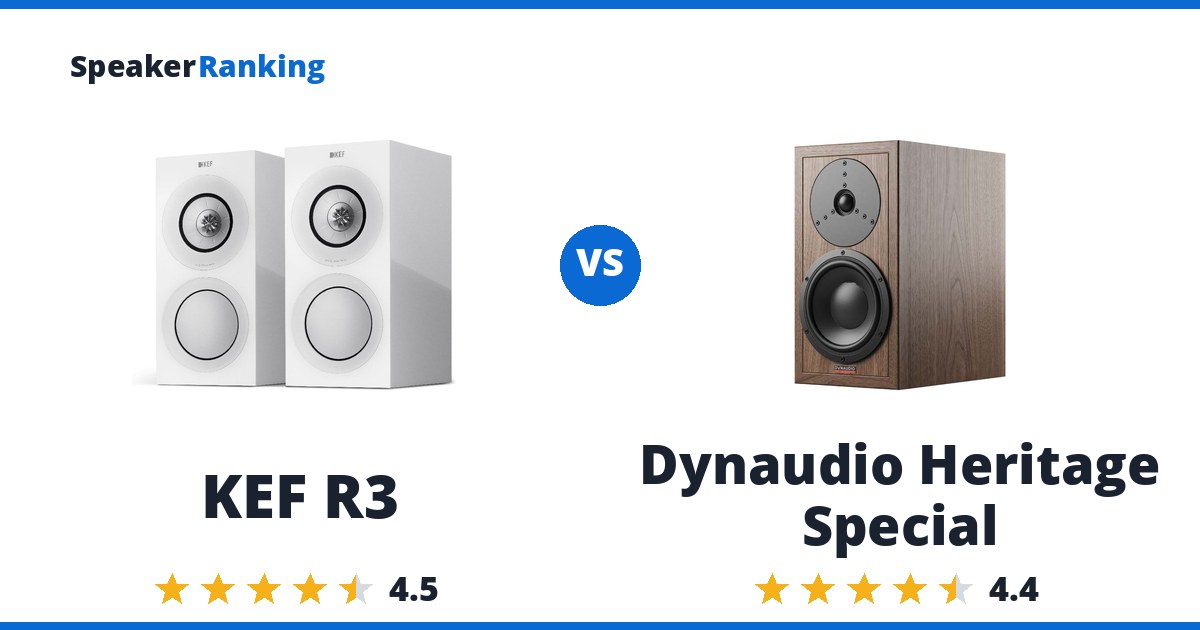
Buy the KEF R3. It is rated higher for sound quality than the Dynaudio Heritage Special and costs less, so only choose the other one for a particular feature it does better.
Still deciding? The full Passive Home rankings cover every ranked option.
Specifications Side By Side
| KEF R3 | Dynaudio Heritage Special | |
|---|---|---|
| Price | $2,200 per pair | $7,000 per pair |
| Ranked | #15 of 134 in Large Size Bookshelf Speakers | #28 of 134 in Large Size Bookshelf Speakers |
| Bass Extension (-3dB) | Approximately 58Hz (manufacturer specified; consistent with Erin’s measured roll-off) | 52Hz (measured, Erin’s Audio Corner) |
| Bass Extension (-10dB) | 35.2Hz (measured, Audio Science Review) | 38Hz (measured, Erin’s Audio Corner) |
| Sensitivity | Approximately 86-87dB/2.83V/1m (measured, Erin’s Audio Corner) | 85dB (measured at 2.83V/1m, Erin’s Audio Corner) |
| Impedance | 8 ohms nominal; suitable for Erin’s 4/8-ohm-rated amplifier | 5.1 ohms minimum, ported mode (measured, Erin’s Audio Corner) |
| Drivers | 1” tweeter coaxial with 5” midrange; 6.5” woofer | 18cm MSP cone woofer, 28mm Esotar 3 dome tweeter |
| Dimensions | 16.6”H x 7.9”W x 13.2”D | 15.2”H x 8.2”W x 12.6”D (385 x 208 x 320 mm) |
| Woofer Cabinet | ported, rear Flexible Port | - |
| Weight | 29.9 lbs (13.55 kg) each | 24.3 lbs (11 kg) each |
| Spinorama Preference Score | 6.2 (spinorama.org) | 4.32 |
| Spinorama Preference Score with Perfect Sub | 7.97 (spinorama.org) | 6.33 |
| DIY Kit | No | No |
| Country | - | Denmark |
Related Speaker Comparisons
More top alternatives to KEF R3:
- TAD Compact Reference One (CR1TX) vs KEF R3
- KEF R3 vs Perlisten S4b
- KEF Reference 1 Meta vs KEF R3
- KEF R3 vs GR-Research NX-Studio
- March Audio Sointuva AWG vs KEF R3
Prices on this page were last checked October 2, 2026 at 10:18 PM UTC. Product prices and availability are accurate as of that date/time and are subject to change; the price and availability shown on Amazon at the time of purchase will apply to the purchase of this product.
As an eBay Partner, we may be compensated if you make a purchase.
The Two Speakers In Full
 KEF R3: $2,200 per pair Amazon eBay
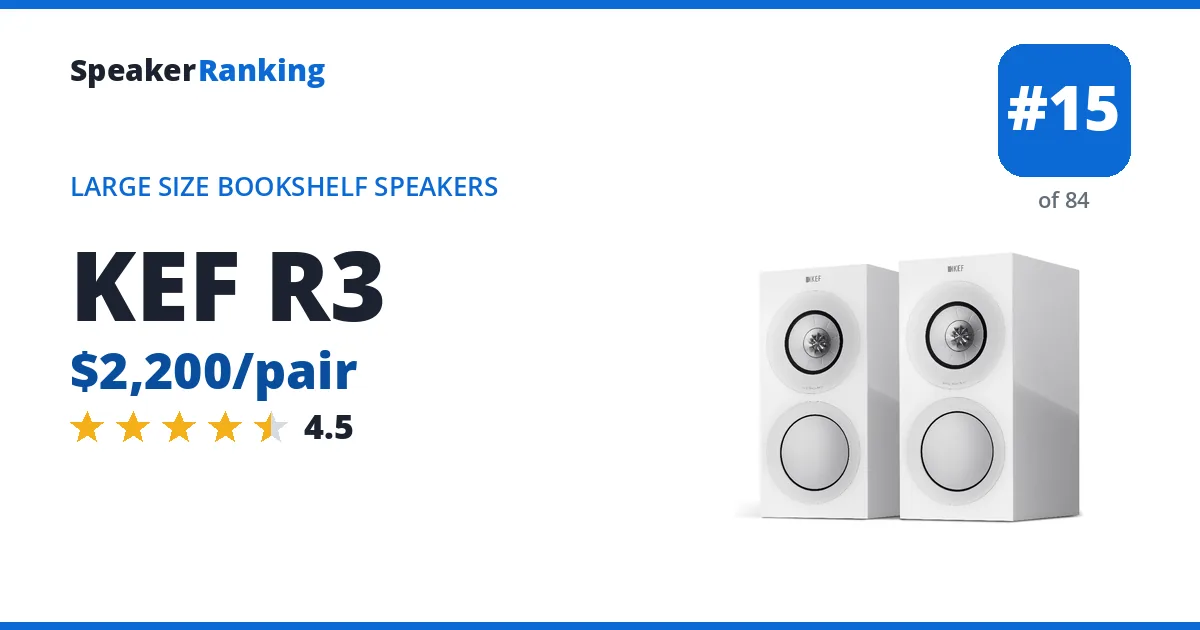
Pros: True three-way stand-mount with a 6.5-inch woofer below KEF’s 5-inch Uni-Q midrange/1-inch tweeter. Erin measured approximately 86-87dB/2.83V/1m sensitivity, exceptionally low sub-1% distortion at 86dB and orderly directivity in both planes. The coaxial geometry maintains image stability across seats, while Flexible Port Technology avoids the strong midrange port resonance common to rear-vented competitors. A 110W Parasound drove it successfully in Erin’s listening. Measured bass extension of 35.2Hz (-10dB), with a measured sensitivity of 87dB.
Cons: The low-frequency alignment rolls gradually rather than delivering high-output sub-bass; KEF specifies 58Hz +/-3dB and Erin’s high-level data supports using an 80Hz subwoofer crossover. Narrow high-frequency features and natural Uni-Q narrowing toward the top octave make toe angle audible, although off-axis tracking remains smooth. Sensitivity is moderate, the cabinet weighs almost 30 lb, and this original R3 lacks the Meta successor’s MAT absorber.
Full KEF R3 review and specifications →
| Bass Extension (-10dB) | 35.2Hz (measured, Audio Science Review) |
|---|---|
| Bass Extension (-3dB) | Approximately 58Hz (manufacturer specified; consistent with Erin’s measured roll-off) |
| DIY Kit | No |
| Dimensions | 16.6”H x 7.9”W x 13.2”D |
| Drivers | 1” tweeter coaxial with 5” midrange; 6.5” woofer |
| Impedance | 8 ohms nominal; suitable for Erin’s 4/8-ohm-rated amplifier |
| Sensitivity | Approximately 86-87dB/2.83V/1m (measured, Erin’s Audio Corner) |
| Spinorama Preference Score | 6.2 (spinorama.org) |
| Spinorama Preference Score with Perfect Sub | 7.97 (spinorama.org) |
| Weight | 29.9 lbs (13.55 kg) each |
| Woofer Cabinet | ported, rear Flexible Port |
- Links
- Reviews, Comparisons and Sound Samples
- Erin’s Audio Corner: KEF R3 Review More from Erin’s Audio Corner →
- Erin’s Audio Corner Website: KEF R3
- Audio Science Review Measurements More from Audio Science Review →
- Audio Science Review Measurements (spinorama.org)
- Erin’s Audio Corner: Which is Better for Home Theater: (3) Kef R3 or (3) Kef R2c Center Channel speakers?
- Erin’s Audio Corner: KEF R3 vs R3 Meta vs Reference 1 Meta. Why such a big price gap?
- Head-to-Head Comparisons
 Dynaudio Heritage Special: $7,000 per pair Safe and Sound HQ eBay
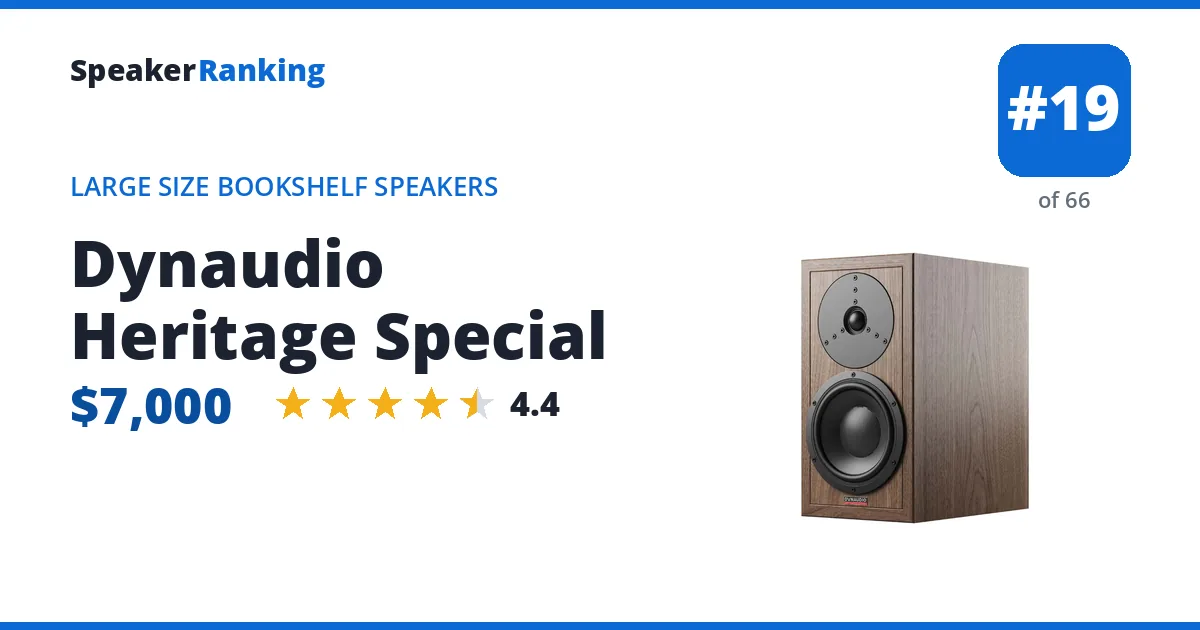
Pros: One of the rare cases where the reviewer measured a speaker as flawed but still genuinely enjoyed listening to it. A massive 4” voice coil on the midwoofer gives it exceptional output capability for a bookshelf speaker: averaged 100dB at 3.5 meters with no audible mechanical noise, port chuffing, or woofer bottoming even when deliberately pushed hard. Bass is very robust and doesn’t noticeably give up output as volume increases, staying solid at both low and high listening levels. Big, well-proportioned soundstage: wide without losing image focus. Limited run of 2,500 pairs with genuine collectible/heritage value; the tweeter (Esotar 3) and midwoofer both use premium Dynaudio-made drivers with an unusually wide, stout voice coil. Measured bass extension of 52Hz (-3dB), with a measured sensitivity of 85dB.
Cons: At lower listening volumes, dynamic range and kick-drum punch fell short of higher-sensitivity speakers the reviewer has tested (JBL 4367, KEF Reference 1 Meta): the sheer output ceiling is impressive, but it isn’t a highly dynamic-sounding speaker at modest levels. A degree of “softness” in the upper mid-range. Selective sibilance in the 4-6kHz treble region that shows up on some tracks but not others, which the reviewer found mildly aggravating and would want to EQ down given the choice. Neither the tweeter nor the woofer is fully flush-mounted to the baffle, likely intentional as part of the heritage-styled look, but the reviewer wonders how much this affected linearity. At $7000/pair (and a discontinued limited run, so used/open-box pricing around $5,000/pair is about the best you’ll do now), this is a serious investment for a bookshelf speaker.
Full Dynaudio Heritage Special review and specifications →
| Bass Extension (-10dB) | 38Hz (measured, Erin’s Audio Corner) |
|---|---|
| Bass Extension (-3dB) | 52Hz (measured, Erin’s Audio Corner) |
| Country | Denmark |
| DIY Kit | No |
| Dimensions | 15.2”H x 8.2”W x 12.6”D (385 x 208 x 320 mm) |
| Drivers | 18cm MSP cone woofer, 28mm Esotar 3 dome tweeter |
| Impedance | 5.1 ohms minimum, ported mode (measured, Erin’s Audio Corner) |
| Sensitivity | 85dB (measured at 2.83V/1m, Erin’s Audio Corner) |
| Spinorama Preference Score | 4.32 |
| Spinorama Preference Score with Perfect Sub | 6.33 |
| Weight | 24.3 lbs (11 kg) each |
- Links
- Reviews, Comparisons and Sound Samples
- Head-to-Head Comparisons
- Dynaudio Heritage Special vs Radiant Acoustics Clarity 6.2
- Dynaudio Heritage Special vs MoFi SourcePoint 10
- Dynaudio Heritage Special vs Wharfedale Linton 85
- Dynaudio Heritage Special vs Wharfedale Super Linton
- Dynaudio Heritage Special vs Ascend Acoustics Sierra-LX
- Dynaudio Heritage Special vs Ascend Acoustics CMT-340 SE2
- Dynaudio Heritage Special vs Arendal 1528 Monitor 8
- Dynaudio Heritage Special vs Revel M126Be
- See all 47 comparisons