Short answer: the KEF LSX II LT. It ranks #35 of 100 powered bookshelf speakers by sound quality (rated 4.0/5); the Donner Dyna 3 ranks #97 (rated 1.8/5).
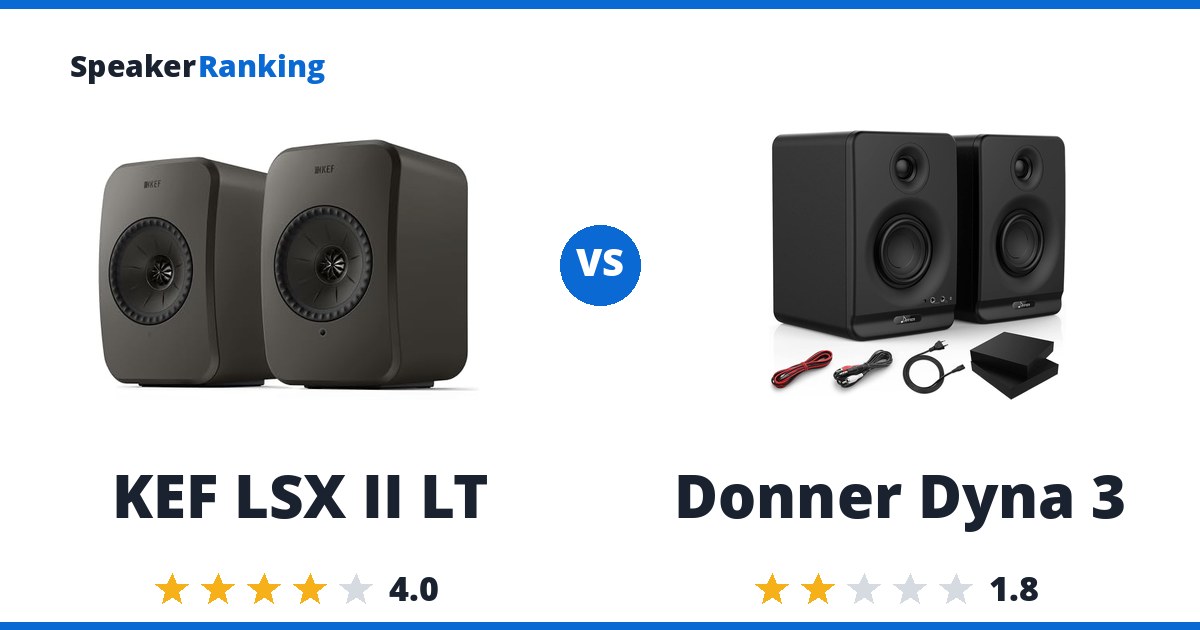
The KEF LSX II LT is the more accurate, deeper-bass pick. The coincident driver provides useful consistency across listening positions, and the app offers placement and subwoofer adjustments. Its measured preference score, a predictor of how neutral it sounds, is 4.81 against -0.06 for the Donner Dyna 3. Its bass reaches about 55Hz before falling 3dB, against 85Hz for the Donner Dyna 3. The catch: The 3.4dB midrange response span and treble-region dips keep it below more neutral monitors.
The case for the Donner Dyna 3: A low-cost powered desktop pair with several input options and a small footprint. It keeps a wired aux input, which the KEF LSX II LT lacks. The catch: Erin’s Klippel measurements give a negative standalone preference score of -0.06 and only 3.24 with an ideal subwoofer.
Buy the KEF LSX II LT. It is rated higher for sound quality than the Donner Dyna 3.
Looking for alternatives? See the complete Powered Home rankings.
Specifications Side By Side
| KEF LSX II LT | Donner Dyna 3 | |
|---|---|---|
| Price | $549.99 per pair | - |
| Ranked | #35 of 100 in Medium Size Powered Bookshelf Speakers | #97 of 100 in Medium Size Powered Bookshelf Speakers |
| Dimensions | 9.5”H x 6.1”W x 7.1”D (241.3 x 154.9 x 180.3 mm) | 5.4” x 5.9” x 8.1” (136 x 150 x 205 mm) |
| Inputs | Wifi, USB-C, HDMI, Optical, Bluetooth | Bluetooth, TRS, RCA and 3.5mm |
| Outputs | RCA Subwoofer | - |
| Drivers | 115mm (4.5in.) magnesium/aluminium alloy cone woofer, 19mm (0.75in.) aluminium dome tweeter | 1” dome tweeter; 3” woofer |
| Weight | 15 lbs (6.8 kg) | - |
| App | No | - |
| Bluetooth | Yes | Yes |
| EQ | No | - |
| Amplifier Power | 100w RMS Per Speaker | Built in |
| Bass Extension (-3dB) | 55Hz (measured, Erin’s Audio Corner) | 85.0Hz (measured, Erin’s Audio Corner) |
| Bass Extension (-10dB) | 46Hz (measured, Erin’s Audio Corner) | 66.8Hz (measured, Erin’s Audio Corner) |
| Sensitivity | 84dB (measured at 0.3V/1m, Erin’s Audio Corner) | - |
| Spinorama Preference Score | 4.81 | -0.06 |
| Spinorama Preference Score with Perfect Sub | 7.03 | 3.24 |
| Subwoofer Output | Yes | - |
| XLR Input | No | No |
| RCA Input | No | Yes |
| TRS Input | No | Yes |
| Optical Input | Yes | No |
| Coaxial Input | No | No |
| USB Input | Yes | No |
| HDMI Input | Yes | No |
| AES Input | No | No |
| Aux Input | No | Yes |
| Frequency Response | 54Hz - 28kHz (±3dB) (Manufacturer specified) | 80Hz - 22kHz (Manufacturer specified) |
| Bass Extension | - | Limited by 3” woofer (Erin’s Audio Corner measurement) |
| Bluetooth Version | - | 5.0 |
Related Speaker Comparisons
More top alternatives to KEF LSX II LT:
- KEF LSX II LT vs Genelec 8331A
- KEF LSX II LT vs Neumann KH120 MKII
- Genelec 8030C vs KEF LSX II LT
- KEF LSX II LT vs Neumann KH80 DSP
- KEF LSX II LT vs Reflector Audio Square Two
Prices on this page were last checked October 7, 2026 at 9:25 PM UTC. Product prices and availability are accurate as of that date/time and are subject to change; the price and availability shown on Amazon at the time of purchase will apply to the purchase of this product.
As an eBay Partner, we may be compensated if you make a purchase.
The Two Speakers In Full
 KEF LSX II LT: $549.99 per pair Amazon eBay
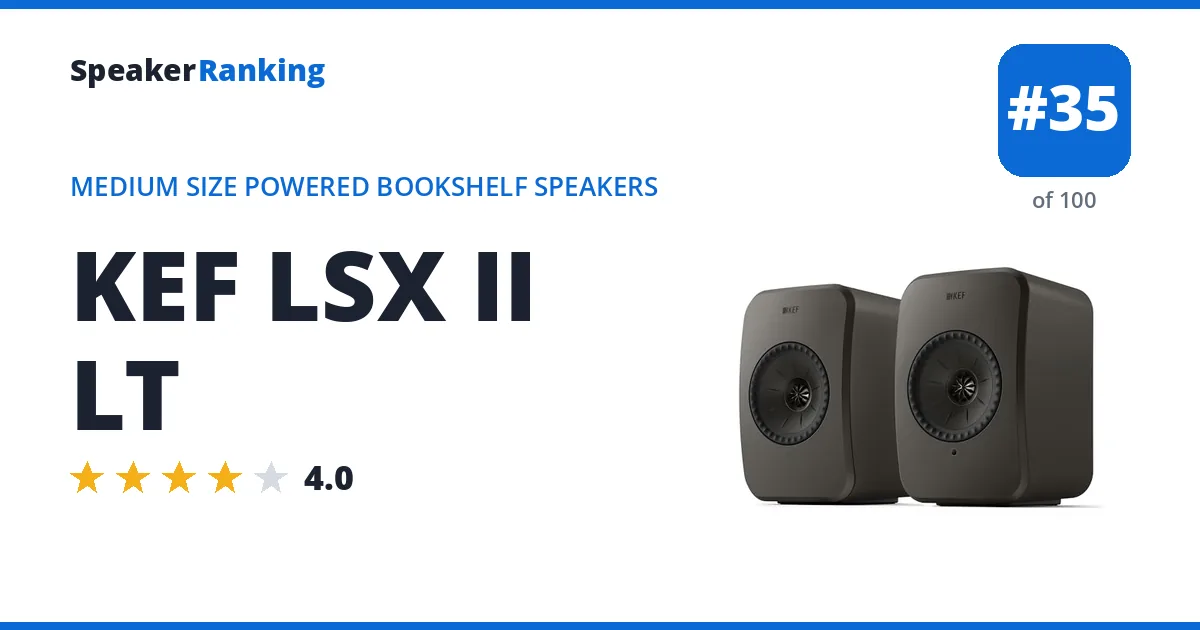
Same family: the KEF LSX II (larger bookshelf, estimated 4.1/5), the KEF LS50 Wireless II (larger bookshelf, ranked higher, rated 4.3/5) and the KEF LS60 (floorstanding, rated 4.8/5).
Pros: The coincident driver provides useful consistency across listening positions, and the app offers placement and subwoofer adjustments. Erin’s measurements give preference scores of 4.81 standalone and 7.03 with an ideal subwoofer, with -3dB bass around 56Hz. HDMI and USB connectivity make it convenient for a small TV or desktop system. Horizontal and vertical dispersion both reach about ±60°, giving a broad sweet spot for more than one seat. Measured bass extension of 55Hz (-3dB), with a measured sensitivity of 84dB.
Cons: The 3.4dB midrange response span and treble-region dips keep it below more neutral monitors. The existing review finds bass compression around 88-92dB/1m and rising distortion at higher levels, so the small drivers suit close listening rather than a large room. This LT version has no analog input; a turntable cannot plug straight into it.
Full KEF LSX II LT review and specifications →
| AES Input | No |
|---|---|
| Amplifier Power | 100w RMS Per Speaker |
| App | No |
| Aux Input | No |
| Bass Extension (-10dB) | 46Hz (measured, Erin’s Audio Corner) |
| Bass Extension (-3dB) | 55Hz (measured, Erin’s Audio Corner) |
| Bluetooth | Yes |
| Coaxial Input | No |
| Dimensions | 9.5”H x 6.1”W x 7.1”D (241.3 x 154.9 x 180.3 mm) |
| Drivers | 115mm (4.5in.) magnesium/aluminium alloy cone woofer, 19mm (0.75in.) aluminium dome tweeter |
| EQ | No |
| Frequency Response | 54Hz - 28kHz (±3dB) (Manufacturer specified) |
| HDMI Input | Yes |
| Inputs | Wifi, USB-C, HDMI, Optical, Bluetooth |
| Optical Input | Yes |
| Outputs | RCA Subwoofer |
| RCA Input | No |
| Sensitivity | 84dB (measured at 0.3V/1m, Erin’s Audio Corner) |
| Spinorama Preference Score | 4.81 |
| Spinorama Preference Score with Perfect Sub | 7.03 |
| Subwoofer Output | Yes |
| TRS Input | No |
| USB Input | Yes |
| Weight | 15 lbs (6.8 kg) |
| XLR Input | No |
- Links
- Reviews, Comparisons and Sound Samples
- Erin’s Audio Corner: Transform Your Sound System with the KEF LSX II LT Speaker More from Erin’s Audio Corner →
- Erin’s Audio Corner Website: KEF LSX II LT
- Erin’s Audio Corner Measurements (spinorama.org)
- Jasper Tech: Best Desktop Computer Speakers for Every Budget – 2026 More from Jasper Tech →
- Jasper Tech: Best Bookshelf Speakers For TV & Gaming - 2025
- Jasper Tech: Best Powered Bookshelf Speakers for Every Budget - 2025
- Head-to-Head Comparisons
 Donner Dyna 3 eBay
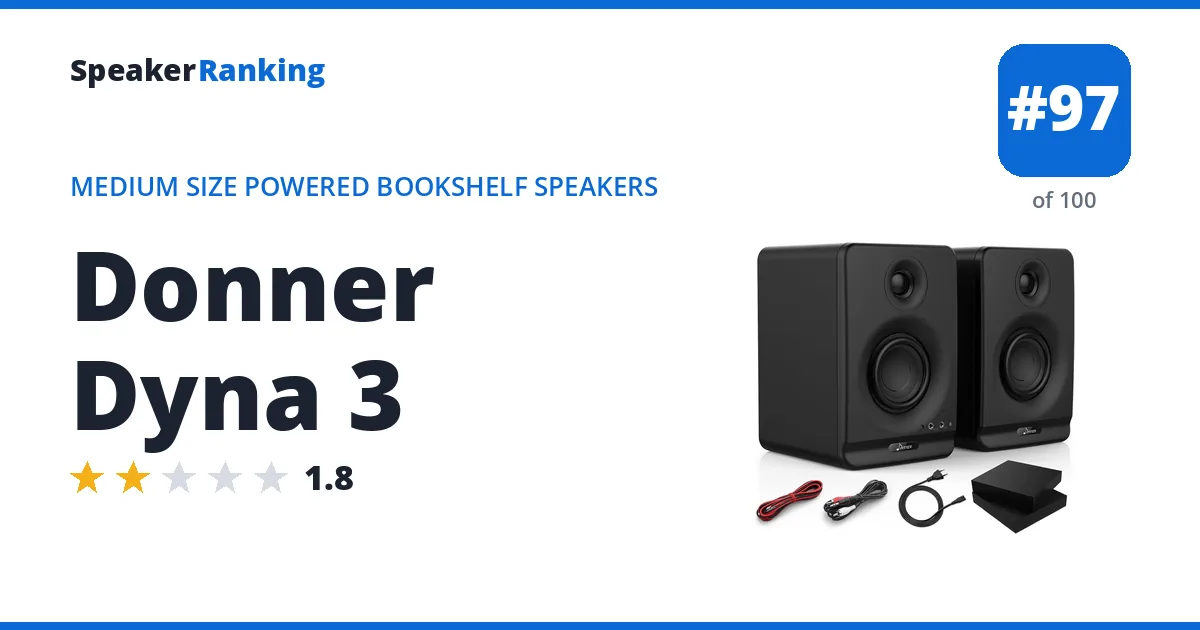
Pros: A low-cost powered desktop pair with several input options and a small footprint. It can provide basic close-range background playback without an external amplifier. Measured bass extension of 85.0Hz (-3dB).
Cons: Erin’s Klippel measurements give a negative standalone preference score of -0.06 and only 3.24 with an ideal subwoofer. The response spans 8.2dB from 300Hz to 5kHz, with large listening-window irregularities. Bass reaches -3dB around 85Hz, and the existing review reports distortion and compression limits. It is not a credible neutral studio monitor despite that style of marketing.
Full Donner Dyna 3 review and specifications →
| AES Input | No |
|---|---|
| Amplifier Power | Built in |
| Aux Input | Yes |
| Bass Extension | Limited by 3” woofer (Erin’s Audio Corner measurement) |
| Bass Extension (-10dB) | 66.8Hz (measured, Erin’s Audio Corner) |
| Bass Extension (-3dB) | 85.0Hz (measured, Erin’s Audio Corner) |
| Bluetooth | Yes |
| Bluetooth Version | 5.0 |
| Coaxial Input | No |
| Dimensions | 5.4” x 5.9” x 8.1” (136 x 150 x 205 mm) |
| Drivers | 1” dome tweeter; 3” woofer |
| Frequency Response | 80Hz - 22kHz (Manufacturer specified) |
| HDMI Input | No |
| Inputs | Bluetooth, TRS, RCA and 3.5mm |
| Optical Input | No |
| RCA Input | Yes |
| Spinorama Preference Score | -0.06 |
| Spinorama Preference Score with Perfect Sub | 3.24 |
| TRS Input | Yes |
| USB Input | No |
| XLR Input | No |
- Links
- Reviews, Comparisons and Sound Samples
- Head-to-Head Comparisons