Short answer: the KEF LSX II LT is the compact connected system, while the Neumann KH120 MKII is the much more serious accuracy monitor. KEF’s coaxial arrangement offers coherent point-source behavior but its small drivers compress bass once output rises beyond nearfield levels. Neumann’s response and distortion performance are exceptional, with a minor 2kHz directivity blip, but it costs $1450.01 more.
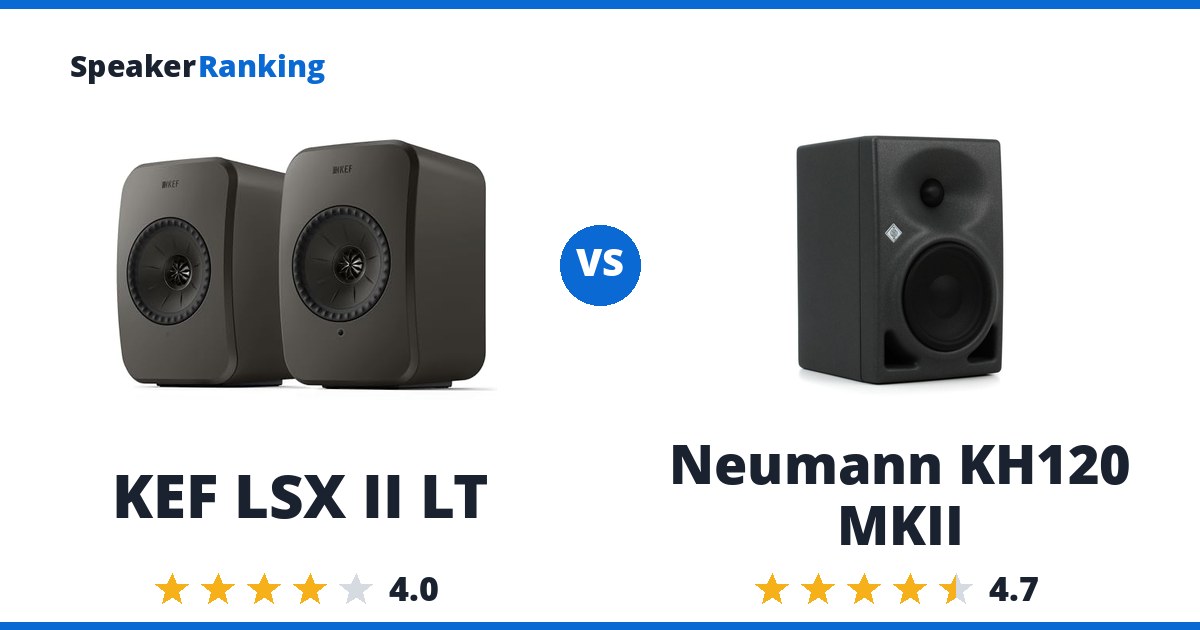
On the KEF LSX II LT side: Coaxial (Uni-Q-style) driver keeps the tweeter centered in the midrange. The tradeoff: Small drivers mean it’s SPL-limited: bass compression kicks in around 88-92dB/1m per speaker.
The case for the Neumann KH120 MKII: CEA2034 spinorama is about as flat as the reviewer has measured, with excellent directivity aside from a small blip around 2kHz. Set against that: A minor directivity blip appears around 2kHz.
Buy the KEF LSX II LT if you want a compact, user-friendly powered system for moderate listening levels.
Buy the Neumann KH120 MKII if critical monitoring accuracy and clean output are worth the higher investment.
Want more options? Browse the full Powered Home rankings.
Specifications Side By Side
| KEF LSX II LT | Neumann KH120 MKII | |
|---|---|---|
| Price | $549.99 per pair | $2000 per pair |
| Ranked | #26 of 65 in Medium Size Powered Bookshelf Speakers | #2 of 65 in Medium Size Powered Bookshelf Speakers |
| Dimensions | 9.5"H x 6.1"W x 7.1"D (241.3 x 154.9 x 180.3 mm) | 11.3"H x 7.2"W x 8.9"D (287 x 182.9 x 226.1 mm) |
| Inputs | Wifi, USB-C, HDMI, Optical, Bluetooth | XLR |
| Outputs | RCA Subwoofer | - |
| Drivers | 115mm (4.5in.) magnesium/aluminium alloy cone woofer, 19mm (0.75in.) aluminium dome tweeter | 5.25" woofer, 1" titanium fabric dome tweeter |
| Weight | 15 lbs (6.8 kg) | 14.6 lbs (6.6 kg) each |
| App | No | Yes (MA 1 alignment) |
| Bluetooth | No | No |
| EQ | No | Yes (via DSP) |
| Amplifier Power | 100w RMS Per Speaker | 245W (145W woofer + 100W tweeter) |
| Bass Extension (-3dB) | 55Hz (measured, Erin's Audio Corner) | 46Hz (measured, Audio Science Review) |
| Bass Extension (-10dB) | 46Hz (measured, Erin's Audio Corner) | 36Hz (measured, Audio Science Review) |
| Sensitivity | 84dB (measured at 0.3V/1m, Erin's Audio Corner) | - |
| Spinorama Preference Score | 3.26 | 5.75 |
| Spinorama Preference Score with Perfect Sub | 5.62 | 7.70 |
| Subwoofer Output | Yes | - |
| XLR Input | No | Yes |
| RCA Input | No | No |
| TRS Input | No | No |
| Optical Input | Yes | No |
| Coaxial Input | No | No |
| USB Input | Yes | No |
| HDMI Input | Yes | No |
| AES Input | No | No |
| Aux Input | No | No |
| Frequency Response | 54Hz - 28kHz (±3dB) (Manufacturer specified) | 44Hz - 21kHz (±3dB) (Manufacturer specified) |
| DSP | - | Yes |
| Maximum SPL | - | 116.8dB @ 1m (manufacturer specified) |
Related Speaker Comparisons
How Neumann KH120 MKII compares with other leading options:
- Genelec 8331A vs Neumann KH120 MKII
- Genelec 8030C vs Neumann KH120 MKII
- Neumann KH120 MKII vs Neumann KH80 DSP
- Neumann KH120 MKII vs Dynaudio LYD 5
- Neumann KH120 MKII vs Genelec 8330A
Prices on this page were last checked September 23, 2026 at 11:24 PM UTC. Product prices and availability are accurate as of that date/time and are subject to change; the price and availability shown on Amazon at the time of purchase will apply to the purchase of this product.
As an eBay Partner, we may be compensated if you make a purchase.
The Two Speakers In Full
 KEF LSX II LT: $549.99 per pair Amazon eBay
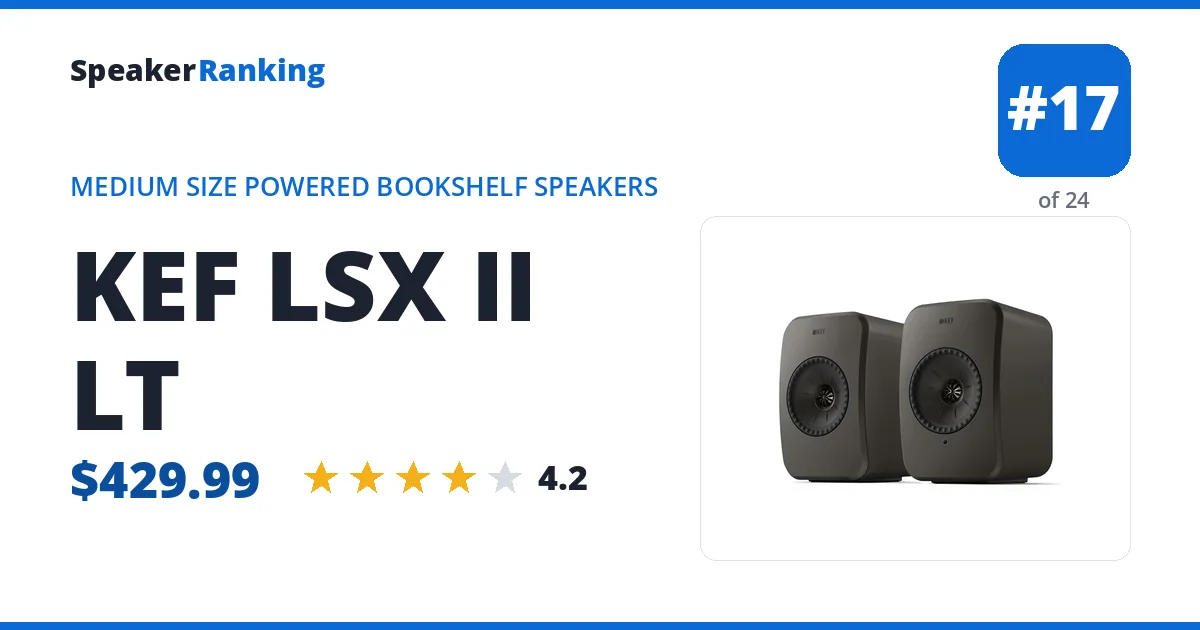
Pros: The coincident driver provides useful consistency across listening positions, and the app offers placement and subwoofer adjustments. Erin’s measurements give preference scores of 3.93 standalone and 6.16 with an ideal subwoofer, with -3dB bass around 56Hz. HDMI and USB connectivity make it convenient for a small TV or desktop system. Measured bass extension of 55Hz (-3dB), with a measured sensitivity of 84dB.
Cons: The 3.4dB midrange response span and treble-region dips keep it below more neutral monitors. The existing review finds bass compression around 88-92dB/1m and rising distortion at higher levels, so the small drivers suit close listening rather than a large room. This LT version has no analog input; a turntable cannot plug straight into it.
Full KEF LSX II LT review and specifications →
| AES Input | No |
|---|---|
| Amplifier Power | 100w RMS Per Speaker |
| App | No |
| Aux Input | No |
| Bass Extension (-10dB) | 46Hz (measured, Erin's Audio Corner) |
| Bass Extension (-3dB) | 55Hz (measured, Erin's Audio Corner) |
| Bluetooth | No |
| Coaxial Input | No |
| Dimensions | 9.5"H x 6.1"W x 7.1"D (241.3 x 154.9 x 180.3 mm) |
| Drivers | 115mm (4.5in.) magnesium/aluminium alloy cone woofer, 19mm (0.75in.) aluminium dome tweeter |
| EQ | No |
| Frequency Response | 54Hz - 28kHz (±3dB) (Manufacturer specified) |
| HDMI Input | Yes |
| Inputs | Wifi, USB-C, HDMI, Optical, Bluetooth |
| Optical Input | Yes |
| Outputs | RCA Subwoofer |
| RCA Input | No |
| Sensitivity | 84dB (measured at 0.3V/1m, Erin's Audio Corner) |
| Spinorama Preference Score | 3.26 |
| Spinorama Preference Score with Perfect Sub | 5.62 |
| Subwoofer Output | Yes |
| TRS Input | No |
| USB Input | Yes |
| Weight | 15 lbs (6.8 kg) |
| XLR Input | No |
- Links
- Reviews, Comparisons and Sound Samples
- Erin’s Audio Corner: Transform Your Sound System with the KEF LSX II LT Speaker More from Erin’s Audio Corner →
- Erin’s Audio Corner Website: KEF LSX II LT
- Erin’s Audio Corner Measurements (spinorama.org)
- Jasper Tech: Best Desktop Computer Speakers for Every Budget – 2026 More from Jasper Tech →
- Jasper Tech: Best Bookshelf Speakers For TV & Gaming - 2025
- Jasper Tech: Best Powered Bookshelf Speakers for Every Budget - 2025
- Head-to-Head Comparisons
 Neumann KH120 MKII: $2000 per pair B&H Photo Video eBay
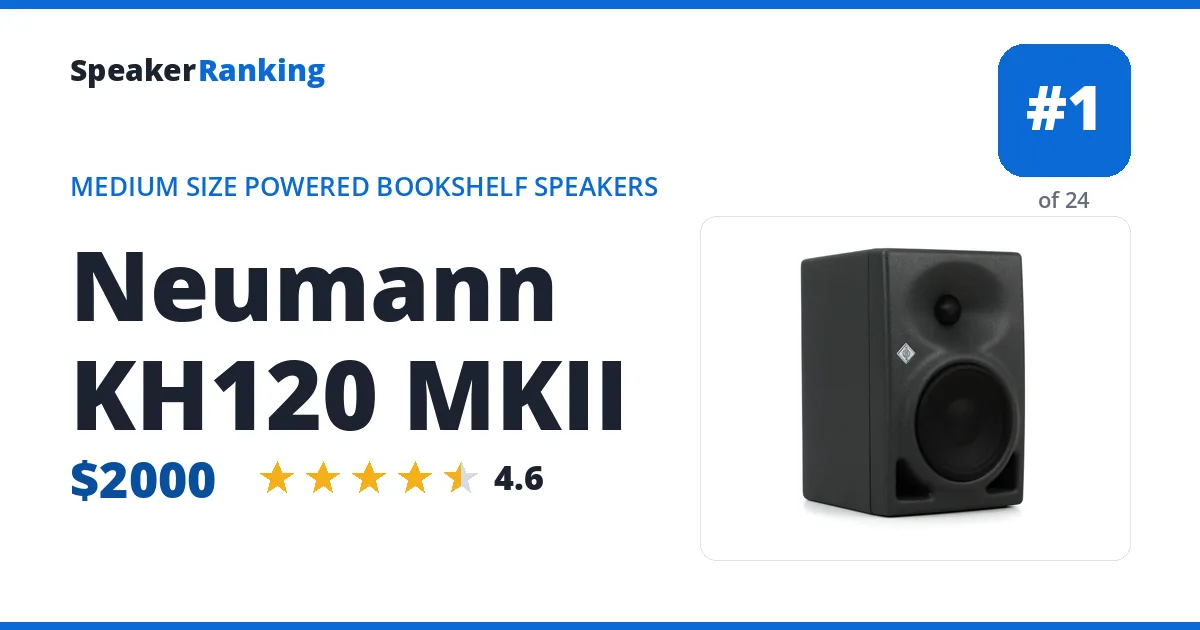
Pros: ASR’s Klippel data shows exceptional neutrality: only a 1.5dB span from 300Hz to 5kHz and low listening-window narrow-band deviation of 0.208. Scores of 5.75 standalone and 7.70 with an ideal subwoofer place it among the strongest measured options here. Bass reaches -3dB around 45Hz. The review reports very low distortion at 86dB/1m and clean performance outside deep bass at 96dB. Measured bass extension of 46Hz (-3dB).
Cons: Vertical crossover interference makes listening height important even though horizontal dispersion is well controlled. A small directivity irregularity remains around 2kHz. Distortion increases below about 50Hz at high output; a subwoofer can extend the system and reduce low-frequency demands. High price, and a flat anechoic response still needs suitable placement in the room.
Full Neumann KH120 MKII review and specifications →
| AES Input | No |
|---|---|
| Amplifier Power | 245W (145W woofer + 100W tweeter) |
| App | Yes (MA 1 alignment) |
| Aux Input | No |
| Bass Extension (-10dB) | 36Hz (measured, Audio Science Review) |
| Bass Extension (-3dB) | 46Hz (measured, Audio Science Review) |
| Bluetooth | No |
| Coaxial Input | No |
| DSP | Yes |
| Dimensions | 11.3"H x 7.2"W x 8.9"D (287 x 182.9 x 226.1 mm) |
| Drivers | 5.25" woofer, 1" titanium fabric dome tweeter |
| EQ | Yes (via DSP) |
| Frequency Response | 44Hz - 21kHz (±3dB) (Manufacturer specified) |
| HDMI Input | No |
| Inputs | XLR |
| Maximum SPL | 116.8dB @ 1m (manufacturer specified) |
| Optical Input | No |
| RCA Input | No |
| Spinorama Preference Score | 5.75 |
| Spinorama Preference Score with Perfect Sub | 7.70 |
| TRS Input | No |
| USB Input | No |
| Weight | 14.6 lbs (6.6 kg) each |
| XLR Input | Yes |
- Links
- Reviews, Comparisons and Sound Samples
- Head-to-Head Comparisons
- Neumann KH120 MKII vs Genelec 8030C
- Neumann KH120 MKII vs Genelec 8331A
- Neumann KH120 MKII vs Neumann KH80 DSP
- Neumann KH120 MKII vs Dynaudio LYD 5
- Neumann KH120 MKII vs Genelec 8330A
- Neumann KH120 MKII vs Genelec 8320A
- Neumann KH120 MKII vs Devialet Phantom II 98 dB
- Neumann KH120 MKII vs Topping MA4
- See all 50 comparisons