Short answer: the JBL Partybox On the Go. It ranks #59 of 89 boombox speakers by sound quality, rated 3.0/5, at $300. The Pioneer PBM5 ranks #89, rated 2.0/5, at $149, $151 cheaper, which does not close the gap in sound quality.
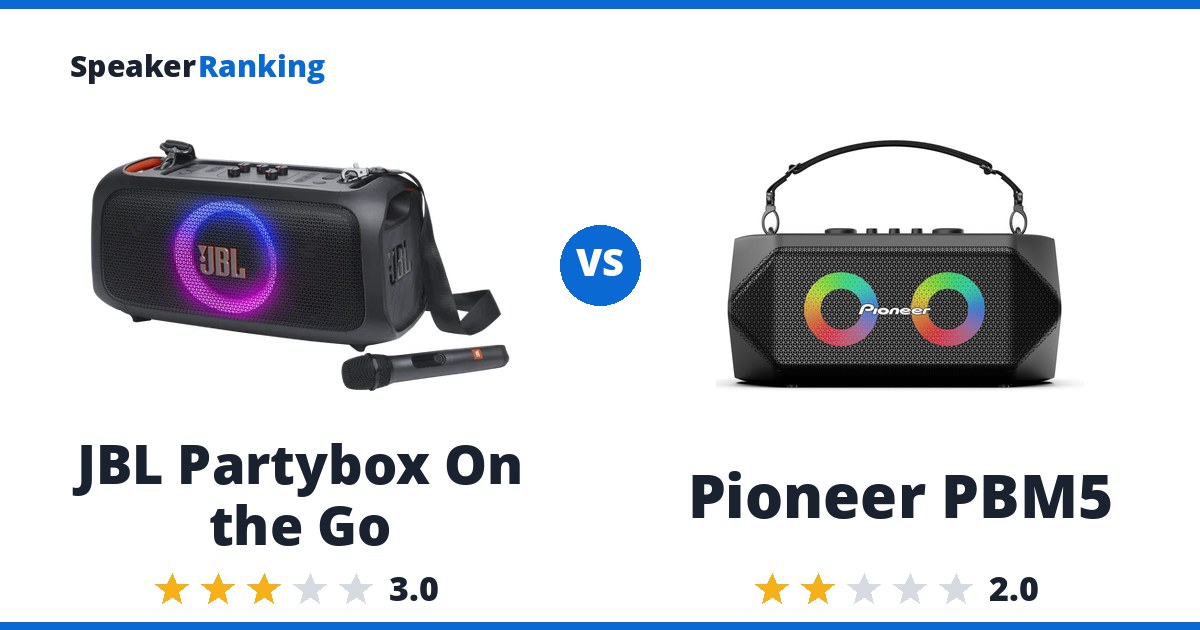
The case for the JBL Partybox On the Go: JBL Partybox On the Go uses 5.1” woofer + tweeters. The catch: Bass is limited by its 49Hz specification.
The case for the Pioneer PBM5: Loud for its size: Williston Audio Labs measured about 105 dB at 2 meters, louder than the Turtlebox Original Gen3 and Kicker Bullfrog BF400 in the same test. Watch for: Williston Audio Labs was not impressed with its sound: there is very little bass below 100Hz, and the amplifier’s output has a big dip from 1.6kHz to 10kHz that leaves the upper mids and treble recessed.
Buy the JBL Partybox On the Go. It is rated higher for sound quality, and the $151 saving on the Pioneer PBM5 is not enough to make up the difference.
There is a real battery-life gap here: the Pioneer PBM5 is rated for 13 hours, the JBL Partybox On the Go only 6 hours.
Want more options? Browse the full Portable Bluetooth rankings.
Specifications Side By Side
| JBL Partybox On the Go | Pioneer PBM5 | |
|---|---|---|
| Price | $300 | $149.00 |
| Ranked | #59 of 89 in Boombox Size Portable Bluetooth Speakers | #89 of 89 in Boombox Size Portable Bluetooth Speakers |
| Aux Input | Yes | Yes |
| Bass Extension (-10dB) | 49Hz | - |
| Battery Life | 6 hours (Manufacturer specified) | 13 hours at 60% volume (Manufacturer specified) |
| IP Rating | IPX4 | IPX5 |
| Power Bank | Yes (USB-A, 5V/2.1A) | - |
| Stereo | Partially | - |
| Omnidirectional | No | No |
| USB Playback | Yes | Yes (MP3 only) |
| Weight | 16.5 lbs (7.5 kg) | 14.1 lbs (6.4 kg) |
| Bluetooth | Yes | Yes |
| Bluetooth Codecs | SBC | - |
| App | Yes (JBL PartyBox app) | Yes |
| EQ | No | Yes (presets + user EQ) |
| TWS | Yes | Yes |
| Party Mode | No | Yes (Auracast) |
| Built-in Microphone | No | - |
| Power Input | USB-C | USB-C or AC Power cord |
| Bluetooth Version | 4.2 | 5.4 |
| Amplifier Power | 100W | 300W peak (Manufacturer specified), about 90W measured |
| Dimensions | 19.3” x 8.8” x 9.6” (489 x 224 x 244.5 mm) | 8.9”H x 17.4”W x 8.1”D (226 x 442 x 207 mm) |
| Drivers | 5.1” woofer + tweeters | 2x 133mm (5.25”) woofers + 2x 51mm (2”) tweeters |
| Maximum SPL | 94dB (Manufacturer specified) | 105dB at 2m (measured by Williston Audio Labs) |
| Digital Aux Input | No | - |
| Strap | Yes (detachable shoulder strap) | Yes (detachable shoulder strap) |
| Guitar Input | - | Yes |
| Lights | - | Yes |
| Microphone Input | - | Yes (2 inputs) |
Related Speaker Comparisons
How JBL Partybox On the Go compares with other leading options:
- Tribit Stormbox Blast vs JBL Partybox On the Go
- Harman Kardon Go + Play 3 vs JBL Partybox On the Go
- JBL Partybox Encore 2 vs JBL Partybox On the Go
- JBL PartyBox On-The-Go 2 Plus vs JBL Partybox On the Go
- JBL Partybox Encore Essential 2 vs JBL Partybox On the Go
Prices on this page were last checked September 30, 2026 at 2:57 PM UTC. Product prices and availability are accurate as of that date/time and are subject to change; the price and availability shown on Amazon at the time of purchase will apply to the purchase of this product.
As an eBay Partner, we may be compensated if you make a purchase.
The Two Speakers In Full
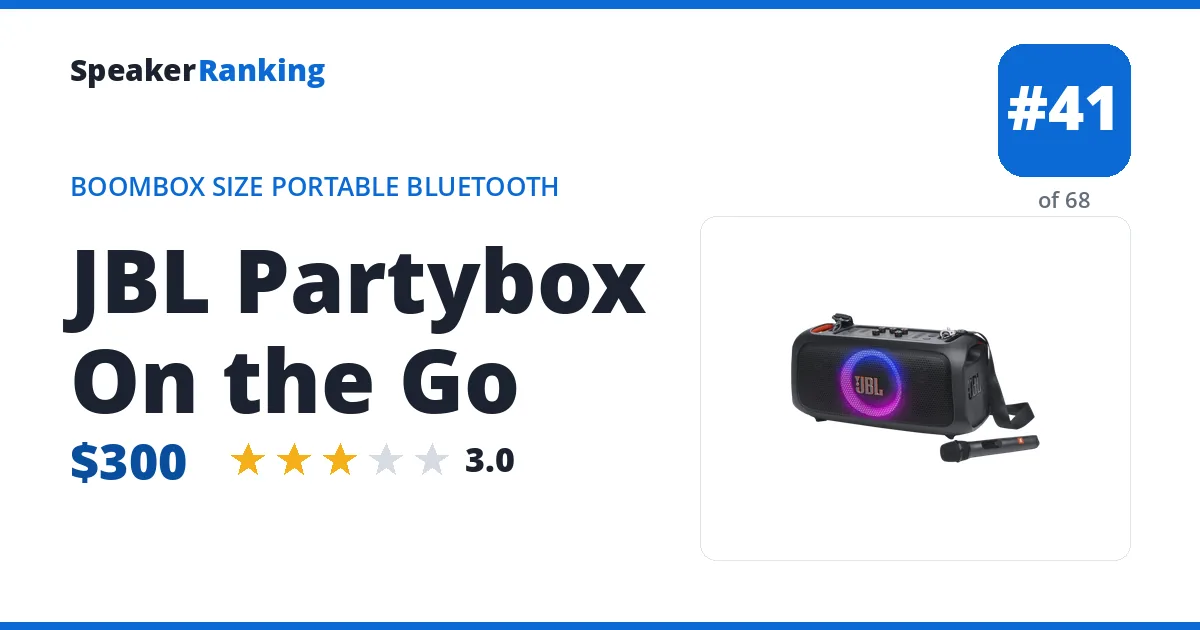
 JBL Partybox On the Go: $300 Amazon eBay
Newer model: the JBL PartyBox On-The-Go 2 Plus, ranked higher, rated 4.4/5.
Pros: JBL Partybox On the Go uses 5.1” woofer + tweeters. Its 7.5 kg, claimed 6 hours (Manufacturer specified) battery life, IPX4 protection, aux input, up to 94dB and limited-stereo playback make it a practical option for its intended room or portable use. A wireless microphone is included. Measured bass extension of 49Hz (-10dB).
Cons: Bass is limited by its 49Hz specification. No EQ adjustment. Battery life is short, and its sound trails the rest of the Partybox line.
Full JBL Partybox On the Go review and specifications →
| Amplifier Power | 100W |
|---|---|
| App | Yes (JBL PartyBox app) |
| Aux Input | Yes |
| Bass Extension (-10dB) | 49Hz |
| Battery Life | 6 hours (Manufacturer specified) |
| Bluetooth | Yes |
| Bluetooth Codecs | SBC |
| Bluetooth Version | 4.2 |
| Built-in Microphone | No |
| Digital Aux Input | No |
| Dimensions | 19.3” x 8.8” x 9.6” (489 x 224 x 244.5 mm) |
| Drivers | 5.1” woofer + tweeters |
| EQ | No |
| IP Rating | IPX4 |
| Maximum SPL | 94dB (Manufacturer specified) |
| Omnidirectional | No |
| Party Mode | No |
| Power Bank | Yes (USB-A, 5V/2.1A) |
| Power Input | USB-C |
| Stereo | Partially |
| Strap | Yes (detachable shoulder strap) |
| TWS | Yes |
| USB Playback | Yes |
| Weight | 16.5 lbs (7.5 kg) |
- Links
- Reviews, Comparisons and Sound Samples
- Head-to-Head Comparisons
- JBL Partybox On the Go vs Sony SRS-XG500
- JBL Partybox On the Go vs Onn Medium Party Speaker Gen 2
- JBL Partybox On the Go vs JBL Boombox
- JBL Partybox On the Go vs Soundcore Rave Party 2
- JBL Partybox On the Go vs Soundcore Motion Boom+
- JBL Partybox On the Go vs Sony ULT Field 7
- JBL Partybox On the Go vs Skullcandy Barrel
- JBL Partybox On the Go vs Demerbox DB2
- See all 83 comparisons
 Pioneer PBM5: $149.00 Sam’s Club eBay
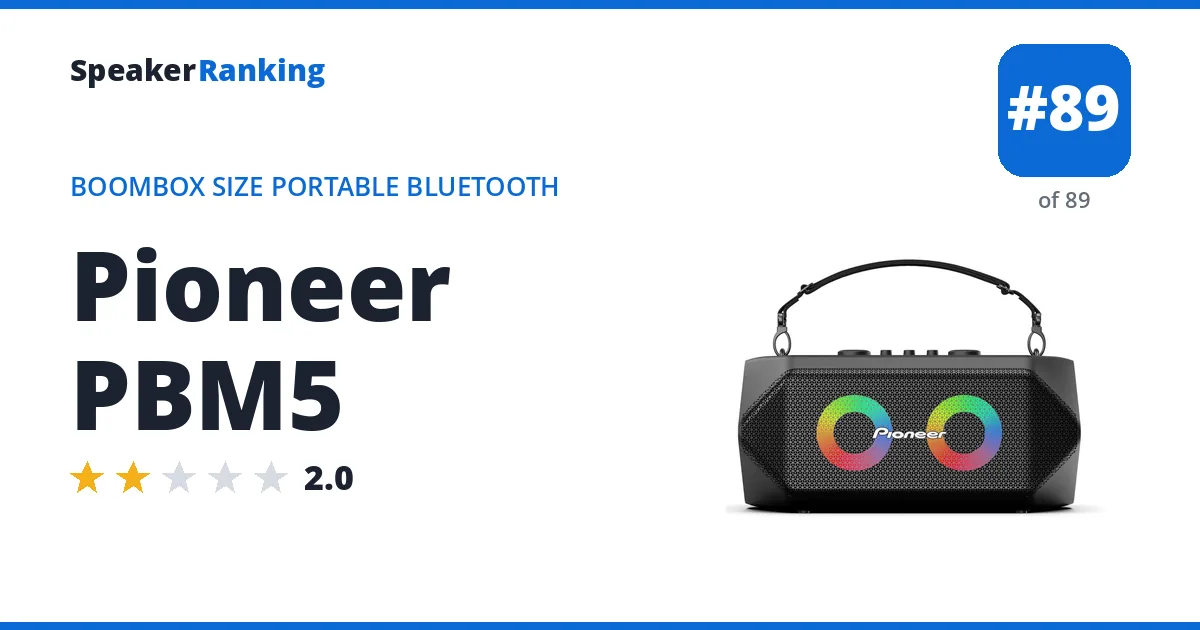
Pros: Loud for its size: Williston Audio Labs measured about 105 dB at 2 meters, louder than the Turtlebox Original Gen3 and Kicker Bullfrog BF400 in the same test. Two 5.25 inch woofers and two 2 inch tweeters with a port tuned to 48Hz, two microphone inputs plus a guitar input with bass, treble and reverb controls for the mics, aux and USB playback, IPX5 splash resistance, RGB lights, a shoulder strap, Bluetooth 5.4 with Auracast, and charging from either USB-C or the included AC cord. A rated 13 hours at 60% volume.
Cons: Williston Audio Labs was not impressed with its sound: there is very little bass below 100Hz, and the amplifier’s output has a big dip from 1.6kHz to 10kHz that leaves the upper mids and treble recessed. None of the EQ presets fixed it, and a 1990 JVC boombox sounded cleaner. The amp measured about 90W in total, not the claimed 300W, and only about 23W per woofer channel on battery. USB playback is MP3 only, there is no audio output and no microphone in the box, and it is sold only at Sam’s Club.
Full Pioneer PBM5 review and specifications →
| Amplifier Power | 300W peak (Manufacturer specified), about 90W measured |
|---|---|
| App | Yes |
| Aux Input | Yes |
| Battery Life | 13 hours at 60% volume (Manufacturer specified) |
| Bluetooth | Yes |
| Bluetooth Version | 5.4 |
| Dimensions | 8.9”H x 17.4”W x 8.1”D (226 x 442 x 207 mm) |
| Drivers | 2x 133mm (5.25”) woofers + 2x 51mm (2”) tweeters |
| EQ | Yes (presets + user EQ) |
| Guitar Input | Yes |
| IP Rating | IPX5 |
| Lights | Yes |
| Maximum SPL | 105dB at 2m (measured by Williston Audio Labs) |
| Microphone Input | Yes (2 inputs) |
| Omnidirectional | No |
| Party Mode | Yes (Auracast) |
| Power Input | USB-C or AC Power cord |
| Strap | Yes (detachable shoulder strap) |
| TWS | Yes |
| USB Playback | Yes (MP3 only) |
| Weight | 14.1 lbs (6.4 kg) |
- Links
- Reviews, Comparisons and Sound Samples
- Head-to-Head Comparisons