Short answer: the Arendal 1961 Monitor. It ranks #8 of 160 bookshelf speakers by sound quality, rated 4.3/5, at $1,150. The ELAC Uni-Fi 2.0 UB52 ranks #130, rated 2.4/5, at $599, $551 cheaper, not enough of a saving to outweigh the sound-quality gap.
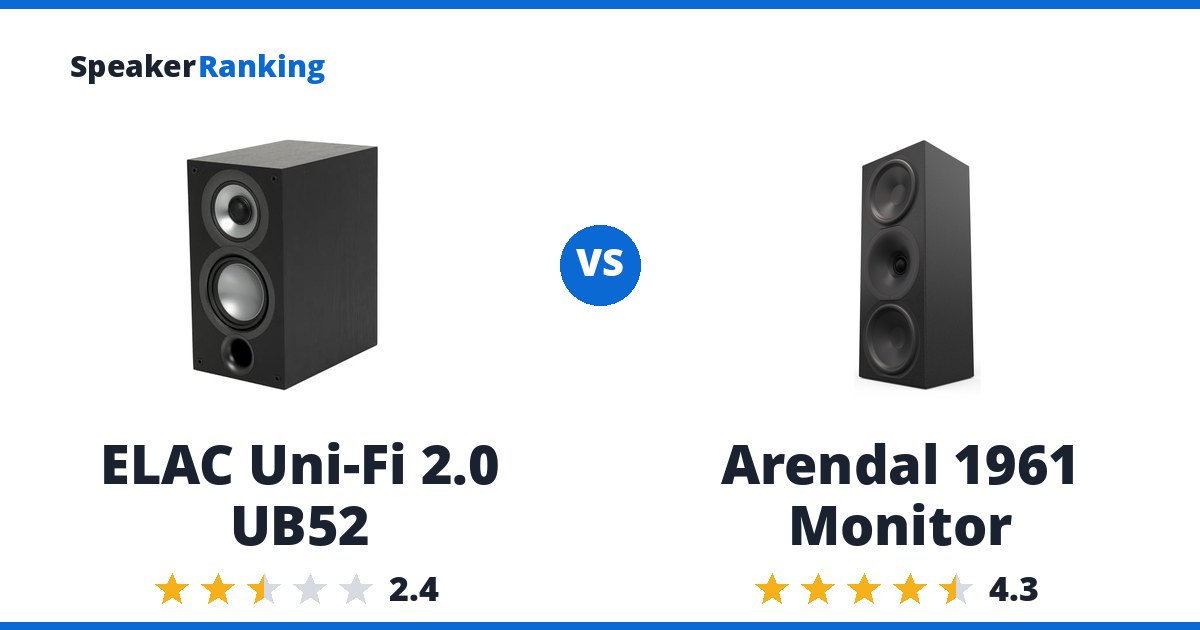
The ELAC Uni-Fi 2.0 UB52 is the more accurate, deeper-bass pick. Wide, smooth horizontal directivity: beamwidth holds to about ±60 degrees up to 8kHz before narrowing. Its measured preference score, a predictor of how neutral it sounds, is 5.32 against 3.38 for the Arendal 1961 Monitor. Its bass reaches about 55.7Hz before falling 3dB, against 84Hz for the Arendal 1961 Monitor. The tradeoff: Dipped 3db from 1.5-3kHz.
The Arendal 1961 Monitor is the better-sounding pick. A physically robust build the reviewer calls “a little bit of a tank,” delivering low compression, low distortion, and overall really good neutrality: one of the reviewer’s top 10 picks under $1,500 across roughly 250 speakers tested. The tradeoff: Bass rolls off around 70-80Hz, so it cannot be used as full-range mains for music without a subwoofer, and a sub is recommended for home theater use as well.
Buy the Arendal 1961 Monitor. It is rated higher for sound quality, and the $551 saving on the ELAC Uni-Fi 2.0 UB52 is not enough to make up the difference.
Still deciding? The full Passive Home rankings cover every ranked option.
Specifications Side By Side
| ELAC Uni-Fi 2.0 UB52 | Arendal 1961 Monitor | |
|---|---|---|
| Price | $599.00 per pair | $1150 per pair |
| Ranked | #130 of 160 in Medium Size Bookshelf Speakers | #8 of 160 in Medium Size Bookshelf Speakers |
| Crossover Frequency | 200Hz / 2000Hz | 1500Hz |
| Dimensions | 13.6”H x 7.3”W x 10.8”D (346 x 185 x 275 mm) | 16.6”H x 6.4”W x 5.9”D (421.6 x 162.6 x 149.9 mm) |
| Impedance | 6 ohms | 4 ohms nominal (4.1 ohms minimum above 80Hz, measured by Erin’s Audio Corner) |
| Sensitivity | 83.3dB (measured by Audio Science Review; 85dB manufacturer specified) | 85.9dB (measured average, Erin’s Audio Corner) |
| Drivers | 5.25” aluminum woofer, 4” aluminum midrange, 1” soft dome tweeter | 2 x 5.5” woofers, 28mm tweeter |
| Power Handling | 140W max | - |
| Woofer Cabinet | ported | sealed |
| Weight | 7.7 lbs (3.5 kg) | 16 lbs (7.25 kg) each |
| Bass Extension (-3dB) | 55.7Hz (measured, Audio Science Review) | 84Hz (measured, Erin’s Audio Corner) |
| Bass Extension (-10dB) | 38.6Hz (measured, Audio Science Review) | 60Hz (measured, Erin’s Audio Corner) |
| Spinorama Preference Score | 5.32 (spinorama.org) | 3.38 |
| Spinorama Preference Score with Perfect Sub | 7.34 (spinorama.org) | 6.69 |
| DIY Kit | No | No |
Related Speaker Comparisons
More worthwhile head-to-heads for Arendal 1961 Monitor:
- Audio First Fidelia vs Arendal 1961 Monitor
- Arendal 1961 Monitor vs Philharmonic Ceramic Mini
- Arendal 1961 Monitor vs Ascend Sierra 1 v2
- Arendal 1961 Monitor vs KEF LS50 Meta
- XMechanik Mechano23 DIY vs Arendal 1961 Monitor
Prices on this page were last checked October 7, 2026 at 9:25 PM UTC. Product prices and availability are accurate as of that date/time and are subject to change; the price and availability shown on Amazon at the time of purchase will apply to the purchase of this product.
As an eBay Partner, we may be compensated if you make a purchase.
The Two Speakers In Full
 ELAC Uni-Fi 2.0 UB52: $599.00 per pair Amazon eBay
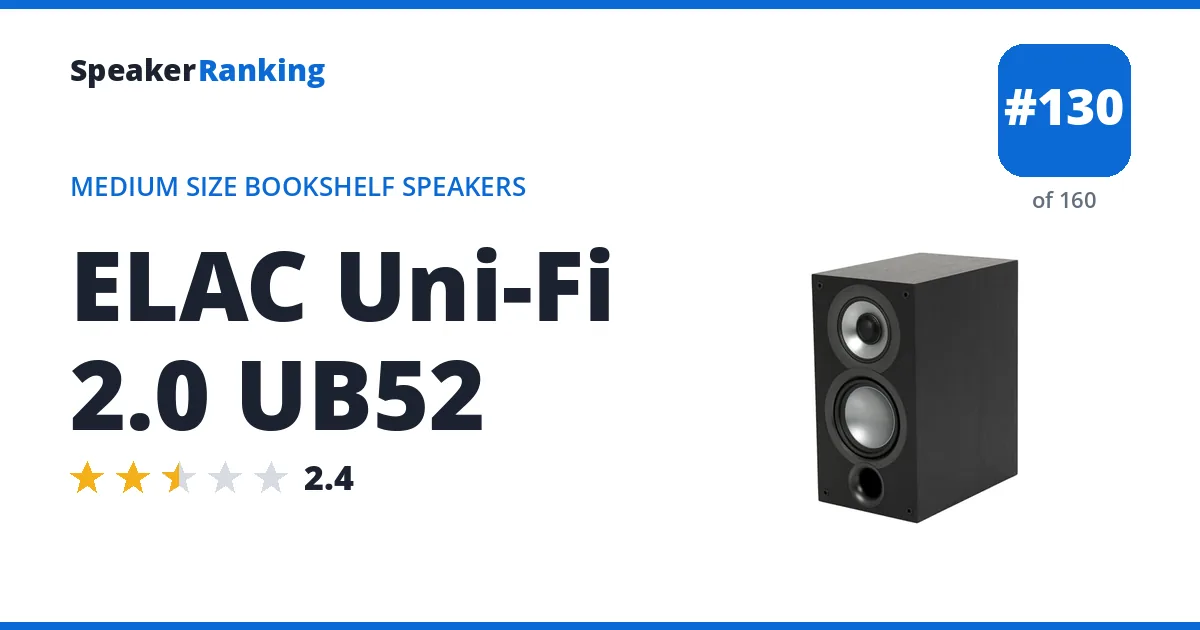
Same family: the ELAC Uni-Fi 2.0 UF52 (floorstanding, estimated 4.2/5) and the ELAC Uni-Fi 2.0 UC52 (center, rated 3.9/5).
Pros: Wide, smooth horizontal directivity: beamwidth holds to about ±60 degrees up to 8kHz before narrowing. Vertical directivity is substantially better than average, giving more listening-height leeway than most two-way bookshelf speakers. Measured bass extension of 55.7Hz (-3dB), with a measured sensitivity of 83.3dB.
Cons: Dipped 3db from 1.5-3kHz. On-axis response shelves down above 1.5kHz along with multiple resonances, leading the reviewer to predict it will “likely sound dull.” Nasty resonance at 600Hz: audible as an actual buzzing artifact on some recordings (the reviewer demonstrated it with an Eva Cassidy track), and it shows up as a sharp distortion spike exceeding 4% at 585Hz when driven to 96dB SPL/1m. Not recommended.
Full ELAC Uni-Fi 2.0 UB52 review and specifications →
| Bass Extension (-10dB) | 38.6Hz (measured, Audio Science Review) |
|---|---|
| Bass Extension (-3dB) | 55.7Hz (measured, Audio Science Review) |
| Crossover Frequency | 200Hz / 2000Hz |
| DIY Kit | No |
| Dimensions | 13.6”H x 7.3”W x 10.8”D (346 x 185 x 275 mm) |
| Drivers | 5.25” aluminum woofer, 4” aluminum midrange, 1” soft dome tweeter |
| Impedance | 6 ohms |
| Power Handling | 140W max |
| Sensitivity | 83.3dB (measured by Audio Science Review; 85dB manufacturer specified) |
| Spinorama Preference Score | 5.32 (spinorama.org) |
| Spinorama Preference Score with Perfect Sub | 7.34 (spinorama.org) |
| Weight | 7.7 lbs (3.5 kg) |
| Woofer Cabinet | ported |
- Links
- Reviews, Comparisons and Sound Samples
- Head-to-Head Comparisons
- ELAC Uni-Fi 2.0 UB52 vs KEF Q100
- ELAC Uni-Fi 2.0 UB52 vs JBL Stage A120
- ELAC Uni-Fi 2.0 UB52 vs Q Acoustics 3020i
- ELAC Uni-Fi 2.0 UB52 vs Micca RB42
- ELAC Uni-Fi 2.0 UB52 vs Q Acoustics 5020
- ELAC Uni-Fi 2.0 UB52 vs JBL L52 Classic
- ELAC Uni-Fi 2.0 UB52 vs JBL Stage A130
- ELAC Uni-Fi 2.0 UB52 vs Fluance Signature HFS
- See all 41 comparisons
 Arendal 1961 Monitor: $1150 per pair Arendal Sound eBay
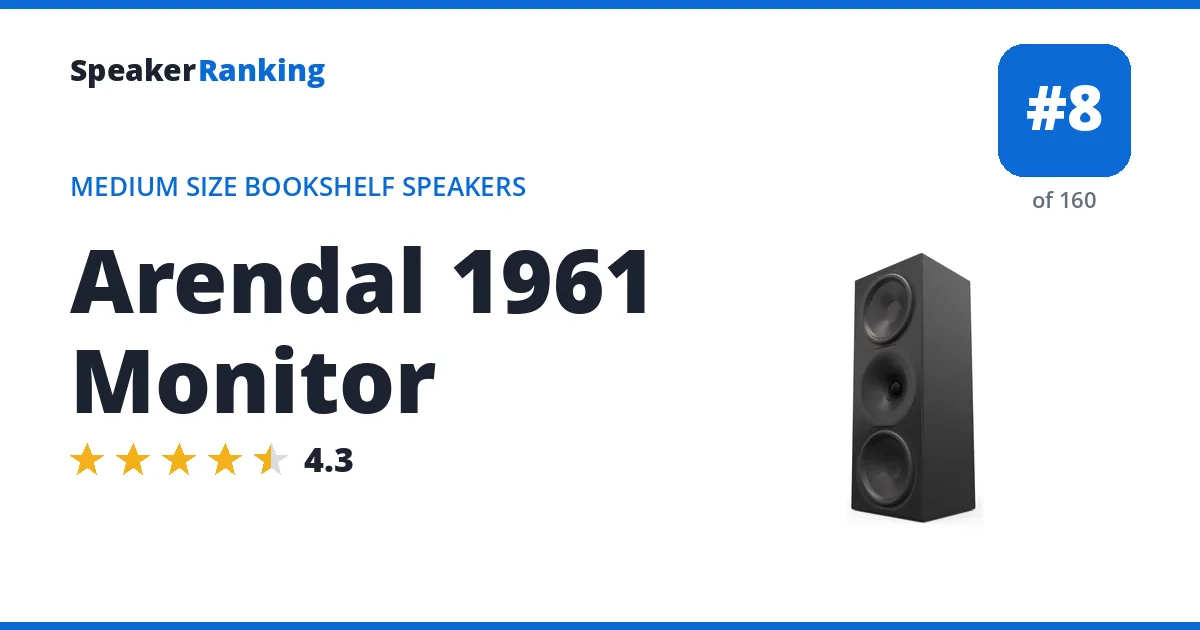
Same family: the Arendal Sound 1961 Bookshelf (smaller bookshelf, ranked lower, rated 4.2/5), the Arendal 1961 Tower (floorstanding, rated 4.4/5) and the Arendal Sound 1961 Center (center, rated 3.6/5).
Pros: A physically robust build the reviewer calls “a little bit of a tank,” delivering low compression, low distortion, and overall really good neutrality: one of the reviewer’s top 10 picks under $1,500 across roughly 250 speakers tested. Works well both as home theater mains and as surrounds. Independent ASR Klippel measurements corroborate the low-distortion finding: THD at 86dB SPL/1m stays well below the reviewer’s audibility threshold, and even at 96dB SPL/1m it stays “far better than most bookshelves” thanks to the built-in high-pass filter that protects the woofers. Measured bass extension of 84Hz (-3dB), with a measured sensitivity of 85.9dB.
Cons: Bass rolls off around 70-80Hz, so it cannot be used as full-range mains for music without a subwoofer, and a sub is recommended for home theater use as well. Vertical radiation window is narrow, typical of MTM (mid-tweeter-mid) layouts (tighter than a standard two-way’s roughly ±20°) so a second home theater row sitting above or below the tweeter axis will hear a noticeably different tonal balance. ASR’s CEA2034 measurements show the response is elevated above 2kHz with resonant peaks around 3kHz and 9kHz, leading the reviewer to predict it will “likely sound bright.” Those same resonances show up as lingering ridges in the cumulative spectral decay (waterfall) at 96dB SPL/1m.
Full Arendal 1961 Monitor review and specifications →
| Bass Extension (-10dB) | 60Hz (measured, Erin’s Audio Corner) |
|---|---|
| Bass Extension (-3dB) | 84Hz (measured, Erin’s Audio Corner) |
| Crossover Frequency | 1500Hz |
| DIY Kit | No |
| Dimensions | 16.6”H x 6.4”W x 5.9”D (421.6 x 162.6 x 149.9 mm) |
| Drivers | 2 x 5.5” woofers, 28mm tweeter |
| Impedance | 4 ohms nominal (4.1 ohms minimum above 80Hz, measured by Erin’s Audio Corner) |
| Sensitivity | 85.9dB (measured average, Erin’s Audio Corner) |
| Spinorama Preference Score | 3.38 |
| Spinorama Preference Score with Perfect Sub | 6.69 |
| Weight | 16 lbs (7.25 kg) each |
| Woofer Cabinet | sealed |
- Links
- Reviews, Comparisons and Sound Samples
- Head-to-Head Comparisons
- Arendal 1961 Monitor vs SunAudio Purified 4
- Arendal 1961 Monitor vs Ascend Acoustics HTM-200SE2
- Arendal 1961 Monitor vs XMechanik Mechano23 DIY
- Arendal 1961 Monitor vs Ascend Acoustics Luna V2 Mini-Monitor Titan
- Arendal 1961 Monitor vs Aalto Speakers Aalto 1 EVO
- Arendal 1961 Monitor vs KEF LS50 Meta
- Arendal 1961 Monitor vs Ascend Sierra 1 v2
- Arendal 1961 Monitor vs Moondrop M4P MTM
- See all 55 comparisons