Short answer: the ELAC DBR62. It ranks #77 of 203 bookshelf speakers by sound quality, rated 4.0/5, at $678.97; the Sonus Faber Sonetto II G2 ranks #168, rated 3.1/5, and costs $3,500, so there is not much of a tradeoff to weigh.
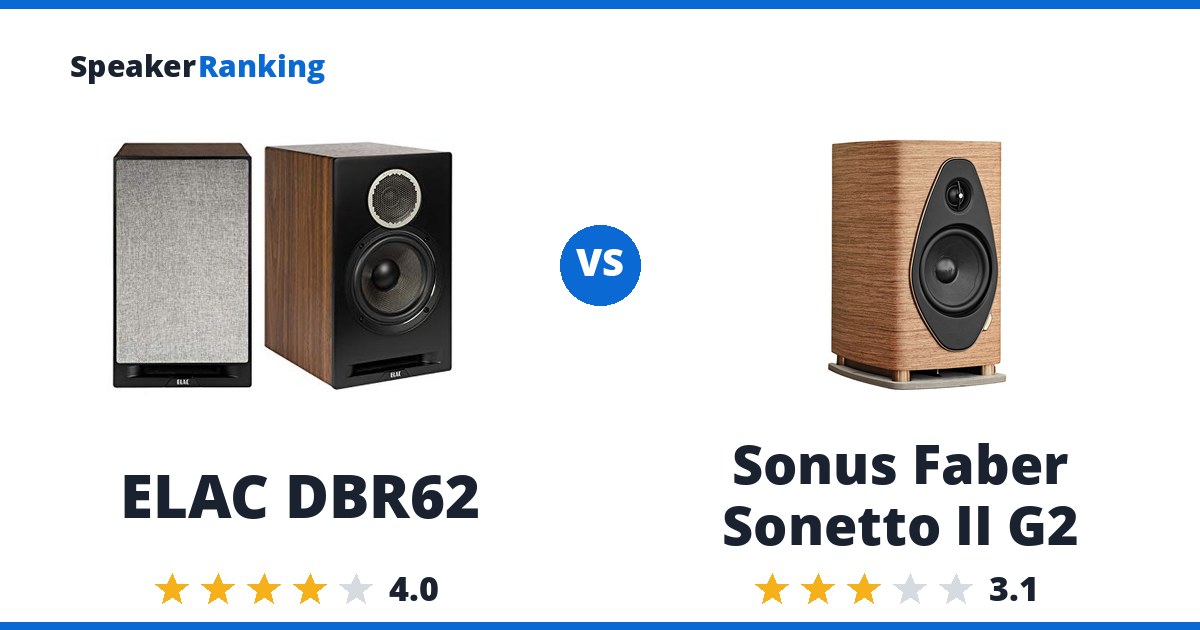
The ELAC DBR62 is the more accurate, deeper-bass option. Two-way design with a 6.5” woofer and 1” dome tweeter in a shallow waveguide, with the tweeter positioned close to the woofer for near-point-source coherence: giving more vertical listening leeway than typical two-ways. Its measured preference score, a predictor of how neutral it sounds, is 5.07 against 4.25 for the Sonus Faber Sonetto II G2. Its bass reaches about 53Hz before falling 3dB, against 62Hz for the Sonus Faber Sonetto II G2. The tradeoff: A slight recess in the 1-2kHz region reduces vocal presence somewhat compared to other speakers in direct comparison.
The case for the Sonus Faber Sonetto II G2: Two-way design with a 1.125” damped Apex Dome silk tweeter and 6.5” cone woofer, using a base of concrete, aluminum, and steel with under-cabinet venting. The catch: Sounds notably bright pointed directly on-axis; toeing the speaker out about 30° reduces treble energy and sibilance meaningfully.
Buy the ELAC DBR62. It is rated higher for sound quality than the Sonus Faber Sonetto II G2 and costs less, so it is the default pick unless a specific strength of the other one matters more to you.
Want more options? Browse the full Passive Home rankings.
Specifications Side By Side
| ELAC DBR62 | Sonus Faber Sonetto II G2 | |
|---|---|---|
| Price | $678.97 per pair | $3500 per pair |
| Ranked | #77 of 203 in Large Size Bookshelf Speakers | #168 of 203 in Large Size Bookshelf Speakers |
| Bass Extension (-10dB) | 41Hz (measured, Erin’s Audio Corner) | 38Hz (measured, Erin’s Audio Corner) |
| Bass Extension (-3dB) | 53Hz (measured, Erin’s Audio Corner) | 62Hz (measured, Erin’s Audio Corner) |
| Dimensions | 14.1”H x 8.2”W x 10.8”D (358.1 x 208.3 x 274.3 mm) | 16.3”H x 8.9”W x 14”D (414.3 x 227.0 x 355.6 mm) |
| Impedance | 6 ohms nominal, 5.2 ohms minimum (measured above 80Hz, Erin’s Audio Corner) | 4 ohms nominal (4.2 ohms minimum, measured by Erin’s Audio Corner) |
| Sensitivity | 84.3dB (measured average 300Hz-3kHz @ 2.83V/1m, Erin’s Audio Corner; 86dB manufacturer specified) | 87dB (measured, Erin’s Audio Corner) |
| Drivers | 6.5” Aramid Fiber woofer, 1” soft dome tweeter | 1x 6.5” mid-woofer (paper cone), 1x 1.1” (28mm) DAD soft dome tweeter |
| Weight | 18.1 lbs (8.2 kg) each | 38.4 lbs (17.4 kg) |
| Woofer Cabinet | ported, front | ported, front |
| Spinorama Preference Score | 5.07 | 4.25 |
| Spinorama Preference Score with Perfect Sub | 7.27 | 6.54 |
| DIY Kit | No | No |
Related Speaker Comparisons
How ELAC DBR62 compares with other leading options:
- ELAC DBR62 vs Perlisten S4b
- ELAC DBR62 vs KEF Reference 1 Meta
- ELAC DBR62 vs GR-Research NX-Studio
- ELAC DBR62 vs AsciLab C6B
- ELAC DBR62 vs Audio First Cadentia 3
Prices on this page were last checked October 7, 2026 at 9:25 PM UTC. Product prices and availability are accurate as of that date/time and are subject to change; the price and availability shown on Amazon at the time of purchase will apply to the purchase of this product.
As an eBay Partner, we may be compensated if you make a purchase.
The Two Speakers In Full
 ELAC DBR62: $678.97 per pair Amazon Crutchfield eBay
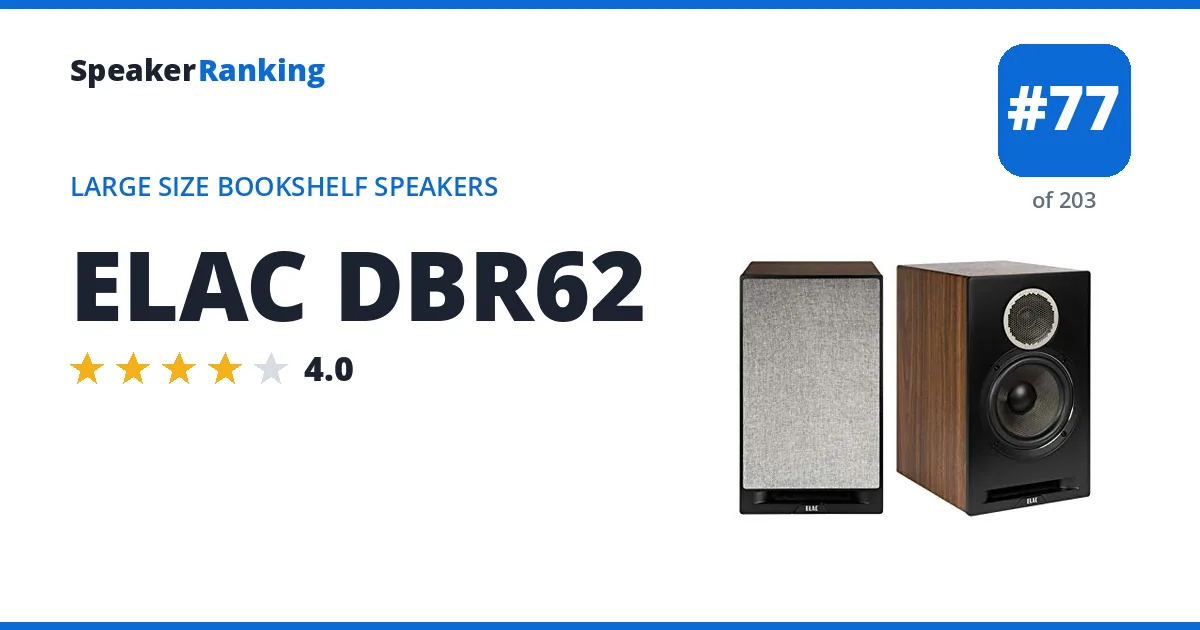
Same family: the ELAC Debut Reference DFR52 (floorstanding, estimated 4.3/5) and the ELAC Debut Reference DCR52 (center, estimated 3.4/5).
Pros: Two-way design with a 6.5” woofer and 1” dome tweeter in a shallow waveguide, with the tweeter positioned close to the woofer for near-point-source coherence: giving more vertical listening leeway than typical two-ways. Notably forgiving of placement and aiming: sounds good from directly on-axis all the way to 30° of toe-out (parallel with the rear wall), making it more room-independent than many speakers this price. Wide horizontal radiation of about ±70° until the tweeter starts beaming, right in the reviewer’s preferred sweet spot. A mild, wide-Q bass bump centered around 100Hz adds a bit of extra punch that the reviewer personally likes. On-axis linearity within about ±2.5dB, with a strong measured preference score of 5.3. Distortion stays below 3% at both 86dB and 96dB until around 50Hz. Vertical sweet spot of about ±10-20° works well for multi-row home theater seating. The reviewer calls it “the epitome of a good speaker” for its price, with no reservations recommending it. Measured bass extension of 53Hz (-3dB), with a measured sensitivity of 84.3dB.
Cons: A slight recess in the 1-2kHz region reduces vocal presence somewhat compared to other speakers in direct comparison. A mild hot spot around 4-5kHz can read as slight sibilance when pointed directly on-axis. Low-to-mid sensitivity (about 84.3dB) combined with a current draw that behaves like roughly 2.4 ohms between 100-200Hz means it’s best driven by a dedicated 4-ohm-capable amplifier rather than an AVR. A diffraction dip from the baffle edge is visible in measurements: typical of any standard rectangular-baffle speaker and not correctable without a much more expensive curved-baffle design. Multitone distortion testing suggests some potential midrange distortion could be audible on certain material, though the reviewer didn’t personally notice it. Minor resonances appear around 700Hz and 1-1.5kHz, possibly tied to the enclosure, port, or cone/surround edge termination, though their audible impact appears minimal. F3 of 53Hz means a subwoofer is still needed for real bass extension below about 40Hz.
Full ELAC DBR62 review and specifications →
| Bass Extension (-10dB) | 41Hz (measured, Erin’s Audio Corner) |
|---|---|
| Bass Extension (-3dB) | 53Hz (measured, Erin’s Audio Corner) |
| DIY Kit | No |
| Dimensions | 14.1”H x 8.2”W x 10.8”D (358.1 x 208.3 x 274.3 mm) |
| Drivers | 6.5” Aramid Fiber woofer, 1” soft dome tweeter |
| Impedance | 6 ohms nominal, 5.2 ohms minimum (measured above 80Hz, Erin’s Audio Corner) |
| Sensitivity | 84.3dB (measured average 300Hz-3kHz @ 2.83V/1m, Erin’s Audio Corner; 86dB manufacturer specified) |
| Spinorama Preference Score | 5.07 |
| Spinorama Preference Score with Perfect Sub | 7.27 |
| Weight | 18.1 lbs (8.2 kg) each |
| Woofer Cabinet | ported, front |
- Links
- Reviews, Comparisons and Sound Samples
- Erin’s Audio Corner: Top 3 Things You Need to Know About ELAC DBR62 Before You Buy More from Erin’s Audio Corner →
- Erin’s Audio Corner Website Elac DBR62
- Erin’s Audio Corner: 5 AWESOME SPEAKERS Under $1000 You Won’t Regret
- Erin’s Audio Corner: My Top Picks of 2023: Must-Haves Under $3000
- Audio Science Review Measurements More from Audio Science Review →
- Erin’s Audio Corner Measurements (spinorama.org)
- Head-to-Head Comparisons
- ELAC DBR62 vs Yamaha NS-800A
- ELAC DBR62 vs Definitive Technology Demand D11
- ELAC DBR62 vs Buchardt S400 MK3
- ELAC DBR62 vs Technics SB-C700
- ELAC DBR62 vs ELAC Uni-Fi Reference UBR62
- ELAC DBR62 vs Ascend Acoustics Sierra Duo V2 Ribbon
- ELAC DBR62 vs Dynaudio Contour 20i
- ELAC DBR62 vs Revel Concerta2 M16
- See all 68 comparisons
 Sonus Faber Sonetto II G2: $3500 per pair Crutchfield eBay
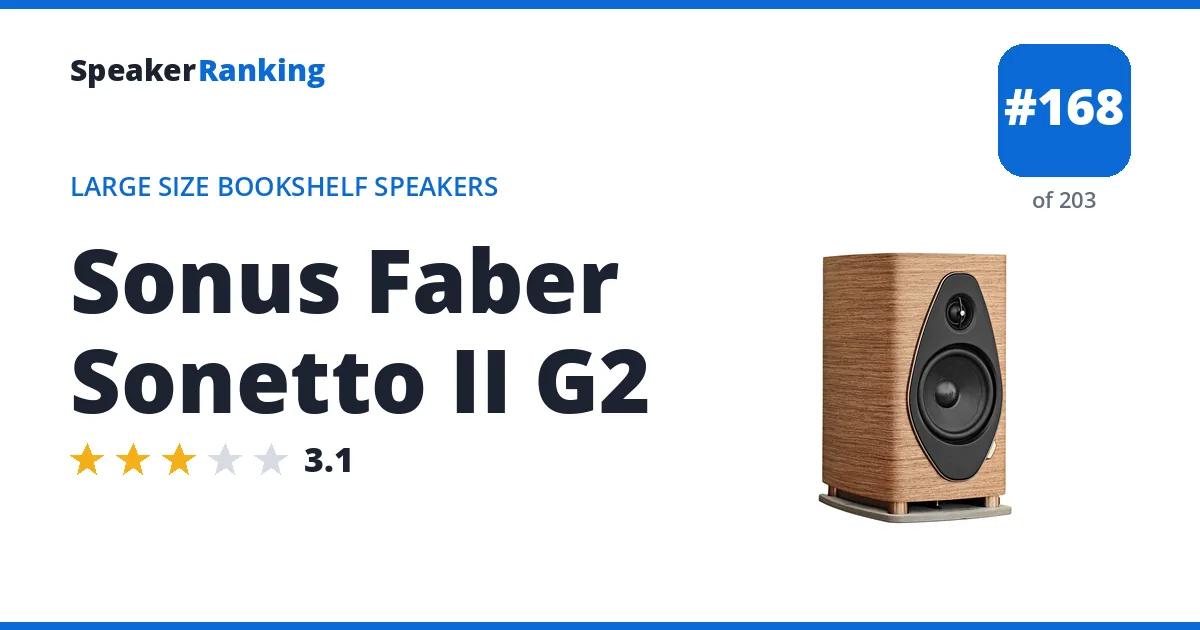
Older model: the Sonus Faber Sonetto II (ranked lower, rated 3/5).
Same family: the Sonus Faber Sonetto I G2 (smaller bookshelf, estimated 3/5), the Sonus Faber Sonetto III G2 (smaller floorstanding, estimated 3.2/5), the Sonus Faber Sonetto V G2 (larger floorstanding, estimated 3.3/5) and the Sonus Faber Sonetto Center G2 (center, estimated 3/5).
Pros: Two-way design with a 1.125” damped Apex Dome silk tweeter and 6.5” cone woofer, using a base of concrete, aluminum, and steel with under-cabinet venting. Notably more neutral than Sonus Faber’s own Lumina 2, which runs 2-5dB hotter in the treble. Horizontal directivity narrows at a fairly constant, well-behaved rate rather than narrowing-then-widening-then-narrowing like some rivals (including the Lumina 2), meaning sidewall reflections match the direct sound well enough that the reviewer doesn’t recommend sidewall absorption for this speaker. The tweeter-to-woofer crossover handoff around 3kHz looks clean, suggesting a higher-order crossover than typical for the size/price class. Good dynamic range: the low end loses only about 2dB from 76dB to 96dB, otherwise holding up well. Not a difficult amplifier load (about 4.2 ohms minimum impedance). Bass extension reaches a genuine 50Hz in-room, fuller than the Lumina 2. Measured bass extension of 62Hz (-3dB), with a measured sensitivity of 87dB.
Cons: Sounds notably bright pointed directly on-axis; toeing the speaker out about 30° reduces treble energy and sibilance meaningfully. A resonance around 700Hz gives vocals a slightly nasal, hollow quality. A dip in the upper midrange (roughly 1-2kHz) reduces perceived detail and attack, while the elevated treble can read as “analytical” or “detailed” to some listeners despite being a coloration rather than true resolution. Needs more clearance from the rear wall than some rivals (about 1.5-2 feet in an ideal room, more or less depending on your specific room modes) or the 80-120Hz region can become boomy. Vertical listening window is limited to about ±10-15° from the tweeter axis. Some unexplained directivity irregularities appear around 1.2kHz and 1.6kHz, possibly port-related, along with a longer decay in the 800Hz-1600Hz range in burst-decay measurements. Multitone distortion approaches the reviewer’s 3% threshold through the midrange, though likely not obviously audible without direct A/B comparison. A resonance in the cabinet appears around 400Hz in impedance measurements.
Full Sonus Faber Sonetto II G2 review and specifications →
| Bass Extension (-10dB) | 38Hz (measured, Erin’s Audio Corner) |
|---|---|
| Bass Extension (-3dB) | 62Hz (measured, Erin’s Audio Corner) |
| DIY Kit | No |
| Dimensions | 16.3”H x 8.9”W x 14”D (414.3 x 227.0 x 355.6 mm) |
| Drivers | 1x 6.5” mid-woofer (paper cone), 1x 1.1” (28mm) DAD soft dome tweeter |
| Impedance | 4 ohms nominal (4.2 ohms minimum, measured by Erin’s Audio Corner) |
| Sensitivity | 87dB (measured, Erin’s Audio Corner) |
| Spinorama Preference Score | 4.25 |
| Spinorama Preference Score with Perfect Sub | 6.54 |
| Weight | 38.4 lbs (17.4 kg) |
| Woofer Cabinet | ported, front |
- Links
- Reviews, Comparisons and Sound Samples
- Head-to-Head Comparisons
- Sonus Faber Sonetto II G2 vs Audio Craftsmen Victoria
- Sonus Faber Sonetto II G2 vs Emotiva Airmotiv B2+
- Sonus Faber Sonetto II G2 vs Pylon Jasper Monitor 18
- Sonus Faber Sonetto II G2 vs JBL XPL-90
- Sonus Faber Sonetto II G2 vs KEF Q350
- Sonus Faber Sonetto II G2 vs Sonus Faber Lumina II Amator
- Sonus Faber Sonetto II G2 vs Polk R200
- Sonus Faber Sonetto II G2 vs Sonus Faber Sonetto II
- See all 64 comparisons