Short answer: the ELAC DBR62. It ranks #55 of 130 bookshelf speakers by sound quality; the Mission LX-3 MKII ranks #80.
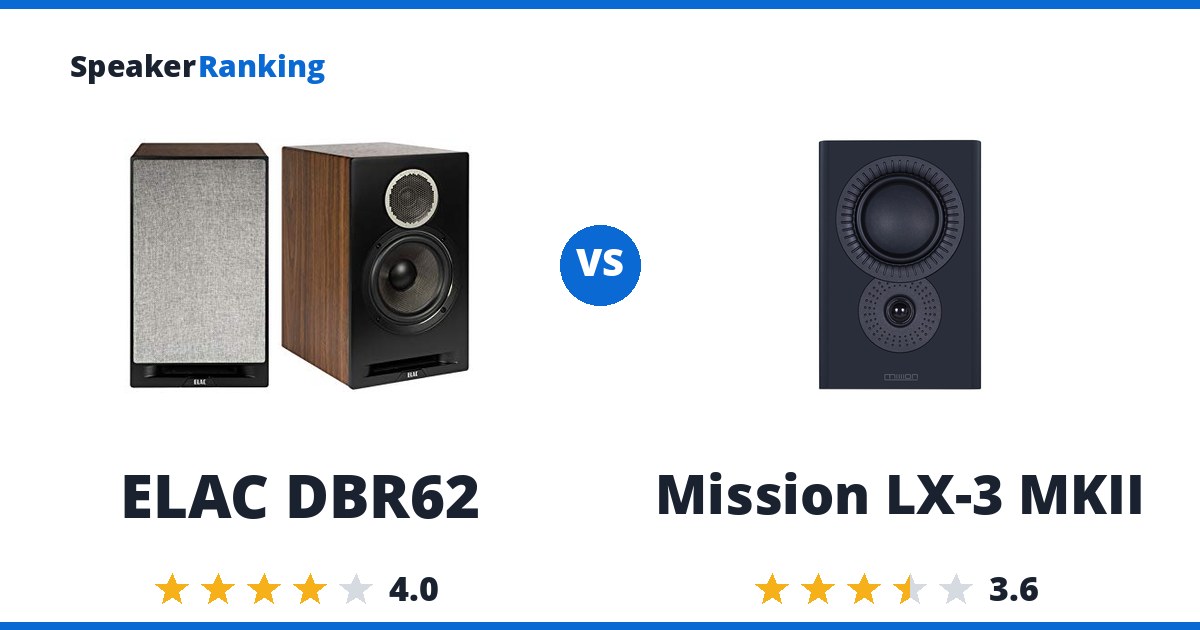
What the ELAC DBR62 offers: Two-way design with a 6.5” woofer and 1” dome tweeter in a shallow waveguide, with the tweeter positioned close to the woofer for near-point-source coherence - giving more vertical listening leeway than typical two-ways. Notably forgiving of placement and aiming: sounds good from directly on-axis all the way to 30° of toe-out (parallel with the rear wall), making it more room-independent than many speakers this price. Wide horizontal radiation of about ±70° until the tweeter starts beaming, right in the reviewer’s preferred sweet spot. A mild, wide-Q bass bump centered around 100Hz adds a bit of extra punch that the reviewer personally likes. On-axis linearity within about ±2.5dB, with a strong measured preference score of 5.3. Distortion stays below 3% at both 86dB and 96dB until around 50Hz. Vertical sweet spot of about ±10-20° works well for multi-row home theater seating. The reviewer calls it “the epitome of a good speaker” for its price, with no reservations recommending it. Watch for: A slight recess in the 1-2kHz region reduces vocal presence somewhat compared to other speakers in direct comparison. A mild hot spot around 4-5kHz can read as slight sibilance when pointed directly on-axis. Low-to-mid sensitivity (about 84.3dB) combined with a current draw that behaves like roughly 2.4 ohms between 100-200Hz means it’s best driven by a dedicated 4-ohm-capable amplifier rather than an AVR. A diffraction dip from the baffle edge is visible in measurements - typical of any standard rectangular-baffle speaker and not correctable without a much more expensive curved-baffle design. Multitone distortion testing suggests some potential midrange distortion could be audible on certain material, though the reviewer didn’t personally notice it. Minor resonances appear around 700Hz and 1-1.5kHz, possibly tied to the enclosure, port, or cone/surround edge termination, though their audible impact appears minimal. F3 of 53Hz means a subwoofer is still needed for real bass extension below about 40Hz.
What the Mission LX-3 MKII offers: A large affordable standmount with a 6.5-inch woofer, 88dB rated sensitivity and useful bass. ASR measured 48Hz estimated in-room extension, a controlled Q of 0.60, a 5.52 subwoofer-assisted preference score and reasonable +/-55-degree horizontal coverage. Watch for: On-axis smoothness of 0.217 and predicted in-room smoothness of 0.344 reveal clear response unevenness, with a -0.46dB-per-octave downward tilt. The 345mm-tall, 8.4kg cabinet is bulky and current US availability is limited.
Buy the ELAC DBR62 when sound quality outweighs the price for you, and the Mission LX-3 MKII when the price outweighs sound quality instead.
Looking for alternatives? See the complete Passive Home rankings.
Specifications Side By Side
| ELAC DBR62 | Mission LX-3 MKII | |
|---|---|---|
| Price | $799.00 per pair | £249 per pair |
| Ranked | #55 of 130 in Large Size Bookshelf Speakers | #80 of 130 in Large Size Bookshelf Speakers |
| Bass Extension (-10dB) | 41Hz (measured, Erin's Audio Corner) | - |
| Bass Extension (-3dB) | 53Hz (measured, Erin's Audio Corner) | - |
| Dimensions | 14.1"H x 8.2"W x 10.8"D (358.1 x 208.3 x 274.3 mm) | 13.6H x 8.9W x 12.1D in |
| Impedance | 6 ohms nominal, 5.2 ohms minimum (measured above 80Hz, Erin's Audio Corner) | 8 ohms nominal, 4.1 ohms minimum |
| Sensitivity | 84.3dB (measured average 300Hz-3kHz @ 2.83V/1m, Erin's Audio Corner; 86dB manufacturer specified) | 88dB |
| Drivers | 6.5" Aramid Fiber woofer, 1" soft dome tweeter | 1" microfiber-dome tweeter, 6.5" composite-fiber woofer |
| Weight | 18.1 lbs (8.2 kg) each | 18.5 lbs (8.4 kg) each |
| Woofer Cabinet | ported, front | - |
| Spinorama Preference Score | 4.16 | 3.26 |
| Spinorama Preference Score with Perfect Sub | 6.35 | 5.52 |
| Enclosure | - | 2-way, bass-reflex |
| Country | - | United Kingdom (design) |
Related Speaker Comparisons
More top alternatives to ELAC DBR62:
- ELAC DBR62 vs Perlisten S4b
- ELAC DBR62 vs KEF Reference 1 Meta
- ELAC DBR62 vs GR-Research NX-Studio
- ELAC DBR62 vs AsciLab C6B
- ELAC DBR62 vs Audio First Cadentia 3
Prices on this page were last checked September 16, 2026 at 12:41 AM UTC. Product prices and availability are accurate as of that date/time and are subject to change; the price and availability shown on Amazon at the time of purchase will apply to the purchase of this product.
As an eBay Partner, we may be compensated if you make a purchase.
The Two Speakers In Full
 ELAC DBR62: $799.00 per pair Amazon Crutchfield eBay
Pros: Two-way design with a 6.5” woofer and 1” dome tweeter in a shallow waveguide, with the tweeter positioned close to the woofer for near-point-source coherence - giving more vertical listening leeway than typical two-ways. Notably forgiving of placement and aiming: sounds good from directly on-axis all the way to 30° of toe-out (parallel with the rear wall), making it more room-independent than many speakers this price. Wide horizontal radiation of about ±70° until the tweeter starts beaming, right in the reviewer’s preferred sweet spot. A mild, wide-Q bass bump centered around 100Hz adds a bit of extra punch that the reviewer personally likes. On-axis linearity within about ±2.5dB, with a strong measured preference score of 5.3. Distortion stays below 3% at both 86dB and 96dB until around 50Hz. Vertical sweet spot of about ±10-20° works well for multi-row home theater seating. The reviewer calls it “the epitome of a good speaker” for its price, with no reservations recommending it. Measured bass extension of 53Hz (-3dB), with a measured sensitivity of 84.3dB.
Cons: A slight recess in the 1-2kHz region reduces vocal presence somewhat compared to other speakers in direct comparison. A mild hot spot around 4-5kHz can read as slight sibilance when pointed directly on-axis. Low-to-mid sensitivity (about 84.3dB) combined with a current draw that behaves like roughly 2.4 ohms between 100-200Hz means it’s best driven by a dedicated 4-ohm-capable amplifier rather than an AVR. A diffraction dip from the baffle edge is visible in measurements - typical of any standard rectangular-baffle speaker and not correctable without a much more expensive curved-baffle design. Multitone distortion testing suggests some potential midrange distortion could be audible on certain material, though the reviewer didn’t personally notice it. Minor resonances appear around 700Hz and 1-1.5kHz, possibly tied to the enclosure, port, or cone/surround edge termination, though their audible impact appears minimal. F3 of 53Hz means a subwoofer is still needed for real bass extension below about 40Hz.
Full ELAC DBR62 review and specifications →
| Bass Extension (-10dB) | 41Hz (measured, Erin's Audio Corner) |
|---|---|
| Bass Extension (-3dB) | 53Hz (measured, Erin's Audio Corner) |
| Dimensions | 14.1"H x 8.2"W x 10.8"D (358.1 x 208.3 x 274.3 mm) |
| Drivers | 6.5" Aramid Fiber woofer, 1" soft dome tweeter |
| Impedance | 6 ohms nominal, 5.2 ohms minimum (measured above 80Hz, Erin's Audio Corner) |
| Sensitivity | 84.3dB (measured average 300Hz-3kHz @ 2.83V/1m, Erin's Audio Corner; 86dB manufacturer specified) |
| Spinorama Preference Score | 4.16 |
| Spinorama Preference Score with Perfect Sub | 6.35 |
| Weight | 18.1 lbs (8.2 kg) each |
| Woofer Cabinet | ported, front |
- Links
- Reviews, Comparisons and Sound Samples
- Erin’s Audio Corner: Top 3 Things You Need to Know About ELAC DBR62 Before You Buy More from Erin’s Audio Corner →
- Erin’s Audio Corner Website Elac DBR62
- Erin’s Audio Corner: 5 AWESOME SPEAKERS Under $1000 You Won’t Regret
- Erin’s Audio Corner: My Top Picks of 2023: Must-Haves Under $3000
- Audio Science Review Measurements More from Audio Science Review →
- Erin’s Audio Corner Measurements (spinorama.org)
- Head-to-Head Comparisons
- ELAC DBR62 vs ELAC Uni-Fi Reference UBR62
- ELAC DBR62 vs Yamaha NS-800A
- ELAC DBR62 vs Definitive Technology Demand D11
- ELAC DBR62 vs Technics SB-C700
- ELAC DBR62 vs Dynaudio Contour 20i
- ELAC DBR62 vs SVS Ultra Bookshelf
- ELAC DBR62 vs Revel Concerta2 M16
- ELAC DBR62 vs Infinity Reference R162
- See all 62 comparisons
 Mission LX-3 MKII: £249 per pair Richer Sounds eBay
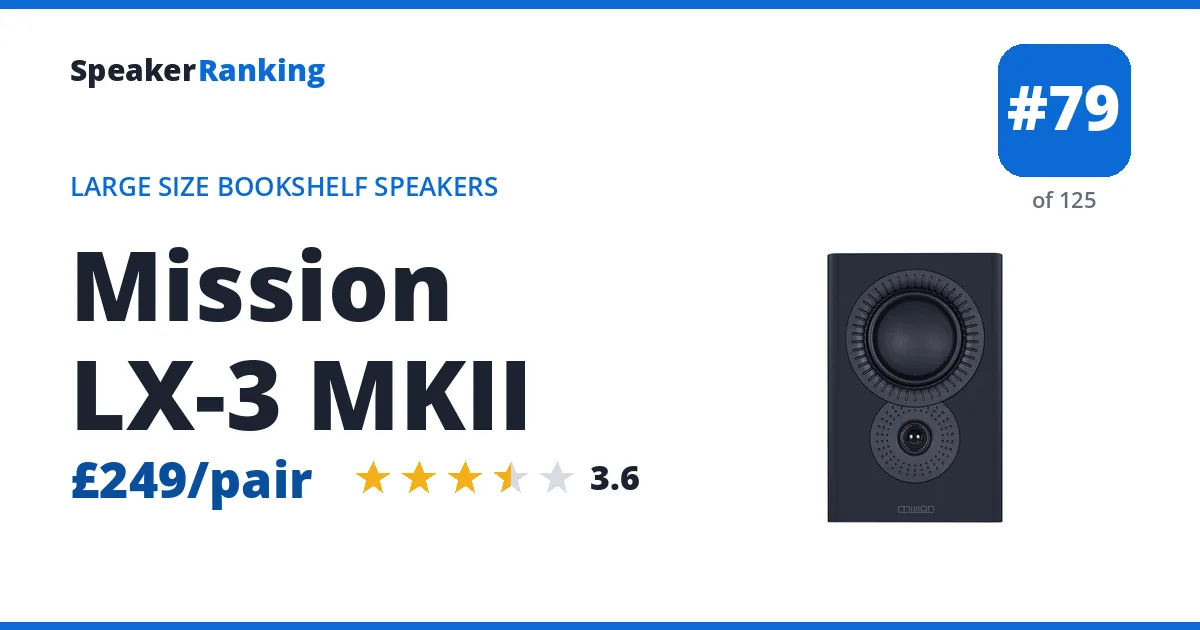
Pros: A large affordable standmount with a 6.5-inch woofer, 88dB rated sensitivity and useful bass. ASR measured 48Hz estimated in-room extension, a controlled Q of 0.60, a 5.52 subwoofer-assisted preference score and reasonable +/-55-degree horizontal coverage.
Cons: On-axis smoothness of 0.217 and predicted in-room smoothness of 0.344 reveal clear response unevenness, with a -0.46dB-per-octave downward tilt. The 345mm-tall, 8.4kg cabinet is bulky and current US availability is limited.
Full Mission LX-3 MKII review and specifications →
| Country | United Kingdom (design) |
|---|---|
| Dimensions | 13.6H x 8.9W x 12.1D in |
| Drivers | 1" microfiber-dome tweeter, 6.5" composite-fiber woofer |
| Enclosure | 2-way, bass-reflex |
| Impedance | 8 ohms nominal, 4.1 ohms minimum |
| Sensitivity | 88dB |
| Spinorama Preference Score | 3.26 |
| Spinorama Preference Score with Perfect Sub | 5.52 |
| Weight | 18.5 lbs (8.4 kg) each |
- Links
- Reviews, Comparisons and Sound Samples
- Head-to-Head Comparisons
- Mission LX-3 MKII vs GR-Research X-LS Encore
- Mission LX-3 MKII vs Philharmonic BMR Monitor
- Mission LX-3 MKII vs Dynaudio Emit 20
- Mission LX-3 MKII vs Klipsch RP-600M II
- Mission LX-3 MKII vs Dynaudio Special Forty
- Mission LX-3 MKII vs ELAC Debut 2.0 B6.2
- Mission LX-3 MKII vs SVS Prime Bookshelf
- Mission LX-3 MKII vs KEF Q3 Meta
- See all 44 comparisons