Short answer: the Acoustic Energy AE100 Mk2, though neither ranks well in its class. Both are rated 2.9/5 for sound quality (#59 and #58 of 88 bookshelf speakers), and the Acoustic Energy AE100 Mk2 costs $399 against $856 for the ELAC BS U5, so with nothing between them on sound quality, price settles it. Both are rated below 3.0/5 among the 88 bookshelf speakers, and the Philharmonic Ceramic Mini, ranked #2 at $900, is a better place to start if sound quality matters.
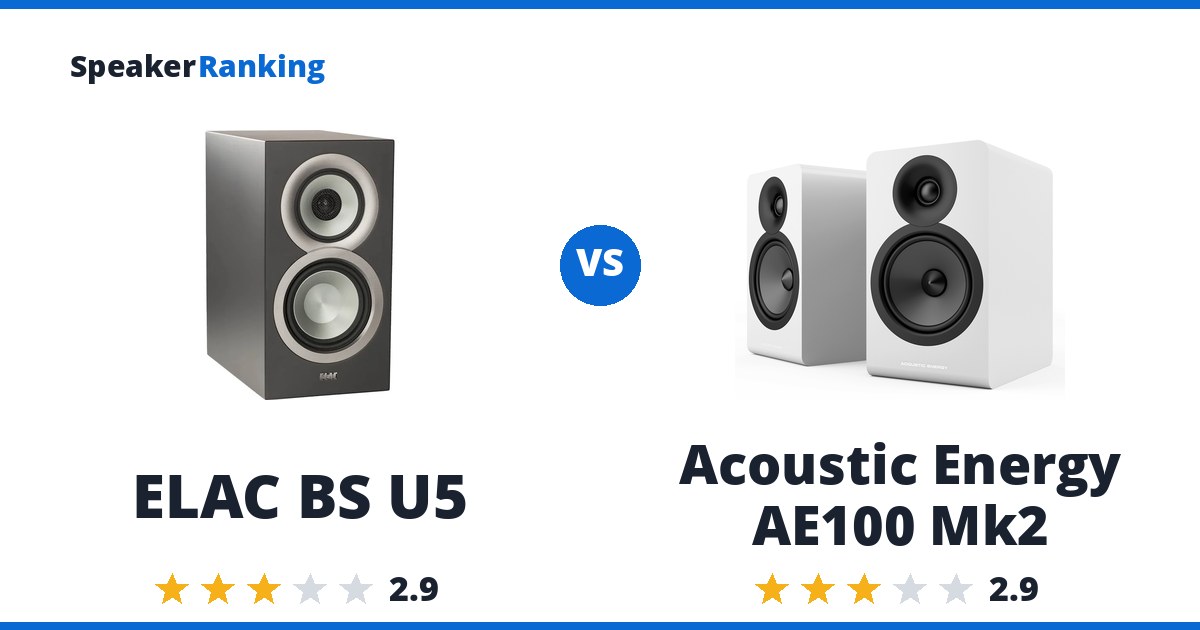
Why pick the ELAC BS U5: This slim three-way coaxial design (an Andrew Jones creation) shows a fairly even on-axis response up to 3kHz, with off-axis behavior notably smoother than the on-axis curve. The tradeoff: Distortion is very high right at both crossover points (around 270Hz (mid-range) and 2700Hz (tweeter)) at both 86dB and 96dB SPL/1m, exceeding 3% at the mid-range crossover.
Why pick the Acoustic Energy AE100 Mk2: Good directivity linearity: on-axis and off-axis response track each other well despite an otherwise uneven overall response, which means the tonal problems can be EQ’d out with reasonably good success. The catch: High-frequency level runs noticeably too hot regardless of placement: the reviewer tried four different setups (near/far from wall, on-axis, 30° off-axis) at two listening distances and couldn’t get it to sound right at any of them.
One note: the ELAC BS U5 is discontinued and no longer widely available new.
Buy the Acoustic Energy AE100 Mk2. Both are rated the same for sound quality, and it costs $457 less than the ELAC BS U5.
Still deciding? The full Passive Home rankings cover every ranked option.
Specifications Side By Side
| ELAC BS U5 | Acoustic Energy AE100 Mk2 | |
|---|---|---|
| Price | $856 per pair Discontinued | $399 per pair Discontinued |
| Ranked | #58 of 88 in Medium Size Bookshelf Speakers | #59 of 88 in Medium Size Bookshelf Speakers |
| Bass Extension (-3dB) | 63Hz (measured, Audio Science Review) | 63Hz (measured, Erin’s Audio Corner) |
| Bass Extension (-10dB) | 41Hz (derived, log-interpolated between spinorama.org -9dB/-12dB points) | 42Hz (measured, Erin’s Audio Corner) |
| Drivers | 1” tweeter + 5.25” woofer | 5.25” midwoofer, 1” soft fabric dome tweeter with waveguide |
| Weight | 13.2 lbs (6 kg) | 20.1 lbs (9.1 kg) each |
| Sensitivity | 83dB (2.83V/1m, measured, Audio Science Review) | 84dB (measured average, Erin’s Audio Corner) |
| Impedance | 4 ohms nominal (3.4 ohms minimum) | 6 ohms nominal, 4.7 ohms minimum (measured, Erin’s Audio Corner) |
| Dimensions | 13.4”H x 7”W x 11.5”D (339.1 x 178.0 x 293.1 mm) | 11.4”H x 6.5”W x 9.8”D (290 x 165 x 250 mm) |
| Woofer Cabinet | ported, rear | ported, rear slot port |
| Spinorama Preference Score | 4.71 (spinorama.org) | 4.96 |
| Spinorama Preference Score with Perfect Sub | 6.79 (spinorama.org) | 7.18 |
| DIY Kit | No | No |
| Crossover Frequency | - | 2.9kHz |
Related Speaker Comparisons
More top alternatives to ELAC BS U5:
- ELAC BS U5 vs Ascend Sierra 1 v2
- KEF LS50 Meta vs ELAC BS U5
- ELAC BS U5 vs Arendal 1961 Monitor
- ELAC BS U5 vs Revel M105
- ELAC BS U5 vs Klipsch RP-500M II
Prices on this page were last checked September 30, 2026 at 2:57 PM UTC. Product prices and availability are accurate as of that date/time and are subject to change; the price and availability shown on Amazon at the time of purchase will apply to the purchase of this product.
As an eBay Partner, we may be compensated if you make a purchase.
The Two Speakers In Full
 ELAC BS U5: $856 per pair Discontinued eBay
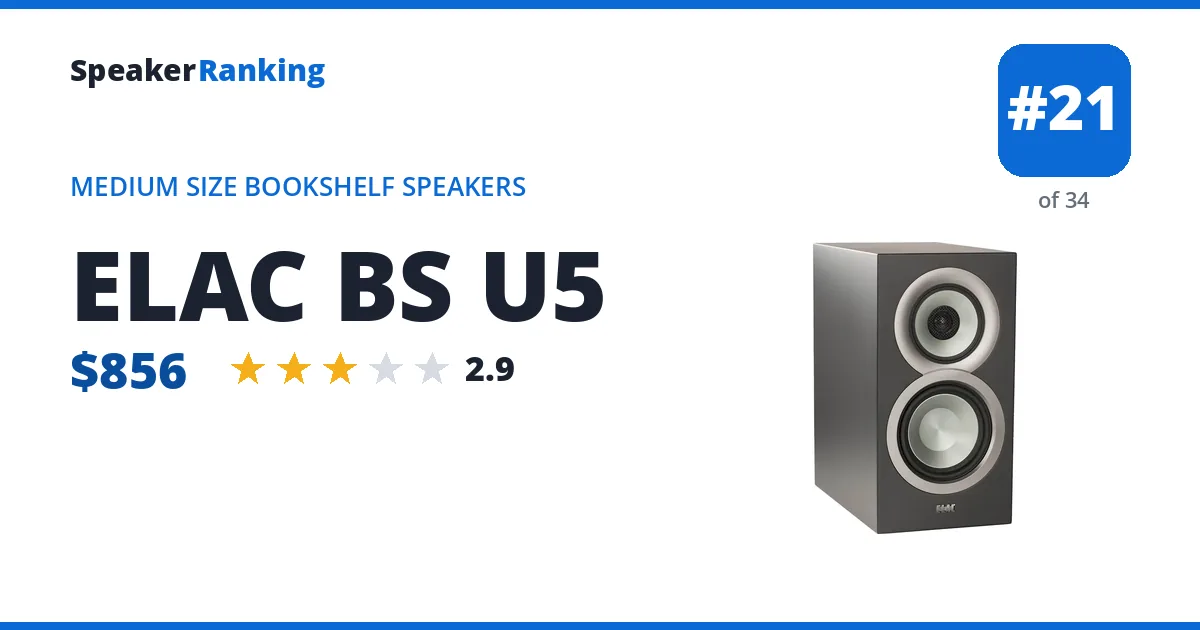
Pros: This slim three-way coaxial design (an Andrew Jones creation) shows a fairly even on-axis response up to 3kHz, with off-axis behavior notably smoother than the on-axis curve. Predicted in-room response looks like it should give good tonality. Vertical directivity is better than average, a benefit of the coaxial layout. Measured bass extension of 63Hz (-3dB), with a measured sensitivity of 83dB.
Cons: Distortion is very high right at both crossover points (around 270Hz (mid-range) and 2700Hz (tweeter)) at both 86dB and 96dB SPL/1m, exceeding 3% at the mid-range crossover. Minimum impedance dips to 3.4 ohms with a possible resonance around 500Hz visible in the impedance/phase curve. Discontinued.
Full ELAC BS U5 review and specifications →
| Bass Extension (-10dB) | 41Hz (derived, log-interpolated between spinorama.org -9dB/-12dB points) |
|---|---|
| Bass Extension (-3dB) | 63Hz (measured, Audio Science Review) |
| DIY Kit | No |
| Dimensions | 13.4”H x 7”W x 11.5”D (339.1 x 178.0 x 293.1 mm) |
| Drivers | 1” tweeter + 5.25” woofer |
| Impedance | 4 ohms nominal (3.4 ohms minimum) |
| Sensitivity | 83dB (2.83V/1m, measured, Audio Science Review) |
| Spinorama Preference Score | 4.71 (spinorama.org) |
| Spinorama Preference Score with Perfect Sub | 6.79 (spinorama.org) |
| Weight | 13.2 lbs (6 kg) |
| Woofer Cabinet | ported, rear |
- Reviews, Comparisons and Sound Samples
- Head-to-Head Comparisons
 Acoustic Energy AE100 Mk2: $399 per pair Discontinued Amazon eBay
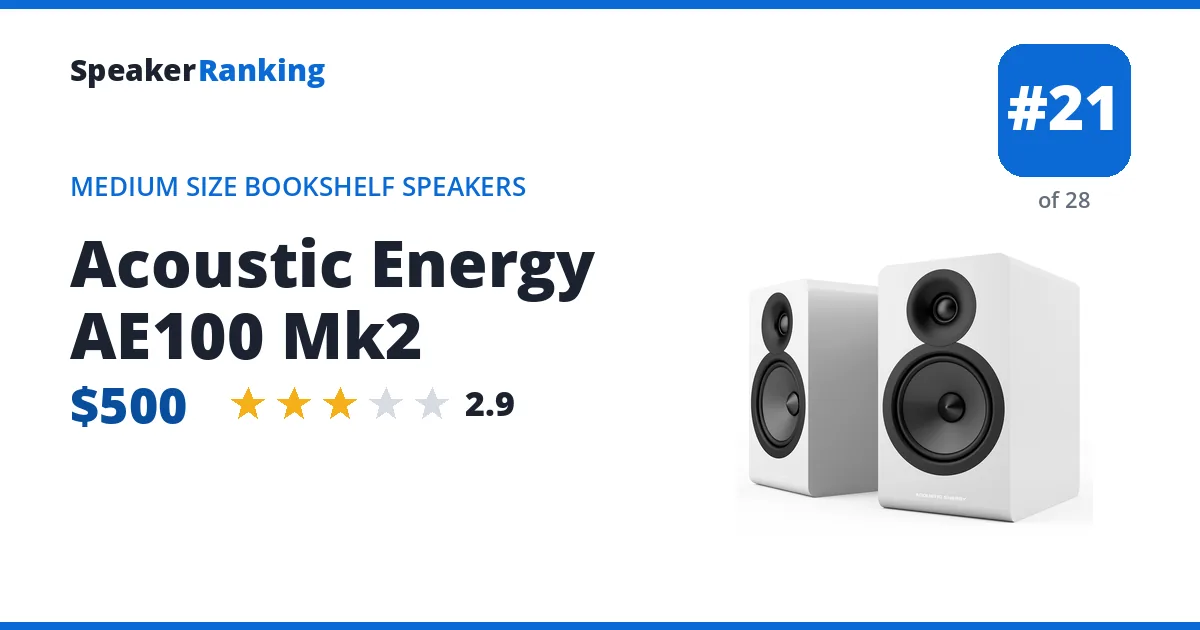
Pros: Good directivity linearity: on-axis and off-axis response track each other well despite an otherwise uneven overall response, which means the tonal problems can be EQ’d out with reasonably good success. Wide horizontal radiation, about ±50°. Nicely finished cabinet: the reviewer specifically called out the fit and finish as a genuine positive. Both units of the review pair measured closely matched to each other. Measured bass extension of 63Hz (-3dB), with a measured sensitivity of 84dB.
Cons: High-frequency level runs noticeably too hot regardless of placement: the reviewer tried four different setups (near/far from wall, on-axis, 30° off-axis) at two listening distances and couldn’t get it to sound right at any of them. A mid-range dip that the reviewer attributes to internal cabinet resonance rather than intentional baffle-step compensation, reinforced by an internal inspection showing no cross-bracing and a slot port that may itself be resonating when tapped. Small tweeter waveguide magnet suggests limited power handling headroom. At this price and radiation pattern, the reviewer would pick the ELAC DBR62 (more neutral, similar ±60° pattern) or, for less money, the ELAC Debut 2.0 B6.2 over this speaker; the KEF Q150 and SVS Prime Bookshelf are also called out as more linear alternatives nearby in price. Discontinued.
Full Acoustic Energy AE100 Mk2 review and specifications →
| Bass Extension (-10dB) | 42Hz (measured, Erin’s Audio Corner) |
|---|---|
| Bass Extension (-3dB) | 63Hz (measured, Erin’s Audio Corner) |
| Crossover Frequency | 2.9kHz |
| DIY Kit | No |
| Dimensions | 11.4”H x 6.5”W x 9.8”D (290 x 165 x 250 mm) |
| Drivers | 5.25” midwoofer, 1” soft fabric dome tweeter with waveguide |
| Impedance | 6 ohms nominal, 4.7 ohms minimum (measured, Erin’s Audio Corner) |
| Sensitivity | 84dB (measured average, Erin’s Audio Corner) |
| Spinorama Preference Score | 4.96 |
| Spinorama Preference Score with Perfect Sub | 7.18 |
| Weight | 20.1 lbs (9.1 kg) each |
| Woofer Cabinet | ported, rear slot port |
- Links
- Reviews, Comparisons and Sound Samples
- Head-to-Head Comparisons