Short answer: the DIYSG HT-10 for better sound quality, the GR Research Klipsch RP-600M Upgrade for the lower price. The DIYSG HT-10 ranks #98 of 131 bookshelf speakers, rated 3.3/5, at $496. The GR Research Klipsch RP-600M Upgrade ranks #100, rated 3.2/5, at $279, $217 cheaper.
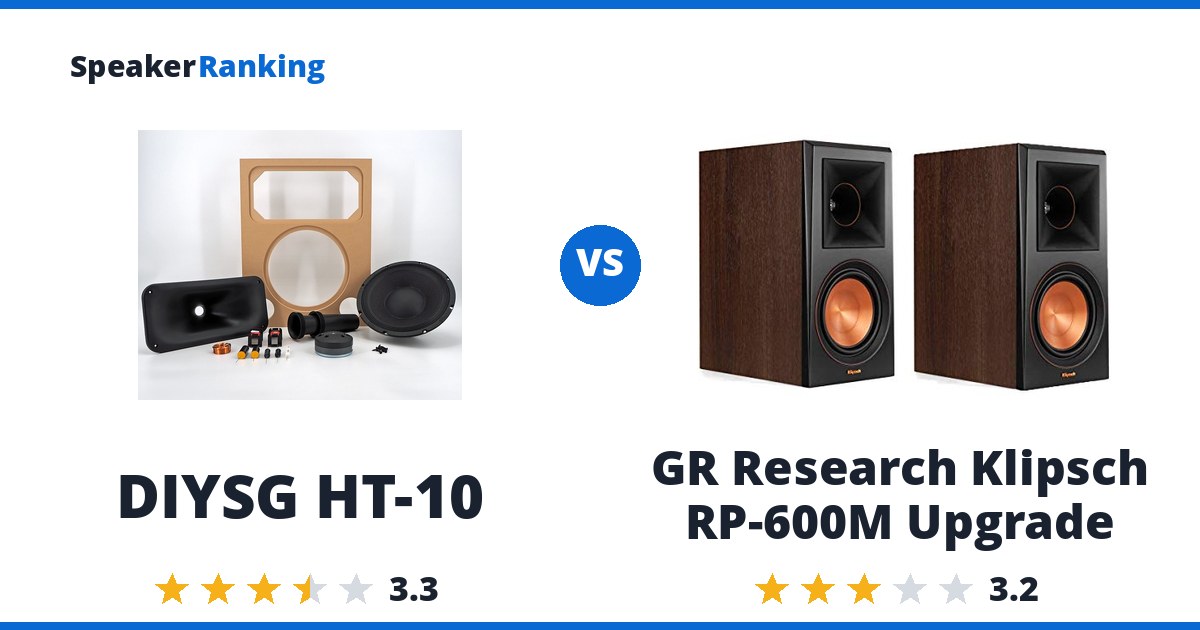
Why pick the DIYSG HT-10: A distinct kit design from DIY Sound Group’s HTM-12 v2, a 10” ported LCR/surround box built around a Celestion woofer and compression tweeter. Watch for: On-axis deviation of 0.537dB is rough, with a pronounced -0.43dB per octave downward tilt giving it a notably dark tonal character, a somewhat resonant bass-alignment Q of 1.76, and the Harman in-room bass extension estimate is a modest 56Hz for a 10” woofer.
What the GR Research Klipsch RP-600M Upgrade does well: GR Research’s replacement crossover fixes the stock Klipsch RP-600M’s biggest flaw, a deep response dip around the crossover, by using gentler first-order filters. The tradeoff: This is a DIY kit, not a finished speaker: you need a pair of the original Klipsch RP-600M, which is discontinued, and must rebuild both crossovers yourself.
Buy the DIYSG HT-10 if sound quality is the priority over the price, or the GR Research Klipsch RP-600M Upgrade if the price is the priority over sound quality.
Looking for alternatives? See the complete Passive Home rankings.
Specifications Side By Side
| DIYSG HT-10 | GR Research Klipsch RP-600M Upgrade | |
|---|---|---|
| Price | $496 per pair | $279 per pair |
| Ranked | #98 of 131 in Large Size Bookshelf Speakers | #100 of 131 in Large Size Bookshelf Speakers |
| Enclosure | Ported, MDF flat-pack cabinet kit | - |
| Drivers | Celestion TF1020 10” woofer, Celestion CDX1-1445DA compression tweeter | 6.5” Cerametallic cone woofer, 1” titanium LTS vented tweeter with Tractrix horn (stock Klipsch RP-600M drivers) |
| Dimensions | 15W x 19.5H x 9D in | 15.7”H x 8”W x 11.9”D (398.8 x 203.2 x 302.3 mm) |
| Weight | approx. 28 lbs (12.7 kg) assembled | 16.1 lbs (7.3 kg) each |
| Country | United States (kit design) | - |
| Spinorama Preference Score | 4.26 | 5.11 |
| Spinorama Preference Score with Perfect Sub | 6.80 | 7.06 |
| Sensitivity | 91.3dB (measured average 300Hz-3kHz @ 2.83V/1m, spinorama.org); 95dB manufacturer specified | 86.7dB (measured, Audio Science Review) |
| Impedance | 8 ohms | - |
| Bass Extension (-3dB) | 73.4Hz (measured, spinorama.org) | 68.8Hz (measured, spinorama.org ASR data) |
| DIY Kit | Yes | Yes |
| Woofer Cabinet | - | ported |
| Bass Extension (-10dB) | - | 40.0Hz (measured, spinorama.org ASR data) |
Related Speaker Comparisons
More top alternatives to DIYSG HT-10:
- ELAC Debut 3.0 DB63 vs DIYSG HT-10
- Klipsch RP-600M II vs DIYSG HT-10
- ELAC Debut 2.0 B6.2 vs GR Research Klipsch RP-600M Upgrade
- Polk Monitor XT20 vs GR Research Klipsch RP-600M Upgrade
- Polk Monitor XT20 vs Polk R200
Prices on this page were last checked September 26, 2026 at 11:14 PM UTC. Product prices and availability are accurate as of that date/time and are subject to change; the price and availability shown on Amazon at the time of purchase will apply to the purchase of this product.
As an eBay Partner, we may be compensated if you make a purchase.
The Two Speakers In Full
 DIYSG HT-10: $496 per pair DIY Sound Group eBay
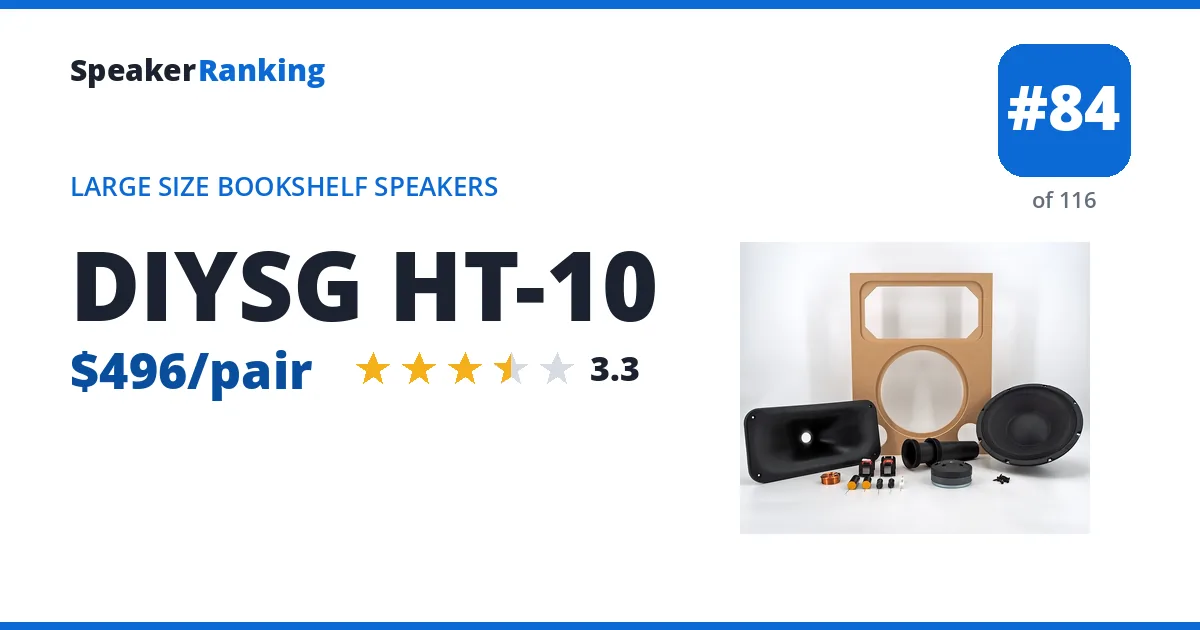
Pros: A distinct kit design from DIY Sound Group’s HTM-12 v2, a 10” ported LCR/surround box built around a Celestion woofer and compression tweeter. Sound-power smoothness of 0.197 is solid for a budget DIY kit. Measured bass extension of 73.4Hz (-3dB), with a measured sensitivity of 91.3dB.
Cons: On-axis deviation of 0.537dB is rough, with a pronounced -0.43dB per octave downward tilt giving it a notably dark tonal character, a somewhat resonant bass-alignment Q of 1.76, and the Harman in-room bass extension estimate is a modest 56Hz for a 10” woofer. It ships as a flat-pack cabinet kit requiring assembly, sold in a minimum order of two units.
Full DIYSG HT-10 review and specifications →
| Bass Extension (-3dB) | 73.4Hz (measured, spinorama.org) |
|---|---|
| Country | United States (kit design) |
| DIY Kit | Yes |
| Dimensions | 15W x 19.5H x 9D in |
| Drivers | Celestion TF1020 10” woofer, Celestion CDX1-1445DA compression tweeter |
| Enclosure | Ported, MDF flat-pack cabinet kit |
| Impedance | 8 ohms |
| Sensitivity | 91.3dB (measured average 300Hz-3kHz @ 2.83V/1m, spinorama.org); 95dB manufacturer specified |
| Spinorama Preference Score | 4.26 |
| Spinorama Preference Score with Perfect Sub | 6.80 |
| Weight | approx. 28 lbs (12.7 kg) assembled |
- Links
- Reviews, Comparisons and Sound Samples
- Head-to-Head Comparisons
 GR Research Klipsch RP-600M Upgrade: $279 per pair GR Research eBay
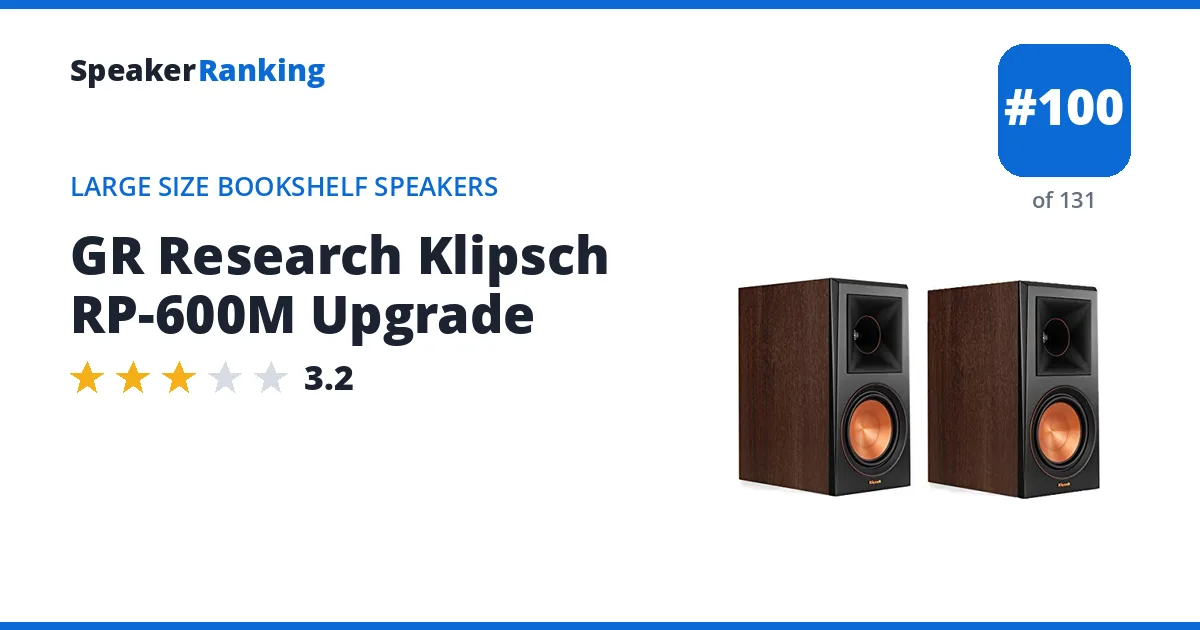
Pros: GR Research’s replacement crossover fixes the stock Klipsch RP-600M’s biggest flaw, a deep response dip around the crossover, by using gentler first-order filters. Audio Science Review’s measurements show listening-window smoothness rising from 0.40 to 0.78 and the preference score from 3.66 to 5.11 (5.61 to 7.06 with an ideal subwoofer), with response within 3dB from 80Hz to 20kHz. Bass reaches 68.8Hz at -3dB and about 40Hz at -10dB, and the kit also cuts ringing around 800Hz. At $279 per pair it comes with all new crossover parts, No-Rez damping, wiring and connectors. Measured bass extension of 68.8Hz (-3dB), with a measured sensitivity of 86.7dB.
Cons: This is a DIY kit, not a finished speaker: you need a pair of the original Klipsch RP-600M, which is discontinued, and must rebuild both crossovers yourself. It does not fit the RP-600M II. Sensitivity drops about 1.5dB to 86.7dB, horizontal directivity narrows for a smaller sweet spot, and a 4.44 directivity-index deviation shows uneven off-axis sound. Average on-axis deviation of 0.49dB is rougher than the stock speaker’s 0.23dB, and the current RP-600M II scores higher (5.64) with no work at all.
Full GR Research Klipsch RP-600M Upgrade review and specifications →
| Bass Extension (-10dB) | 40.0Hz (measured, spinorama.org ASR data) |
|---|---|
| Bass Extension (-3dB) | 68.8Hz (measured, spinorama.org ASR data) |
| DIY Kit | Yes |
| Dimensions | 15.7”H x 8”W x 11.9”D (398.8 x 203.2 x 302.3 mm) |
| Drivers | 6.5” Cerametallic cone woofer, 1” titanium LTS vented tweeter with Tractrix horn (stock Klipsch RP-600M drivers) |
| Sensitivity | 86.7dB (measured, Audio Science Review) |
| Spinorama Preference Score | 5.11 |
| Spinorama Preference Score with Perfect Sub | 7.06 |
| Weight | 16.1 lbs (7.3 kg) each |
| Woofer Cabinet | ported |
- Links
- Reviews, Comparisons and Sound Samples
- Head-to-Head Comparisons