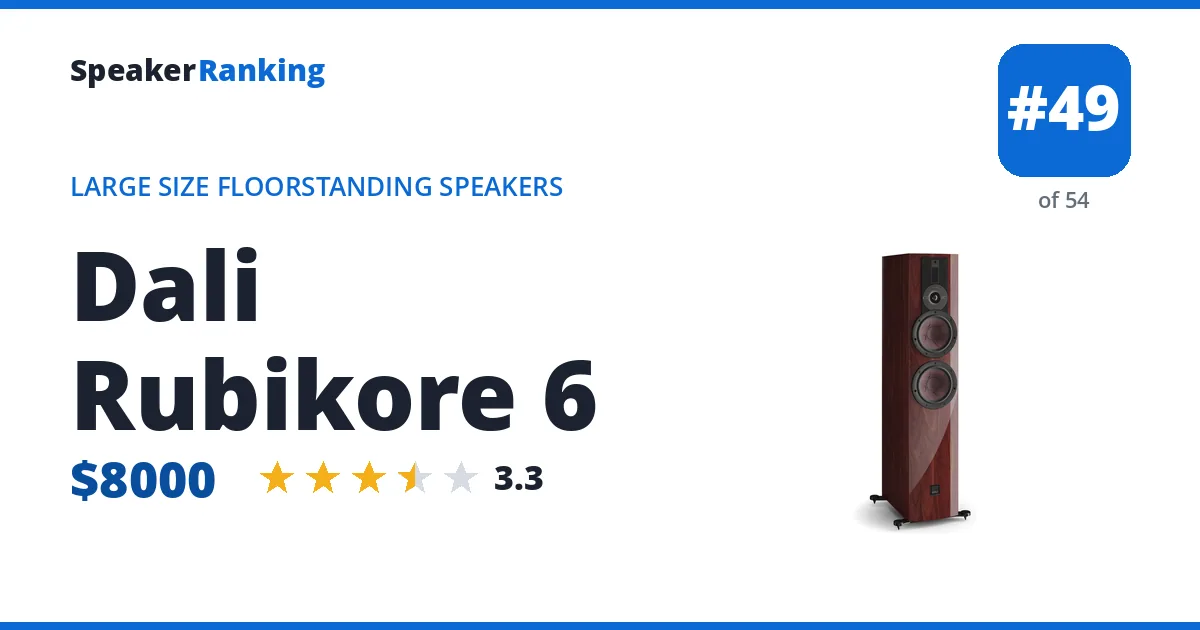
Short answer: the Dali Rubikore 6. It ranks #64 of 74 floorstanding speakers by sound quality, rated 3.3/5, at $8,000; the Endow Audio Bravura 7 ranks #66, rated 3.0/5, and costs $14,000, so there is little reason to consider the other one.
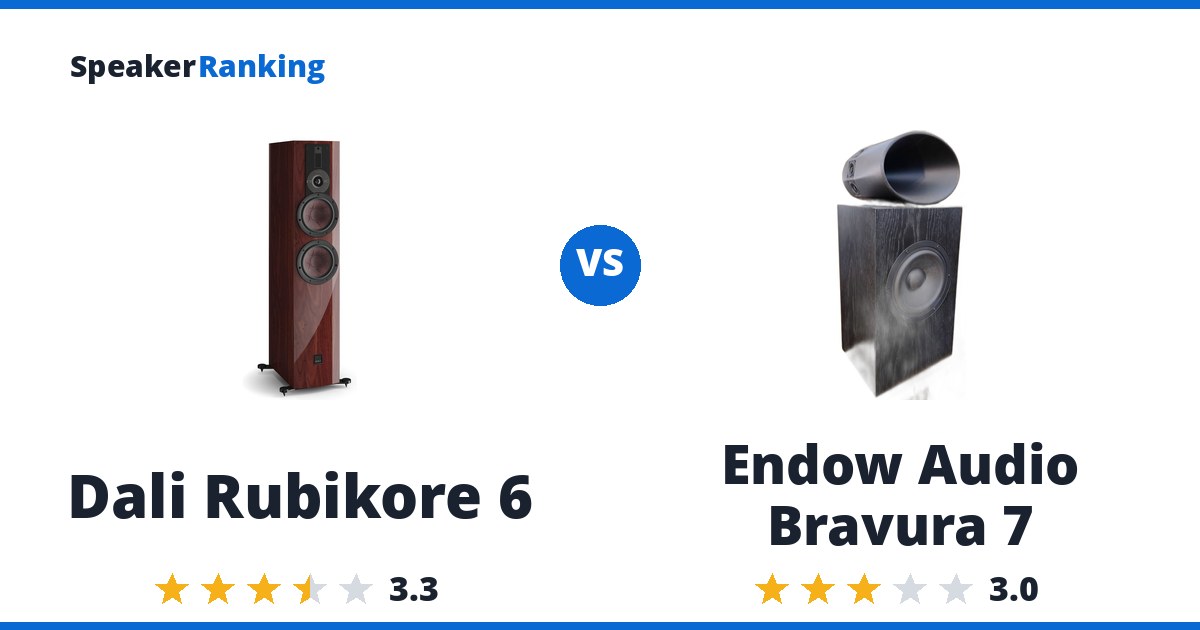
Why pick the Dali Rubikore 6: Unusual 2.5-plus-half-way, four-driver configuration: two woofers overlap up to 800Hz, then one continues alone to about 2600Hz where the tweeter takes over, followed by a supertweeter engaging at 14kHz. The tradeoff: On-axis, the treble sits 3-5dB above the midrange (especially around 4kHz), giving a sibilant, hot top end that the manufacturer itself recommends compensating for with 30° of toe-out (firing the speakers straight into the room rather than at the listener).
What the Endow Audio Bravura 7 does well: A genuinely unusual radiation concept: nine small midrange drivers radiate nearly omnidirectionally from roughly 300Hz to 6kHz, producing an exceptionally large, enveloping soundstage and illuminating the sidewalls, floor and ceiling much more evenly than a conventional box. The tradeoff: The radiation pattern changes abruptly at 6kHz: below it the array is nearly omnidirectional, but the waveguided tweeter collapses to about +/-20 degrees horizontally and less than +/-10 degrees vertically.
One note: the Endow Audio Bravura 7 is no longer in production and isn’t widely stocked new anymore.
Buy the Dali Rubikore 6. It is rated higher for sound quality than the Endow Audio Bravura 7 and costs less, so only choose the other one for a particular feature it does better.
Still deciding? The full Passive Home rankings cover every ranked option.
Specifications Side By Side
| Dali Rubikore 6 | Endow Audio Bravura 7 | |
|---|---|---|
| Price | $8000 per pair | $14000.00 per pair Discontinued |
| Ranked | #64 of 74 in Large Size Floorstanding Speakers | #66 of 74 in Large Size Floorstanding Speakers |
| Bass Extension (-10dB) | 31Hz (measured, Erin’s Audio Corner) | 36Hz (measured, Erin’s Audio Corner) |
| Bass Extension (-3dB) | 43Hz (measured, Erin’s Audio Corner) | 50Hz (measured, Erin’s Audio Corner) |
| Drivers | 28mm tweeter + dual 180mm woofers | 7” woofer, nine 1.5” omnidirectional midrange drivers, waveguided tweeter, rear passive radiator |
| Weight | 114.9 lbs (52.1 kg) | 24.3 lbs (11 kg) each |
| Sensitivity | 86.4dB (measured, Erin’s Audio Corner; 88.5dB manufacturer specified) | 81-82dB (measured, Erin’s Audio Corner) |
| Impedance | 4 ohms nominal (4.3 ohms minimum above 80Hz, measured, Erin’s Audio Corner) | 4 ohms nominal, 3.1 ohms minimum above 80Hz; 1.5 ohms minimum EPDR (measured, Erin’s Audio Corner) |
| Dimensions | 39”H x 7.9”W x 15”D (990.0 x 200.0 x 380.0 mm) | 21”H x 9”W x 11”D (533 x 229 x 279 mm) |
| Woofer Cabinet | ported, rear | passive radiator, rear |
| Spinorama Preference Score | 5.27 | 2.67 |
| Spinorama Preference Score with Perfect Sub | 6.96 | 4.62 |
| DIY Kit | No | No |
Related Speaker Comparisons
How Dali Rubikore 6 compares with other leading options:
- Revel F226Be vs Dali Rubikore 6
- Revel Concerta2 F35 vs Dali Rubikore 6
- JBL Studio 698 vs Dali Rubikore 6
- PS Audio Aspen FR10 vs Dali Rubikore 6
- Focal Aria Evo X N°2 vs Dali Rubikore 6
Prices on this page were last checked September 30, 2026 at 2:57 PM UTC. Product prices and availability are accurate as of that date/time and are subject to change; the price and availability shown on Amazon at the time of purchase will apply to the purchase of this product.
As an eBay Partner, we may be compensated if you make a purchase.
The Two Speakers In Full
 Dali Rubikore 6: $8000 per pair Safe and Sound HQ eBay
Pros: Unusual 2.5-plus-half-way, four-driver configuration: two woofers overlap up to 800Hz, then one continues alone to about 2600Hz where the tweeter takes over, followed by a supertweeter engaging at 14kHz. A design layout the reviewer says he’d never encountered before. Bass extension reaches a solid 40-45Hz in-room. Distortion is quite low overall, with an especially impressive gap between second- and third-order harmonic distortion in the midwoofers. Wide horizontal radiation of about ±75°, close to the reviewer’s preferred range for an enveloping soundstage. Very good dynamic range, holding up to about 26dB of level increase (70dB to 102dB) with distortion staying within the reviewer’s 3% threshold even at full output. Multiple attractive finish options, including bi-wireable connections. Measured bass extension of 43Hz (-3dB), with a measured sensitivity of 86.4dB.
Cons: On-axis, the treble sits 3-5dB above the midrange (especially around 4kHz), giving a sibilant, hot top end that the manufacturer itself recommends compensating for with 30° of toe-out (firing the speakers straight into the room rather than at the listener). Even with that toe-out, the midrange still reads as somewhat scooped and recessed: the reviewer needed a wide, +2dB EQ boost around 2.5kHz to bring vocals back into proper balance. A high-Q resonance appears around 590Hz, and another shows up around 800Hz in burst decay measurements. Best combined with sidewall absorption to help tame the elevated 4-5kHz energy, adding to setup complexity. Needs specific listening-height positioning: ears should be at the tweeter (not supertweeter) level for the most accurate sound. Without EQ or acoustic treatment, the reviewer found the combination of a hot tweeter and recessed midrange a “tough sale” despite otherwise strong measured performance.
Full Dali Rubikore 6 review and specifications →
| Bass Extension (-10dB) | 31Hz (measured, Erin’s Audio Corner) |
|---|---|
| Bass Extension (-3dB) | 43Hz (measured, Erin’s Audio Corner) |
| DIY Kit | No |
| Dimensions | 39”H x 7.9”W x 15”D (990.0 x 200.0 x 380.0 mm) |
| Drivers | 28mm tweeter + dual 180mm woofers |
| Impedance | 4 ohms nominal (4.3 ohms minimum above 80Hz, measured, Erin’s Audio Corner) |
| Sensitivity | 86.4dB (measured, Erin’s Audio Corner; 88.5dB manufacturer specified) |
| Spinorama Preference Score | 5.27 |
| Spinorama Preference Score with Perfect Sub | 6.96 |
| Weight | 114.9 lbs (52.1 kg) |
| Woofer Cabinet | ported, rear |
- Links
- Reviews, Comparisons and Sound Samples
- Head-to-Head Comparisons
 Endow Audio Bravura 7: $14000.00 per pair Discontinued eBay
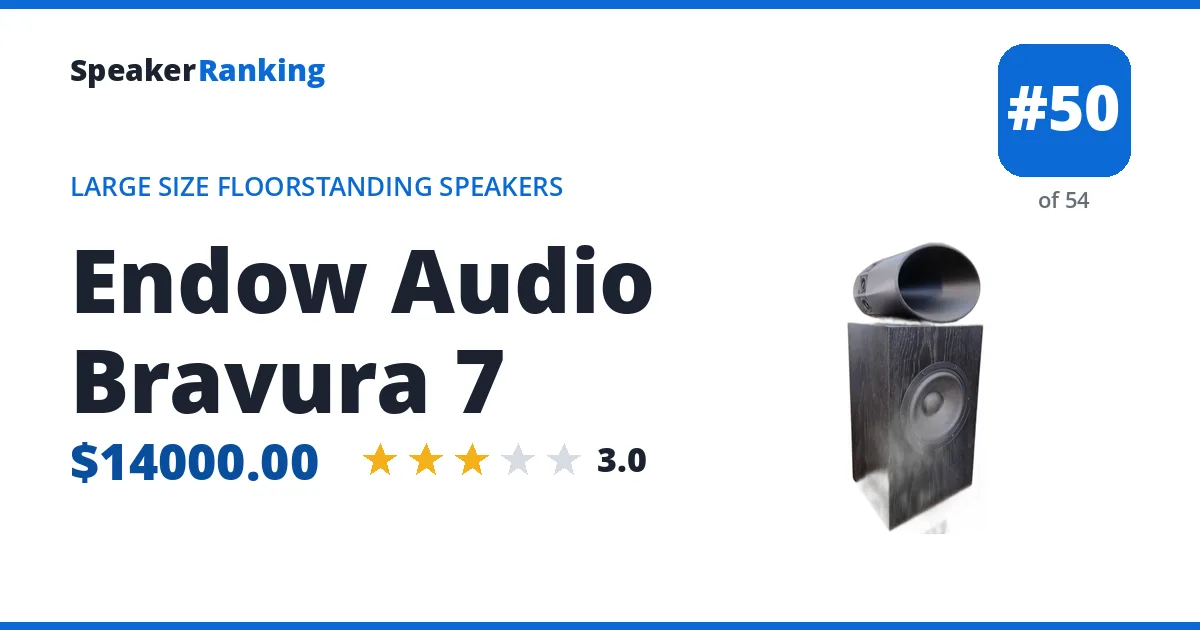
Pros: A genuinely unusual radiation concept: nine small midrange drivers radiate nearly omnidirectionally from roughly 300Hz to 6kHz, producing an exceptionally large, enveloping soundstage and illuminating the sidewalls, floor and ceiling much more evenly than a conventional box. Erin found solid, snappy midbass and measured F3 at 50Hz and F10 at 36Hz. On-axis response below the tweeter transition is broadly linear for such an unconventional array. Multitone distortion remains comparatively well controlled at ordinary levels. The rear passive radiator and 7-inch woofer give useful extension, and the system’s room-filling spatial presentation is unlike a standard forward radiator. Measured bass extension of 50Hz (-3dB), with a measured sensitivity of 82dB.
Cons: The radiation pattern changes abruptly at 6kHz: below it the array is nearly omnidirectional, but the waveguided tweeter collapses to about +/-20 degrees horizontally and less than +/-10 degrees vertically. Ears must remain almost exactly on tweeter axis or the top octave largely disappears. Erin measured very low 81-82dB sensitivity despite the nine-driver array, so substantial amplifier power is required. A 7-8dB high-frequency peak suggests tweeter breakup or diffraction. The small midranges show notable compression at high level; 96dB is acceptable but the 102dB sweep loses significant midrange output, while the woofer compresses below about 60Hz. Harmonic distortion is high around 100Hz at 96dB. Its huge reflected-sound contribution makes results unusually room-dependent, and its price is extremely high for its sensitivity, output limits and discontinuous treble directivity. Discontinued.
Full Endow Audio Bravura 7 review and specifications →
| Bass Extension (-10dB) | 36Hz (measured, Erin’s Audio Corner) |
|---|---|
| Bass Extension (-3dB) | 50Hz (measured, Erin’s Audio Corner) |
| DIY Kit | No |
| Dimensions | 21”H x 9”W x 11”D (533 x 229 x 279 mm) |
| Drivers | 7” woofer, nine 1.5” omnidirectional midrange drivers, waveguided tweeter, rear passive radiator |
| Impedance | 4 ohms nominal, 3.1 ohms minimum above 80Hz; 1.5 ohms minimum EPDR (measured, Erin’s Audio Corner) |
| Sensitivity | 81-82dB (measured, Erin’s Audio Corner) |
| Spinorama Preference Score | 2.67 |
| Spinorama Preference Score with Perfect Sub | 4.62 |
| Weight | 24.3 lbs (11 kg) each |
| Woofer Cabinet | passive radiator, rear |
- Links
- Reviews, Comparisons and Sound Samples
- Head-to-Head Comparisons