Short answer: the Dali Rubikore 6 goes deeper and plays louder with wider horizontal coverage, while the Focal Aria Evo X N°2 is the less expensive tower with a livelier bass balance. Focal’s dual 6.5-inch woofers provide useful 40 to 50Hz in-room bass and low distortion, but its bright tweeter and broad 1 to 4kHz recession need real EQ for an honest tonal balance.
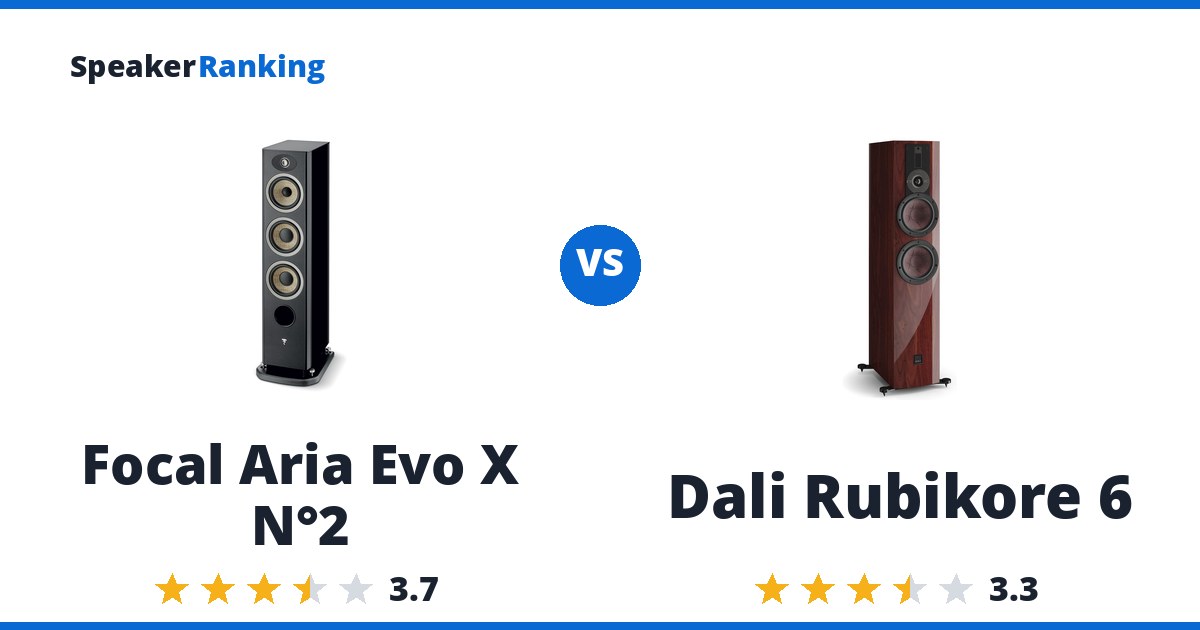
Dali reaches a measured 31Hz F10 and 43Hz F3, holds distortion under control to high levels and radiates broadly. Its treble is also elevated and its midrange recessed, so it likewise benefits from toe-out, EQ and sometimes sidewall treatment.
Neither is plug-and-play neutral. The Focal is the lower-cost choice with more obvious EQ needs; the Dali offers deeper bass and higher headroom if its setup demands fit your room.
Buy the Focal Aria Evo X N°2 if you want the less expensive, sensitive tower and can apply EQ to correct its bright, recessed balance.
Buy the Dali Rubikore 6 if you want deeper bass, broad dispersion and stronger high-output behavior with careful positioning.
Want more options? Browse the full Passive Home rankings.
Specifications Side By Side
| Focal Aria Evo X N°2 | Dali Rubikore 6 | |
|---|---|---|
| Price | $4,798 per pair | $8000 per pair |
| Ranked | #57 of 73 in Large Size Floorstanding Speakers | #64 of 73 in Large Size Floorstanding Speakers |
| Bass Extension (-10dB) | 38Hz (measured, Erin’s Audio Corner) | 31Hz (measured, Erin’s Audio Corner) |
| Bass Extension (-3dB) | 50Hz (measured, Erin’s Audio Corner) | 43Hz (measured, Erin’s Audio Corner) |
| Impedance | 8 ohms nominal (2.9 ohms minimum, Manufacturer specified; 3.4 ohms minimum measured by Erin’s Audio Corner) | 4 ohms nominal (4.3 ohms minimum above 80Hz, measured, Erin’s Audio Corner) |
| Sensitivity | 88.2dB (2.83V/1m, measured by Erin’s Audio Corner; 91.5dB Manufacturer specified) | 86.4dB (measured, Erin’s Audio Corner; 88.5dB manufacturer specified) |
| Drivers | Aluminum-magnesium inverted dome tweeter with waveguide, 6.5” flax midrange, dual 6.5” flax midbass woofers | 28mm tweeter + dual 180mm woofers |
| Weight | 55.1 lbs (25 kg) each | 114.9 lbs (52.1 kg) |
| Dimensions | 40.7”H x 14.6”W x 11.6”D (1035 x 371 x 294 mm) | 39”H x 7.9”W x 15”D (990.0 x 200.0 x 380.0 mm) |
| Woofer Cabinet | 3-way, bass reflex (bottom-firing port, requires plinth) | ported, rear |
| Frequency Response | 45Hz - 30kHz (Manufacturer specified) | - |
| Recommended Power | 40-250W | - |
| Spinorama Preference Score | 4.88 | 5.27 |
| Spinorama Preference Score with Perfect Sub | 6.82 | 6.96 |
| DIY Kit | No | No |
Related Speaker Comparisons
More top alternatives to Focal Aria Evo X N°2:
- Focal Aria Evo X N°2 vs KEF Blade Two Meta
- Focal Aria Evo X N°2 vs MoFi SourcePoint V10 Master Edition
- Focal Aria Evo X N°2 vs MoFi SourcePoint 888
- Revel F328Be vs Focal Aria Evo X N°2
- Focal Aria Evo X N°2 vs KEF R5 Meta
Prices on this page were last checked September 29, 2026 at 3:43 PM UTC. Product prices and availability are accurate as of that date/time and are subject to change; the price and availability shown on Amazon at the time of purchase will apply to the purchase of this product.
As an eBay Partner, we may be compensated if you make a purchase.
The Two Speakers In Full
 Focal Aria Evo X N°2: $4,798 per pair Amazon eBay
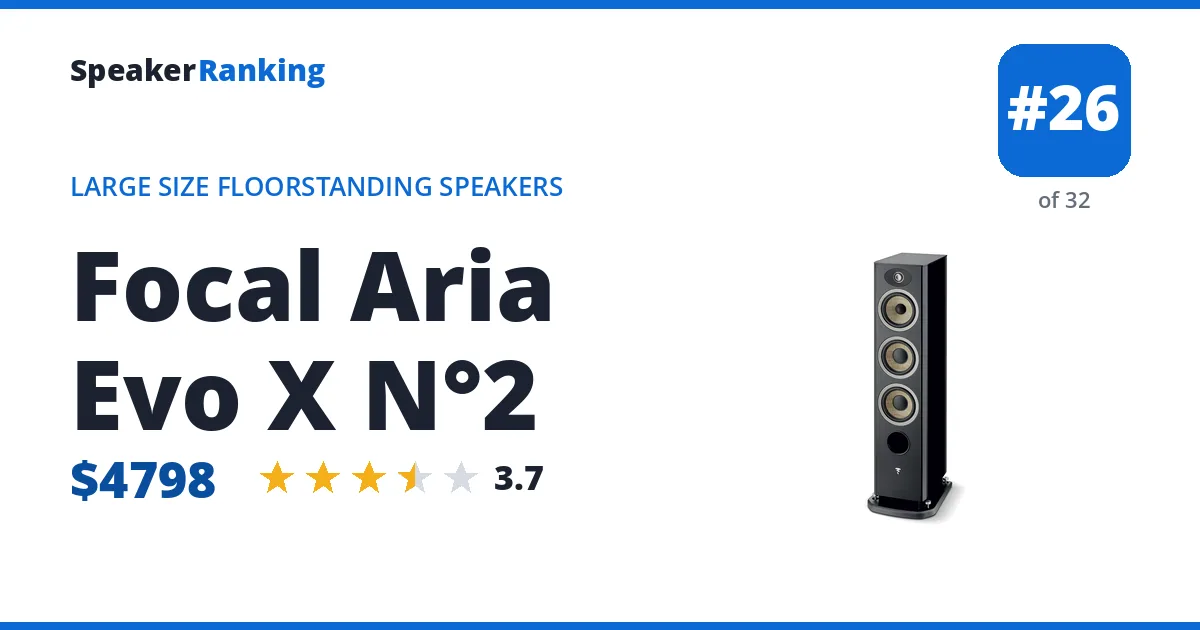
Pros: Solid bass with a deliberate mid-bass bump (80-120Hz) that gives extra thump and weight, extending to about 40-50Hz in-room. High sensitivity (measured 88.2dB) makes it easy to drive, and distortion is low throughout the range even at high output: the reviewer found only a minor compression “glare” around 4.5kHz at very high volumes, not a real concern. Directivity components (mid-range and tweeter) transition smoothly rather than abruptly, and the overall soundstage is wide and enveloping. Measured bass extension of 50Hz (-3dB), with a measured sensitivity of 88.2dB.
Cons: Sounds very bright pointed directly at the listener: the tweeter comes in 5-6dB above the midrange with an unusually wide, roughly two-octave dip (1kHz-4kHz) leading into it, giving a laid-back, low-attack character even after toeing out ~20 degrees. Fixing this properly requires real EQ (a mini DSP or similar), not just toe-out or absorption alone; without EQ, expect it to sound bright for stereo listening. A mild dip around 200Hz makes male vocals sound slightly subdued. Narrow vertical directivity (about +/-15 degrees) means you need to stay close to tweeter-axis height. Impedance dips to 3.4 ohms (EPDR 1.4 ohms), so it wants a 4-ohm-capable amplifier, and requires a plinth for floor clearance since it’s bottom-ported.
Full Focal Aria Evo X N°2 review and specifications →
| Bass Extension (-10dB) | 38Hz (measured, Erin’s Audio Corner) |
|---|---|
| Bass Extension (-3dB) | 50Hz (measured, Erin’s Audio Corner) |
| DIY Kit | No |
| Dimensions | 40.7”H x 14.6”W x 11.6”D (1035 x 371 x 294 mm) |
| Drivers | Aluminum-magnesium inverted dome tweeter with waveguide, 6.5” flax midrange, dual 6.5” flax midbass woofers |
| Frequency Response | 45Hz - 30kHz (Manufacturer specified) |
| Impedance | 8 ohms nominal (2.9 ohms minimum, Manufacturer specified; 3.4 ohms minimum measured by Erin’s Audio Corner) |
| Recommended Power | 40-250W |
| Sensitivity | 88.2dB (2.83V/1m, measured by Erin’s Audio Corner; 91.5dB Manufacturer specified) |
| Spinorama Preference Score | 4.88 |
| Spinorama Preference Score with Perfect Sub | 6.82 |
| Weight | 55.1 lbs (25 kg) each |
| Woofer Cabinet | 3-way, bass reflex (bottom-firing port, requires plinth) |
- Links
- Reviews, Comparisons and Sound Samples
- Head-to-Head Comparisons
- Focal Aria Evo X N°2 vs Polk Audio XT60
- Focal Aria Evo X N°2 vs Polk T50
- Focal Aria Evo X N°2 vs Infinity Reference 253
- Focal Aria Evo X N°2 vs Magnepan LRS+
- Focal Aria Evo X N°2 vs SVS Ultra Evolution Pinnacle
- Focal Aria Evo X N°2 vs Definitive Technology BP-9020
- Focal Aria Evo X N°2 vs Klipsch RP-6000F II
- Focal Aria Evo X N°2 vs JBL Stage 2 280F
- See all 46 comparisons
 Dali Rubikore 6: $8000 per pair Safe and Sound HQ eBay
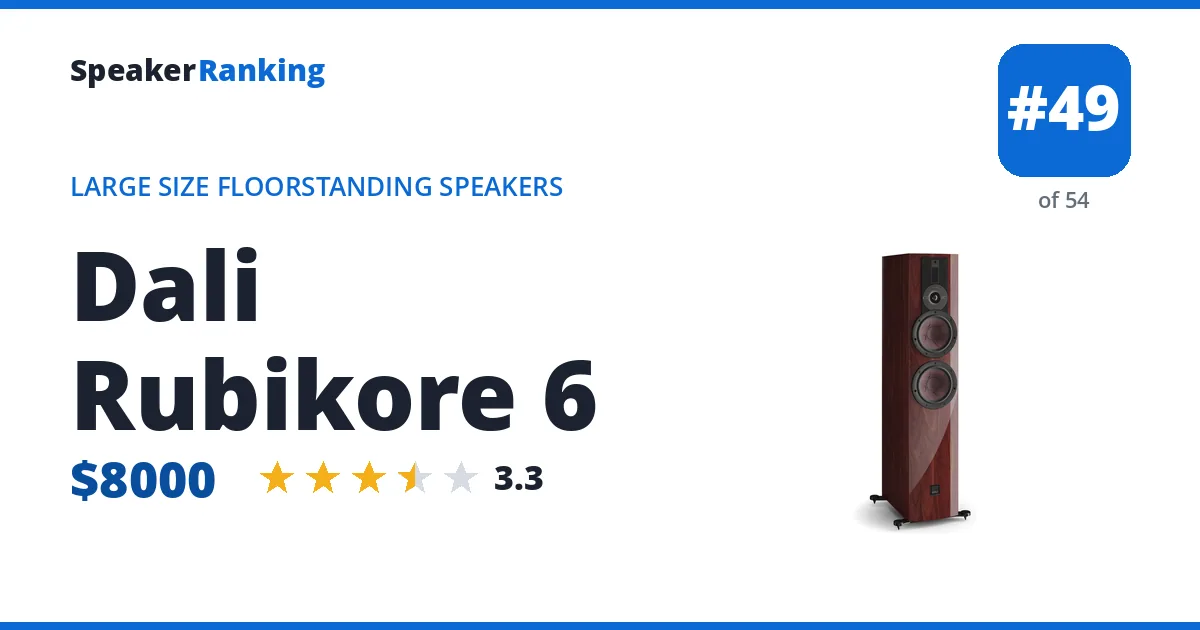
Pros: Unusual 2.5-plus-half-way, four-driver configuration: two woofers overlap up to 800Hz, then one continues alone to about 2600Hz where the tweeter takes over, followed by a supertweeter engaging at 14kHz. A design layout the reviewer says he’d never encountered before. Bass extension reaches a solid 40-45Hz in-room. Distortion is quite low overall, with an especially impressive gap between second- and third-order harmonic distortion in the midwoofers. Wide horizontal radiation of about ±75°, close to the reviewer’s preferred range for an enveloping soundstage. Very good dynamic range, holding up to about 26dB of level increase (70dB to 102dB) with distortion staying within the reviewer’s 3% threshold even at full output. Multiple attractive finish options, including bi-wireable connections. Measured bass extension of 43Hz (-3dB), with a measured sensitivity of 86.4dB.
Cons: On-axis, the treble sits 3-5dB above the midrange (especially around 4kHz), giving a sibilant, hot top end that the manufacturer itself recommends compensating for with 30° of toe-out (firing the speakers straight into the room rather than at the listener). Even with that toe-out, the midrange still reads as somewhat scooped and recessed: the reviewer needed a wide, +2dB EQ boost around 2.5kHz to bring vocals back into proper balance. A high-Q resonance appears around 590Hz, and another shows up around 800Hz in burst decay measurements. Best combined with sidewall absorption to help tame the elevated 4-5kHz energy, adding to setup complexity. Needs specific listening-height positioning: ears should be at the tweeter (not supertweeter) level for the most accurate sound. Without EQ or acoustic treatment, the reviewer found the combination of a hot tweeter and recessed midrange a “tough sale” despite otherwise strong measured performance.
Full Dali Rubikore 6 review and specifications →
| Bass Extension (-10dB) | 31Hz (measured, Erin’s Audio Corner) |
|---|---|
| Bass Extension (-3dB) | 43Hz (measured, Erin’s Audio Corner) |
| DIY Kit | No |
| Dimensions | 39”H x 7.9”W x 15”D (990.0 x 200.0 x 380.0 mm) |
| Drivers | 28mm tweeter + dual 180mm woofers |
| Impedance | 4 ohms nominal (4.3 ohms minimum above 80Hz, measured, Erin’s Audio Corner) |
| Sensitivity | 86.4dB (measured, Erin’s Audio Corner; 88.5dB manufacturer specified) |
| Spinorama Preference Score | 5.27 |
| Spinorama Preference Score with Perfect Sub | 6.96 |
| Weight | 114.9 lbs (52.1 kg) |
| Woofer Cabinet | ported, rear |
- Links
- Reviews, Comparisons and Sound Samples
- Head-to-Head Comparisons