Short answer: the Ascend Acoustics CBM-170 SE2. It ranks #112 of 216 bookshelf speakers by sound quality, rated 3.8/5, at $468. The Polk Signature Elite ES20 ranks #117, rated 3.7/5, at $399, $69 cheaper, which does not close the gap in sound quality.
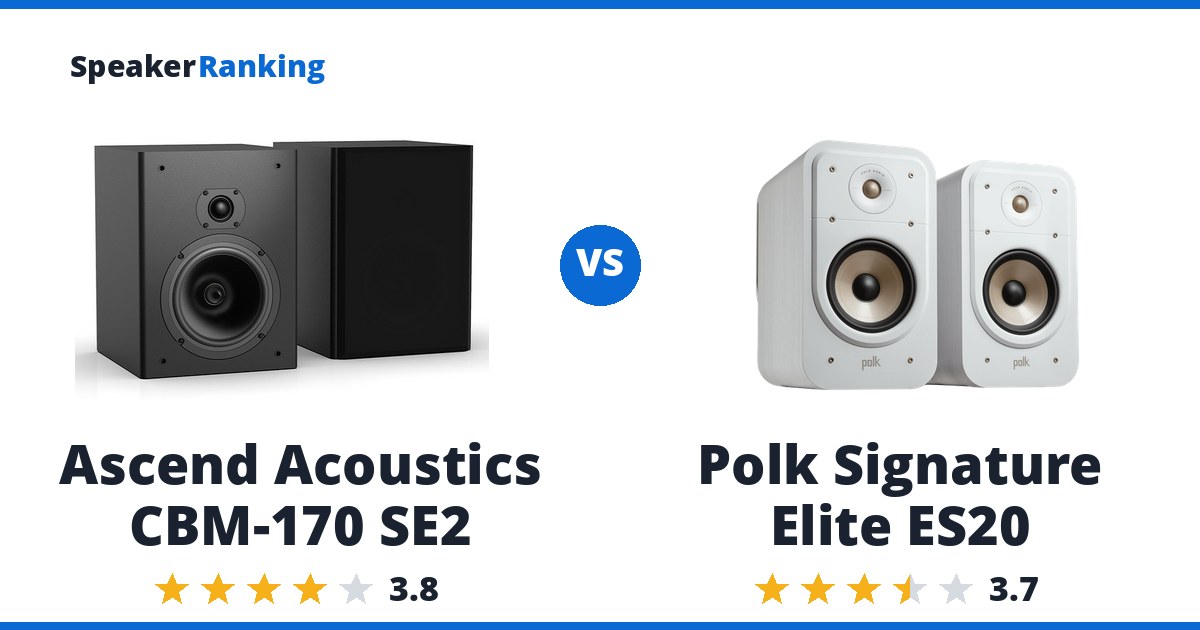
The Ascend Acoustics CBM-170 SE2 is the more accurate choice. On-axis response is impressively flat from about 100Hz to 2kHz, staying within roughly ±1dB, with a clean, gradual bass rolloff below that. Its measured preference score, a predictor of how neutral it sounds, is 6.30 against 4.49 for the Polk Signature Elite ES20. The catch: A narrow dip in the on-axis and listening-window response appears in the 3-5kHz range (down to about -2.7dB), mirrored by a matching dip in the directivity index at the same frequencies: likely a brief widening of dispersion right at the tweeter/woofer crossover.
The Polk Signature Elite ES20 is the deeper-bass option. A full-size, efficient 6.5-inch bookshelf pair with unusually deep bass for the price. Its bass reaches about 55.7Hz before falling 3dB, against 70Hz for the Ascend Acoustics CBM-170 SE2. Watch for: Predicted in-room smoothness of 0.238 and directivity-index consistency of 3.81 are average rather than class-leading.
Buy the Ascend Acoustics CBM-170 SE2. It is rated higher for sound quality, and the $69 you would save on the Polk Signature Elite ES20 does not close the gap.
Looking for alternatives? See the complete Passive Home rankings.
Specifications Side By Side
| Ascend Acoustics CBM-170 SE2 | Polk Signature Elite ES20 | |
|---|---|---|
| Price | $468 per pair | $399.00 per pair |
| Ranked | #112 of 216 in Large Size Bookshelf Speakers | #117 of 216 in Large Size Bookshelf Speakers |
| Bass Extension (-3dB) | 70Hz (measured, manufacturer spinorama data) | 55.7Hz (measured, ASR via spinorama.org) |
| Bass Extension (-10dB) | 50Hz (measured, manufacturer spinorama data) | 38.6Hz (derived, log-interpolated between spinorama.org -9dB/-12dB points) |
| Sensitivity | 86.8dB (2.83V/1m, measured, manufacturer spinorama data; 87dB manufacturer specified) | 86dB |
| Drivers | 27mm custom SEAS soft dome tweeter, 6.5” proprietary composite polygel cone woofer | 1” Terylene dome tweeter, 6.5” polypropylene woofer |
| Dimensions | 12H x 9W x 9.5D in | 14.8H x 8.5W x 13.8D in |
| Weight | 15 lbs (6.8 kg) each | 17 lbs (7.7 kg) each |
| Impedance | 8 ohms | 4/8-ohm compatible |
| Power Handling | 200W continuous, 400W peak | - |
| Woofer Cabinet | ported, rear | - |
| Spinorama Preference Score | 6.30 | 4.49 |
| Spinorama Preference Score with Perfect Sub | 8.66 | 6.44 |
| DIY Kit | No | No |
| Enclosure | - | 2-way, Power Port bass-reflex |
| Country | - | United States (design) |
Frequency Response Compared
Both speakers’ spinorama measurements, overlaid. A flatter line is more neutral: peaks sound forward or harsh, dips sound recessed. Each curve is shifted so its average from 300 Hz to 3 kHz sits at 0 dB, so loudness differences between the two are removed and only the shape is compared. The two were measured by different sources, so small differences, especially in the bass, can come from the measurement setup rather than the speakers.
Measurement data: Ascend Acoustics CBM-170 SE2 (measured by the manufacturer) and Polk Signature Elite ES20 (measured by Audio Science Review), via spinorama.org.
Related Speaker Comparisons
More worthwhile head-to-heads for Ascend Acoustics CBM-170 SE2:
- Ascend Acoustics CBM-170 SE2 vs Perlisten S4b
- Ascend Acoustics CBM-170 SE2 vs KEF Reference 1 Meta
- Ascend Acoustics CBM-170 SE2 vs GR-Research NX-Studio
- AsciLab C6B vs Ascend Acoustics CBM-170 SE2
- Ascend Acoustics CBM-170 SE2 vs Audio First Cadentia 3
Prices on this page were last checked October 14, 2026 at 2:38 PM UTC. Product prices and availability are accurate as of that date/time and are subject to change; the price and availability shown on Amazon at the time of purchase will apply to the purchase of this product.
As an eBay Partner, we may be compensated if you make a purchase.
The Two Speakers In Full
 Ascend Acoustics CBM-170 SE2: $468 per pair Ascend Acoustics $468 eBay
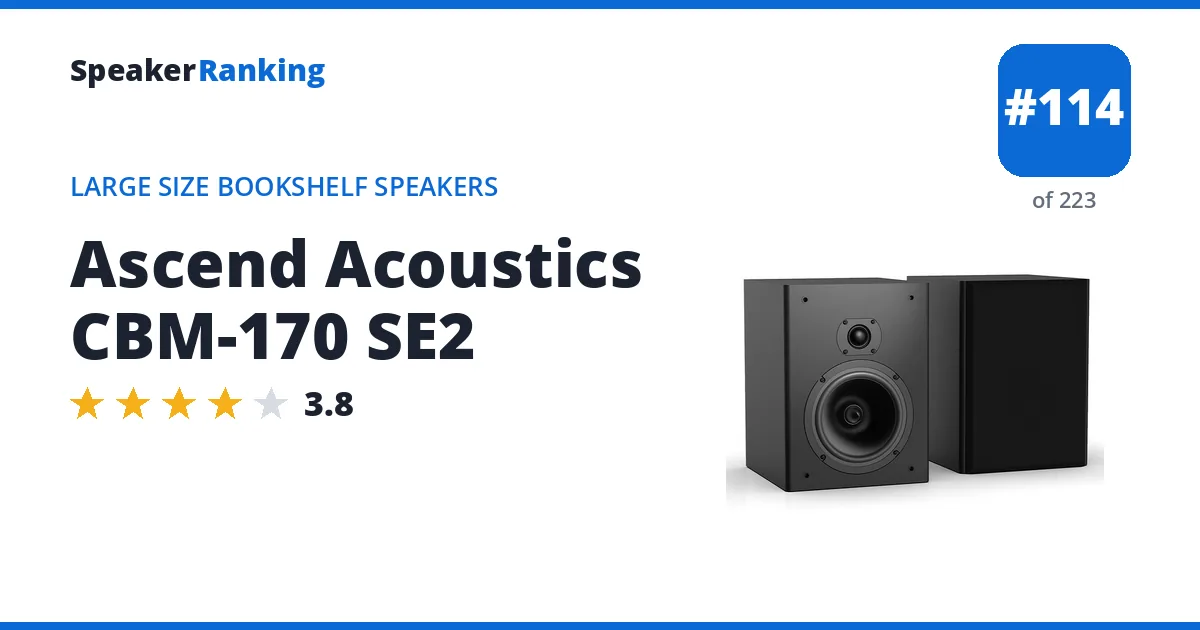
Older model: the Ascend Acoustics CBM-170 SE (ranked lower, rated 2.1/5). See every Ascend CBM, HTM and CMT generation.
Same family: the Ascend Acoustics HTM-200SE2 (larger bookshelf, rated 4.3/5) and the Ascend Acoustics CMT-340 SE2 (larger bookshelf, ranked higher, rated 4.4/5).
Pros: On-axis response is impressively flat from about 100Hz to 2kHz, staying within roughly ±1dB, with a clean, gradual bass rolloff below that. The directivity index rises smoothly and predictably through the crossover region, and the estimated in-room response shows a smooth, consistent downward tilt from 100Hz to 10kHz with no major discontinuities: close to the ideal in-room target shape. Measured sensitivity of 86.8dB nearly matches Ascend’s 87dB spec. The manufacturer’s own preference-score modeling comes out to 6.30 unequalized (rising to 8.66 with an ideal subwoofer, or 6.79/8.86 with EQ applied): a strong result for a compact 2-way, and a clear step up from the original Ascend Acoustics CBM-170 SE this replaces. Measured sensitivity of 86.8dB.
Cons: A narrow dip in the on-axis and listening-window response appears in the 3-5kHz range (down to about -2.7dB), mirrored by a matching dip in the directivity index at the same frequencies: likely a brief widening of dispersion right at the tweeter/woofer crossover. High-frequency directivity narrows substantially above 10kHz, typical for a small dome tweeter, so the top octave will sound more reserved off-axis than on-axis. Bass rolls off as expected for a compact 2-way monitor: -3dB around 70Hz and -10dB around 50Hz, so a subwoofer is needed for full-range use. This data comes from the manufacturer’s own Klippel measurements rather than an independent third-party review, so there’s no outside verification of channel matching, distortion, or unit-to-unit consistency.
Full Ascend Acoustics CBM-170 SE2 review and specifications →
| Released | Jul 2026 (3 months ago) |
|---|---|
| Bass Extension (-10dB) | 50Hz (measured, manufacturer spinorama data) |
| Bass Extension (-3dB) | 70Hz (measured, manufacturer spinorama data) |
| DIY Kit | No |
| Dimensions | 12H x 9W x 9.5D in |
| Drivers | 27mm custom SEAS soft dome tweeter, 6.5” proprietary composite polygel cone woofer |
| Impedance | 8 ohms |
| Power Handling | 200W continuous, 400W peak |
| Sensitivity | 86.8dB (2.83V/1m, measured, manufacturer spinorama data; 87dB manufacturer specified) |
| Spinorama Preference Score | 6.30 |
| Spinorama Preference Score with Perfect Sub | 8.66 |
| Weight | 15 lbs (6.8 kg) each |
| Woofer Cabinet | ported, rear |
- Links
- Reviews, Comparisons and Sound Samples
- Head-to-Head Comparisons
- Ascend Acoustics CBM-170 SE2 vs Klipsch RP-600M II
- Ascend Acoustics CBM-170 SE2 vs Dynaudio Contour 20i
- Ascend Acoustics CBM-170 SE2 vs Dynaudio Emit 20
- Ascend Acoustics CBM-170 SE2 vs Philharmonic BMR Monitor
- Ascend Acoustics CBM-170 SE2 vs Mission LX-3 MKII
- Ascend Acoustics CBM-170 SE2 vs GR-Research X-LS Encore
- Ascend Acoustics CBM-170 SE2 vs Dynaudio Special Forty
- Ascend Acoustics CBM-170 SE2 vs ELAC Debut 2.0 B6.2
- See all 48 comparisons
 Polk Signature Elite ES20: $399.00 per pair Amazon $399.00 B&H Photo Video $259.00 eBay
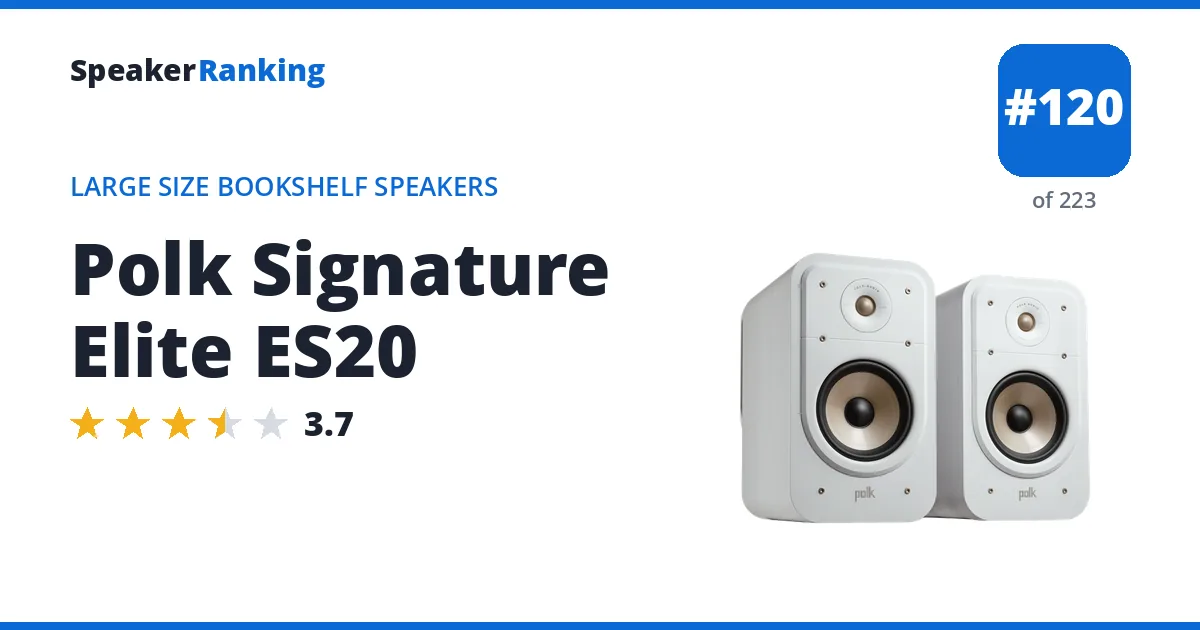
Same family: the Polk Signature Elite ES10 (smaller bookshelf, estimated 3.1/5), the Polk Signature Elite ES15 (smaller bookshelf, rated 3.5/5), the Polk Signature Elite ES50 (smallest floorstanding, estimated 3.8/5), the Polk Signature Elite ES55 (floorstanding, estimated 4/5), the Polk Signature Elite ES60 (largest floorstanding, rated 3.4/5), the Polk Audio Signature Elite ES30 (smaller center, estimated 3.5/5), the Polk Audio Signature Elite ES35 (larger center, estimated 3.4/5), the Polk Audio Signature Elite ES8 Subwoofer (smallest subwoofer, estimated 3.2/5), the Polk Audio Signature Elite ES10 Subwoofer (subwoofer, estimated 3.7/5) and the Polk Audio Signature Elite ES12 Subwoofer (largest subwoofer, estimated 3.8/5). See every Polk Signature generation.
Pros: A full-size, efficient 6.5-inch bookshelf pair with unusually deep bass for the price. ASR measured 41Hz estimated in-room extension, a well-damped Q of 0.66, broad horizontal coverage to roughly +/-60 degrees and a 6.44 preference score with a subwoofer. Measured bass extension of 55.7Hz (-3dB).
Cons: Predicted in-room smoothness of 0.238 and directivity-index consistency of 3.81 are average rather than class-leading. The deep cabinet needs substantial shelf or stand space, and its Power Port still requires rear clearance.
Full Polk Signature Elite ES20 review and specifications →
| Released | Dec 2021 (4 years ago) |
|---|---|
| Bass Extension (-10dB) | 38.6Hz (derived, log-interpolated between spinorama.org -9dB/-12dB points) |
| Bass Extension (-3dB) | 55.7Hz (measured, ASR via spinorama.org) |
| Country | United States (design) |
| DIY Kit | No |
| Dimensions | 14.8H x 8.5W x 13.8D in |
| Drivers | 1” Terylene dome tweeter, 6.5” polypropylene woofer |
| Enclosure | 2-way, Power Port bass-reflex |
| Impedance | 4/8-ohm compatible |
| Sensitivity | 86dB |
| Spinorama Preference Score | 4.49 |
| Spinorama Preference Score with Perfect Sub | 6.44 |
| Weight | 17 lbs (7.7 kg) each |
- Links
- Reviews, Comparisons and Sound Samples
- Head-to-Head Comparisons
- Polk Signature Elite ES20 vs Klipsch RP-600M II
- Polk Signature Elite ES20 vs Dynaudio Emit 20
- Polk Signature Elite ES20 vs Philharmonic BMR Monitor
- Polk Signature Elite ES20 vs Mission LX-3 MKII
- Polk Signature Elite ES20 vs Parts Express Samba MT
- Polk Signature Elite ES20 vs Dynaudio Contour 20i
- Polk Signature Elite ES20 vs GR-Research X-LS Encore
- Polk Signature Elite ES20 vs Dynaudio Special Forty
- See all 47 comparisons