Short answer: the Perlisten S4b if sound quality matters most, the Ascend CBM-170 SE2 if price matters most. The Perlisten S4b ranks #2 of 130 bookshelf speakers at $8000. The Ascend CBM-170 SE2 ranks #66 at $468, $7532 cheaper.
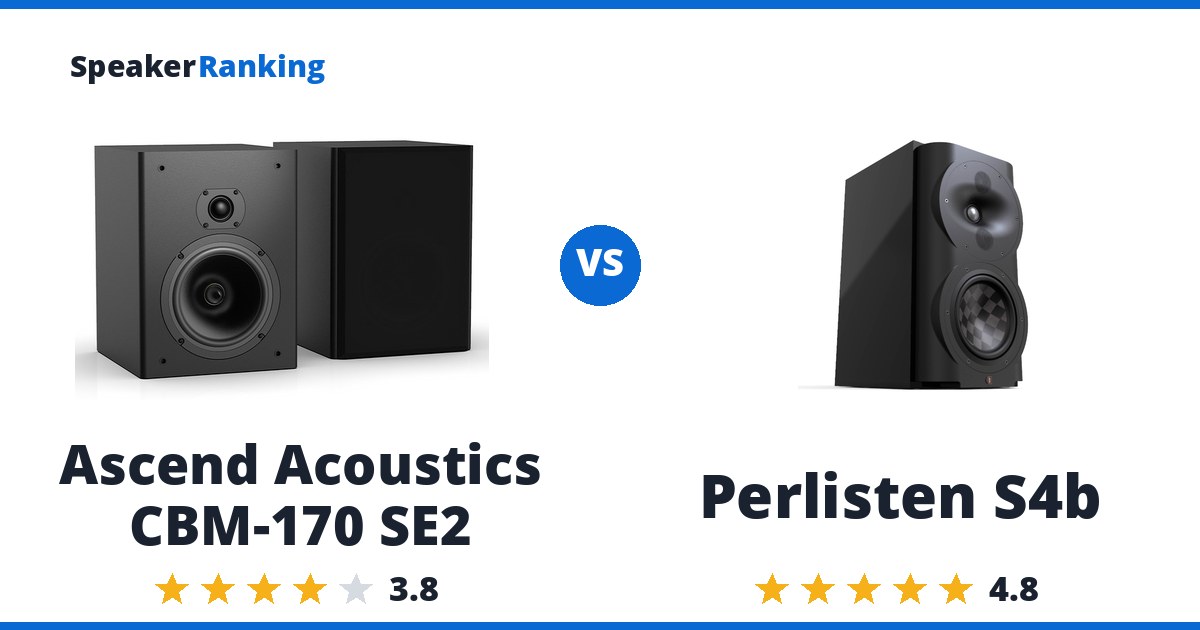
What the Ascend CBM-170 SE2 offers: On-axis response is impressively flat from about 100Hz to 2kHz, staying within roughly ±1dB, with a clean, gradual bass rolloff below that. The directivity index rises smoothly and predictably through the crossover region, and the estimated in-room response shows a smooth, consistent downward tilt from 100Hz to 10kHz with no major discontinuities - close to the ideal in-room target shape. Measured sensitivity of 86.8dB nearly matches Ascend’s 87dB spec. The manufacturer’s own preference-score modeling comes out to 5.81 unequalized (rising to 8.17 with an ideal subwoofer, or 6.33/8.41 with EQ applied) - a strong result for a compact 2-way, and a clear step up from the original CBM-170 SE this replaces. Watch for: A narrow dip in the on-axis and listening-window response appears in the 3-5kHz range (down to about -2.7dB), mirrored by a matching dip in the directivity index at the same frequencies - likely a brief widening of dispersion right at the tweeter/woofer crossover. High-frequency directivity narrows substantially above 10kHz, typical for a small dome tweeter, so the top octave will sound more reserved off-axis than on-axis. Bass rolls off as expected for a compact 2-way monitor: -3dB around 70Hz and -10dB around 50Hz, so a subwoofer is needed for full-range use. This data comes from the manufacturer’s own Klippel measurements rather than an independent third-party review, so there’s no outside verification of channel matching, distortion, or unit-to-unit consistency.
What the Perlisten S4b offers: Reference-grade directivity and output from a compact sealed monitor. Erin called its radiation behavior the smoothest he had measured: Perlisten’s DPC array (beryllium tweeter between two midrange domes) shapes vertical output while transitioning cleanly to the 7-inch woofer. Harmonic distortion remains below 1% at 86dB and, above 100Hz, also below 1% at 96dB; compression is exceptionally low. The response is highly linear, the midrange was a listening highlight, and the sealed F10 of 40Hz provides a predictable slope for subwoofer integration. Watch for: Erin measured only 84.5dB sensitivity and an impedance minimum just under 4 ohms, a difficult efficiency/load combination that deserves substantial clean amplification. Its 78Hz F3 means a subwoofer is effectively mandatory for full-range listening despite the 40Hz F10. A roughly +3dB feature around 10kHz appears on-axis, though Erin did not find it objectionable. Price is extreme for a stand-mount and the tightly managed vertical radiation makes correct stand height important.
Buy the Ascend CBM-170 SE2 if the price matters more than sound quality. Buy the Perlisten S4b if sound quality matters more than the price.
Looking for alternatives? See the complete Passive Home rankings.
Specifications Side By Side
| Ascend CBM-170 SE2 | Perlisten S4b | |
|---|---|---|
| Price | $468 per pair | $8,000 per pair |
| Ranked | #66 of 130 in Large Size Bookshelf Speakers | #2 of 130 in Large Size Bookshelf Speakers |
| Bass Extension (-3dB) | 70Hz (measured, manufacturer spinorama data) | 78Hz (measured, Erin's Audio Corner) |
| Bass Extension (-10dB) | 50Hz (measured, manufacturer spinorama data) | 40Hz (measured, Erin's Audio Corner) |
| Sensitivity | 86.8dB (2.83V/1m, measured, manufacturer spinorama data; 87dB manufacturer specified) | 84.5dB/2.83V/1m (measured, Erin's Audio Corner) |
| Drivers | 27mm custom SEAS soft dome tweeter, 6.5" proprietary composite polygel cone woofer | DPC array with 28mm beryllium tweeter and dual 28mm midrange domes; 7" woofer |
| Dimensions | 12H x 9W x 9.5D in | 16.5"H x 9.4"W x 7.3"D |
| Weight | 15 lbs (6.8 kg) each | 24.3 lbs (11 kg) each |
| Impedance | 8 ohms | Just under 4 ohms minimum (measured, Erin's Audio Corner) |
| Power Handling | 200W continuous, 400W peak | - |
| Woofer Cabinet | ported, rear | sealed |
| Spinorama Preference Score | 5.81 | 4.58 |
| Spinorama Preference Score with Perfect Sub | 8.17 | 7.24 |
Related Speaker Comparisons
How Perlisten S4b compares with other leading options:
- Perlisten S4b vs KEF Reference 1 Meta
- GR-Research NX-Studio vs Perlisten S4b
- AsciLab C6B vs Perlisten S4b
- Perlisten S4b vs Audio First Cadentia 3
- KEF R3 Meta vs Perlisten S4b
Prices on this page were last checked September 16, 2026 at 12:41 AM UTC. Product prices and availability are accurate as of that date/time and are subject to change; the price and availability shown on Amazon at the time of purchase will apply to the purchase of this product.
As an eBay Partner, we may be compensated if you make a purchase.
The Two Speakers In Full
 Ascend CBM-170 SE2: $468 per pair Ascend Acoustics eBay
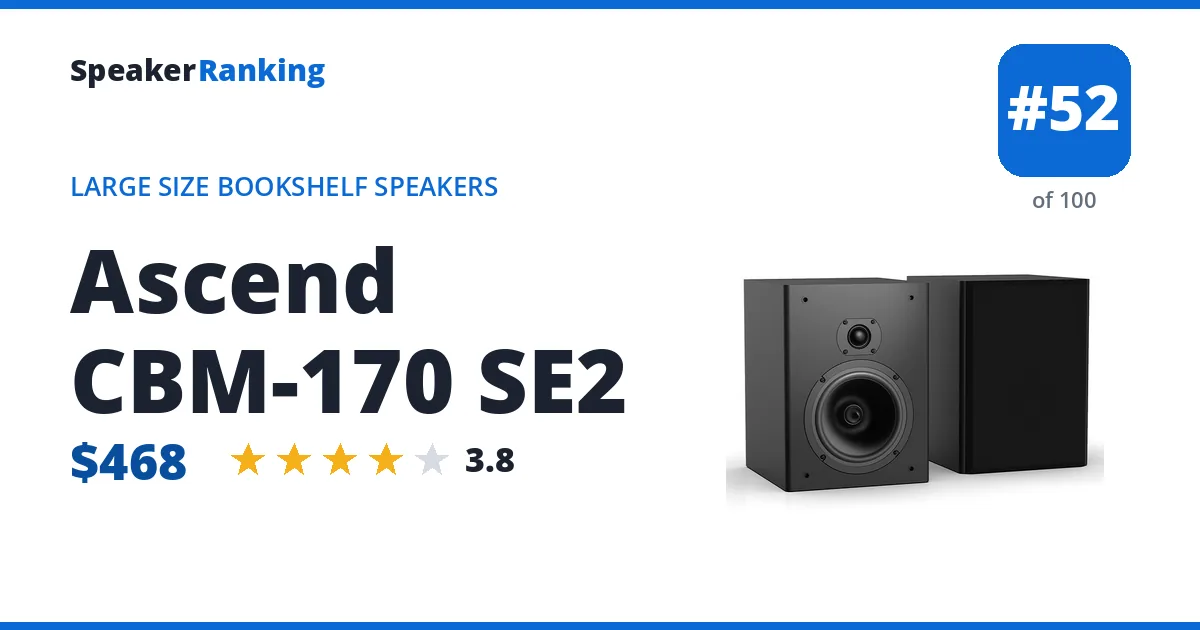
Pros: On-axis response is impressively flat from about 100Hz to 2kHz, staying within roughly ±1dB, with a clean, gradual bass rolloff below that. The directivity index rises smoothly and predictably through the crossover region, and the estimated in-room response shows a smooth, consistent downward tilt from 100Hz to 10kHz with no major discontinuities - close to the ideal in-room target shape. Measured sensitivity of 86.8dB nearly matches Ascend’s 87dB spec. The manufacturer’s own preference-score modeling comes out to 5.81 unequalized (rising to 8.17 with an ideal subwoofer, or 6.33/8.41 with EQ applied) - a strong result for a compact 2-way, and a clear step up from the original CBM-170 SE this replaces. Measured sensitivity of 86.8dB.
Cons: A narrow dip in the on-axis and listening-window response appears in the 3-5kHz range (down to about -2.7dB), mirrored by a matching dip in the directivity index at the same frequencies - likely a brief widening of dispersion right at the tweeter/woofer crossover. High-frequency directivity narrows substantially above 10kHz, typical for a small dome tweeter, so the top octave will sound more reserved off-axis than on-axis. Bass rolls off as expected for a compact 2-way monitor: -3dB around 70Hz and -10dB around 50Hz, so a subwoofer is needed for full-range use. This data comes from the manufacturer’s own Klippel measurements rather than an independent third-party review, so there’s no outside verification of channel matching, distortion, or unit-to-unit consistency.
Full Ascend CBM-170 SE2 review and specifications →
| Bass Extension (-10dB) | 50Hz (measured, manufacturer spinorama data) |
|---|---|
| Bass Extension (-3dB) | 70Hz (measured, manufacturer spinorama data) |
| Dimensions | 12H x 9W x 9.5D in |
| Drivers | 27mm custom SEAS soft dome tweeter, 6.5" proprietary composite polygel cone woofer |
| Impedance | 8 ohms |
| Power Handling | 200W continuous, 400W peak |
| Sensitivity | 86.8dB (2.83V/1m, measured, manufacturer spinorama data; 87dB manufacturer specified) |
| Spinorama Preference Score | 5.81 |
| Spinorama Preference Score with Perfect Sub | 8.17 |
| Weight | 15 lbs (6.8 kg) each |
| Woofer Cabinet | ported, rear |
- Links
- Reviews, Comparisons and Sound Samples
- Head-to-Head Comparisons
- Ascend CBM-170 SE2 vs Polk Signature Elite ES20
- Ascend CBM-170 SE2 vs Dynaudio Contour 20i
- Ascend CBM-170 SE2 vs Klipsch RP-600M II
- Ascend CBM-170 SE2 vs Dynaudio Emit 20
- Ascend CBM-170 SE2 vs Philharmonic BMR Monitor
- Ascend CBM-170 SE2 vs ELAC DBR62
- Ascend CBM-170 SE2 vs Mission LX-3 MKII
- Ascend CBM-170 SE2 vs GR-Research X-LS Encore
- See all 44 comparisons
 Perlisten S4b: $8,000 per pair Perlisten Dealer Locator eBay
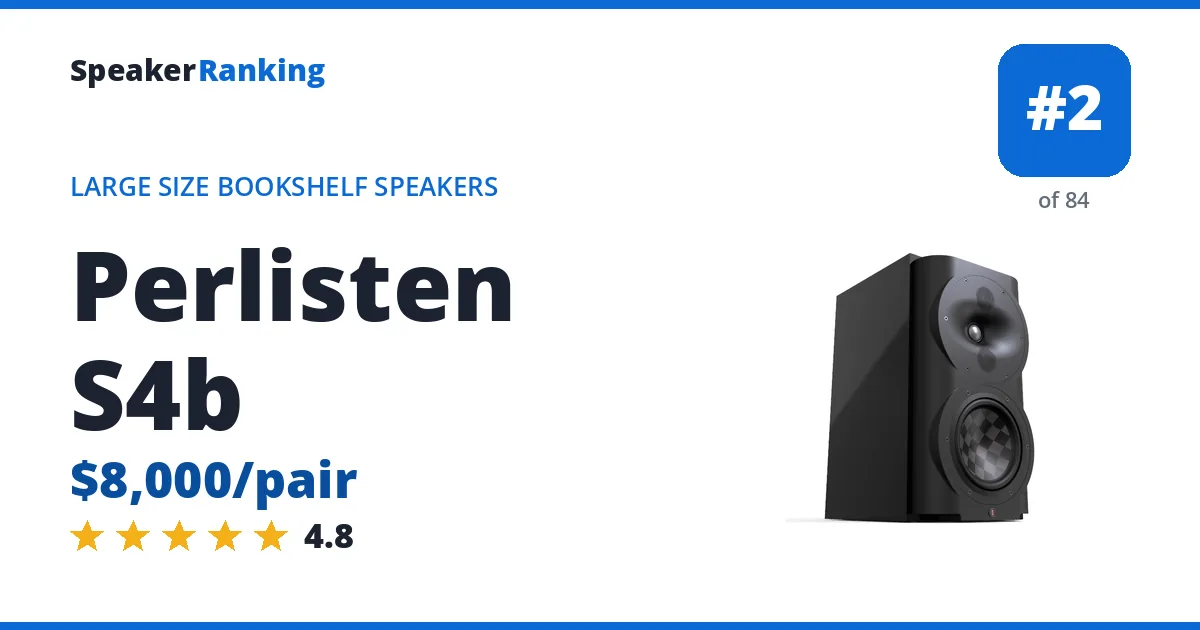
Pros: Reference-grade directivity and output from a compact sealed monitor. Erin called its radiation behavior the smoothest he had measured: Perlisten’s DPC array (beryllium tweeter between two midrange domes) shapes vertical output while transitioning cleanly to the 7-inch woofer. Harmonic distortion remains below 1% at 86dB and, above 100Hz, also below 1% at 96dB; compression is exceptionally low. The response is highly linear, the midrange was a listening highlight, and the sealed F10 of 40Hz provides a predictable slope for subwoofer integration. Measured bass extension of 78Hz (-3dB), with a measured sensitivity of 84.5dB.
Cons: Erin measured only 84.5dB sensitivity and an impedance minimum just under 4 ohms, a difficult efficiency/load combination that deserves substantial clean amplification. Its 78Hz F3 means a subwoofer is effectively mandatory for full-range listening despite the 40Hz F10. A roughly +3dB feature around 10kHz appears on-axis, though Erin did not find it objectionable. Price is extreme for a stand-mount and the tightly managed vertical radiation makes correct stand height important.
Full Perlisten S4b review and specifications →
| Bass Extension (-10dB) | 40Hz (measured, Erin's Audio Corner) |
|---|---|
| Bass Extension (-3dB) | 78Hz (measured, Erin's Audio Corner) |
| Dimensions | 16.5"H x 9.4"W x 7.3"D |
| Drivers | DPC array with 28mm beryllium tweeter and dual 28mm midrange domes; 7" woofer |
| Impedance | Just under 4 ohms minimum (measured, Erin's Audio Corner) |
| Sensitivity | 84.5dB/2.83V/1m (measured, Erin's Audio Corner) |
| Spinorama Preference Score | 4.58 |
| Spinorama Preference Score with Perfect Sub | 7.24 |
| Weight | 24.3 lbs (11 kg) each |
| Woofer Cabinet | sealed |
- Links
- Reviews, Comparisons and Sound Samples
- Head-to-Head Comparisons