Short answer: the Arendal Sound 1723 Monitor THX on measured sound quality, the Power Sound Audio MT-110-M on price. The Arendal Sound 1723 Monitor THX ranks #56 of 223 bookshelf speakers, rated 4.2/5, at $2,400. The Power Sound Audio MT-110-M ranks #64, rated 4.1/5, at $1,350, $1,050 cheaper.
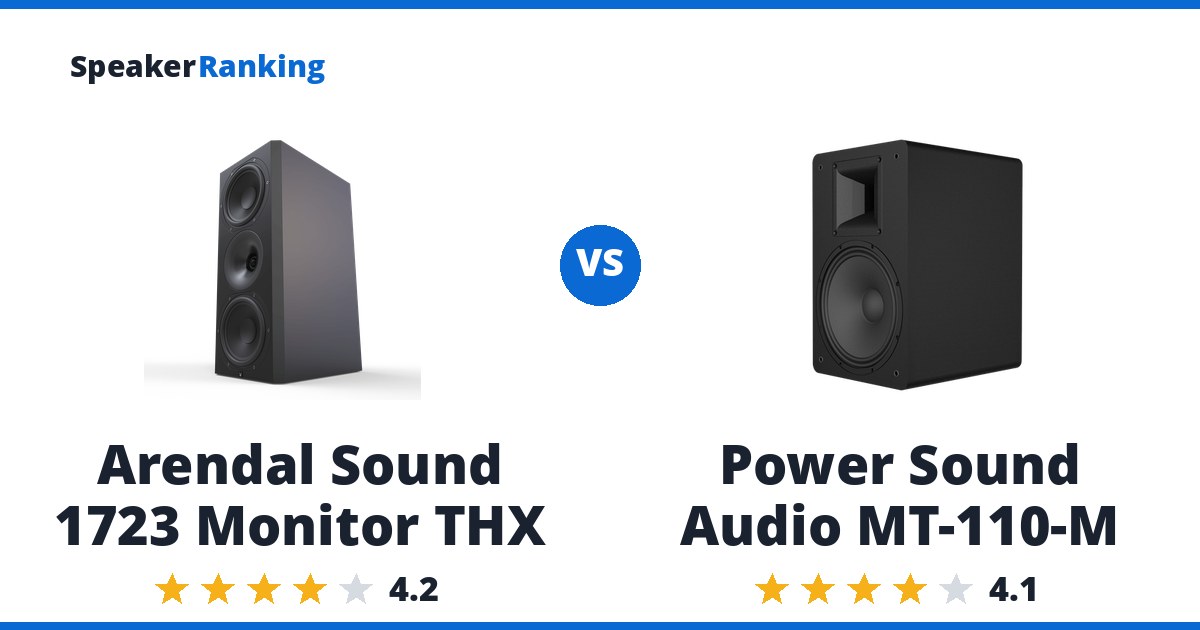
The Arendal Sound 1723 Monitor THX is the more accurate, deeper-bass option. A THX certified monitor with dual 8 inch woofers, a waveguide tweeter, and sturdy build for high output home theater rooms. Its measured preference score, a predictor of how neutral it sounds, is 5.16 against 2.53 for the Power Sound Audio MT-110-M. Its bass reaches about 63Hz before falling 3dB, against 113Hz for the Power Sound Audio MT-110-M. The catch: The measured on-axis average absolute deviation is 0.979dB and the sound-power directivity-index standard deviation is 3.63, so its response and dispersion are less even than the best alternatives.
The case for the Power Sound Audio MT-110-M: A USA made horn tweeter bookshelf speaker with a 10 inch woofer, high sensitivity, and great dynamics without brightness. The tradeoff: A mid-range bump makes the tonal balance sound too thick and needs 2-3 bands of EQ to flatten out; correcting it also pulls measured sensitivity down to about 90-91dB in practice.
Buy the Arendal Sound 1723 Monitor THX if sound quality is the priority over the price, or the Power Sound Audio MT-110-M if the price is the priority over sound quality.
Want more options? Browse the full Passive Home rankings.

A THX certified monitor with dual 8 inch woofers, a waveguide tweeter, and sturdy build for high output home theater rooms.

A USA made horn tweeter bookshelf speaker with a 10 inch woofer, high sensitivity, and great dynamics without brightness.
Prices on this page were last checked October 23, 2026 at 8:27 AM UTC. Product prices and availability are accurate as of that date/time and are subject to change; the price and availability shown on Amazon at the time of purchase will apply to the purchase of this product.
As an eBay Partner, we may be compensated if you make a purchase.
Specifications Side By Side
| Arendal Sound 1723 Monitor THX | Power Sound Audio MT-110-M | |
|---|---|---|
| Price | $2,400 per pair | $1,350 per pair |
| Ranked | #56 of 223 in Large Size Bookshelf Speakers | #64 of 223 in Large Size Bookshelf Speakers |
| Bass Extension (-3dB) | 63Hz (measured, spinorama.org) | 113Hz (measured, Erin’s Audio Corner) |
| Bass Extension (-10dB) | approximately 37Hz (measured, spinorama.org) | 68Hz (measured, Erin’s Audio Corner) |
| Drivers | Two 8-inch woofers; 28mm waveguided tweeter | 1” polyimide compression tweeter with cast aluminum exponential horn, 10” high-efficiency neodymium woofer |
| Impedance | 4 ohms nominal | 8 ohms nominal (measured, Erin’s Audio Corner; matches manufacturer spec) |
| Certification | THX Ultra | - |
| Spinorama Preference Score | 5.16 | 2.53 |
| Spinorama Preference Score with Perfect Sub | 7.30 | 5.86 |
| Sensitivity | 89dB (manufacturer specified, 2.83V/1m) | 92.5dB (measured at 2.83V/1m, Erin’s Audio Corner; matches manufacturer spec) |
| Dimensions | 15.7”H x 10.8”W x 25”D (400 x 275 x 635 mm) | 17.5”H x 11”W x 14”D (includes grille) |
| Weight | 58.9 lbs (26.7 kg) each | 30 lbs (13.6 kg) each (unboxed) |
| DIY Kit | No | No |
| Power Handling | - | 175W |
| Woofer Cabinet | - | sealed |
| Country | - | USA |
Frequency Response Compared
Both speakers’ spinorama measurements, overlaid. A flatter line is more neutral: peaks sound forward or harsh, dips sound recessed. Each curve is shifted so its average from 300 Hz to 3 kHz sits at 0 dB, so loudness differences between the two are removed and only the shape is compared. The two were measured by different sources, so small differences, especially in the bass, can come from the measurement setup rather than the speakers.
Measurement data: Arendal Sound 1723 Monitor THX (measured by Audio Science Review) and Power Sound Audio MT-110-M (measured by Erin’s Audio Corner), via spinorama.org.
Related Speaker Comparisons
More top alternatives to Arendal Sound 1723 Monitor THX: