Short answer: the Arendal 1961 Monitor. It ranks #8 of 88 bookshelf speakers by sound quality, rated 4.3/5, at $1,150. The Dayton Audio OPAL1 ranks #33, rated 3.6/5, at $1,038.99, $111.01 cheaper, not enough of a saving to outweigh the sound-quality gap.
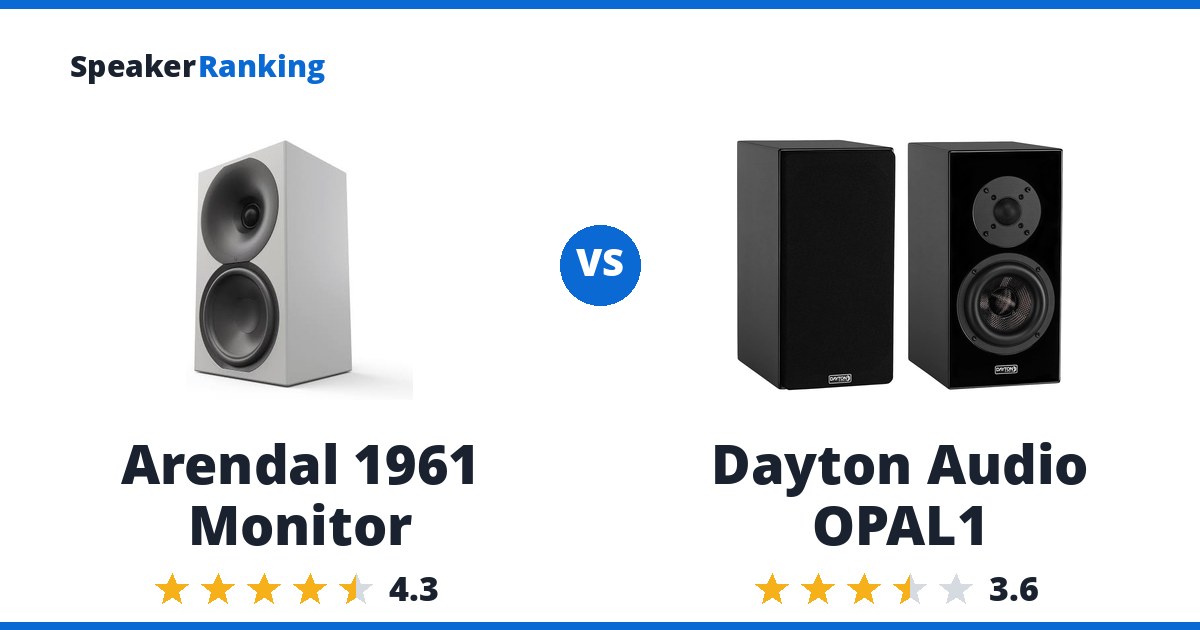
Why pick the Arendal 1961 Monitor: A physically robust build the reviewer calls “a little bit of a tank,” delivering low compression, low distortion, and overall really good neutrality: one of the reviewer’s top 10 picks under $1,500 across roughly 250 speakers tested. The catch: Bass rolls off around 70-80Hz, so it cannot be used as full-range mains for music without a subwoofer, and a sub is recommended for home theater use as well.
What the Dayton Audio OPAL1 does well: A 2-way bookshelf speaker with a 5.25” mid-woofer (large surround) and a 1” dome tweeter, plus two passive radiators on the rear panel. The tradeoff: Measured average sensitivity is notably low at about 75.7dB (well under the 78dB spec) due to a nearly 3dB dip through the midrange, and the reviewer needed serious amplification (monoblock power amps, not just a compact streaming amp) to drive them to real listening levels for bass testing.
Buy the Arendal 1961 Monitor. It is rated higher for sound quality, and the $111.01 you would save on the Dayton Audio OPAL1 does not close the gap.
Still deciding? The full Passive Home rankings cover every ranked option.
Specifications Side By Side
| Arendal 1961 Monitor | Dayton Audio OPAL1 | |
|---|---|---|
| Price | $1150 per pair | $1,038.99 per pair |
| Ranked | #8 of 88 in Medium Size Bookshelf Speakers | #33 of 88 in Medium Size Bookshelf Speakers |
| Bass Extension (-10dB) | 60Hz (measured, Erin’s Audio Corner) | 30Hz (measured, Erin’s Audio Corner) |
| Bass Extension (-3dB) | 84Hz (measured, Erin’s Audio Corner) | 55Hz (measured, Erin’s Audio Corner) |
| Crossover Frequency | 1500Hz | 2,200Hz |
| Dimensions | 16.6”H x 6.4”W x 5.9”D (421.6 x 162.6 x 149.9 mm) | 14”H x 7”W x 9.5”D |
| Impedance | 4 ohms nominal (4.1 ohms minimum above 80Hz, measured by Erin’s Audio Corner) | 8 ohms nominal (4.3 ohms minimum @ 4.4kHz, measured, Erin’s Audio Corner) |
| Sensitivity | 85.9dB (measured average, Erin’s Audio Corner) | 75.7dB (measured by Erin’s Audio Corner; 78dB manufacturer specified) |
| Drivers | 2 x 5.5” woofers, 28mm tweeter | 5.25” mid-woofer, 1” dome tweeter, dual rear passive radiators |
| Weight | 16 lbs (7.25 kg) each | 20.7 lbs (9.4 kg) each |
| Woofer Cabinet | sealed | passive radiator, rear (dual) |
| Spinorama Preference Score | 3.38 | 5.08 |
| Spinorama Preference Score with Perfect Sub | 6.69 | 6.58 |
| DIY Kit | No | No |
| Frequency Response | - | 32Hz - 20kHz (-3dB, half-space, manufacturer specified) |
| Power Handling | - | 200W RMS (75-200W recommended amplifier power) |
Related Speaker Comparisons
More worthwhile head-to-heads for Arendal 1961 Monitor:
- Audio First Fidelia vs Arendal 1961 Monitor
- Arendal 1961 Monitor vs Philharmonic Ceramic Mini
- Arendal 1961 Monitor vs Ascend Sierra 1 v2
- Arendal 1961 Monitor vs KEF LS50 Meta
- XMechanik Mechano23 DIY vs Arendal 1961 Monitor
Prices on this page were last checked September 30, 2026 at 2:57 PM UTC. Product prices and availability are accurate as of that date/time and are subject to change; the price and availability shown on Amazon at the time of purchase will apply to the purchase of this product.
As an eBay Partner, we may be compensated if you make a purchase.
The Two Speakers In Full
 Arendal 1961 Monitor: $1150 per pair Arendal Sound eBay
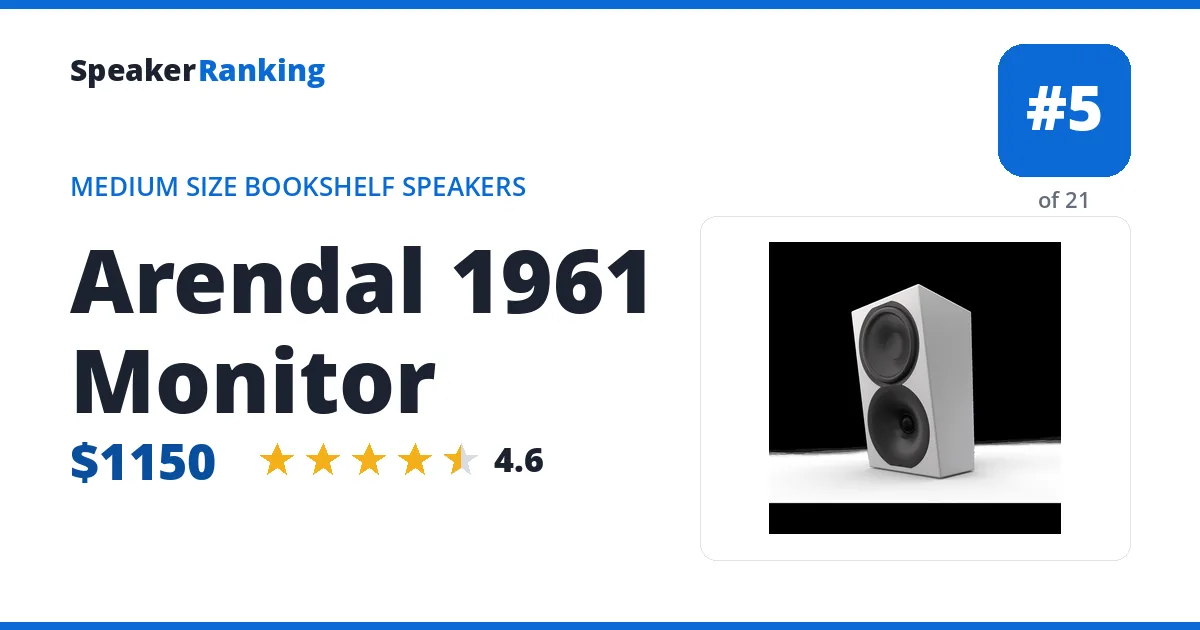
Pros: A physically robust build the reviewer calls “a little bit of a tank,” delivering low compression, low distortion, and overall really good neutrality: one of the reviewer’s top 10 picks under $1,500 across roughly 250 speakers tested. Works well both as home theater mains and as surrounds. Independent ASR Klippel measurements corroborate the low-distortion finding: THD at 86dB SPL/1m stays well below the reviewer’s audibility threshold, and even at 96dB SPL/1m it stays “far better than most bookshelves” thanks to the built-in high-pass filter that protects the woofers. Measured bass extension of 84Hz (-3dB), with a measured sensitivity of 85.9dB.
Cons: Bass rolls off around 70-80Hz, so it cannot be used as full-range mains for music without a subwoofer, and a sub is recommended for home theater use as well. Vertical radiation window is narrow, typical of MTM (mid-tweeter-mid) layouts (tighter than a standard two-way’s roughly ±20°) so a second home theater row sitting above or below the tweeter axis will hear a noticeably different tonal balance. ASR’s CEA2034 measurements show the response is elevated above 2kHz with resonant peaks around 3kHz and 9kHz, leading the reviewer to predict it will “likely sound bright.” Those same resonances show up as lingering ridges in the cumulative spectral decay (waterfall) at 96dB SPL/1m.
Full Arendal 1961 Monitor review and specifications →
| Bass Extension (-10dB) | 60Hz (measured, Erin’s Audio Corner) |
|---|---|
| Bass Extension (-3dB) | 84Hz (measured, Erin’s Audio Corner) |
| Crossover Frequency | 1500Hz |
| DIY Kit | No |
| Dimensions | 16.6”H x 6.4”W x 5.9”D (421.6 x 162.6 x 149.9 mm) |
| Drivers | 2 x 5.5” woofers, 28mm tweeter |
| Impedance | 4 ohms nominal (4.1 ohms minimum above 80Hz, measured by Erin’s Audio Corner) |
| Sensitivity | 85.9dB (measured average, Erin’s Audio Corner) |
| Spinorama Preference Score | 3.38 |
| Spinorama Preference Score with Perfect Sub | 6.69 |
| Weight | 16 lbs (7.25 kg) each |
| Woofer Cabinet | sealed |
- Links
- Reviews, Comparisons and Sound Samples
- Head-to-Head Comparisons
- Arendal 1961 Monitor vs SunAudio Purified 4
- Arendal 1961 Monitor vs Ascend Acoustics HTM-200SE2
- Arendal 1961 Monitor vs XMechanik Mechano23 DIY
- Arendal 1961 Monitor vs Ascend Acoustics Luna V2 Mini-Monitor Titan
- Arendal 1961 Monitor vs Aalto Speakers Aalto 1 EVO
- Arendal 1961 Monitor vs Moondrop M4P MTM
- Arendal 1961 Monitor vs KEF LS50 Meta
- Arendal 1961 Monitor vs Ascend Sierra 1 v2
- See all 55 comparisons
 Dayton Audio OPAL1: $1,038.99 per pair Dayton Audio eBay
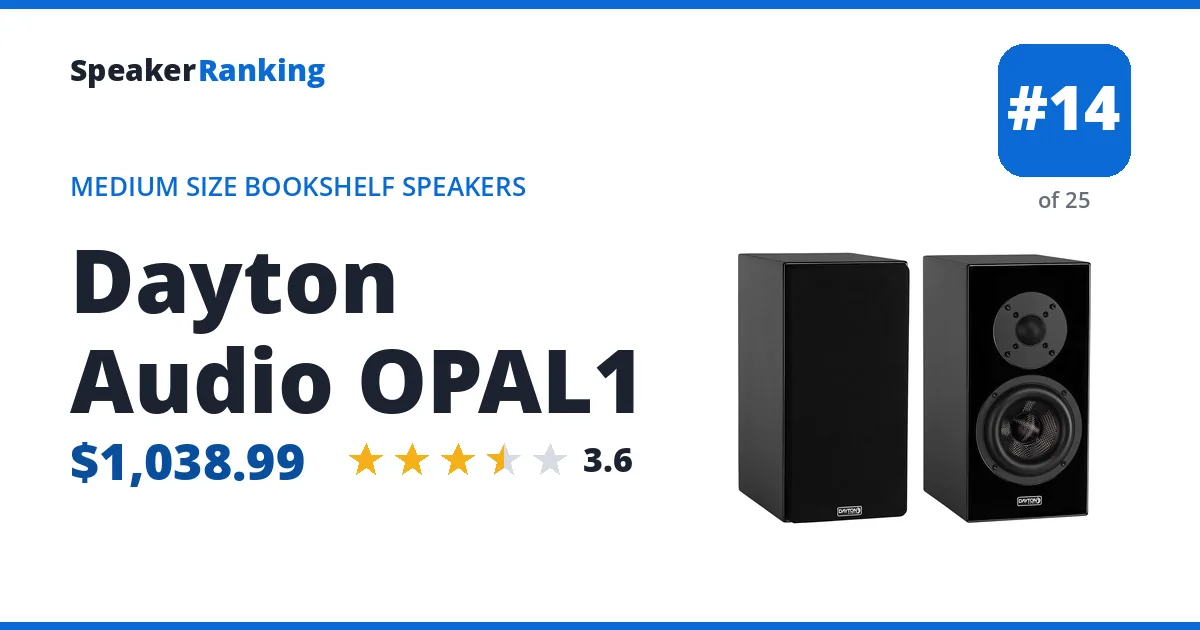
Pros: A 2-way bookshelf speaker with a 5.25” mid-woofer (large surround) and a 1” dome tweeter, plus two passive radiators on the rear panel. A bass shelf in its response lets it sit closer to a wall than many speakers without sounding overly boomy, a similar design trait to the KEF R3 Meta. Measured F3 of about 55Hz and F10 of about 30Hz. Harmonic distortion is good for a 5.25” mid-woofer at both 86dB and 96dB output, and dynamic range/compression is reasonably well controlled up to about 96dB. Horizontal radiation of about ±60° lands right in the reviewer’s personally preferred range for soundstage width. On-axis, the sound is a little forward-leaning rather than dull, and EQ can bring back midrange fullness and a bigger sense of image spread if the stock tuning’s slightly recessed midrange isn’t to your taste. Measured bass extension of 55Hz (-3dB), with a measured sensitivity of 75.7dB.
Cons: Measured average sensitivity is notably low at about 75.7dB (well under the 78dB spec) due to a nearly 3dB dip through the midrange, and the reviewer needed serious amplification (monoblock power amps, not just a compact streaming amp) to drive them to real listening levels for bass testing. On-axis response is within only about ±3dB (a 6dB window) (not very linear) with a mid-range scoop and a bump around 1kHz that makes the sound a bit forward and less full than a neutral reference; EQ can address most of this but makes the image slightly more diffuse in exchange for added fullness. A roughly one-octave-wide diffraction dip between 3-5kHz can’t be corrected with EQ, since boosting it raises reflected energy in a band that’s already elevated off-axis. Top end rolls off fairly quickly above about 10kHz on-axis, and toeing the speakers out more than about 10° loses noticeable air and cymbal/hi-hat detail: best kept close to on-axis. Multitone distortion jumps substantially between 87dB and 96dB SPL/1m, so headroom for loud listening is limited. Vertical window is tight at about ±20°.
Full Dayton Audio OPAL1 review and specifications →
| Bass Extension (-10dB) | 30Hz (measured, Erin’s Audio Corner) |
|---|---|
| Bass Extension (-3dB) | 55Hz (measured, Erin’s Audio Corner) |
| Crossover Frequency | 2,200Hz |
| DIY Kit | No |
| Dimensions | 14”H x 7”W x 9.5”D |
| Drivers | 5.25” mid-woofer, 1” dome tweeter, dual rear passive radiators |
| Frequency Response | 32Hz - 20kHz (-3dB, half-space, manufacturer specified) |
| Impedance | 8 ohms nominal (4.3 ohms minimum @ 4.4kHz, measured, Erin’s Audio Corner) |
| Power Handling | 200W RMS (75-200W recommended amplifier power) |
| Sensitivity | 75.7dB (measured by Erin’s Audio Corner; 78dB manufacturer specified) |
| Spinorama Preference Score | 5.08 |
| Spinorama Preference Score with Perfect Sub | 6.58 |
| Weight | 20.7 lbs (9.4 kg) each |
| Woofer Cabinet | passive radiator, rear (dual) |
- Links
- Reviews, Comparisons and Sound Samples
- Head-to-Head Comparisons