Short answer: the Mackie Thump Go for output, the Sony SRS-XP500 for balance. The Mackie’s 8-inch high-output woofer and 1-inch compression driver deliver powerful audio with incredible dynamic range, but it is not quite as good sounding as an Everse 8 or S1 Pro. The Sony’s 20W three-way system is well balanced, though not as loud as a Partybox 100 or 110.
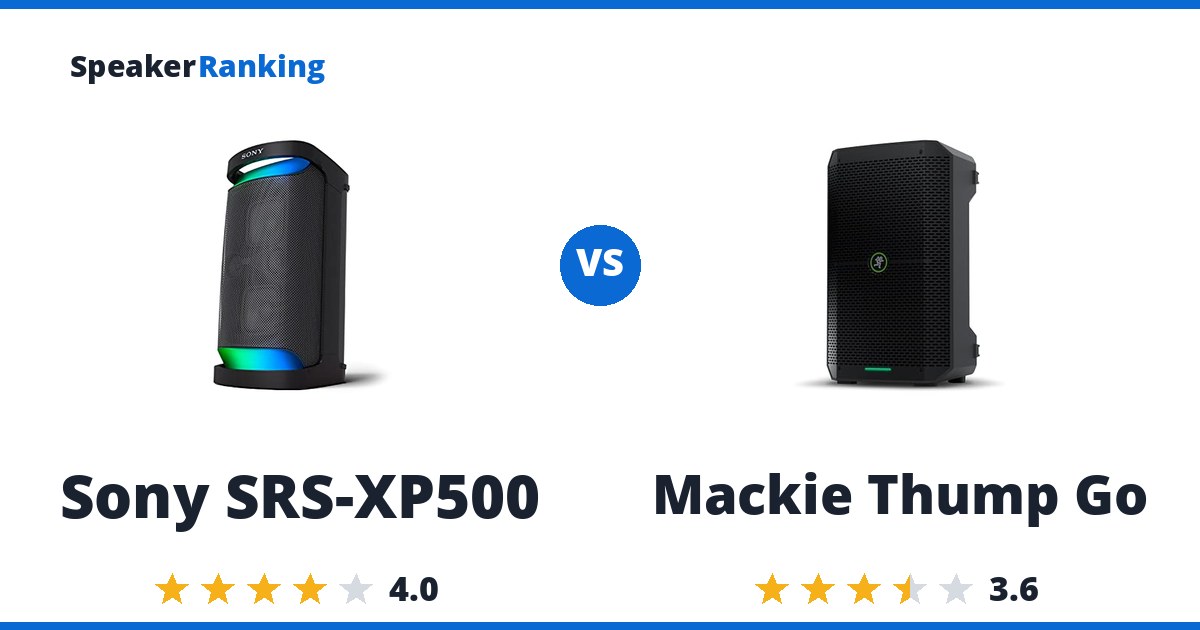
Buy the Sony SRS-XP500 ($549.99) for a party speaker; the Mackie Thump Go ($449.99) suits a battery-powered PA speaker instead.
If battery life is a priority, the Sony SRS-XP500 is rated for 20 hours versus 12 hours for the Mackie Thump Go.
Want more options? Browse the full Portable Bluetooth rankings and PA & Live Sound rankings.
Specifications Side By Side
| Sony SRS-XP500 | Mackie Thump Go | |
|---|---|---|
| Price | $549.99 Discontinued | $449.99 |
| Ranked | #14 of 43 in Party Size Portable Bluetooth Speakers | #7 of 14 in Battery-Powered PA Speakers |
| App | Yes | Yes |
| Aux Input | Yes | Yes |
| Bass Extension (-10dB) | 42Hz | 50Hz |
| Battery Life | 20 hours (Manufacturer specified) | 12 hours (Manufacturer specified) |
| Bluetooth | Yes | Yes |
| Bluetooth Codecs | LDAC, AAC, SBC | SBC |
| Bluetooth Version | 5.0 | - |
| Charging Time | 3 hours | - |
| Dimensions | 10.8” x 22.5” x 11.6” (275 x 572 x 295 mm) | 18” x 9.1” x 11.2” (457 x 230 x 285 mm) |
| EQ | Yes | Yes |
| Guitar Input | Yes | Yes |
| IP Rating | None | None |
| Microphone Input | Yes (Karaoke mode with echo effect) | Yes |
| Party Mode | Yes (Party Connect up to 100 speakers) | No |
| Power Bank | Yes (USB-A) | No |
| Power Input | AC Power cord | - |
| Stereo | Partially | No |
| Omnidirectional | No | No |
| TWS | No | No |
| USB Playback | Yes | No |
| Weight | 24.7 lbs (11.2 kg) | 17.6 lbs (8 kg) |
| Drivers | 2x 140mm woofers + 2x 50mm tweeters | 8” woofer, 1” compression driver |
| Digital Aux Input | No | No |
| Lights | Yes | - |
| Strap | No | - |
| Inputs | - | 2x XLR/TRS combo (mic/line), 3.5mm stereo, Bluetooth |
| XLR Input | - | Yes |
| Maximum SPL | - | 115dB |
| Amplifier Power | - | 200W |
| Configuration | - | Battery-powered 2-way active PA |
| Cabinet Material | - | Polypropylene |
| Rigging | - | 35mm pole mount; monitor wedge |
| Coverage | - | 90° H x 60° V |
| DSP | - | Feedback eliminator, Music Duck and voicing modes |
| Bass Extension (-3dB) | - | 57Hz |
| Frequency Response | - | 57Hz - 20kHz (-3dB, Manufacturer specified) |
Related Speaker Comparisons
More worthwhile head-to-heads for Sony SRS-XP500:
- Sony ULT Tower 7 vs Sony SRS-XP500
- JBL Partybox 330 vs Sony SRS-XP500
- JBL Partybox Stage 320 vs Sony SRS-XP500
- JBL Partybox 310 vs Sony SRS-XP500
- Sony ULT Tower 5 vs Sony SRS-XP500
Prices on this page were last checked October 2, 2026 at 10:18 PM UTC. Product prices and availability are accurate as of that date/time and are subject to change; the price and availability shown on Amazon at the time of purchase will apply to the purchase of this product.
As an eBay Partner, we may be compensated if you make a purchase.
The Two Speakers In Full
 Sony SRS-XP500: $549.99 Discontinued Amazon eBay
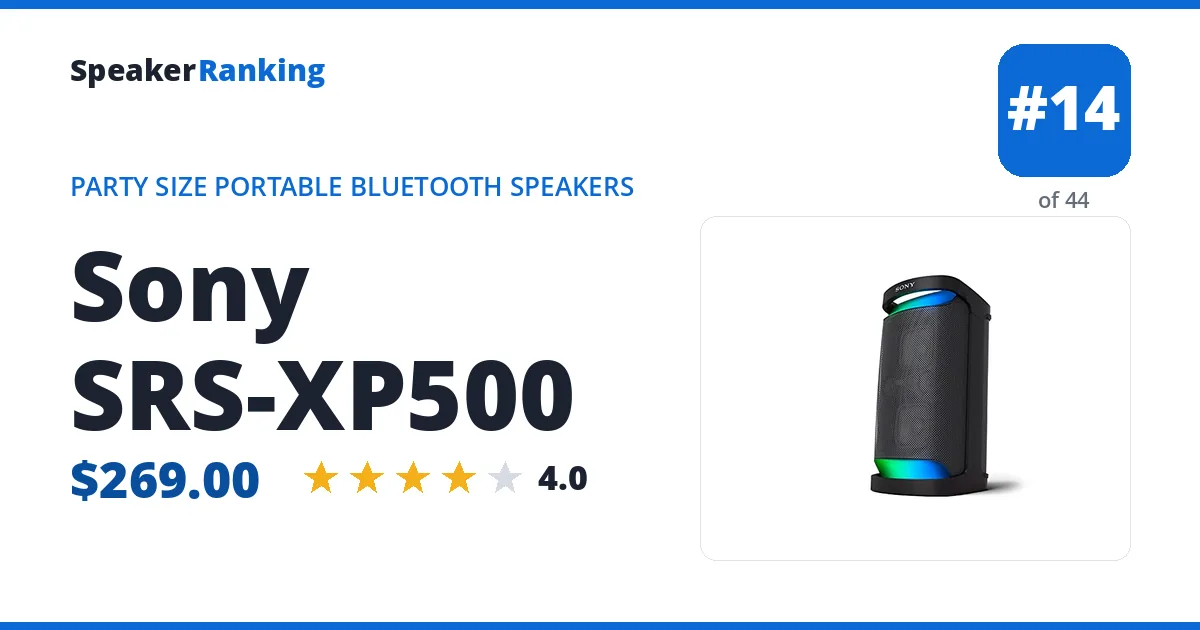
Newer model: the Sony SRS-XV500, ranked lower, rated 4/5.
Pros: 20W 3-way speaker system with dual passive radiators, well-balanced sound (clear highs, detailed mids, punchy bass). 20-hour battery life, immersive room-filling sound. Party Connect feature links multiple compatible Sony speakers. USB charging port for device charging on-the-go. Built-in handle and IPX4 water resistance. Microphone input and karaoke support. Measured bass extension of 42Hz (-10dB).
Cons: Not as loud and bass not as deep as a JBL Partybox 100 or JBL Partybox 110. Discontinued.
Full Sony SRS-XP500 review and specifications →
| App | Yes |
|---|---|
| Aux Input | Yes |
| Bass Extension (-10dB) | 42Hz |
| Battery Life | 20 hours (Manufacturer specified) |
| Bluetooth | Yes |
| Bluetooth Codecs | LDAC, AAC, SBC |
| Bluetooth Version | 5.0 |
| Charging Time | 3 hours |
| Digital Aux Input | No |
| Dimensions | 10.8” x 22.5” x 11.6” (275 x 572 x 295 mm) |
| Drivers | 2x 140mm woofers + 2x 50mm tweeters |
| EQ | Yes |
| Guitar Input | Yes |
| IP Rating | None |
| Lights | Yes |
| Microphone Input | Yes (Karaoke mode with echo effect) |
| Omnidirectional | No |
| Party Mode | Yes (Party Connect up to 100 speakers) |
| Power Bank | Yes (USB-A) |
| Power Input | AC Power cord |
| Stereo | Partially |
| Strap | No |
| TWS | No |
| USB Playback | Yes |
| Weight | 24.7 lbs (11.2 kg) |
- Links
- Reviews, Comparisons and Sound Samples
- Head-to-Head Comparisons
- Sony SRS-XP500 vs Sony SRS-XP700
- Sony SRS-XP500 vs Zealot PT21
- Sony SRS-XP500 vs Onn Large Party gen 2
- Sony SRS-XP500 vs Onn XL Wireless Party Speaker
- Sony SRS-XP500 vs Soundcore Rave 3S
- Sony SRS-XP500 vs JBL Partybox 300
- Sony SRS-XP500 vs JBL Partybox 110
- Sony SRS-XP500 vs JBL Partybox 100
- See all 34 comparisons
 Mackie Thump Go: $449.99 Amazon eBay
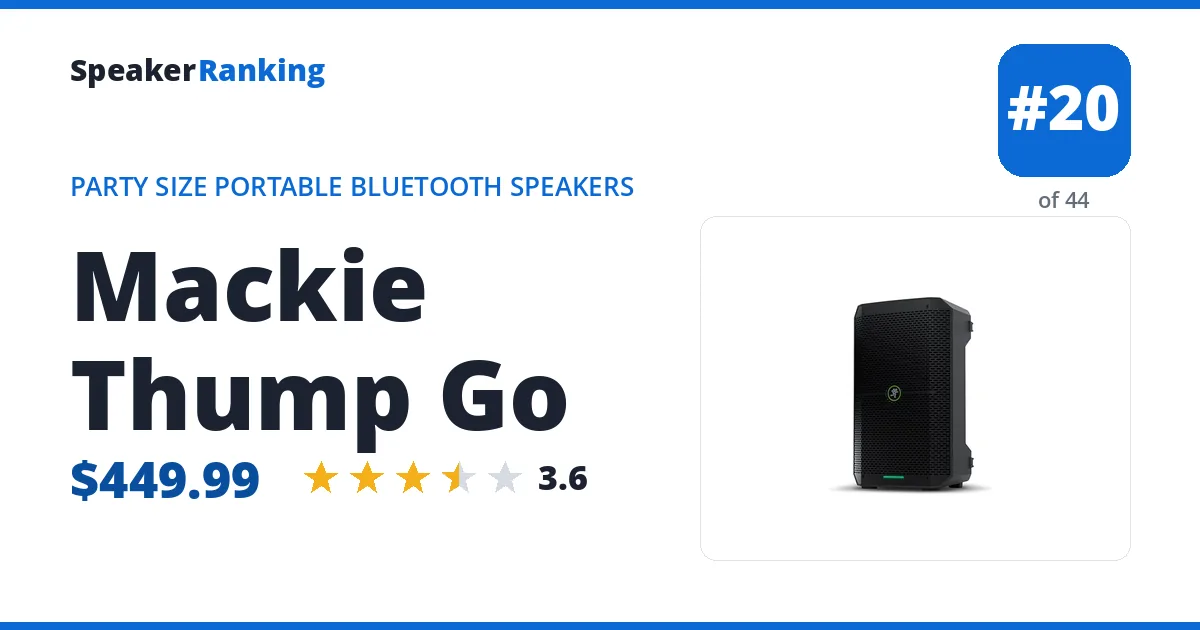
Pros: 8-inch custom high-output woofer + 1-inch compression driver delivers powerful audio with incredible dynamic range. Built-in mini live mixer with two XLR/TRS combo inputs + 3.5mm aux. Up to 12 hours battery (5 hours comfortable gig time), removable for swapping spares. Lightweight 17.6 lbs. Balanced sound with crisp highs, tight lows, natural vocals. Pair two Mackie Thump Gos for stereo via app. High efficiency drivers reach 2-3x the volume of typical speakers for the same wattage. Measured bass extension of 57Hz (-3dB).
Cons: Not quite as good sounding as a Everse 8 or S1 Pro. Bluetooth pairing doesn’t auto connect every time. Designed for more loudness than deeper bass. Battery latch breaks easily. Handle on top also can break off. Not very deep bass
Full Mackie Thump Go review and specifications →
| Amplifier Power | 200W |
|---|---|
| App | Yes |
| Aux Input | Yes |
| Bass Extension (-10dB) | 50Hz |
| Bass Extension (-3dB) | 57Hz |
| Battery Life | 12 hours (Manufacturer specified) |
| Bluetooth | Yes |
| Bluetooth Codecs | SBC |
| Cabinet Material | Polypropylene |
| Configuration | Battery-powered 2-way active PA |
| Coverage | 90° H x 60° V |
| DSP | Feedback eliminator, Music Duck and voicing modes |
| Digital Aux Input | No |
| Dimensions | 18” x 9.1” x 11.2” (457 x 230 x 285 mm) |
| Drivers | 8” woofer, 1” compression driver |
| EQ | Yes |
| Frequency Response | 57Hz - 20kHz (-3dB, Manufacturer specified) |
| Guitar Input | Yes |
| IP Rating | None |
| Inputs | 2x XLR/TRS combo (mic/line), 3.5mm stereo, Bluetooth |
| Maximum SPL | 115dB |
| Microphone Input | Yes |
| Omnidirectional | No |
| Party Mode | No |
| Power Bank | No |
| Rigging | 35mm pole mount; monitor wedge |
| Stereo | No |
| TWS | No |
| USB Playback | No |
| Weight | 17.6 lbs (8 kg) |
| XLR Input | Yes |
- Links
- Reviews, Comparisons and Sound Samples
- W. Weiss: Part 3 Sound Demonstration The New EV Everse 8 compared to The Mackie Thump Go
- W. Weiss: Part 3 Shootout MACKIE THUMP GO vs BOSE S1 PRO vs JBL EON ONE COMPACT Max Volume Demo A New Winner!
- W. Weiss: Part 2 NEW MACKIE THUMP GO review/sound demo VS JBL Compact & Bose S1Pro Most Popular portable PAs
- W. Weiss: The $400 Club - Budget Portable PA’s Mackie Thump Go, JBL Partybox 110, Yamaha DBR10
- Head-to-Head Comparisons
- Mackie Thump Go vs Bose S1 Pro+
- Mackie Thump Go vs Soundboks 4
- Mackie Thump Go vs Teufel Rockster Air
- Mackie Thump Go vs Teufel Rockster Air 2
- Mackie Thump Go vs Teufel Rockster Neo
- Mackie Thump Go vs Electro-Voice Everse 8
- Mackie Thump Go vs Electrotec Stage One
- Mackie Thump Go vs JBL Eon One Compact
- See all 36 comparisons