Short answer: the Philharmonic BMR (v1) if sound quality matters most, the Sonus Faber Lumina II if price matters most. The Philharmonic BMR (v1) ranks #36 of 130 bookshelf speakers at $2200. The Sonus Faber Lumina II ranks #91 at $1600, $600 cheaper.
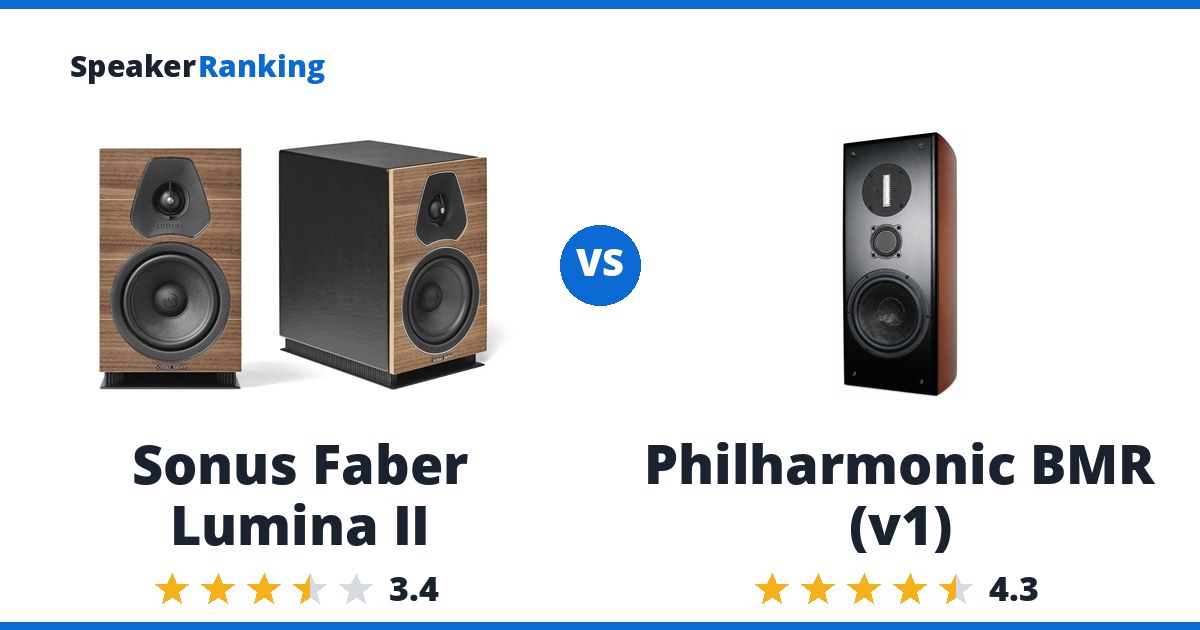
What the Sonus Faber Lumina II offers: Handmade in Italy with a gloss-finished front baffle and black leather-wrapped cabinet - genuinely nice-looking speaker with real brand cachet. Bass extension is competitive for the size, reaching about 50 Hz in-room with mild compression and good distortion figures, so higher output levels and greater listening distances aren’t a problem down to that point. About 20 dB of dynamic range at typical listening levels (73 dB at 4m), which comfortably covers most music without the tonal balance shifting as instruments and vocals peak. Off-axis behavior is consistent - toeing the speakers 20-30 degrees out doesn’t meaningfully change the in-room high-frequency character, so placement flexibility is good once you’ve dialed in the tonal balance. Watch for: Not a neutral speaker - has a persistent high-frequency boost/lift that makes it sound forward and bright, present whether pointed directly at the listener or toed out. A slightly nasal quality traced to a resonance around 1 kHz that EQ can address. The reviewer needed to trim treble by about 4 dB on his preamp to get the tonal balance he wanted, meaning most listeners will want equalization available to fully enjoy this speaker. At roughly the same $1,000ish price point, alternatives like the Ascend Acoustics Sierra 1 V2 measure more linear (with a tradeoff in distortion and crossover-region directivity), and the Dynaudio Emit 20 offers deeper bass extension and lower compression at the cost of a more deliberately colored tonal signature.
What the Philharmonic BMR (v1) offers: Large three-way combining a Scan-Speak 7-inch paper/carbon woofer, 2.5-inch Tectonic balanced-mode midrange and RAAL 64-10 ribbon. Erin measured approximately +/-1.5dB linearity from 80Hz upward, very broad +/-40-degree-or-better horizontal coverage and about 83dB/2.83V/1m sensitivity. The port is tuned in the mid/low-30Hz region without audible chuffing, the midrange provides unusually expansive staging, and distortion remained subjectively unobtrusive. Watch for: The measured 83dB sensitivity and roughly 4-ohm load demand meaningful external amplification. A 1-2dB shelf below about 300Hz reduces warmth unless corrected, while a response/impedance feature near 250-300Hz corresponded with Erin’s sense of resonance. The ribbon produces narrower vertical than horizontal radiation, and second-order high-frequency distortion plus dynamic enhancement near 3kHz appeared in testing. This was an earlier cabinet/version, not the current v2.
Buy the Sonus Faber Lumina II when the price outweighs sound quality for you, and the Philharmonic BMR (v1) when sound quality outweighs the price instead.
Still deciding? The full Passive Home rankings cover every ranked option.
Specifications Side By Side
| Sonus Faber Lumina II | Philharmonic BMR (v1) | |
|---|---|---|
| Price | $1,600 per pair | $2,395 per pair |
| Ranked | #91 of 130 in Large Size Bookshelf Speakers | #36 of 130 in Large Size Bookshelf Speakers |
| Drivers | 29mm DAD dome tweeter, 150mm paper cone mid-woofer | RAAL 64-10 ribbon; 2.5" BMR midrange; 7" Scan-Speak woofer |
| Crossover Frequency | 1800Hz | - |
| Dimensions | 12" x 7.1" x 10.4" (304 x 180 x 263 mm) | - |
| Weight | 12.5 lbs (5.65 kg) each | - |
| Impedance | 4 ohms nominal, 4.1 ohms minimum (measured, Erin's Audio Corner) | Approximately 4 ohms nominal (measured, Erin's Audio Corner) |
| Sensitivity | 86dB (measured average, Erin's Audio Corner; matches manufacturer spec) | Approximately 83dB/2.83V/1m (measured, Erin's Audio Corner) |
| Bass Extension (-3dB) | 60Hz (measured, Erin's Audio Corner) | Approximately 62Hz relative to mean (measured, Erin's Audio Corner website) |
| Bass Extension (-10dB) | 41Hz (measured, Erin's Audio Corner) | 37.8Hz (measured, Erin's Audio Corner) |
| Frequency Response | 55Hz - 24kHz (manufacturer specified) | - |
| Recommended Power | 30W - 150W | - |
| Spinorama Preference Score | 3.04 | 5.24 |
| Spinorama Preference Score with Perfect Sub | 5.32 | 6.90 |
| Port Tuning | - | Mid/low-30Hz range (measured, Erin's Audio Corner) |
| Woofer Cabinet | - | ported |
Related Speaker Comparisons
More worthwhile head-to-heads for Philharmonic BMR (v1):
- Philharmonic BMR (v1) vs Perlisten S4b
- KEF Reference 1 Meta vs Philharmonic BMR (v1)
- Philharmonic BMR (v1) vs GR-Research NX-Studio
- AsciLab C6B vs Philharmonic BMR (v1)
- Audio First Cadentia 3 vs Philharmonic BMR (v1)
Prices on this page were last checked September 16, 2026 at 12:41 AM UTC. Product prices and availability are accurate as of that date/time and are subject to change; the price and availability shown on Amazon at the time of purchase will apply to the purchase of this product.
As an eBay Partner, we may be compensated if you make a purchase.
The Two Speakers In Full
 Sonus Faber Lumina II: $1,600 per pair Crutchfield eBay
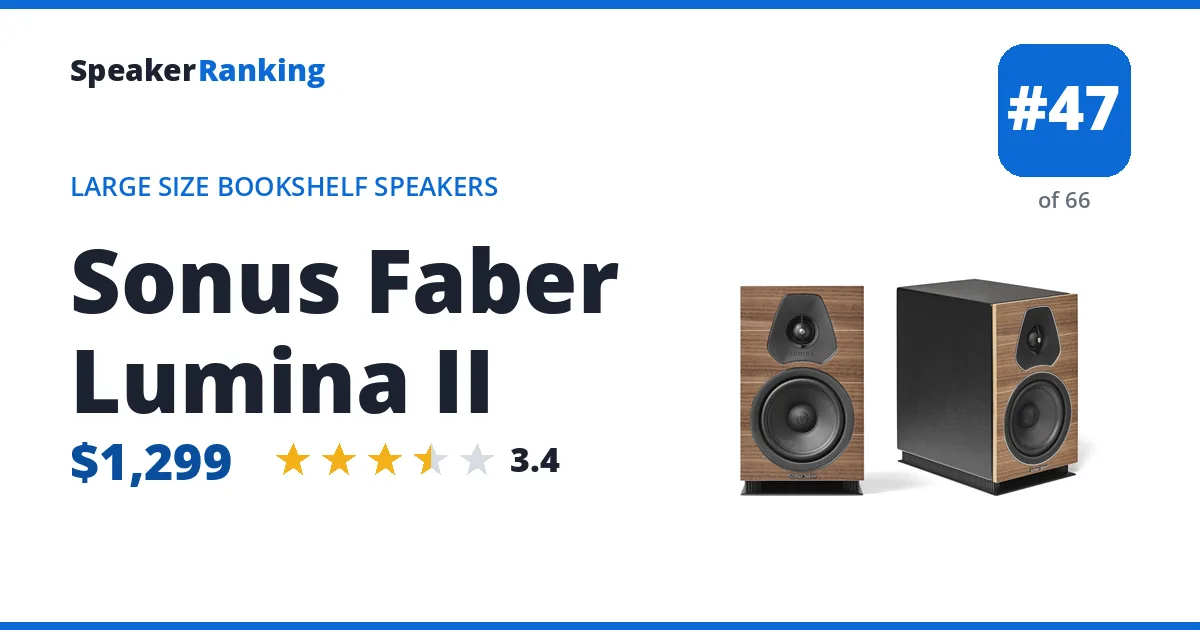
Pros: Handmade in Italy with a gloss-finished front baffle and black leather-wrapped cabinet - genuinely nice-looking speaker with real brand cachet. Bass extension is competitive for the size, reaching about 50 Hz in-room with mild compression and good distortion figures, so higher output levels and greater listening distances aren’t a problem down to that point. About 20 dB of dynamic range at typical listening levels (73 dB at 4m), which comfortably covers most music without the tonal balance shifting as instruments and vocals peak. Off-axis behavior is consistent - toeing the speakers 20-30 degrees out doesn’t meaningfully change the in-room high-frequency character, so placement flexibility is good once you’ve dialed in the tonal balance. Measured bass extension of 60Hz (-3dB), with a measured sensitivity of 86dB.
Cons: Not a neutral speaker - has a persistent high-frequency boost/lift that makes it sound forward and bright, present whether pointed directly at the listener or toed out. A slightly nasal quality traced to a resonance around 1 kHz that EQ can address. The reviewer needed to trim treble by about 4 dB on his preamp to get the tonal balance he wanted, meaning most listeners will want equalization available to fully enjoy this speaker. At roughly the same $1,000ish price point, alternatives like the Ascend Acoustics Sierra 1 V2 measure more linear (with a tradeoff in distortion and crossover-region directivity), and the Dynaudio Emit 20 offers deeper bass extension and lower compression at the cost of a more deliberately colored tonal signature.
Full Sonus Faber Lumina II review and specifications →
| Bass Extension (-10dB) | 41Hz (measured, Erin's Audio Corner) |
|---|---|
| Bass Extension (-3dB) | 60Hz (measured, Erin's Audio Corner) |
| Crossover Frequency | 1800Hz |
| Dimensions | 12" x 7.1" x 10.4" (304 x 180 x 263 mm) |
| Drivers | 29mm DAD dome tweeter, 150mm paper cone mid-woofer |
| Frequency Response | 55Hz - 24kHz (manufacturer specified) |
| Impedance | 4 ohms nominal, 4.1 ohms minimum (measured, Erin's Audio Corner) |
| Recommended Power | 30W - 150W |
| Sensitivity | 86dB (measured average, Erin's Audio Corner; matches manufacturer spec) |
| Spinorama Preference Score | 3.04 |
| Spinorama Preference Score with Perfect Sub | 5.32 |
| Weight | 12.5 lbs (5.65 kg) each |
- Links
- Reviews, Comparisons and Sound Samples
- Head-to-Head Comparisons
- Sonus Faber Lumina II vs Polk Monitor XT20
- Sonus Faber Lumina II vs XTZ Spirit 4
- Sonus Faber Lumina II vs Focal Aria 906
- Sonus Faber Lumina II vs KEF Q3 Meta
- Sonus Faber Lumina II vs Revel Performa M22
- Sonus Faber Lumina II vs SVS Prime Bookshelf
- Sonus Faber Lumina II vs ELAC Debut 2.0 B6.2
- Sonus Faber Lumina II vs Dynaudio Special Forty
- See all 56 comparisons
 Philharmonic BMR (v1): $2,395 per pair Philharmonic Audio eBay
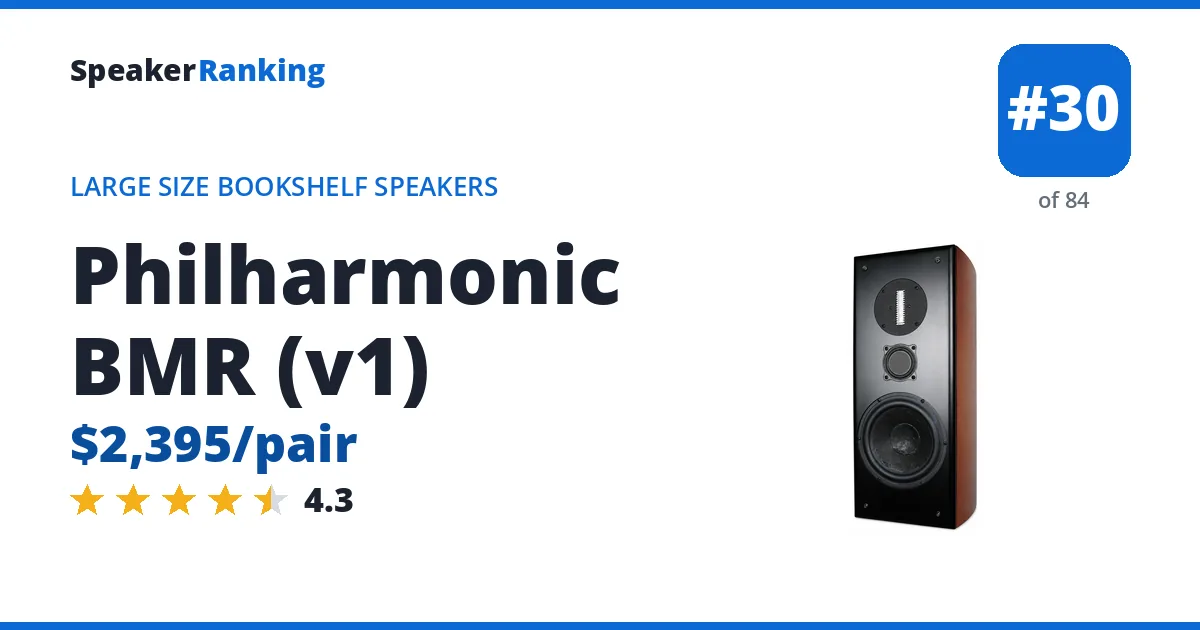
Pros: Large three-way combining a Scan-Speak 7-inch paper/carbon woofer, 2.5-inch Tectonic balanced-mode midrange and RAAL 64-10 ribbon. Erin measured approximately +/-1.5dB linearity from 80Hz upward, very broad +/-40-degree-or-better horizontal coverage and about 83dB/2.83V/1m sensitivity. The port is tuned in the mid/low-30Hz region without audible chuffing, the midrange provides unusually expansive staging, and distortion remained subjectively unobtrusive. Measured bass extension of 62Hz (-3dB), with a measured sensitivity of 83dB.
Cons: The measured 83dB sensitivity and roughly 4-ohm load demand meaningful external amplification. A 1-2dB shelf below about 300Hz reduces warmth unless corrected, while a response/impedance feature near 250-300Hz corresponded with Erin’s sense of resonance. The ribbon produces narrower vertical than horizontal radiation, and second-order high-frequency distortion plus dynamic enhancement near 3kHz appeared in testing. This was an earlier cabinet/version, not the current v2.
Full Philharmonic BMR (v1) review and specifications →
| Bass Extension (-10dB) | 37.8Hz (measured, Erin's Audio Corner) |
|---|---|
| Bass Extension (-3dB) | Approximately 62Hz relative to mean (measured, Erin's Audio Corner website) |
| Drivers | RAAL 64-10 ribbon; 2.5" BMR midrange; 7" Scan-Speak woofer |
| Impedance | Approximately 4 ohms nominal (measured, Erin's Audio Corner) |
| Port Tuning | Mid/low-30Hz range (measured, Erin's Audio Corner) |
| Sensitivity | Approximately 83dB/2.83V/1m (measured, Erin's Audio Corner) |
| Spinorama Preference Score | 5.24 |
| Spinorama Preference Score with Perfect Sub | 6.90 |
| Woofer Cabinet | ported |
- Links
- Reviews, Comparisons and Sound Samples
- Head-to-Head Comparisons
- Philharmonic BMR (v1) vs ELAC VELA BS 403
- Philharmonic BMR (v1) vs Selah Audio Integrity
- Philharmonic BMR (v1) vs Ascend Acoustics Sierra-2EX V2
- Philharmonic BMR (v1) vs Ascend Acoustics Sierra-LX
- Philharmonic BMR (v1) vs Wharfedale Linton 85
- Philharmonic BMR (v1) vs Emotiva Airmotiv XB2
- Philharmonic BMR (v1) vs ELAC Debut 3.0 DB63
- Philharmonic BMR (v1) vs Selah Audio Purezza
- See all 49 comparisons