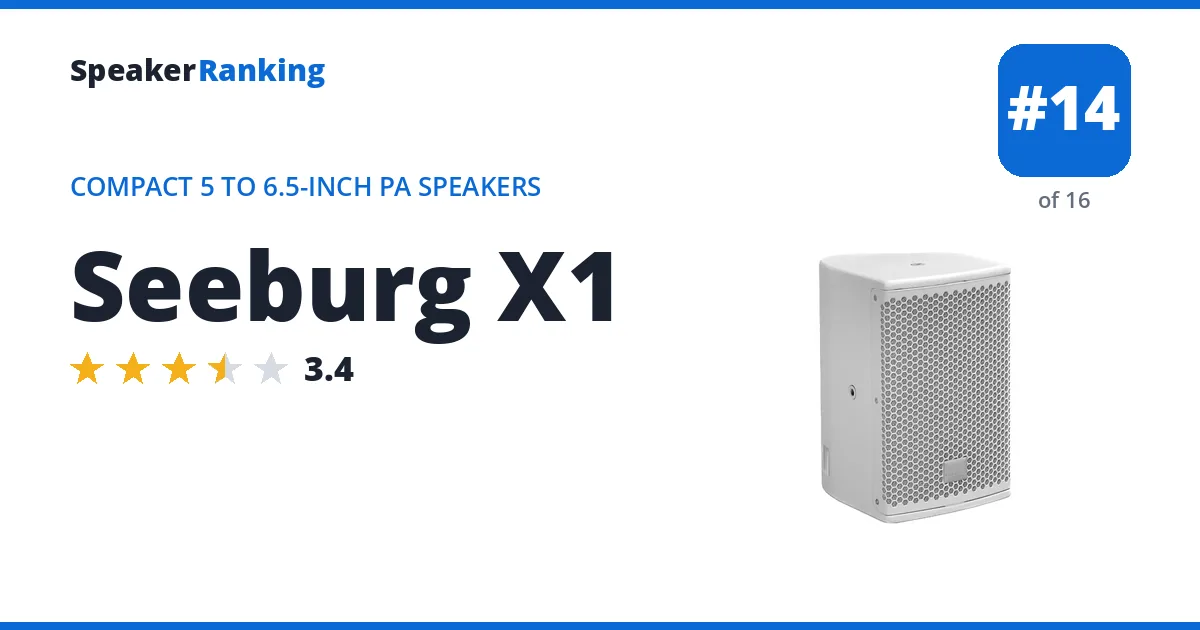
Short answer: the Seeburg X1. It ranks #14 of 16 compact 5 to 6.5-inch pa speakers by sound quality (rated 3.4/5); the Meyer Sound Ultra X23 ranks #15 (rated 3.3/5).
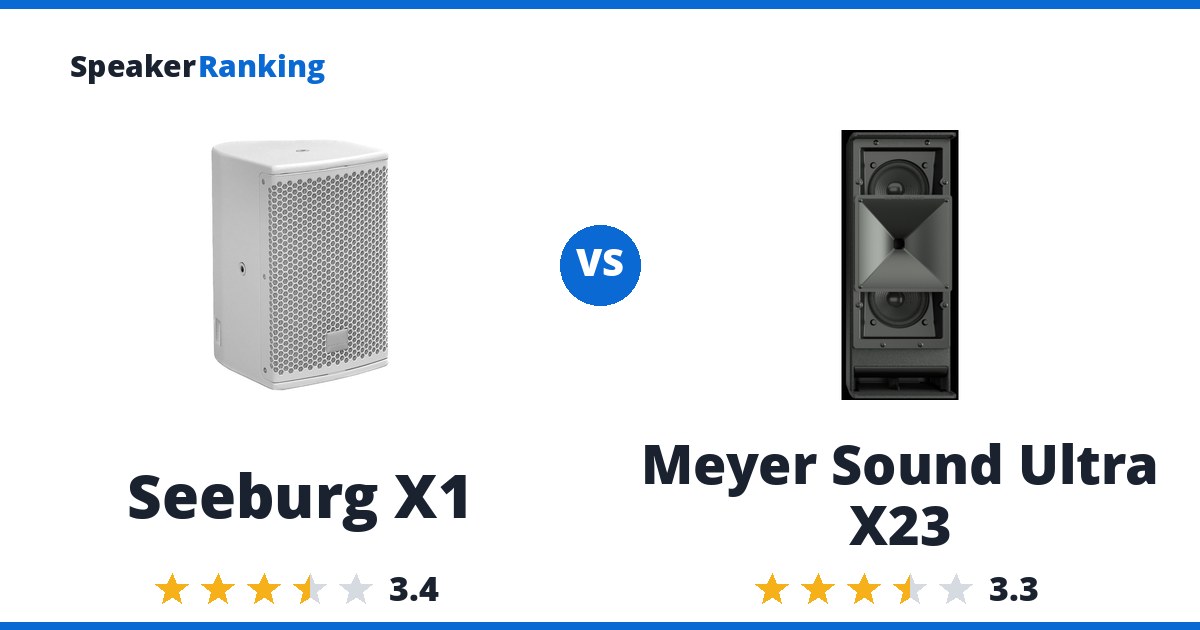
The case for the Seeburg X1: A 5.99 preference score with an ideal subwoofer and a 2.0dB reference band give an even tonal balance from a 5.5kg box. Watch for: Bass is very limited, at 97.5Hz for -3dB and about 85Hz for -10dB, so it needs a subwoofer for any music at volume.
What the Meyer Sound Ultra X23 does well: The widest-coverage member of Meyer’s ULTRA-X20 family, with a 110° x 110° horn for close-in fill where listeners sit far off to the sides. The tradeoff: Manufacturer measurements give a 1.73 standalone and 4.53 ideal-subwoofer preference score, well below its narrower-coverage X20 and X22 siblings, with a 4.1dB reference band.
Buy the Seeburg X1. It is rated higher for sound quality than the Meyer Sound Ultra X23.
Looking for alternatives? See the complete PA & Live Sound rankings.
Specifications Side By Side
| Seeburg X1 | Meyer Sound Ultra X23 | |
|---|---|---|
| Price | $866 | - |
| Ranked | #14 of 16 in Compact 5 to 6.5-Inch PA Speakers | #15 of 16 in Compact 5 to 6.5-Inch PA Speakers |
| Configuration | Passive 2-way coaxial compact speaker | Self-powered 2-way concentric compact loudspeaker |
| Drivers | 6.5” neodymium woofer (2” voice coil), coaxial 1” neodymium compression driver | 2x 5” cone woofers, concentric 2” compression driver |
| Frequency Response | 80Hz - 19kHz (-6dB, manufacturer specified) | - |
| Dimensions | 12.2”H x 7.9”W x 8.7”D (310 x 200 x 220 mm) | 19.1”H x 7.5”W x 8.6”D (484 x 191 x 218 mm) |
| Amplifier Power | Passive speaker; requires external amplification (self-powered X1 dp version available) | 860W peak, 3-channel Class D |
| Power Handling | 200W AES / 600W peak | - |
| Maximum SPL | 120dB peak (manufacturer specified) | 123.5dB peak (M-Noise, ULTRA-X20 family, manufacturer specified) |
| Coverage | 90° x 60° (rotatable) | 110° x 110° |
| Sensitivity | 92dB (1W/1m) | - |
| Impedance | 8 ohms | - |
| DSP | No (passive) | Yes |
| Rigging | 4x M10 points | - |
| Weight | 12.1 lbs (5.5 kg) | - |
| Bluetooth | No | No |
| XLR Input | No | Yes |
| RCA Input | No | No |
| TRS Input | No | No |
| Optical Input | No | No |
| Coaxial Input | No | No |
| USB Input | No | No |
| HDMI Input | No | No |
| AES Input | No | No |
| Aux Input | No | No |
| Microphone Input | No | No |
| Guitar Input | No | No |
| Bass Extension (-3dB) | 97.5Hz (measured, vendor Spinorama data) | 71Hz (measured, vendor Spinorama data) |
| Bass Extension (-10dB) | about 84.9Hz (measured, vendor Spinorama data) | about 62.5Hz (measured, vendor Spinorama data) |
| Spinorama Preference Score | 2.52 | 1.73 |
| Spinorama Preference Score with Perfect Sub | 5.99 | 4.53 |
Related Speaker Comparisons
More worthwhile head-to-heads for Seeburg X1:
- EAW MKC60 vs Seeburg X1
- EAW MKC50 vs Seeburg X1
- DB Audiotechnik 44S vs Seeburg X1
- Kling Freitag CA 106 Pro vs Seeburg X1
- Seeburg X1 vs Alcons Audio SR9
Prices on this page were last checked September 26, 2026 at 11:14 PM UTC. Product prices and availability are accurate as of that date/time and are subject to change; the price and availability shown on Amazon at the time of purchase will apply to the purchase of this product.
As an eBay Partner, we may be compensated if you make a purchase.
The Two Speakers In Full
 Seeburg X1: $866 Passive Thomann eBay
Pros: A 5.99 preference score with an ideal subwoofer and a 2.0dB reference band give an even tonal balance from a 5.5kg box. The coaxial 6.5-inch and 1-inch neodymium drivers keep sound consistent across the 90° x 60° pattern, which suits fills, small rooms and speech. It reaches a 120dB peak and has M10 points for wall and ceiling mounting. Measured bass extension of 97.5Hz (-3dB).
Cons: Bass is very limited, at 97.5Hz for -3dB and about 85Hz for -10dB, so it needs a subwoofer for any music at volume. The standalone preference score is only 2.52. It is passive and needs an external amplifier with Seeburg presets unless you buy the self-powered X1 dp.
Full Seeburg X1 review and specifications →
| AES Input | No |
|---|---|
| Amplifier Power | Passive speaker; requires external amplification (self-powered X1 dp version available) |
| Aux Input | No |
| Bass Extension (-10dB) | about 84.9Hz (measured, vendor Spinorama data) |
| Bass Extension (-3dB) | 97.5Hz (measured, vendor Spinorama data) |
| Bluetooth | No |
| Coaxial Input | No |
| Configuration | Passive 2-way coaxial compact speaker |
| Coverage | 90° x 60° (rotatable) |
| DSP | No (passive) |
| Dimensions | 12.2”H x 7.9”W x 8.7”D (310 x 200 x 220 mm) |
| Drivers | 6.5” neodymium woofer (2” voice coil), coaxial 1” neodymium compression driver |
| Frequency Response | 80Hz - 19kHz (-6dB, manufacturer specified) |
| Guitar Input | No |
| HDMI Input | No |
| Impedance | 8 ohms |
| Maximum SPL | 120dB peak (manufacturer specified) |
| Microphone Input | No |
| Optical Input | No |
| Power Handling | 200W AES / 600W peak |
| RCA Input | No |
| Rigging | 4x M10 points |
| Sensitivity | 92dB (1W/1m) |
| Spinorama Preference Score | 2.52 |
| Spinorama Preference Score with Perfect Sub | 5.99 |
| TRS Input | No |
| USB Input | No |
| Weight | 12.1 lbs (5.5 kg) |
| XLR Input | No |
- Links
- Reviews, Comparisons and Sound Samples
- Head-to-Head Comparisons
 Meyer Sound Ultra X23 eBay
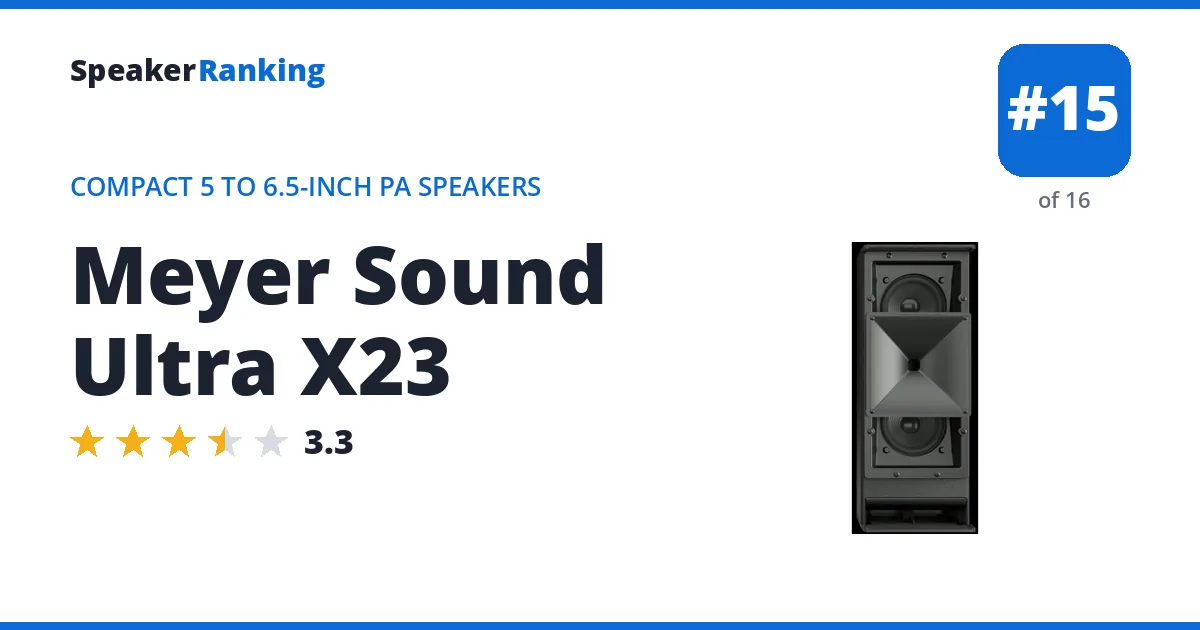
Pros: The widest-coverage member of Meyer’s ULTRA-X20 family, with a 110° x 110° horn for close-in fill where listeners sit far off to the sides. Bass reaches 71Hz at -3dB from two 5-inch woofers around a concentric 2-inch compression driver, and a built-in 860W peak amplifier with Meyer processing makes it self-powered. Measured bass extension of 71Hz (-3dB).
Cons: Manufacturer measurements give a 1.73 standalone and 4.53 ideal-subwoofer preference score, well below its narrower-coverage X20 and X22 siblings, with a 4.1dB reference band. Output tops out around 123.5dB, and it is sold only through Meyer dealers.
Full Meyer Sound Ultra X23 review and specifications →
| AES Input | No |
|---|---|
| Amplifier Power | 860W peak, 3-channel Class D |
| Aux Input | No |
| Bass Extension (-10dB) | about 62.5Hz (measured, vendor Spinorama data) |
| Bass Extension (-3dB) | 71Hz (measured, vendor Spinorama data) |
| Bluetooth | No |
| Coaxial Input | No |
| Configuration | Self-powered 2-way concentric compact loudspeaker |
| Coverage | 110° x 110° |
| DSP | Yes |
| Dimensions | 19.1”H x 7.5”W x 8.6”D (484 x 191 x 218 mm) |
| Drivers | 2x 5” cone woofers, concentric 2” compression driver |
| Guitar Input | No |
| HDMI Input | No |
| Maximum SPL | 123.5dB peak (M-Noise, ULTRA-X20 family, manufacturer specified) |
| Microphone Input | No |
| Optical Input | No |
| RCA Input | No |
| Spinorama Preference Score | 1.73 |
| Spinorama Preference Score with Perfect Sub | 4.53 |
| TRS Input | No |
| USB Input | No |
| XLR Input | Yes |
- Links
- Reviews, Comparisons and Sound Samples
- Head-to-Head Comparisons