Short answer: the Q Acoustics 5040 for better sound quality, the Klipsch RP-6000F II for the lower price. The Q Acoustics 5040 ranks #113 of 226 floorstanding speakers, rated 4.1/5, at $4,014.96. The Klipsch RP-6000F II ranks #140, rated 3.9/5, at $999.98, $3,014.98 cheaper.
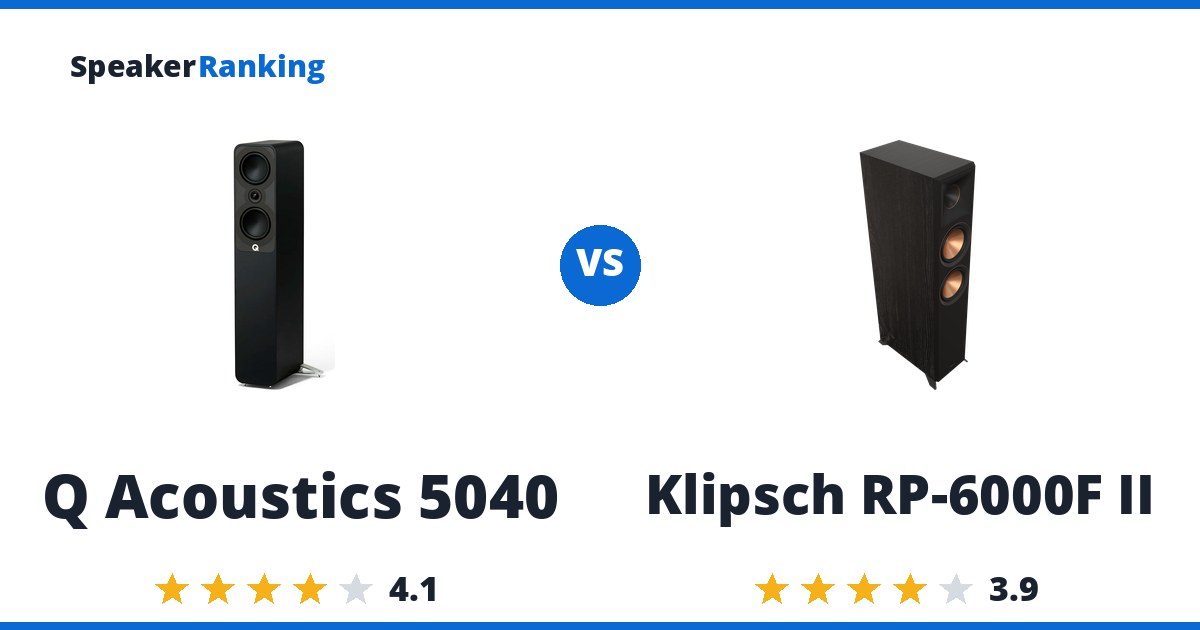
Why pick the Q Acoustics 5040: C3 (Continuous Curved Cone) driver profile technology provides smooth midrange integration, controlled cone breakup, and improved bass damping. Watch for: Free-field frequency response exhibits a noticeable mid-bass scoop around 200Hz (~6dB lower than mean SPL), causing an F3 of 70Hz (F10 of 39Hz) in open space and requiring boundary placement (11-22 inches from front wall) to reinforce upper bass output.
The Klipsch RP-6000F II is the more accurate choice. Highest power handling and clean, well-behaved compression at typical volumes. Its measured preference score, a predictor of how neutral it sounds, is 5.74 against 3.80 for the Q Acoustics 5040. The catch: Worse baffle-step coloration than the smaller Klipsch RP-5000F II (3-4dB swing vs 2dB), plus a sibilance issue the 5000F doesn’t have: a real regression in tonal balance despite the higher price.
Buy the Q Acoustics 5040 if sound quality is the priority over the price, or the Klipsch RP-6000F II if the price is the priority over sound quality.
Want more options? Browse the full Passive Home rankings.
Specifications Side By Side
| Q Acoustics 5040 | Klipsch RP-6000F II | |
|---|---|---|
| Price | $4,014.96 per pair | $999.98 per pair |
| Ranked | #113 of 226 in Large Size Floorstanding Speakers | #140 of 226 in Large Size Floorstanding Speakers |
| Bass Extension (-10dB) | 39Hz (measured, Erin’s Audio Corner) | 33Hz (measured, Erin’s Audio Corner) |
| Bass Extension (-3dB) | 70Hz (measured, Erin’s Audio Corner) | 67Hz (measured, Erin’s Audio Corner) |
| Dimensions | 38.1”H x 11.5”W x 14.2”D (967 x 293 x 361 mm) | 39.6” x 9.3” x 17.6” (1006 x 236 x 446 mm) |
| Impedance | 6 ohms nominal (3.0 ohms minimum, measured by Erin’s Audio Corner) | 8 ohms nominal (3.7 ohms minimum, measured, Erin’s Audio Corner) |
| Sensitivity | 91.5dB (measured average, Erin’s Audio Corner) | 90dB (2.83V/1m, measured by Erin’s Audio Corner) |
| Drivers | 0.88 in. decoupled dome tweeter, twin 5.0 in. C3 Continuous Curved Cone woofers | 1” titanium tweeter with Tractrix horn, dual 6.5” cerametallic woofers |
| Weight | 39.7 lbs (18.0 kg) each | 49.4 lbs (22.4 kg) |
| Woofer Cabinet | ported, rear | ported, rear |
| Spinorama Preference Score | 3.80 | 5.74 |
| Spinorama Preference Score with Perfect Sub | 6.41 | 7.47 |
| DIY Kit | No | No |
| Frequency Response | - | 38Hz - 25kHz (+-3dB, Manufacturer specified) |
| Crossover Frequency | - | 1770Hz |
| Power Handling | - | 125W continuous, 500W peak |
Related Speaker Comparisons
More worthwhile head-to-heads for Q Acoustics 5040:
- Q Acoustics 5040 vs KEF Blade Two Meta
- MoFi SourcePoint V10 Master Edition vs Q Acoustics 5040
- MoFi SourcePoint 888 vs Q Acoustics 5040
- Q Acoustics 5040 vs Revel F328Be
- Radiant Acoustics Clarity 66 vs Q Acoustics 5040
Prices on this page were last checked October 9, 2026 at 8:01 AM UTC. Product prices and availability are accurate as of that date/time and are subject to change; the price and availability shown on Amazon at the time of purchase will apply to the purchase of this product.
As an eBay Partner, we may be compensated if you make a purchase.
The Two Speakers In Full
 Q Acoustics 5040: $4,014.96 per pair Amazon eBay
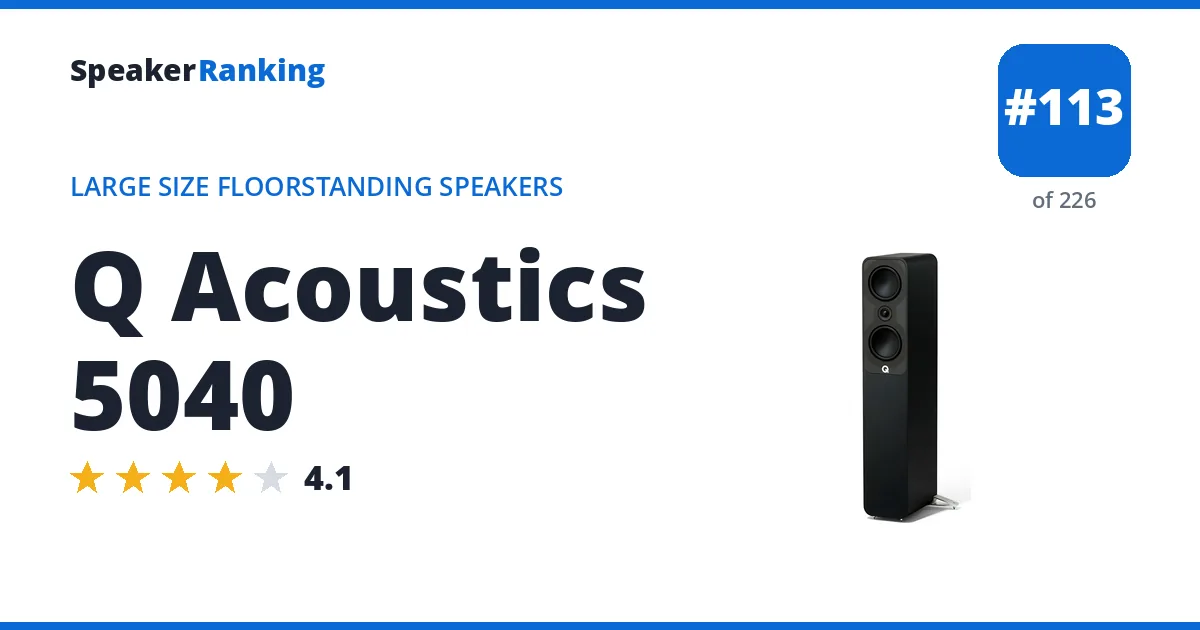
Same family: the Q Acoustics 5010 (smaller bookshelf, estimated 3.5/5), the Q Acoustics 5020 (larger bookshelf, rated 2.2/5), the Q Acoustics 5050 (larger floorstanding, ranked higher, estimated 4.3/5) and the Q Acoustics 5090 (center, estimated 3.7/5).
Pros: C3 (Continuous Curved Cone) driver profile technology provides smooth midrange integration, controlled cone breakup, and improved bass damping. High voltage sensitivity (91.5dB SPL at 2.83V/1m) allows loud listening with low-to-moderate amplifier wattage. Cabinet features Point-to-Point (P2P) internal bracing and Helmholtz Pressure Equalizer (HPE) tubes to suppress internal standing waves and panel vibrations. Measured bass extension of 70Hz (-3dB), with a measured sensitivity of 91.5dB.
Cons: Free-field frequency response exhibits a noticeable mid-bass scoop around 200Hz (~6dB lower than mean SPL), causing an F3 of 70Hz (F10 of 39Hz) in open space and requiring boundary placement (11-22 inches from front wall) to reinforce upper bass output. Measurements indicate an enclosure resonance near 300Hz visible in sound power data. Minimum impedance drops to 3.0 ohms, demanding a stable 4-ohm rated amplifier despite high sensitivity.
Full Q Acoustics 5040 review and specifications →
| Bass Extension (-10dB) | 39Hz (measured, Erin’s Audio Corner) |
|---|---|
| Bass Extension (-3dB) | 70Hz (measured, Erin’s Audio Corner) |
| DIY Kit | No |
| Dimensions | 38.1”H x 11.5”W x 14.2”D (967 x 293 x 361 mm) |
| Drivers | 0.88 in. decoupled dome tweeter, twin 5.0 in. C3 Continuous Curved Cone woofers |
| Impedance | 6 ohms nominal (3.0 ohms minimum, measured by Erin’s Audio Corner) |
| Sensitivity | 91.5dB (measured average, Erin’s Audio Corner) |
| Spinorama Preference Score | 3.80 |
| Spinorama Preference Score with Perfect Sub | 6.41 |
| Weight | 39.7 lbs (18.0 kg) each |
| Woofer Cabinet | ported, rear |
- Links
- Reviews, Comparisons and Sound Samples
- Head-to-Head Comparisons
- Q Acoustics 5040 vs Klipsch Forte IV
- Q Acoustics 5040 vs KEF Q11 Meta
- Q Acoustics 5040 vs Klipsch RP-5000F II
- Q Acoustics 5040 vs Infinity Primus 360
- Q Acoustics 5040 vs Klipsch RP-8000F II
- Q Acoustics 5040 vs Dynaudio Emit 30
- Q Acoustics 5040 vs Polk Reserve R500
- Q Acoustics 5040 vs ELAC Debut 3.0 DF63
- See all 45 comparisons
 Klipsch RP-6000F II: $999.98 per pair Amazon eBay
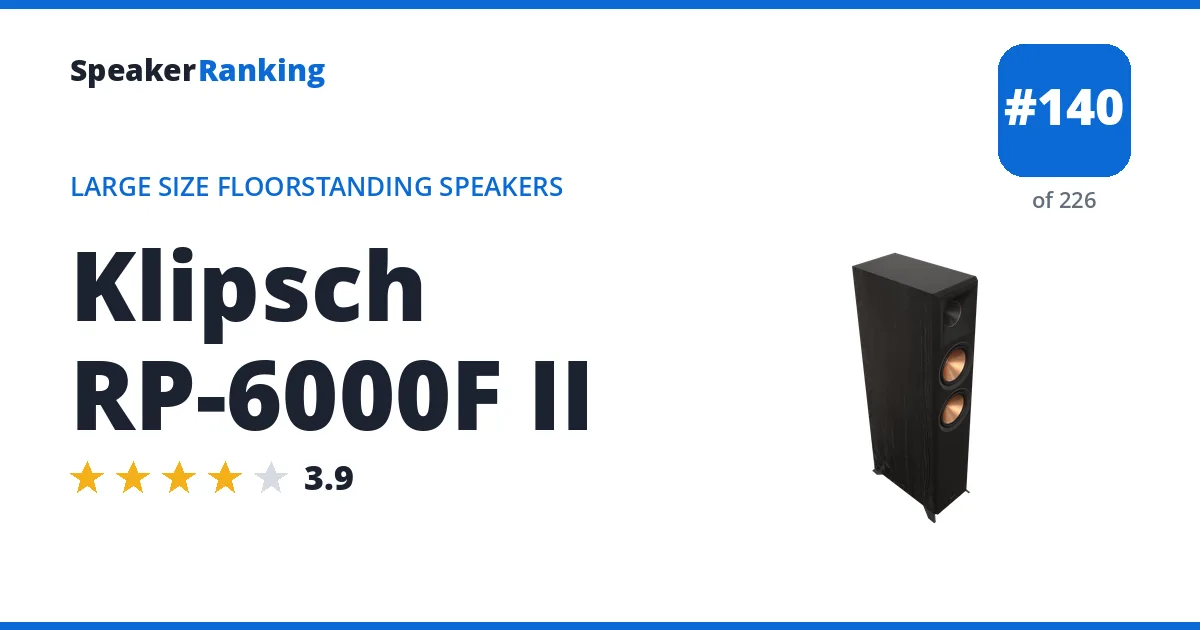
Same family: the Klipsch RP-500M II (smaller bookshelf, rated 4/5), the Klipsch RP-600M II (larger bookshelf, rated 3.7/5), the Klipsch RP-5000F II (smaller floorstanding, ranked higher, rated 4/5), the Klipsch RP-8000F II (larger floorstanding, ranked higher, rated 3.9/5), the Klipsch RP-8060FA II (larger floorstanding, ranked lower, estimated 3.8/5), the Klipsch RP-404C II (smallest center, rated 3.7/5), the Klipsch RP-500C II (center, rated 3.9/5), the Klipsch RP-504C II (largest center, rated 3.8/5), the Klipsch Reference Premiere RP-500SA II (smaller surround, estimated 3.5/5) and the Klipsch Reference Premiere RP-502S II (larger surround, estimated 3.5/5). See every Klipsch Reference Premiere generation.
Pros: Highest power handling and clean, well-behaved compression at typical volumes. Precise imaging from the controlled horn directivity. Measured bass extension of 67Hz (-3dB), with a measured sensitivity of 90dB.
Cons: Worse baffle-step coloration than the smaller Klipsch RP-5000F II (3-4dB swing vs 2dB), plus a sibilance issue the 5000F doesn’t have: a real regression in tonal balance despite the higher price. Bass extension is mixed (less deep at -3dB (67Hz) than the 5000F) and needs a subwoofer regardless. Narrow horizontal dispersion (~50-60 degrees).
Full Klipsch RP-6000F II review and specifications →
| Bass Extension (-10dB) | 33Hz (measured, Erin’s Audio Corner) |
|---|---|
| Bass Extension (-3dB) | 67Hz (measured, Erin’s Audio Corner) |
| Crossover Frequency | 1770Hz |
| DIY Kit | No |
| Dimensions | 39.6” x 9.3” x 17.6” (1006 x 236 x 446 mm) |
| Drivers | 1” titanium tweeter with Tractrix horn, dual 6.5” cerametallic woofers |
| Frequency Response | 38Hz - 25kHz (+-3dB, Manufacturer specified) |
| Impedance | 8 ohms nominal (3.7 ohms minimum, measured, Erin’s Audio Corner) |
| Power Handling | 125W continuous, 500W peak |
| Sensitivity | 90dB (2.83V/1m, measured by Erin’s Audio Corner) |
| Spinorama Preference Score | 5.74 |
| Spinorama Preference Score with Perfect Sub | 7.47 |
| Weight | 49.4 lbs (22.4 kg) |
| Woofer Cabinet | ported, rear |
- Links
- Reviews, Comparisons and Sound Samples
- Head-to-Head Comparisons
- Klipsch RP-6000F II vs Dynaudio Emit 30
- Klipsch RP-6000F II vs Klipsch RP-8000F II
- Klipsch RP-6000F II vs Definitive Technology BP-9020
- Klipsch RP-6000F II vs SVS Ultra Evolution Pinnacle
- Klipsch RP-6000F II vs Polk T50
- Klipsch RP-6000F II vs Klipsch RP-5000F II
- Klipsch RP-6000F II vs KEF Q11 Meta
- Klipsch RP-6000F II vs Klipsch Forte IV
- See all 41 comparisons