Short answer: the Parts Express Copperhead Desktop Kit, though neither ranks well in its class. It ranks #66 of 88 bookshelf speakers by sound quality, rated 2.5/5, at $119.98; the Jamo S 803 ranks #85, rated 1.4/5, and costs $119.99, so there is not much of a tradeoff to weigh. Both are rated below 3.0/5 among the 88 bookshelf speakers, so if sound quality matters, consider the Neumi BS5 instead, ranked #22 at $139.99.
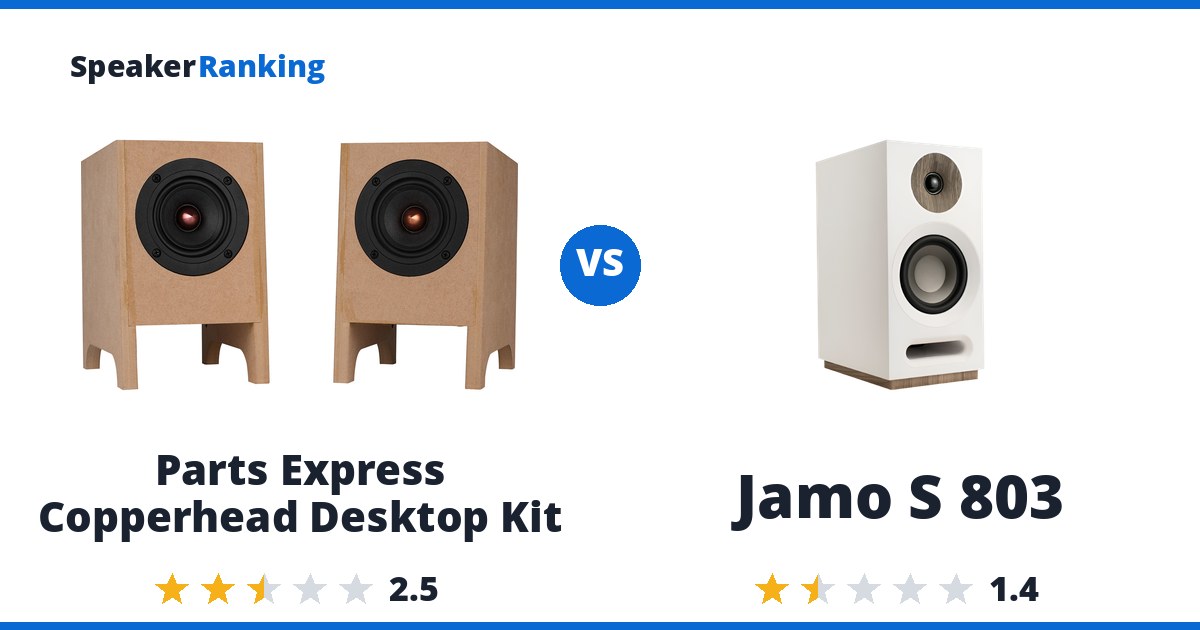
Why pick the Parts Express Copperhead Desktop Kit: Inexpensive, beginner-friendly CNC flat-pack kit with a compact 8 x 5-inch desktop footprint and only one 3.5-inch full-range driver per channel. The tradeoff: Despite the ‘full-range’ label, output rolls off around 120-150Hz and a subwoofer with an unusually high 100-200Hz crossover is effectively mandatory.
Why pick the Jamo S 803: Low pair price, compact dimensions and a front slot port suit inexpensive desktop or surround installations. Watch for: A textbook V-shaped response rather than accurate reproduction.
Buy the Parts Express Copperhead Desktop Kit. It is rated higher for sound quality than the Jamo S 803 and costs less, which makes it the one to get unless you need something the other one does better.
Want more options? Browse the full Passive Home rankings.
Specifications Side By Side
| Parts Express Copperhead Desktop Kit | Jamo S 803 | |
|---|---|---|
| Price | $119.98 per pair | $119.99 per pair |
| Ranked | #66 of 88 in Medium Size Bookshelf Speakers | #85 of 88 in Medium Size Bookshelf Speakers |
| Frequency Response | 120Hz-20kHz +/-3dB (manufacturer specified) | 57Hz-26kHz (manufacturer specified) |
| Bass Extension (-3dB) | 98.1Hz (measured, Erin’s Audio Corner) | 60.1Hz (measured, Erin’s Audio Corner) |
| Bass Extension (-10dB) | 69.3Hz (measured, Erin’s Audio Corner) | 48.7Hz (measured, Erin’s Audio Corner) |
| Dimensions | 8”H x 5”W x 6.5”D (203 x 127 x 165 mm) | 13.9”H x 7.5”W x 9.9”D (353 x 191 x 252 mm) |
| Impedance | 8 ohms (manufacturer specified) | 8 ohms nominal (manufacturer specified) |
| Sensitivity | 81dB @ 1W/1m (measured by Erin’s Audio Corner and manufacturer specified) | 81dB (measured average 300Hz-3kHz, Erin’s Audio Corner; 87dB manufacturer specified) |
| Drivers | 3.5” Dayton Audio PS95-8 full-range driver | 5” polyfiber woofer, 1” soft-dome tweeter with waveguide |
| Power Handling | 10W RMS / 20W maximum; 25W RMS with 50Hz high-pass | - |
| Woofer Cabinet | ported, bottom | ported, front slot |
| Spinorama Preference Score | 2.11 (spinorama.org) | 3.59 |
| Spinorama Preference Score with Perfect Sub | 5.35 (spinorama.org) | 6.10 |
| DIY Kit | Yes | No |
| Weight | - | 13 lbs (5.9 kg) each |
Related Speaker Comparisons
More worthwhile head-to-heads for Parts Express Copperhead Desktop Kit:
- KEF LS50 Meta vs Parts Express Copperhead Desktop Kit
- Arendal 1961 Monitor vs Parts Express Copperhead Desktop Kit
- Neumi BS5 vs Parts Express Copperhead Desktop Kit
- KEF Q150 vs Parts Express Copperhead Desktop Kit
- JBL Studio 530 vs Parts Express Copperhead Desktop Kit
Prices on this page were last checked September 29, 2026 at 3:43 PM UTC. Product prices and availability are accurate as of that date/time and are subject to change; the price and availability shown on Amazon at the time of purchase will apply to the purchase of this product.
As an eBay Partner, we may be compensated if you make a purchase.
The Two Speakers In Full
 Parts Express Copperhead Desktop Kit: $119.98 per pair Parts Express eBay
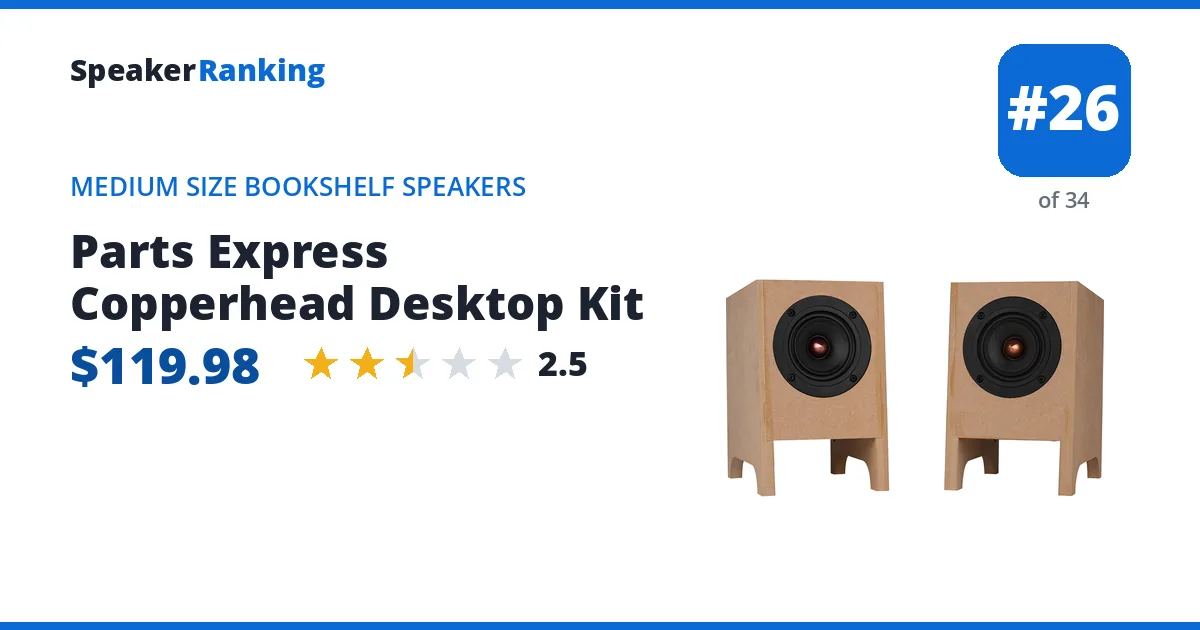
Pros: Inexpensive, beginner-friendly CNC flat-pack kit with a compact 8 x 5-inch desktop footprint and only one 3.5-inch full-range driver per channel. The point-source layout avoids a conventional woofer/tweeter crossover and, when listened to around 20 degrees above the driver as intended, can produce precise near-field imaging. Erin measured roughly 81dB sensitivity, consistent with Parts Express’s specification. The included baffle-step network improves lower-midrange balance, while the optional series inductor reduces the driver’s rising top end; Erin recommends retaining it. Several remaining narrow peaks can be corrected with desktop software EQ. Bottom porting conserves desk space, and unfinished MDF invites custom finishing. Measured bass extension of 98.1Hz (-3dB), with a measured sensitivity of 81dB.
Cons: Despite the ‘full-range’ label, output rolls off around 120-150Hz and a subwoofer with an unusually high 100-200Hz crossover is effectively mandatory. Native response has resonances near roughly 2.1kHz and 8kHz plus a broad 14-20kHz rise of 5-8dB, so it is not smooth without the supplied network and additional EQ. Distortion already exceeds 3% in places at 86dB/1m and becomes extreme at 96dB. Erin’s multitone test approached -10dB distortion (roughly 30%) full-range at the highest level, accompanied by 3-4dB compression; even a 200Hz high-pass leaves roughly 3-5% distortion and 2-3dB compression. The angled cabinet demands a specific near-field ear height, and its very low sensitivity plus 10W RMS power rating leave almost no clean-output headroom for room listening.
Full Parts Express Copperhead Desktop Kit review and specifications →
| Bass Extension (-10dB) | 69.3Hz (measured, Erin’s Audio Corner) |
|---|---|
| Bass Extension (-3dB) | 98.1Hz (measured, Erin’s Audio Corner) |
| DIY Kit | Yes |
| Dimensions | 8”H x 5”W x 6.5”D (203 x 127 x 165 mm) |
| Drivers | 3.5” Dayton Audio PS95-8 full-range driver |
| Frequency Response | 120Hz-20kHz +/-3dB (manufacturer specified) |
| Impedance | 8 ohms (manufacturer specified) |
| Power Handling | 10W RMS / 20W maximum; 25W RMS with 50Hz high-pass |
| Sensitivity | 81dB @ 1W/1m (measured by Erin’s Audio Corner and manufacturer specified) |
| Spinorama Preference Score | 2.11 (spinorama.org) |
| Spinorama Preference Score with Perfect Sub | 5.35 (spinorama.org) |
| Woofer Cabinet | ported, bottom |
- Links
- Reviews, Comparisons and Sound Samples
- Head-to-Head Comparisons
- Parts Express Copperhead Desktop Kit vs JBL Stage A120
- Parts Express Copperhead Desktop Kit vs Pioneer SP-BS22-LR (Philharmonic AAM Mod)
- Parts Express Copperhead Desktop Kit vs JBL Studio 530
- Parts Express Copperhead Desktop Kit vs KEF Q150
- Parts Express Copperhead Desktop Kit vs Neumi BS5
- Parts Express Copperhead Desktop Kit vs Arendal 1961 Monitor
- Parts Express Copperhead Desktop Kit vs KEF LS50 Meta
 Jamo S 803: $119.99 per pair Amazon Crutchfield eBay
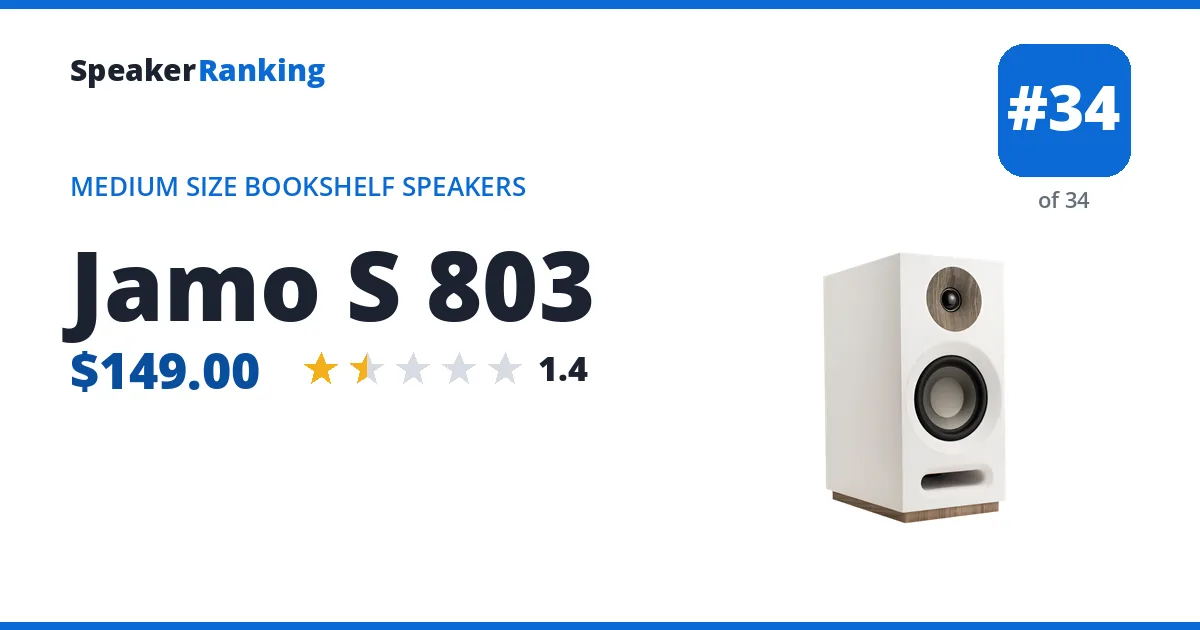
Pros: Low pair price, compact dimensions and a front slot port suit inexpensive desktop or surround installations. The pronounced 80-100Hz hump supplies immediate punch and can sound impressive in a short demonstration. Harmonic distortion at 86dB is broadly typical for an inexpensive 5-inch two-way, and high-passing near 80Hz reduces some woofer-driven midrange distortion. The cabinet also accepts Jamo’s matching top-mounted Atmos module. Measured bass extension of 60.1Hz (-3dB), with a measured sensitivity of 81dB.
Cons: A textbook V-shaped response rather than accurate reproduction. Erin measured only about 81dB average sensitivity from 300Hz-3kHz, far below Jamo’s 87dB claim; bass around 80-100Hz and the treble are each roughly 5dB above that midrange reference. The bass is therefore resonant one-note punch rather than deep extension. Horizontal coverage is only about +/-50 degrees, while the midwoofer narrows before the tweeter widens abruptly, creating a directivity discontinuity that EQ cannot repair around 4kHz. Vertical tolerance is especially asymmetric: roughly 10 degrees above tweeter axis is usable, but moving below it rapidly damages the response. At high output, compression and multitone distortion become audible; an 80Hz crossover helps but does not correct the native tonality. Erin’s conclusion was an unequivocal pass in favor of a more neutral alternative.
Full Jamo S 803 review and specifications →
| Bass Extension (-10dB) | 48.7Hz (measured, Erin’s Audio Corner) |
|---|---|
| Bass Extension (-3dB) | 60.1Hz (measured, Erin’s Audio Corner) |
| DIY Kit | No |
| Dimensions | 13.9”H x 7.5”W x 9.9”D (353 x 191 x 252 mm) |
| Drivers | 5” polyfiber woofer, 1” soft-dome tweeter with waveguide |
| Frequency Response | 57Hz-26kHz (manufacturer specified) |
| Impedance | 8 ohms nominal (manufacturer specified) |
| Sensitivity | 81dB (measured average 300Hz-3kHz, Erin’s Audio Corner; 87dB manufacturer specified) |
| Spinorama Preference Score | 3.59 |
| Spinorama Preference Score with Perfect Sub | 6.10 |
| Weight | 13 lbs (5.9 kg) each |
| Woofer Cabinet | ported, front slot |
- Links
- Reviews, Comparisons and Sound Samples
- Head-to-Head Comparisons