Short answer: pick the Fluid Audio C35BT if you want sound quality that has been measured and ranked; the Midiplus MI3 II V2 is unmeasured so far, so its case rests on features and price.
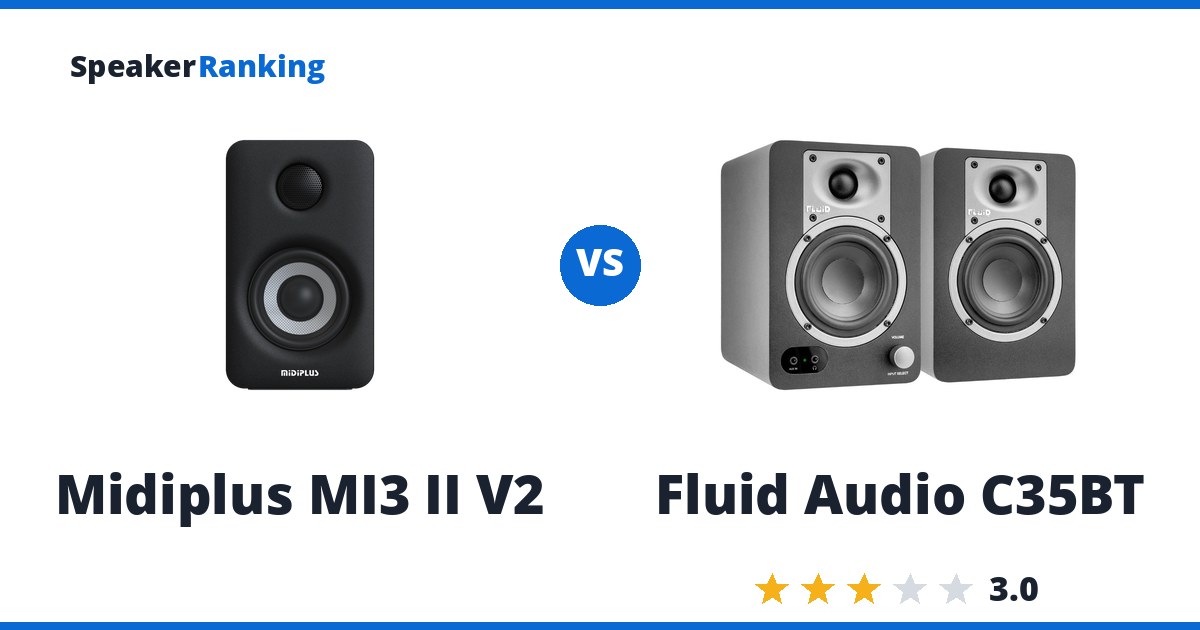
The case for the Midiplus MI3 II V2: The second generation of Midiplus’s smallest powered monitor pair: a 3.5” woven fiberglass woofer and a 1” silk dome tweeter behind a metal mesh guard in each wooden cabinet, driven by 2x 25W of Class D power.
On the Fluid Audio C35BT side: Balanced TRS inputs, Bluetooth, front volume control and a headphone output make this inexpensive pair practical for a basic desktop setup.
On paper: The Midiplus MI3 II V2 is rated down to 70Hz against 80Hz, though makers quote these at different tolerances. The Fluid Audio C35BT has more amplifier power, 64W against 25W.
Buy the Fluid Audio C35BT if you want a speaker whose sound quality has been measured and ranked. It also has more power.
Buy the Midiplus MI3 II V2 if you want deeper rated bass, and you can wait for measurements to confirm how it sounds.
Looking for alternatives? See the complete Powered Home rankings.
Specifications Side By Side
| Midiplus MI3 II V2 | Fluid Audio C35BT | |
|---|---|---|
| Price | - | $139 per pair |
| Ranked | - | #19 of 24 in Small Size Powered Bookshelf Speakers |
| AES Input | No | No |
| Amplifier Power | 2x 25W (Class D) | 64W total |
| Aux Input | Yes | Yes |
| Bluetooth | Yes | Yes, 5.0 |
| Bluetooth Codecs | SBC | - |
| Bluetooth Version | 5.0 | - |
| Coaxial Input | No | No |
| Dimensions | 202H x 120W x 160D mm | 7.3H x 4.9W x 5.9D in |
| Drivers | 1” silk dome tweeter, 3.5” woven fiberglass woofer | 0.8” silk-dome tweeter, 3.5” composite woofer |
| Enclosure | Powered 2-way rear-ported, wooden cabinet | Powered 2-way, front-ported |
| Frequency Response | 70Hz - 20kHz (Manufacturer specified) | 80Hz - 20kHz (Manufacturer specified) |
| HDMI Input | No | No |
| Inputs | 1/4” TRS, RCA, 3.5mm, Bluetooth | Bluetooth, RCA, 3.5mm, balanced TRS |
| Optical Input | No | No |
| RCA Input | Yes | Yes |
| Subwoofer Output | No | - |
| TRS Input | Yes | Yes |
| USB Input | No | No |
| Weight | 3.31 kg per pair | 10 lbs (4.52 kg) pair |
| XLR Input | No | No |
| Outputs | - | Headphone |
| Spinorama Preference Score | - | 2.57 |
| Spinorama Preference Score with Perfect Sub | - | 5.57 |
| Headphone Output | - | Yes |
Prices on this page were last checked September 29, 2026 at 3:43 PM UTC. Product prices and availability are accurate as of that date/time and are subject to change; the price and availability shown on Amazon at the time of purchase will apply to the purchase of this product.
As an eBay Partner, we may be compensated if you make a purchase.
The Two Speakers In Full
 Midiplus MI3 II V2 eBay
Older model: the Midiplus MI3 II (rated 2.4/5).
Pros: The second generation of Midiplus’s smallest powered monitor pair: a 3.5” woven fiberglass woofer and a 1” silk dome tweeter behind a metal mesh guard in each wooden cabinet, driven by 2x 25W of Class D power. It adds balanced 1/4” TRS inputs, which the MI3 II lacked, alongside RCA, a 3.5mm aux input and Bluetooth 5.0. Midiplus rates it at 70Hz to 20kHz, and the pair weighs just 3.31 kg, so it fits on a small desk.
Cons: No independent measurements have been published yet, so its tonal balance can’t be compared with ranked speakers. The MI3 II it replaces measured poorly on spinorama.org (a 0.99 preference score), and there is no data yet showing whether the V2 improves on it. The 70Hz rated low end means a subwoofer is needed for real bass, and it has no subwoofer output. It is mainly sold through Midiplus’s European and Asian distributors, with no US retailer yet.
Full Midiplus MI3 II V2 review and specifications →
| AES Input | No |
|---|---|
| Amplifier Power | 2x 25W (Class D) |
| Aux Input | Yes |
| Bluetooth | Yes |
| Bluetooth Codecs | SBC |
| Bluetooth Version | 5.0 |
| Coaxial Input | No |
| Dimensions | 202H x 120W x 160D mm |
| Drivers | 1” silk dome tweeter, 3.5” woven fiberglass woofer |
| Enclosure | Powered 2-way rear-ported, wooden cabinet |
| Frequency Response | 70Hz - 20kHz (Manufacturer specified) |
| HDMI Input | No |
| Inputs | 1/4” TRS, RCA, 3.5mm, Bluetooth |
| Optical Input | No |
| RCA Input | Yes |
| Subwoofer Output | No |
| TRS Input | Yes |
| USB Input | No |
| Weight | 3.31 kg per pair |
| XLR Input | No |
- Links
- Reviews, Comparisons and Sound Samples
- These figures are manufacturer-specified rather than independently measured.
- Head-to-Head Comparisons
 Fluid Audio C35BT: $139 per pair Amazon eBay
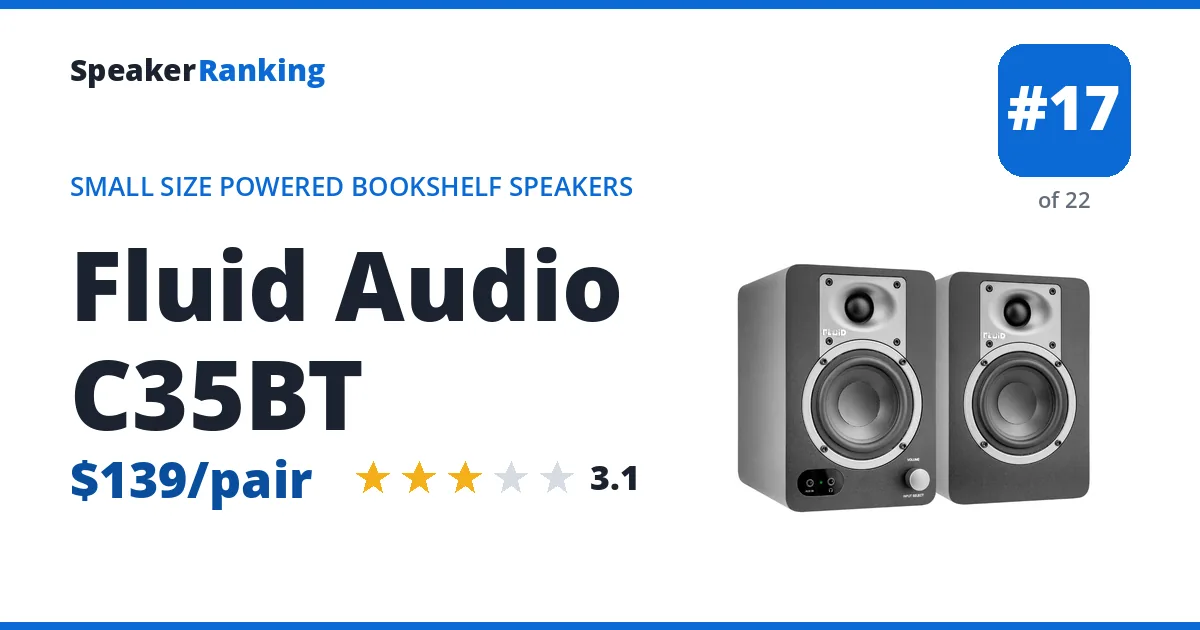
Pros: Balanced TRS inputs, Bluetooth, front volume control and a headphone output make this inexpensive pair practical for a basic desktop setup. ASR’s measured -3dB point is about 78Hz, so it covers more upper bass than the shallowest-reaching mini speakers.
Cons: Preference scores of 2.57 standalone and 5.57 with an ideal subwoofer indicate that the limitations are not just missing bass. Listening-window narrow-band deviation of 0.555 and sound-power deviation of 0.657 show that response irregularities affect both direct and room-reflected sound. A subwoofer cannot correct those tonal problems, and the small drivers are not a basis for expecting high clean output.
Full Fluid Audio C35BT review and specifications →
| AES Input | No |
|---|---|
| Amplifier Power | 64W total |
| Aux Input | Yes |
| Bluetooth | Yes, 5.0 |
| Coaxial Input | No |
| Dimensions | 7.3H x 4.9W x 5.9D in |
| Drivers | 0.8” silk-dome tweeter, 3.5” composite woofer |
| Enclosure | Powered 2-way, front-ported |
| Frequency Response | 80Hz - 20kHz (Manufacturer specified) |
| HDMI Input | No |
| Headphone Output | Yes |
| Inputs | Bluetooth, RCA, 3.5mm, balanced TRS |
| Optical Input | No |
| Outputs | Headphone |
| RCA Input | Yes |
| Spinorama Preference Score | 2.57 |
| Spinorama Preference Score with Perfect Sub | 5.57 |
| TRS Input | Yes |
| USB Input | No |
| Weight | 10 lbs (4.52 kg) pair |
| XLR Input | No |
- Links
- Reviews, Comparisons and Sound Samples
- Head-to-Head Comparisons
- Fluid Audio C35BT vs Mackie CR3-X
- Fluid Audio C35BT vs Fiio SP3
- Fluid Audio C35BT vs M-Audio BX3
- Fluid Audio C35BT vs Audioengine HD3
- Fluid Audio C35BT vs Monoprice Monolith MM-3
- Fluid Audio C35BT vs Presonus Eris E3.5 2nd Gen
- Fluid Audio C35BT vs Midiplus MI3 II
- Fluid Audio C35BT vs Klipsch ProMedia Lumina
- See all 10 comparisons