Short answer: pick the Edifier MR3 if you want sound quality that has been measured and ranked; the Midiplus MI3 II V2 is unmeasured so far, so its case rests on features and price.
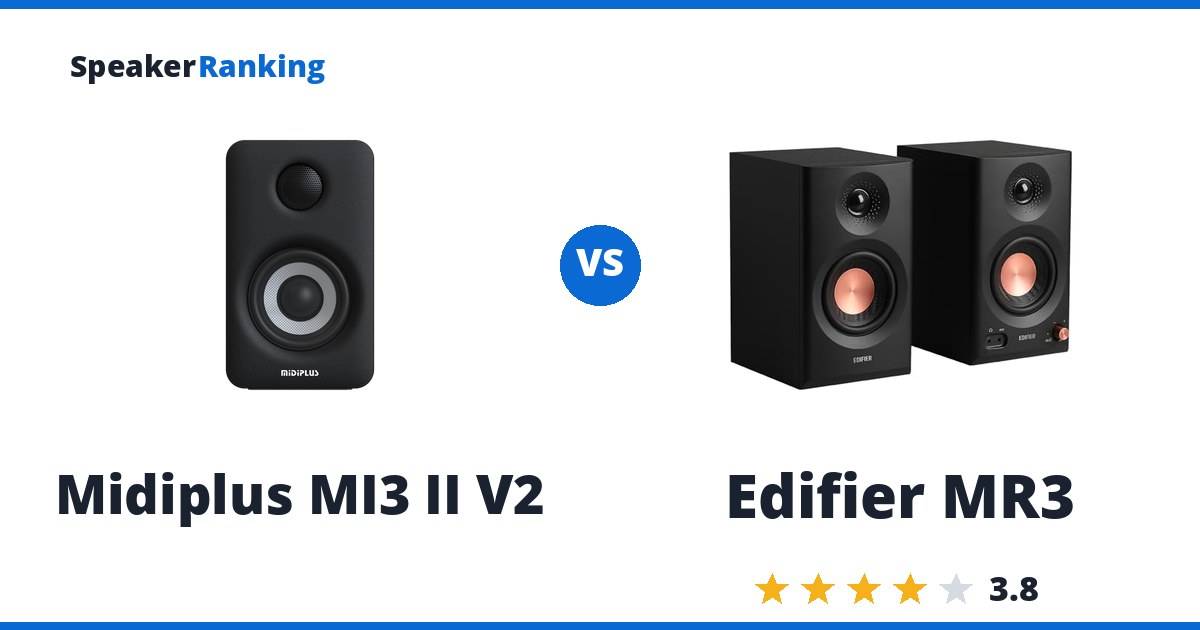
The case for the Midiplus MI3 II V2: The second generation of Midiplus’s smallest powered monitor pair: a 3.5” woven fiberglass woofer and a 1” silk dome tweeter behind a metal mesh guard in each wooden cabinet, driven by 2x 25W of Class D power.
On the Edifier MR3 side: Erin’s measurements show little overall tilt across the listening window, helping voices retain a broadly natural balance at a desk.
On paper: The Edifier MR3 is rated down to 52Hz against 70Hz, though makers quote these at different tolerances.
Buy the Edifier MR3 if you want a speaker whose sound quality has been measured and ranked. It also has deeper rated bass.
Buy the Midiplus MI3 II V2 if you prefer its design or features, and you can wait for measurements to confirm how it sounds.
Looking for alternatives? See the complete Powered Home rankings.
Specifications Side By Side
| Midiplus MI3 II V2 | Edifier MR3 | |
|---|---|---|
| Price | - | $109.99 per pair |
| Ranked | - | #8 of 24 in Small Size Powered Bookshelf Speakers |
| AES Input | No | No |
| Amplifier Power | 2x 25W (Class D) | 36W total (18W per speaker) |
| Aux Input | Yes | Yes |
| Bluetooth | Yes | Yes |
| Bluetooth Codecs | SBC | SBC |
| Bluetooth Version | 5.0 | 5.4 |
| Coaxial Input | No | No |
| Dimensions | 202H x 120W x 160D mm | 8.7”H x 4.9”W x 7.3”D (220 x 125.5 x 185 mm) (active); 220H x 125.5W x 176D mm (passive) |
| Drivers | 1” silk dome tweeter, 3.5” woven fiberglass woofer | 3.5” mid-low driver, 1” silk dome tweeter |
| Enclosure | Powered 2-way rear-ported, wooden cabinet | - |
| Frequency Response | 70Hz - 20kHz (Manufacturer specified) | 52Hz - 40kHz (Manufacturer specified) |
| HDMI Input | No | No |
| Inputs | 1/4” TRS, RCA, 3.5mm, Bluetooth | Balanced TRS, RCA, Aux, Bluetooth |
| Optical Input | No | No |
| RCA Input | Yes | Yes |
| Subwoofer Output | No | - |
| TRS Input | Yes | Yes |
| USB Input | No | No |
| Weight | 3.31 kg per pair | 8.5 lbs (3.85 kg) |
| XLR Input | No | No |
| App | - | Yes (Edifier ConneX) |
| EQ | - | Yes (rear knobs and app room compensation) |
| Bass Extension (-10dB) | - | 53Hz (measured, Erin’s Audio Corner) |
| Bass Extension (-3dB) | - | 70Hz (measured, Erin’s Audio Corner) |
| Sensitivity | - | 83.3dB (measured at 0.3V/1m, Erin’s Audio Corner) |
| Maximum SPL | - | 93dB @ 1m (manufacturer specified) |
| Spinorama Preference Score | - | 3.91 |
| Spinorama Preference Score with Perfect Sub | - | 6.53 |
| Outputs | - | 3.5mm headphone |
| Headphone Output | - | Yes |
Prices on this page were last checked September 29, 2026 at 3:43 PM UTC. Product prices and availability are accurate as of that date/time and are subject to change; the price and availability shown on Amazon at the time of purchase will apply to the purchase of this product.
As an eBay Partner, we may be compensated if you make a purchase.
The Two Speakers In Full
 Midiplus MI3 II V2 eBay
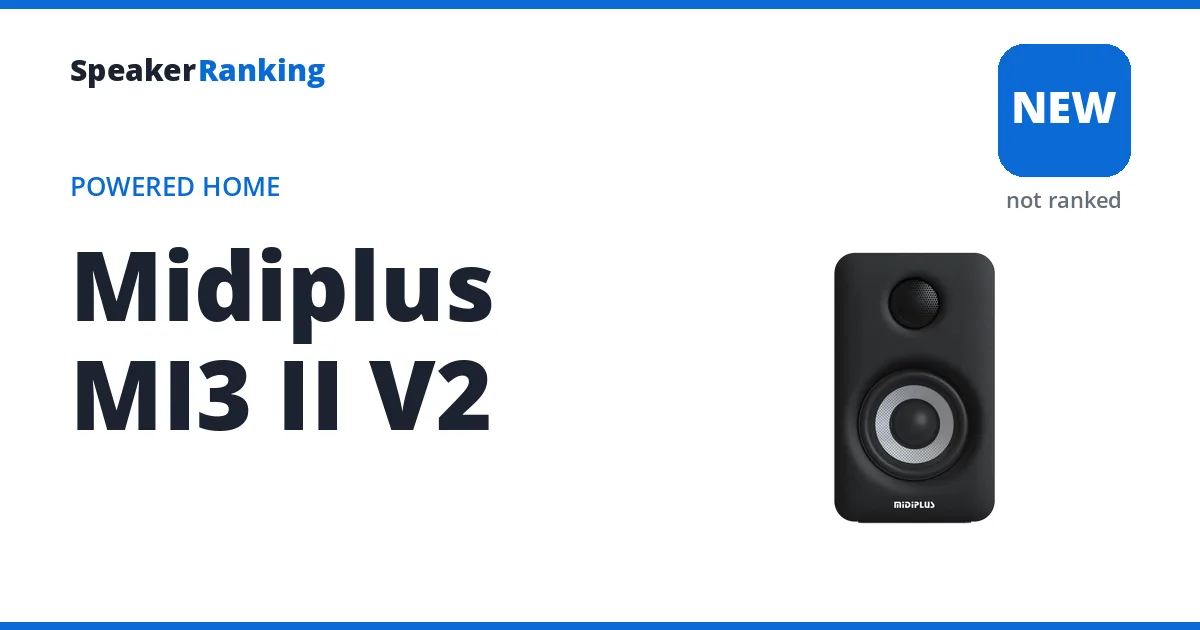
Older model: the Midiplus MI3 II (rated 2.4/5).
Pros: The second generation of Midiplus’s smallest powered monitor pair: a 3.5” woven fiberglass woofer and a 1” silk dome tweeter behind a metal mesh guard in each wooden cabinet, driven by 2x 25W of Class D power. It adds balanced 1/4” TRS inputs, which the MI3 II lacked, alongside RCA, a 3.5mm aux input and Bluetooth 5.0. Midiplus rates it at 70Hz to 20kHz, and the pair weighs just 3.31 kg, so it fits on a small desk.
Cons: No independent measurements have been published yet, so its tonal balance can’t be compared with ranked speakers. The MI3 II it replaces measured poorly on spinorama.org (a 0.99 preference score), and there is no data yet showing whether the V2 improves on it. The 70Hz rated low end means a subwoofer is needed for real bass, and it has no subwoofer output. It is mainly sold through Midiplus’s European and Asian distributors, with no US retailer yet.
Full Midiplus MI3 II V2 review and specifications →
| AES Input | No |
|---|---|
| Amplifier Power | 2x 25W (Class D) |
| Aux Input | Yes |
| Bluetooth | Yes |
| Bluetooth Codecs | SBC |
| Bluetooth Version | 5.0 |
| Coaxial Input | No |
| Dimensions | 202H x 120W x 160D mm |
| Drivers | 1” silk dome tweeter, 3.5” woven fiberglass woofer |
| Enclosure | Powered 2-way rear-ported, wooden cabinet |
| Frequency Response | 70Hz - 20kHz (Manufacturer specified) |
| HDMI Input | No |
| Inputs | 1/4” TRS, RCA, 3.5mm, Bluetooth |
| Optical Input | No |
| RCA Input | Yes |
| Subwoofer Output | No |
| TRS Input | Yes |
| USB Input | No |
| Weight | 3.31 kg per pair |
| XLR Input | No |
- Links
- Reviews, Comparisons and Sound Samples
- These figures are manufacturer-specified rather than independently measured.
- Head-to-Head Comparisons
 Edifier MR3: $109.99 per pair Amazon eBay
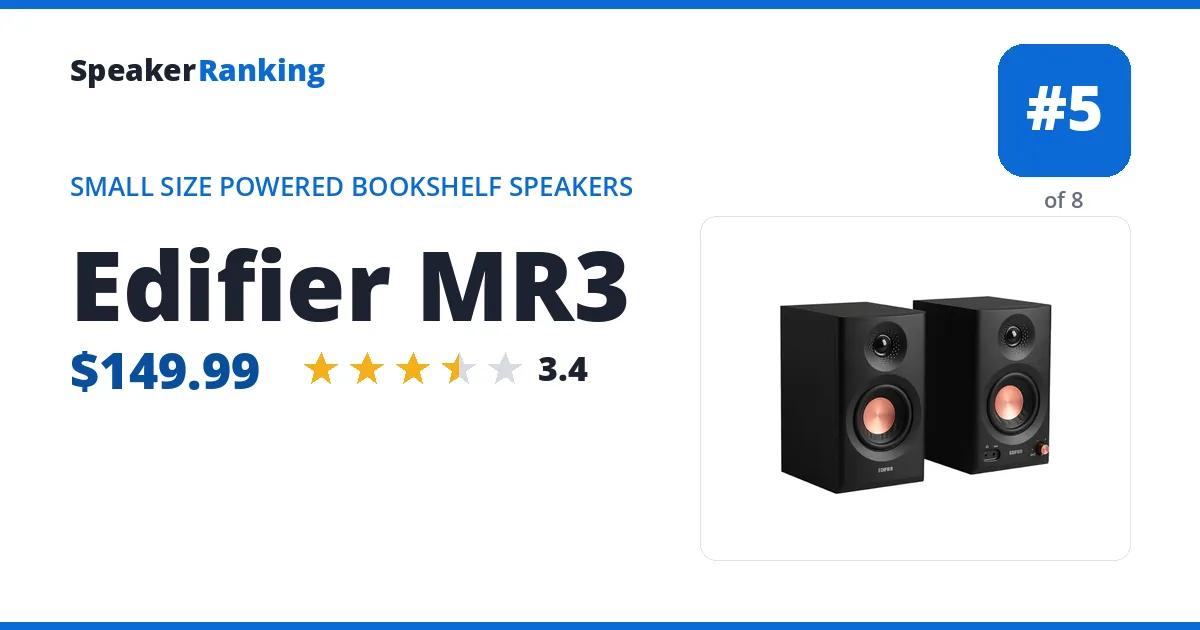
Pros: Erin’s measurements show little overall tilt across the listening window, helping voices retain a broadly natural balance at a desk. Scores of 3.91 standalone and 6.53 with an ideal subwoofer support it as a useful budget nearfield option rather than a reference monitor. Tone controls and app-based EQ provide unusually flexible adjustment, and its bass extends farther than the Fostex PM03’s. Measured bass extension of 70Hz (-3dB), with a measured sensitivity of 83.3dB.
Cons: Local response ripples remain: the measured 300Hz-5kHz span is 4.5dB and listening-window narrow-band deviation is 0.538. Bass reaches -3dB at about 70Hz. The limiter protects the drivers but prevents much extra loudness when pushed; existing compression testing puts effective single-speaker output around 86-87dB at 1m. Vertical crossover interference makes tweeter height and tilt important.
Full Edifier MR3 review and specifications →
| AES Input | No |
|---|---|
| Amplifier Power | 36W total (18W per speaker) |
| App | Yes (Edifier ConneX) |
| Aux Input | Yes |
| Bass Extension (-10dB) | 53Hz (measured, Erin’s Audio Corner) |
| Bass Extension (-3dB) | 70Hz (measured, Erin’s Audio Corner) |
| Bluetooth | Yes |
| Bluetooth Codecs | SBC |
| Bluetooth Version | 5.4 |
| Coaxial Input | No |
| Dimensions | 8.7”H x 4.9”W x 7.3”D (220 x 125.5 x 185 mm) (active); 220H x 125.5W x 176D mm (passive) |
| Drivers | 3.5” mid-low driver, 1” silk dome tweeter |
| EQ | Yes (rear knobs and app room compensation) |
| Frequency Response | 52Hz - 40kHz (Manufacturer specified) |
| HDMI Input | No |
| Headphone Output | Yes |
| Inputs | Balanced TRS, RCA, Aux, Bluetooth |
| Maximum SPL | 93dB @ 1m (manufacturer specified) |
| Optical Input | No |
| Outputs | 3.5mm headphone |
| RCA Input | Yes |
| Sensitivity | 83.3dB (measured at 0.3V/1m, Erin’s Audio Corner) |
| Spinorama Preference Score | 3.91 |
| Spinorama Preference Score with Perfect Sub | 6.53 |
| TRS Input | Yes |
| USB Input | No |
| Weight | 8.5 lbs (3.85 kg) |
| XLR Input | No |
- Links
- Reviews, Comparisons and Sound Samples
- Head-to-Head Comparisons