Short answer: the Polk Audio XT15. It ranks #52 of 160 bookshelf speakers by sound quality, rated 3.7/5, at $149; the Micca RB42 ranks #137, rated 2.3/5, and costs $159.99, so there is not much of a tradeoff to weigh.
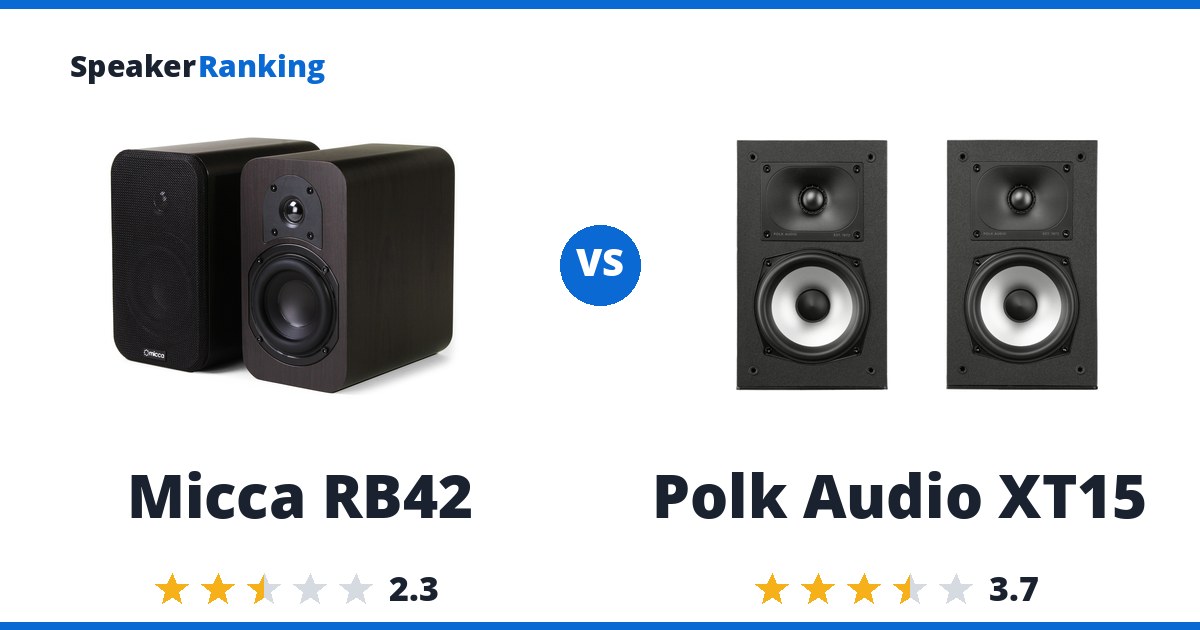
The XT15 is the more even, easier-to-drive bookshelf. Its off-axis sound tracks its on-axis response reasonably well for the price, it reaches 77.6Hz before falling 3dB, and it handles 4 or 8 ohm amplifier outputs, so it drops into almost any receiver. Its 86dB sensitivity wants a reasonably powerful amp.
The RB42 looks expensive but sounds fatiguing. Its curved cabinet has a fit and finish beyond its price. Audio Science Review found peaks and dips in the treble, excess high-frequency energy, and off-axis sound that diverges heavily from on-axis. Its 83dB sensitivity is low, and the woofer distorts at moderate volume.
Buy the Polk Audio XT15. It is rated higher for sound quality than the Micca RB42 and costs less, so it is the default pick unless a specific strength of the other one matters more to you.
Still deciding? The full Passive Home rankings cover every ranked option.
Specifications Side By Side
| Micca RB42 | Polk Audio XT15 | |
|---|---|---|
| Price | $159.99 per pair | $149.00 per pair |
| Ranked | #137 of 160 in Medium Size Bookshelf Speakers | #52 of 160 in Medium Size Bookshelf Speakers |
| Bass Extension (-3dB) | 85Hz (measured, Audio Science Review) - the reviewer noted an artificial boost around 100-300Hz, so true extension may be worse than this on-axis reading suggests | 77.6Hz (measured, spinorama.org) |
| Bass Extension (-10dB) | 62Hz (measured, Audio Science Review) - the reviewer noted an artificial boost around 100-300Hz, so true extension may be worse than this on-axis reading suggests | 54.2Hz (measured, spinorama.org) |
| Drivers | 4” coated paper woofer, 0.75” silk dome tweeter | 1” Terylene dome tweeter, 5.25” bi-laminate paper woofer |
| Dimensions | 8.7H x 4.9W x 7.9D in | 16.51 x 18.24cm (6.5 x 7.18 in), 4.08kg (9 lb) each |
| Weight | 6 lbs (2.7 kg) each (per retailer listing) | 9 lbs (4.08 kg) each |
| Frequency Response | 50Hz - 20kHz (Manufacturer specified, typical in-room) | - |
| Sensitivity | 80dB (2.83V/1m, measured, Audio Science Review) | 86dB (1W/1m) |
| Impedance | 4-8 ohms | 4/8-ohm compatible |
| Power Handling | 15-100W each | - |
| Woofer Cabinet | ported, front | Ported |
| Spinorama Preference Score | 4.59 | 4.56 |
| Spinorama Preference Score with Perfect Sub | 6.87 | 7.31 |
| DIY Kit | No | No |
Related Speaker Comparisons
More top alternatives to Polk Audio XT15:
- Polk Audio XT15 vs Audio First Fidelia
- Polk Audio XT15 vs Philharmonic Ceramic Mini
- Ascend Sierra 1 v2 vs Polk Audio XT15
- KEF LS50 Meta vs Polk Audio XT15
- Polk Audio XT15 vs XMechanik Mechano23 DIY
Prices on this page were last checked October 9, 2026 at 8:01 AM UTC. Product prices and availability are accurate as of that date/time and are subject to change; the price and availability shown on Amazon at the time of purchase will apply to the purchase of this product.
As an eBay Partner, we may be compensated if you make a purchase.
The Two Speakers In Full
 Micca RB42: $159.99 per pair Amazon eBay
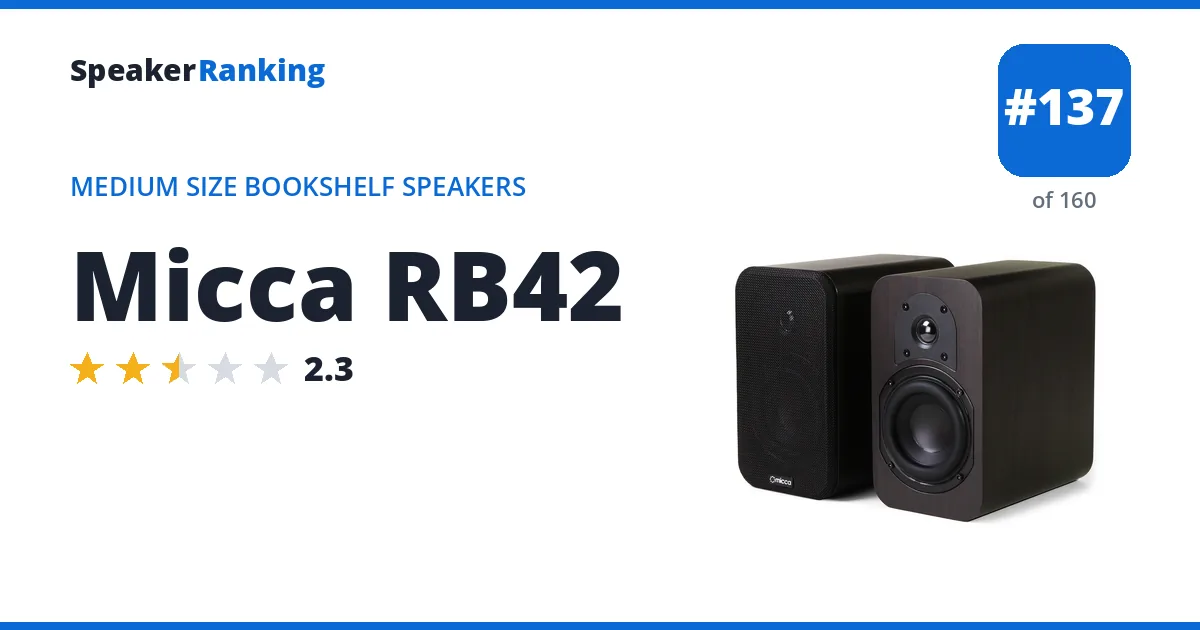
Same family: the Micca RB42-C (center, estimated 2.1/5).
Pros: Curved cabinet fit and finish look closer to a speaker costing three times as much. Rated for a wide 15-100W amplifier range with 4-8 ohm compatibility, giving flexibility with modest amplification. Measured bass extension of 85Hz (-3dB), with a measured sensitivity of 80dB.
Cons: CEA2034 spinorama shows significant peaks and valleys in the on-axis and listening-window response starting a few kHz up, with excess high-frequency energy the reviewer found fatiguing over time despite an initial impression of “detail.” Off-axis response diverges heavily from on-axis, meaning tonality shifts with room and listening position in ways EQ can’t correct. Distorts and the woofer visibly flaps under moderate volume; low 83dB sensitivity makes it a harder amplifier load than its size suggests.
Full Micca RB42 review and specifications →
| Bass Extension (-10dB) | 62Hz (measured, Audio Science Review) - the reviewer noted an artificial boost around 100-300Hz, so true extension may be worse than this on-axis reading suggests |
|---|---|
| Bass Extension (-3dB) | 85Hz (measured, Audio Science Review) - the reviewer noted an artificial boost around 100-300Hz, so true extension may be worse than this on-axis reading suggests |
| DIY Kit | No |
| Dimensions | 8.7H x 4.9W x 7.9D in |
| Drivers | 4” coated paper woofer, 0.75” silk dome tweeter |
| Frequency Response | 50Hz - 20kHz (Manufacturer specified, typical in-room) |
| Impedance | 4-8 ohms |
| Power Handling | 15-100W each |
| Sensitivity | 80dB (2.83V/1m, measured, Audio Science Review) |
| Spinorama Preference Score | 4.59 |
| Spinorama Preference Score with Perfect Sub | 6.87 |
| Weight | 6 lbs (2.7 kg) each (per retailer listing) |
| Woofer Cabinet | ported, front |
- Links
- Reviews, Comparisons and Sound Samples
- Head-to-Head Comparisons
 Polk Audio XT15: $149.00 per pair Amazon B&H Photo Video Crutchfield eBay
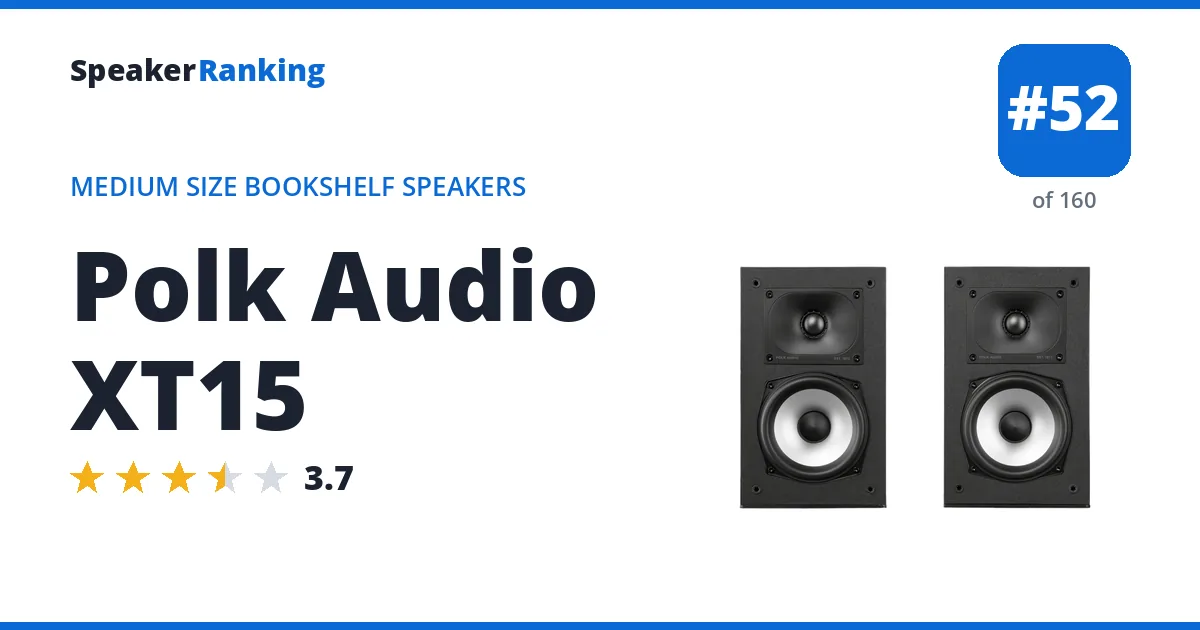
Same family: the Polk Monitor XT20 (larger bookshelf, rated 3.4/5), the Polk Audio XT60 (smaller floorstanding, rated 3.5/5), the Polk Audio XT70 (larger floorstanding, rated 3.6/5), the Polk Audio XT30 (smaller center, rated 3.6/5), the Polk Audio XT35 (larger center, rated 4.1/5), the Polk Audio Monitor XT10 (smaller subwoofer, estimated 3.1/5) and the Polk Audio Monitor XT12 (larger subwoofer, estimated 3.3/5).
Pros: Very low $149/pair entry price for a Hi-Res Audio Certified 2-way design that’s Dolby Atmos and DTS:X compatible, and works with either 4- or 8-ohm amplifier outputs so it drops into almost any AVR without matching concerns. Off axis sound tracks the on axis response reasonably consistently for the price. Measured bass extension of 77.6Hz (-3dB).
Cons: Bass rolls off early, at 77.6Hz (-3dB) and 54.2Hz (-10dB). On-axis response is relatively uneven, with an average deviation of about 0.45dB, and its listening window is less smooth than pricier speakers. Modest 86dB sensitivity wants a reasonably powered amp channel. The 5.25” bi-laminate paper woofer is Polk’s entry-tier driver, not the polypropylene/Turbine cones used in its pricier Signature Elite/Reserve lines.
Full Polk Audio XT15 review and specifications →
| Bass Extension (-10dB) | 54.2Hz (measured, spinorama.org) |
|---|---|
| Bass Extension (-3dB) | 77.6Hz (measured, spinorama.org) |
| DIY Kit | No |
| Dimensions | 16.51 x 18.24cm (6.5 x 7.18 in), 4.08kg (9 lb) each |
| Drivers | 1” Terylene dome tweeter, 5.25” bi-laminate paper woofer |
| Impedance | 4/8-ohm compatible |
| Sensitivity | 86dB (1W/1m) |
| Spinorama Preference Score | 4.56 |
| Spinorama Preference Score with Perfect Sub | 7.31 |
| Weight | 9 lbs (4.08 kg) each |
| Woofer Cabinet | Ported |
- Links
- Reviews, Comparisons and Sound Samples
- Head-to-Head Comparisons
- Polk Audio XT15 vs Wharfedale Diamond 220
- Polk Audio XT15 vs KEF Q150
- Polk Audio XT15 vs Neumi Silk 4
- Polk Audio XT15 vs Boston Acoustics A25
- Polk Audio XT15 vs Radiant Acoustics Clarity 4.2
- Polk Audio XT15 vs Neumi BS5
- Polk Audio XT15 vs ELAC BS41
- Polk Audio XT15 vs Wharfedale Diamond 12.1
- See all 42 comparisons