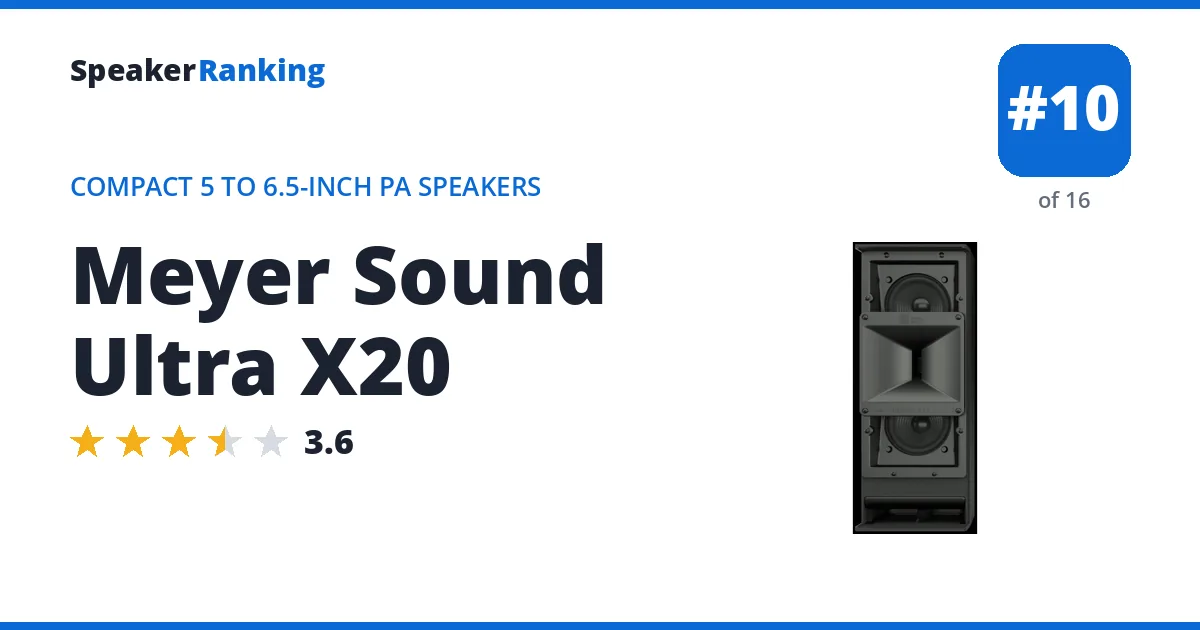
Short answer: a tie on sound quality. Both are rated 3.6/5 (#10 and #11 of 16 compact 5 to 6.5-inch pa speakers), so choose on features and fit.
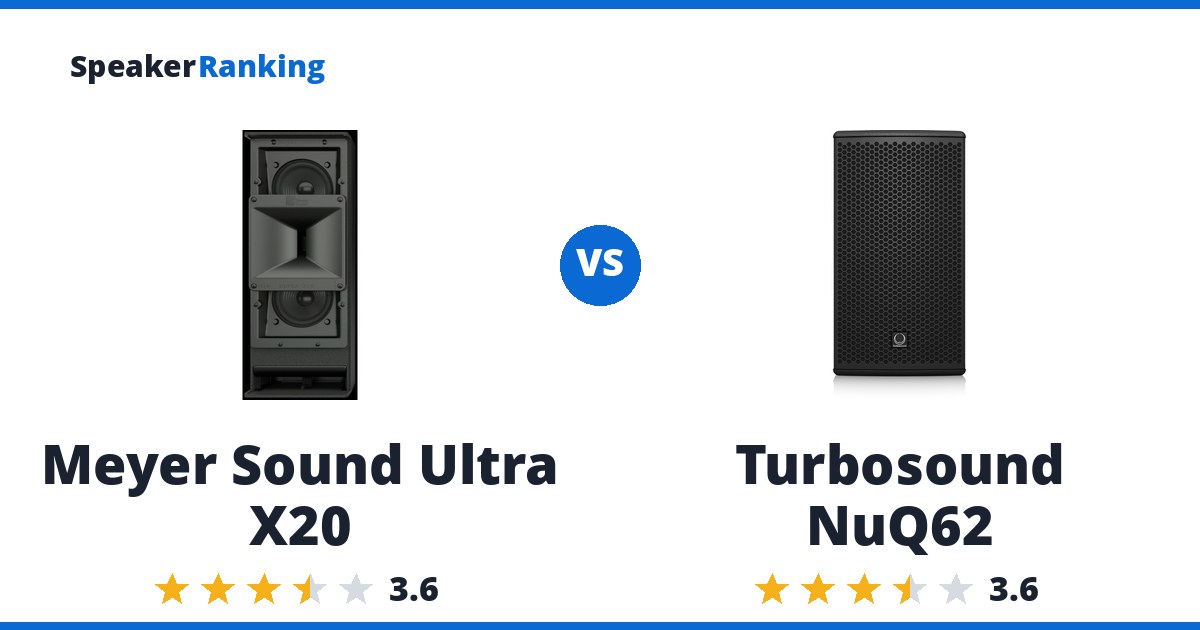
What the Meyer Sound Ultra X20 does well: Manufacturer measurements give preference scores of 2.88 standalone and 5.68 with an ideal subwoofer, and bass reaches 69Hz at -3dB, deep for two 5-inch woofers. The tradeoff: Its standalone score trails its narrower-coverage Ultra X22 sibling.
The case for the Turbosound NuQ62: The lowest price in this ranking for a two-way 6.5-inch box from a major PA brand, with a 6.3kg cabinet and 100° x 60° coverage. The catch: The Spinorama data is low quality, and predicted in-room smoothness of 0.356 is the weakest of the group.
Buy the Meyer Sound Ultra X20 or the Turbosound NuQ62 on features: they are rated the same for sound quality at close to the same price.
Want more options? Browse the full PA & Live Sound rankings.
Specifications Side By Side
| Meyer Sound Ultra X20 | Turbosound NuQ62 | |
|---|---|---|
| Price | - | - |
| Ranked | #10 of 16 in Compact 5 to 6.5-Inch PA Speakers | #11 of 16 in Compact 5 to 6.5-Inch PA Speakers |
| Configuration | Self-powered 2-way concentric compact loudspeaker | Passive 2-way bass-reflex PA speaker |
| Drivers | 2x 5” cone woofers, concentric 2” compression driver | 6.5” low-frequency driver, 1” neodymium compression driver |
| Dimensions | 19.1”H x 7.5”W x 8.6”D (484 x 191 x 218 mm) | 13.8”H x 7.5”W x 8.3”D (350 x 190 x 210 mm) |
| Amplifier Power | 860W peak, 3-channel Class D | Passive speaker; requires external amplification |
| Maximum SPL | 123.5dB peak (M-Noise, manufacturer specified) | 116dB peak (manufacturer specified) |
| Coverage | 110° x 50° (rotatable horn) | 100° x 60° |
| DSP | Yes | No (passive) |
| Bluetooth | No | No |
| XLR Input | Yes | No |
| RCA Input | No | No |
| TRS Input | No | No |
| Optical Input | No | No |
| Coaxial Input | No | No |
| USB Input | No | No |
| HDMI Input | No | No |
| AES Input | No | No |
| Aux Input | No | No |
| Microphone Input | No | No |
| Guitar Input | No | No |
| Bass Extension (-3dB) | 69Hz (measured, vendor Spinorama data) | 73Hz (measured, vendor Spinorama data) |
| Bass Extension (-10dB) | about 61Hz (measured, vendor Spinorama data) | - |
| Spinorama Preference Score | 2.88 | 3.39 |
| Spinorama Preference Score with Perfect Sub | 5.68 | 6.14 |
| Sensitivity | - | 88dB |
| Weight | - | 13.9 lbs (6.3 kg) |
Related Speaker Comparisons
How Meyer Sound Ultra X20 compares with other leading options:
- EAW MKC60 vs Meyer Sound Ultra X20
- EAW MKC50 vs Meyer Sound Ultra X20
- DB Audiotechnik 44S vs Meyer Sound Ultra X20
- Meyer Sound Ultra X20 vs Meyer Sound Ultra X23
- Meyer Sound Ultra X20 vs Alcons Audio SR9
Prices on this page were last checked September 26, 2026 at 11:14 PM UTC. Product prices and availability are accurate as of that date/time and are subject to change; the price and availability shown on Amazon at the time of purchase will apply to the purchase of this product.
As an eBay Partner, we may be compensated if you make a purchase.
The Two Speakers In Full
 Meyer Sound Ultra X20 eBay
Pros: Manufacturer measurements give preference scores of 2.88 standalone and 5.68 with an ideal subwoofer, and bass reaches 69Hz at -3dB, deep for two 5-inch woofers. The concentric 2-inch compression driver keeps coverage consistent across its 110° x 50° horn, and a built-in 860W peak amplifier with Meyer’s processing makes it a complete self-powered system. At 7.5 inches wide it suits fills, theaters and discreet installs. Measured bass extension of 69Hz (-3dB).
Cons: Its standalone score trails its narrower-coverage Ultra X22 sibling. A 123.5dB peak rating limits it to small and medium spaces, and a 3.73 directivity-index deviation means off-axis tone varies. It is sold through pro dealers with no published price.
Full Meyer Sound Ultra X20 review and specifications →
| AES Input | No |
|---|---|
| Amplifier Power | 860W peak, 3-channel Class D |
| Aux Input | No |
| Bass Extension (-10dB) | about 61Hz (measured, vendor Spinorama data) |
| Bass Extension (-3dB) | 69Hz (measured, vendor Spinorama data) |
| Bluetooth | No |
| Coaxial Input | No |
| Configuration | Self-powered 2-way concentric compact loudspeaker |
| Coverage | 110° x 50° (rotatable horn) |
| DSP | Yes |
| Dimensions | 19.1”H x 7.5”W x 8.6”D (484 x 191 x 218 mm) |
| Drivers | 2x 5” cone woofers, concentric 2” compression driver |
| Guitar Input | No |
| HDMI Input | No |
| Maximum SPL | 123.5dB peak (M-Noise, manufacturer specified) |
| Microphone Input | No |
| Optical Input | No |
| RCA Input | No |
| Spinorama Preference Score | 2.88 |
| Spinorama Preference Score with Perfect Sub | 5.68 |
| TRS Input | No |
| USB Input | No |
| XLR Input | Yes |
- Links
- Reviews, Comparisons and Sound Samples
- Head-to-Head Comparisons
 Turbosound NuQ62 Passive B&H Photo Video eBay
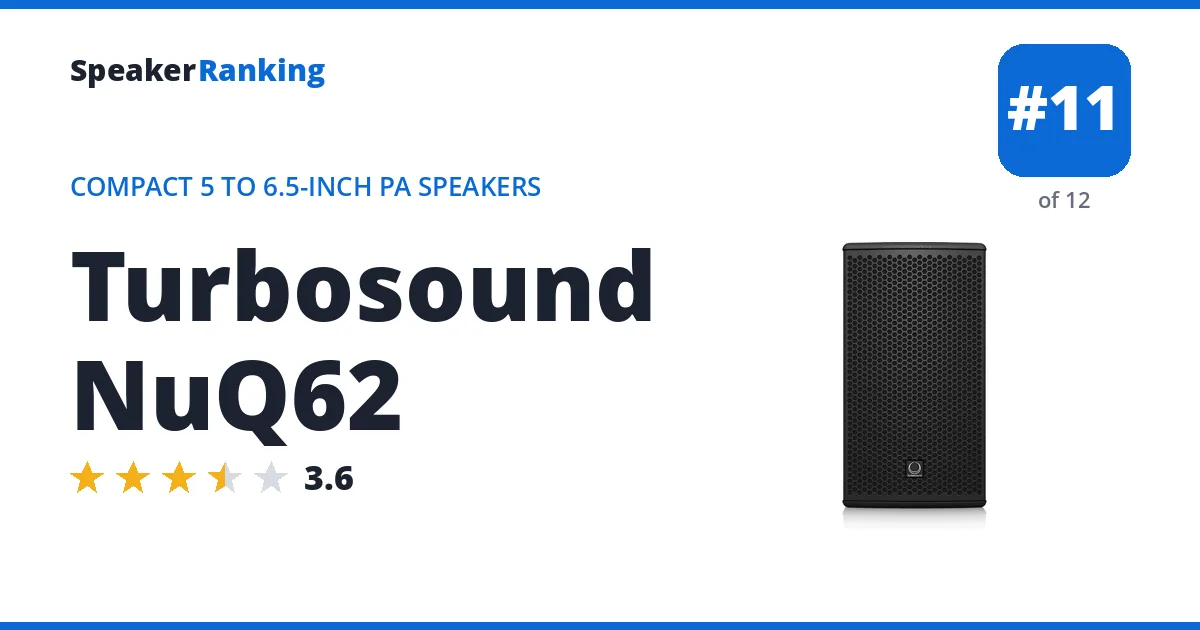
Pros: The lowest price in this ranking for a two-way 6.5-inch box from a major PA brand, with a 6.3kg cabinet and 100° x 60° coverage. Bass reaches about 73Hz (-3dB) in vendor Spinorama data, with preference scores of 3.39 standalone and 6.14 with an ideal subwoofer. Measured bass extension of 73Hz (-3dB).
Cons: The Spinorama data is low quality, and predicted in-room smoothness of 0.356 is the weakest of the group. Maximum output of 116dB is modest, and it is passive, so an amplifier is required.
Full Turbosound NuQ62 review and specifications →
| AES Input | No |
|---|---|
| Amplifier Power | Passive speaker; requires external amplification |
| Aux Input | No |
| Bass Extension (-3dB) | 73Hz (measured, vendor Spinorama data) |
| Bluetooth | No |
| Coaxial Input | No |
| Configuration | Passive 2-way bass-reflex PA speaker |
| Coverage | 100° x 60° |
| DSP | No (passive) |
| Dimensions | 13.8”H x 7.5”W x 8.3”D (350 x 190 x 210 mm) |
| Drivers | 6.5” low-frequency driver, 1” neodymium compression driver |
| Guitar Input | No |
| HDMI Input | No |
| Maximum SPL | 116dB peak (manufacturer specified) |
| Microphone Input | No |
| Optical Input | No |
| RCA Input | No |
| Sensitivity | 88dB |
| Spinorama Preference Score | 3.39 |
| Spinorama Preference Score with Perfect Sub | 6.14 |
| TRS Input | No |
| USB Input | No |
| Weight | 13.9 lbs (6.3 kg) |
| XLR Input | No |
- Links
- Reviews, Comparisons and Sound Samples
- Head-to-Head Comparisons