Short answer: the Mackie MR524. It ranks #23 of 67 powered bookshelf speakers by sound quality, rated 4.0/5, at $189.99. The M-Audio BX5 D3 ranks #30, rated 3.9/5, at $149.50, $40.49 cheaper, not enough of a saving to outweigh the sound-quality gap.
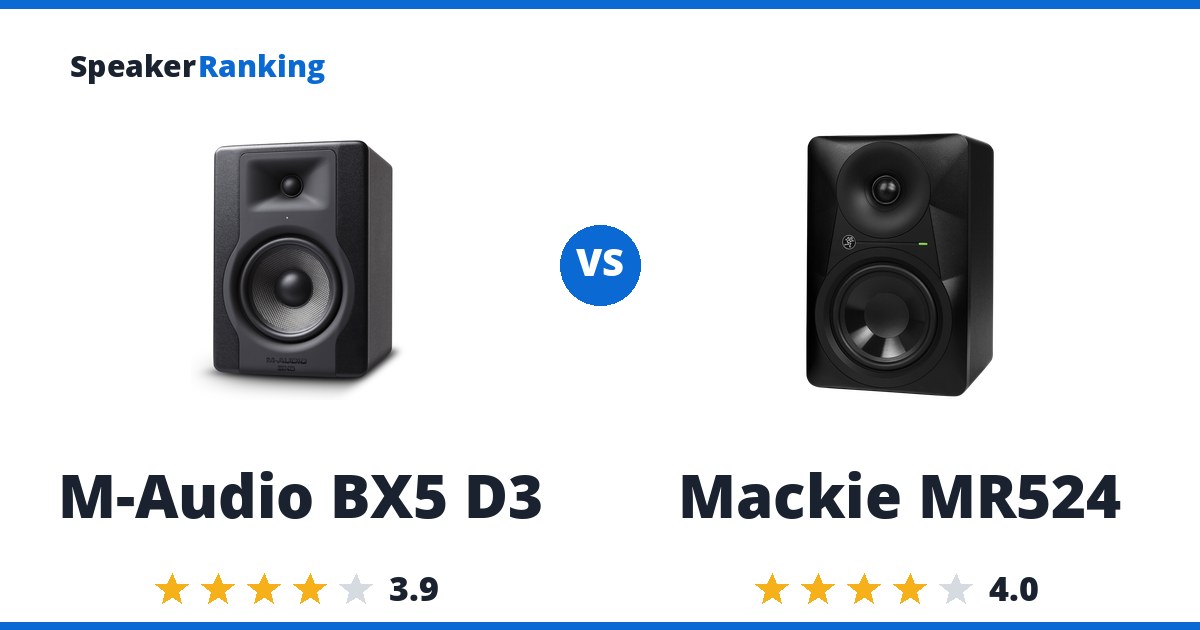
The case for the M-Audio BX5 D3: The third-party measurements suggest scores of 4.09 standalone and 6.69 with an ideal subwoofer, with a 2.4dB midrange span. Watch for: The response slopes downward by about 0.65dB per octave, potentially softening treble relative to the midrange.
What the Mackie MR524 does well: The available third-party data suggests a useful combination of bass reach and midrange balance: -3dB around 46Hz, a 2.0dB midrange span, and preference estimates of 5.11 standalone and 7.06 with an ideal subwoofer. The tradeoff: The measured response trends upward toward the treble by about 0.47dB per octave, which can lend a brighter balance.
Buy the Mackie MR524. It is rated higher for sound quality, and saving $40.49 with the M-Audio BX5 D3 does not make up for the sound-quality gap.
Want more options? Browse the full Powered Home rankings.
Specifications Side By Side
| M-Audio BX5 D3 | Mackie MR524 | |
|---|---|---|
| Price | $299 per pair | $379.98 per pair |
| Ranked | #30 of 67 in Medium Size Powered Bookshelf Speakers | #23 of 67 in Medium Size Powered Bookshelf Speakers |
| Enclosure | Active 2-way, rear-ported | - |
| Drivers | 1-inch silk tweeter, 5-inch Kevlar woofer | 5-inch polypropylene woofer; 1-inch silk-dome tweeter |
| Frequency Response | 52Hz-35kHz | 45Hz-20kHz |
| Amplifier Power | 100W each | 50W bi-amplified per speaker |
| Maximum SPL | 110dB | - |
| Inputs | XLR and TRS | Balanced XLR, balanced TRS, RCA |
| Dimensions | 10H x 6.9W x 7.8D in | 11.1" x 7.1" x 8.7" (281 x 180 x 221 mm) (H x W x D) |
| Weight | 12.3 lbs (5.6 kg) each | 10.1 lbs (4.6 kg) |
| Spinorama Preference Score | 4.09 | 5.11 |
| Spinorama Preference Score with Perfect Sub | 6.69 | 7.06 |
| XLR Input | Yes | Yes |
| RCA Input | No | Yes |
| TRS Input | Yes | Yes |
| Optical Input | No | No |
| Coaxial Input | No | No |
| USB Input | No | No |
| HDMI Input | No | No |
| AES Input | No | No |
| Aux Input | No | No |
| Bluetooth | No | No |
| Bass Extension (-3dB) | - | 46.2Hz (measured, spinorama.org) |
| Bass Extension (-10dB) | - | approximately 38Hz (measured, spinorama.org) |
Related Speaker Comparisons
How Mackie MR524 compares with other leading options:
- Neumann KH80 DSP vs Mackie MR524
- JBL 305P MKII vs Mackie MR524
- IK Multimedia iLoud MTM MKII vs Mackie MR524
- Kali Audio IN-5 vs Mackie MR524
- KEF LSX II LT vs Mackie MR524
Prices on this page were last checked September 23, 2026 at 11:24 PM UTC. Product prices and availability are accurate as of that date/time and are subject to change; the price and availability shown on Amazon at the time of purchase will apply to the purchase of this product.
As an eBay Partner, we may be compensated if you make a purchase.
The Two Speakers In Full
 M-Audio BX5 D3: $299 per pair Amazon eBay
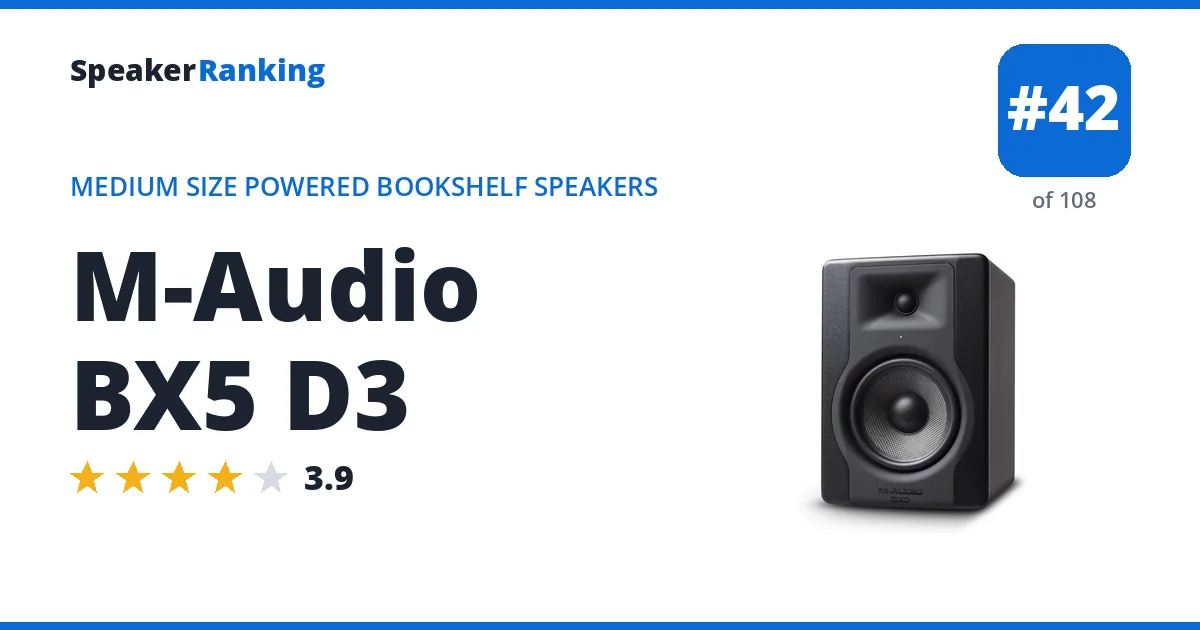
Pros: The third-party measurements suggest scores of 4.09 standalone and 6.69 with an ideal subwoofer, with a 2.4dB midrange span. Balanced inputs and acoustic-space adjustment are useful for a basic studio setup. The measured -3dB estimate is about 64Hz.
Cons: The response slopes downward by about 0.65dB per octave, potentially softening treble relative to the midrange. There is no digital input or automatic calibration, and the preference estimate does not verify distortion or output headroom.
Full M-Audio BX5 D3 review and specifications →
| AES Input | No |
|---|---|
| Amplifier Power | 100W each |
| Aux Input | No |
| Bluetooth | No |
| Coaxial Input | No |
| Dimensions | 10H x 6.9W x 7.8D in |
| Drivers | 1-inch silk tweeter, 5-inch Kevlar woofer |
| Enclosure | Active 2-way, rear-ported |
| Frequency Response | 52Hz-35kHz |
| HDMI Input | No |
| Inputs | XLR and TRS |
| Maximum SPL | 110dB |
| Optical Input | No |
| RCA Input | No |
| Spinorama Preference Score | 4.09 |
| Spinorama Preference Score with Perfect Sub | 6.69 |
| TRS Input | Yes |
| USB Input | No |
| Weight | 12.3 lbs (5.6 kg) each |
| XLR Input | Yes |
- Links
- Reviews, Comparisons and Sound Samples
- Head-to-Head Comparisons
- M-Audio BX5 D3 vs Kanto YU6
- M-Audio BX5 D3 vs Adam Audio T5V
- M-Audio BX5 D3 vs Kali LP-UNF
- M-Audio BX5 D3 vs Audioengine A5+ Classic
- M-Audio BX5 D3 vs KEF LSX II LT
- M-Audio BX5 D3 vs Vanatoo Transparent Zero Plus
- M-Audio BX5 D3 vs Airpulse A100
- M-Audio BX5 D3 vs Neumi BS5P-ARC
- See all 43 comparisons
 Mackie MR524: $379.98 per pair B&H Photo Video eBay
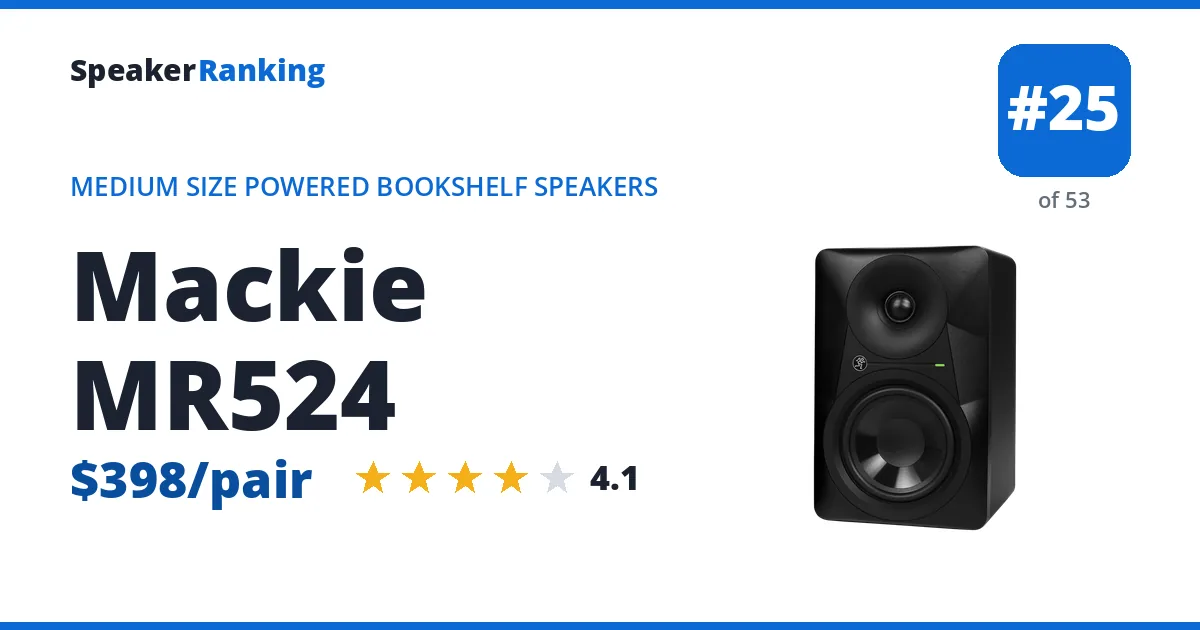
Pros: The available third-party data suggests a useful combination of bass reach and midrange balance: -3dB around 46Hz, a 2.0dB midrange span, and preference estimates of 5.11 standalone and 7.06 with an ideal subwoofer. Balanced inputs, boundary compensation and treble trim are practical studio features. Measured bass extension of 46.2Hz (-3dB).
Cons: The measured response trends upward toward the treble by about 0.47dB per octave, which can lend a brighter balance. Boundary compensation and treble trim help with setup but are less flexible than parametric correction.
Full Mackie MR524 review and specifications →
| AES Input | No |
|---|---|
| Amplifier Power | 50W bi-amplified per speaker |
| Aux Input | No |
| Bass Extension (-10dB) | approximately 38Hz (measured, spinorama.org) |
| Bass Extension (-3dB) | 46.2Hz (measured, spinorama.org) |
| Bluetooth | No |
| Coaxial Input | No |
| Dimensions | 11.1" x 7.1" x 8.7" (281 x 180 x 221 mm) (H x W x D) |
| Drivers | 5-inch polypropylene woofer; 1-inch silk-dome tweeter |
| Frequency Response | 45Hz-20kHz |
| HDMI Input | No |
| Inputs | Balanced XLR, balanced TRS, RCA |
| Optical Input | No |
| RCA Input | Yes |
| Spinorama Preference Score | 5.11 |
| Spinorama Preference Score with Perfect Sub | 7.06 |
| TRS Input | Yes |
| USB Input | No |
| Weight | 10.1 lbs (4.6 kg) |
| XLR Input | Yes |
- Links
- Reviews, Comparisons and Sound Samples
- Head-to-Head Comparisons