Short answer: the Kali Audio IN-5 if sound quality matters most, the Mackie MR524 if price matters most. The Kali Audio IN-5 ranks #26 of 100 powered bookshelf speakers, rated 4.2/5, at $898. The Mackie MR524 ranks #32, rated 4.0/5, at $379.98, $518.02 cheaper.
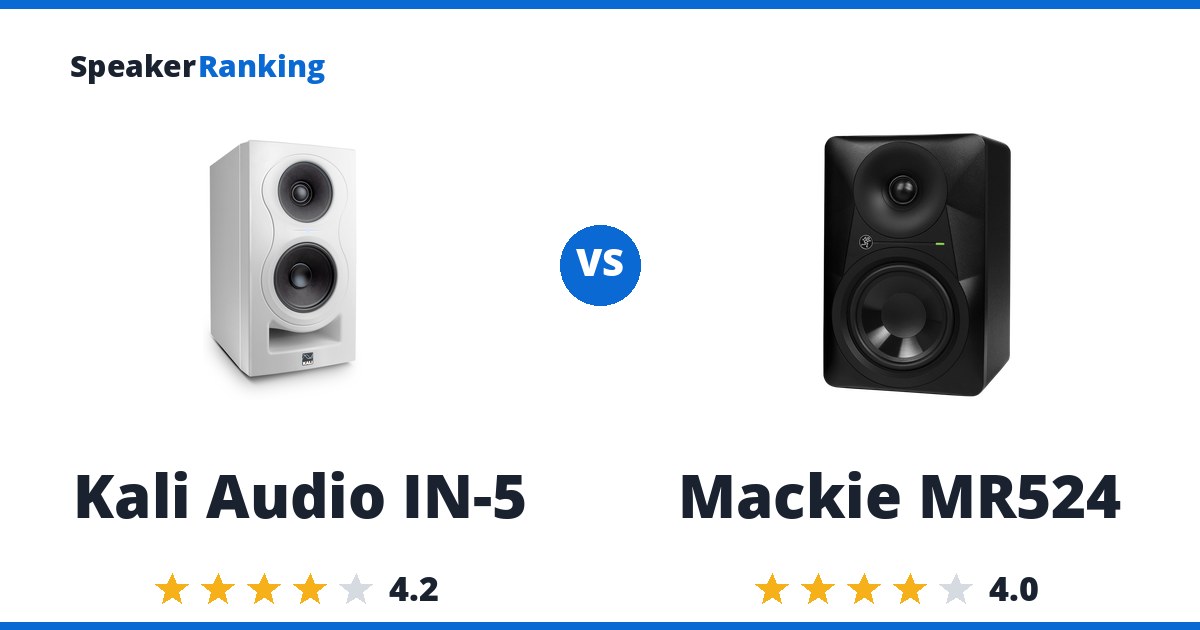
Why pick the Kali Audio IN-5: The active three-way layout separates bass duties from the coaxial mid/tweeter, giving flexible listening geometry. The tradeoff: Local listening-window irregularities remain despite the small overall midrange span.
What the Mackie MR524 does well: The available third-party data suggests a useful combination of bass reach and midrange balance: -3dB around 46Hz, a 2.0dB midrange span, and preference estimates of 5.11 standalone and 7.06 with an ideal subwoofer. The tradeoff: The measured response trends upward toward the treble by about 0.47dB per octave, which can lend a brighter balance.
Buy the Kali Audio IN-5 when sound quality outweighs the price for you, and the Mackie MR524 when the price outweighs sound quality instead.
Want more options? Browse the full Powered Home rankings.
Specifications Side By Side
| Kali Audio IN-5 | Mackie MR524 | |
|---|---|---|
| Price | $898 per pair | $379.98 per pair |
| Ranked | #26 of 100 in Medium Size Powered Bookshelf Speakers | #32 of 100 in Medium Size Powered Bookshelf Speakers |
| Bass Extension (-3dB) | Approximately 45Hz (measured, Erin’s Audio Corner) | 46.2Hz (measured, spinorama.org) |
| Bass Extension (-10dB) | 40.0Hz (measured, Erin’s Audio Corner) | approximately 38Hz (measured, spinorama.org) |
| Drivers | 1” tweeter coaxial with 4” midrange; 5” woofer | 5-inch polypropylene woofer; 1-inch silk-dome tweeter |
| Amplifier Power | 80W LF + 40W mid + 40W HF | 50W bi-amplified per speaker |
| Woofer Cabinet | ported, front | - |
| Spinorama Preference Score | 5.12 | 5.11 |
| Spinorama Preference Score with Perfect Sub | 7.13 | 7.06 |
| Inputs | XLR, TRS, RCA | Balanced XLR, balanced TRS, RCA |
| XLR Input | Yes | Yes |
| RCA Input | Yes | Yes |
| TRS Input | Yes | Yes |
| Optical Input | No | No |
| Coaxial Input | No | No |
| USB Input | No | No |
| HDMI Input | No | No |
| AES Input | No | No |
| Aux Input | No | No |
| Bluetooth | No | No |
| Dimensions | 15” x 8.1” x 11.1” (382 x 206 x 282 mm) (H x W x D) | 11.1” x 7.1” x 8.7” (281 x 180 x 221 mm) (H x W x D) |
| Frequency Response | 39Hz - 25kHz (-10dB) (Manufacturer specified) | 45Hz-20kHz |
| Weight | 18.6 lbs (8.43 kg) each | 10.1 lbs (4.6 kg) |
Related Speaker Comparisons
How Kali Audio IN-5 compares with other leading options:
- Kali Audio IN-5 vs Genelec 8331A
- Neumann KH120 MKII vs Kali Audio IN-5
- Genelec 8030C vs Kali Audio IN-5
- Neumann KH80 DSP vs Kali Audio IN-5
- Kali Audio IN-5 vs Reflector Audio Square Two
Prices on this page were last checked October 9, 2026 at 8:01 AM UTC. Product prices and availability are accurate as of that date/time and are subject to change; the price and availability shown on Amazon at the time of purchase will apply to the purchase of this product.
As an eBay Partner, we may be compensated if you make a purchase.
The Two Speakers In Full
 Kali Audio IN-5: $898 per pair Amazon B&H Photo Video eBay
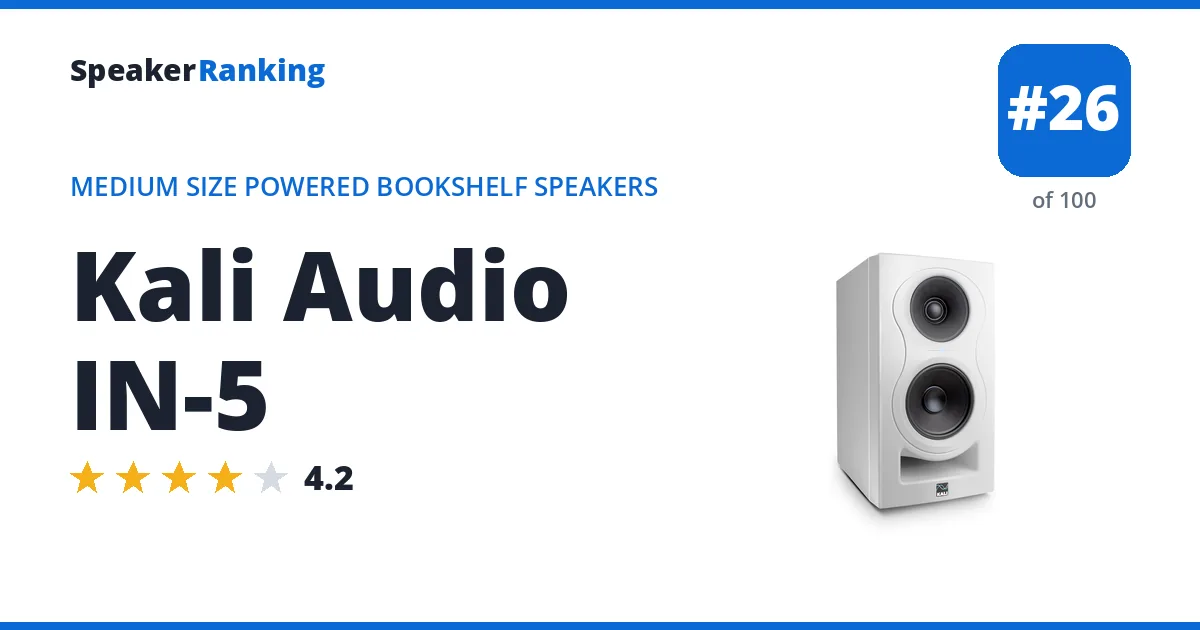
Same family: the Kali Audio IN-8 V2 (larger bookshelf, rated 4.4/5) and the Kali Audio IN-UNF (larger bookshelf, ranked lower, rated 3.3/5).
Pros: The active three-way layout separates bass duties from the coaxial mid/tweeter, giving flexible listening geometry. Erin’s data shows a 1.8dB midrange response span and -3dB bass around 45Hz, with scores of 5.12 standalone and 7.13 with an ideal subwoofer. Placement switches and balanced inputs help integrate it into a studio; moderate-level distortion is well controlled in the existing review. Measured bass extension of 45Hz (-3dB).
Cons: Local listening-window irregularities remain despite the small overall midrange span. The review reports midrange distortion rising above 3% at 96dB and a brighter perceived balance at closer distances. Limiting makes it unsuitable for demanding farfield playback. Coaxial construction improves geometry but does not remove response errors or guarantee unlimited output.
Full Kali Audio IN-5 review and specifications →
| AES Input | No |
|---|---|
| Amplifier Power | 80W LF + 40W mid + 40W HF |
| Aux Input | No |
| Bass Extension (-10dB) | 40.0Hz (measured, Erin’s Audio Corner) |
| Bass Extension (-3dB) | Approximately 45Hz (measured, Erin’s Audio Corner) |
| Bluetooth | No |
| Coaxial Input | No |
| Dimensions | 15” x 8.1” x 11.1” (382 x 206 x 282 mm) (H x W x D) |
| Drivers | 1” tweeter coaxial with 4” midrange; 5” woofer |
| Frequency Response | 39Hz - 25kHz (-10dB) (Manufacturer specified) |
| HDMI Input | No |
| Inputs | XLR, TRS, RCA |
| Optical Input | No |
| RCA Input | Yes |
| Spinorama Preference Score | 5.12 |
| Spinorama Preference Score with Perfect Sub | 7.13 |
| TRS Input | Yes |
| USB Input | No |
| Weight | 18.6 lbs (8.43 kg) each |
| Woofer Cabinet | ported, front |
| XLR Input | Yes |
- Links
- Reviews, Comparisons and Sound Samples
- Head-to-Head Comparisons
- Kali Audio IN-5 vs Kali Audio SM-5
- Kali Audio IN-5 vs HEDD Type 05 A-CORE
- Kali Audio IN-5 vs Sigberg Audio SBS Gen 2
- Kali Audio IN-5 vs IK Multimedia iLoud MTM MKII
- Kali Audio IN-5 vs IK Multimedia iLoud MTM
- Kali Audio IN-5 vs Sigberg Audio SBS.1
- Kali Audio IN-5 vs Pioneer DJ VM-50
- Kali Audio IN-5 vs Vanatoo Transparent One Encore Plus
- See all 61 comparisons
 Mackie MR524: $379.98 per pair B&H Photo Video eBay
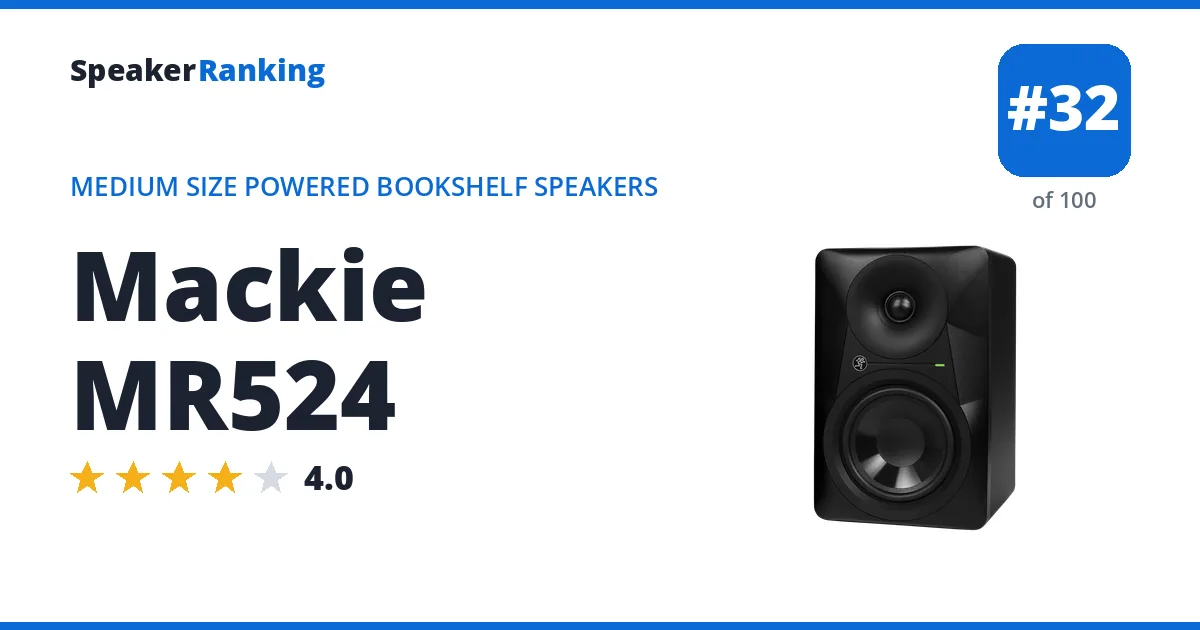
Same family: the Mackie MR624 (larger bookshelf, estimated 4/5) and the Mackie MR824 (larger bookshelf, estimated 4/5).
Pros: The available third-party data suggests a useful combination of bass reach and midrange balance: -3dB around 46Hz, a 2.0dB midrange span, and preference estimates of 5.11 standalone and 7.06 with an ideal subwoofer. Balanced inputs, boundary compensation and treble trim are practical studio features. Measured bass extension of 46.2Hz (-3dB).
Cons: The measured response trends upward toward the treble by about 0.47dB per octave, which can lend a brighter balance. Boundary compensation and treble trim help with setup but are less flexible than parametric correction.
Full Mackie MR524 review and specifications →
| AES Input | No |
|---|---|
| Amplifier Power | 50W bi-amplified per speaker |
| Aux Input | No |
| Bass Extension (-10dB) | approximately 38Hz (measured, spinorama.org) |
| Bass Extension (-3dB) | 46.2Hz (measured, spinorama.org) |
| Bluetooth | No |
| Coaxial Input | No |
| Dimensions | 11.1” x 7.1” x 8.7” (281 x 180 x 221 mm) (H x W x D) |
| Drivers | 5-inch polypropylene woofer; 1-inch silk-dome tweeter |
| Frequency Response | 45Hz-20kHz |
| HDMI Input | No |
| Inputs | Balanced XLR, balanced TRS, RCA |
| Optical Input | No |
| RCA Input | Yes |
| Spinorama Preference Score | 5.11 |
| Spinorama Preference Score with Perfect Sub | 7.06 |
| TRS Input | Yes |
| USB Input | No |
| Weight | 10.1 lbs (4.6 kg) |
| XLR Input | Yes |
- Links
- Reviews, Comparisons and Sound Samples
- Head-to-Head Comparisons