Short answer: the Klipsch The Fives. It ranks #16 of 100 powered bookshelf speakers by sound quality, rated 4.3/5, at $324.95. The Dayton Audio M4 ranks #52, rated 3.8/5, at $249.98, $74.97 cheaper, a saving that is not big enough to make up the sound-quality gap.
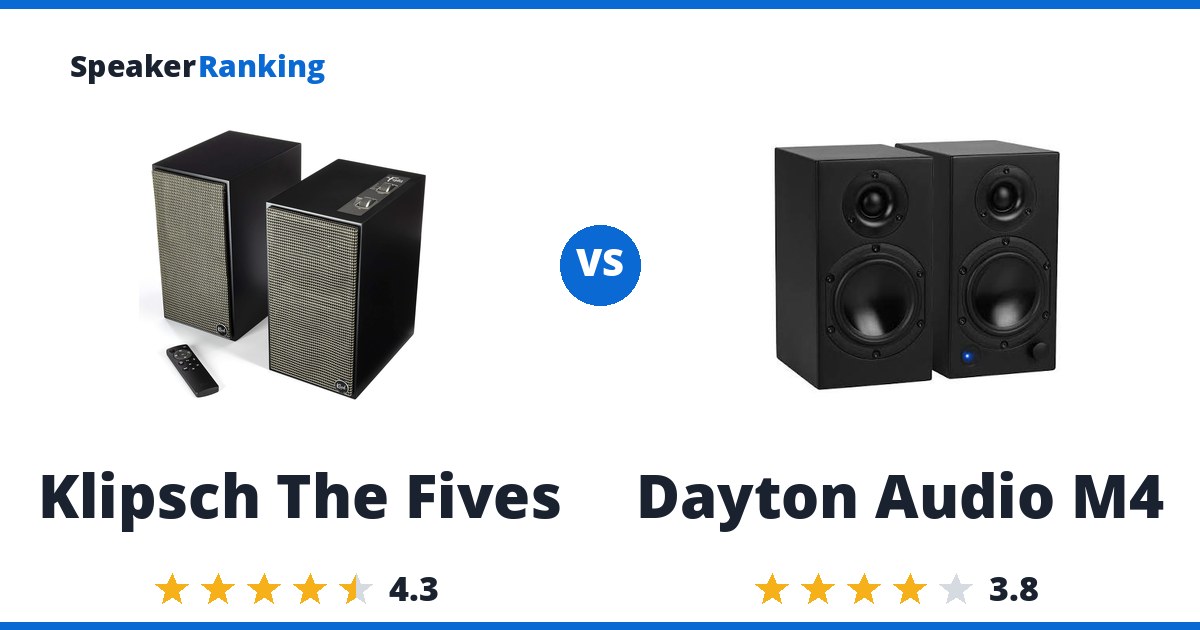
The Klipsch The Fives is the better-sounding, deeper-bass choice. In the tested Bass Cut mode, Erin’s Klippel data gives preference scores of 5.52 standalone and 7.89 with an ideal subwoofer, with a 2.7dB midrange response span. Its bass reaches about 57Hz before falling 3dB, against 121Hz for the Dayton Audio M4. It supports aptX HD Bluetooth, which the Dayton Audio M4 lacks. The tradeoff: The favorable score specifically requires Bass Cut mode; it does not describe every firmware or bass setting.
What the Dayton Audio M4 does well: A compact powered pair with a subwoofer output, useful source connections and a solid cabinet. It keeps a wired aux input, which the Klipsch The Fives lacks. The tradeoff: Existing listening and output notes describe limited bass, a balance that changes with distance, and distortion rising above roughly 93dB.
Buy the Klipsch The Fives. It is rated higher for sound quality, and the $74.97 you would save on the Dayton Audio M4 does not close the gap.
Want more options? Browse the full Powered Home rankings.
Specifications Side By Side
| Klipsch The Fives | Dayton Audio M4 | |
|---|---|---|
| Price | $324.95 per pair | $249.98 per pair |
| Ranked | #16 of 100 in Medium Size Powered Bookshelf Speakers | #52 of 100 in Medium Size Powered Bookshelf Speakers |
| Bass Extension (-3dB) | 57Hz (measured, Erin’s Audio Corner) | 121Hz (measured, Erin’s Audio Corner) |
| Bass Extension (-10dB) | 47.3Hz (measured, Erin’s Audio Corner) | 60Hz (measured, Erin’s Audio Corner) |
| Drivers | 1” horn-loaded tweeter; 4.5” woofer | 4” aluminum woofer, 1” silk dome tweeter |
| Inputs | HDMI ARC, USB, optical, Bluetooth, phono/line RCA | RCA, USB-C, Bluetooth |
| Bluetooth Codecs | SBC, AAC, aptX, aptX HD | SBC, aptX |
| DSP | Dynamic Bass, Flat and Bass Cut profiles | - |
| Spinorama Preference Score | 5.52 | - |
| Spinorama Preference Score with Perfect Sub | 7.89 | - |
| Subwoofer Output | Yes | Yes |
| Outputs | Subwoofer | Subwoofer (20Hz-200Hz) |
| XLR Input | No | No |
| RCA Input | Yes | Yes |
| TRS Input | No | No |
| Optical Input | Yes | No |
| Coaxial Input | No | No |
| USB Input | Yes | Yes |
| HDMI Input | Yes | No |
| AES Input | No | No |
| Aux Input | No | Yes (RCA) |
| Weight | Primary 11.8 lbs (5.35 kg), Secondary 10.7 lbs (4.85 kg) | 6.2 lbs (2.81 kg) (active), 5.1 lbs (2.31 kg) (passive) |
| Dimensions | 12”H x 6.5”W x 9.2”D (304.8 x 165.1 x 234.95 mm) | 5” x 6.5” x 9.5” (127 x 165 x 241 mm) (W x D x H) |
| Amplifier Power | 160W total system power (320W peak) | 75W RMS (150W peak) |
| Bluetooth | Yes | Yes |
| Bluetooth Version | 5.0 | 5.0 |
| Frequency Response | 50Hz - 25kHz (Manufacturer specified) | 40Hz - 20kHz (Manufacturer specified) |
| Digital Aux Input | - | Yes (USB-C DAC, up to 192kHz/32-bit) |
| App | - | No |
| Stereo | - | Yes |
| Power Input | - | AC Power cord |
Related Speaker Comparisons
How Klipsch The Fives compares with other leading options:
- Klipsch The Fives vs Genelec 8331A
- Klipsch The Fives vs Neumann KH120 MKII
- Genelec 8030C vs Klipsch The Fives
- Neumann KH80 DSP vs Klipsch The Fives
- Klipsch The Fives vs Dynaudio LYD 5
Prices on this page were last checked October 7, 2026 at 9:25 PM UTC. Product prices and availability are accurate as of that date/time and are subject to change; the price and availability shown on Amazon at the time of purchase will apply to the purchase of this product.
As an eBay Partner, we may be compensated if you make a purchase.
The Two Speakers In Full
 Klipsch The Fives: $324.95 per pair Amazon eBay
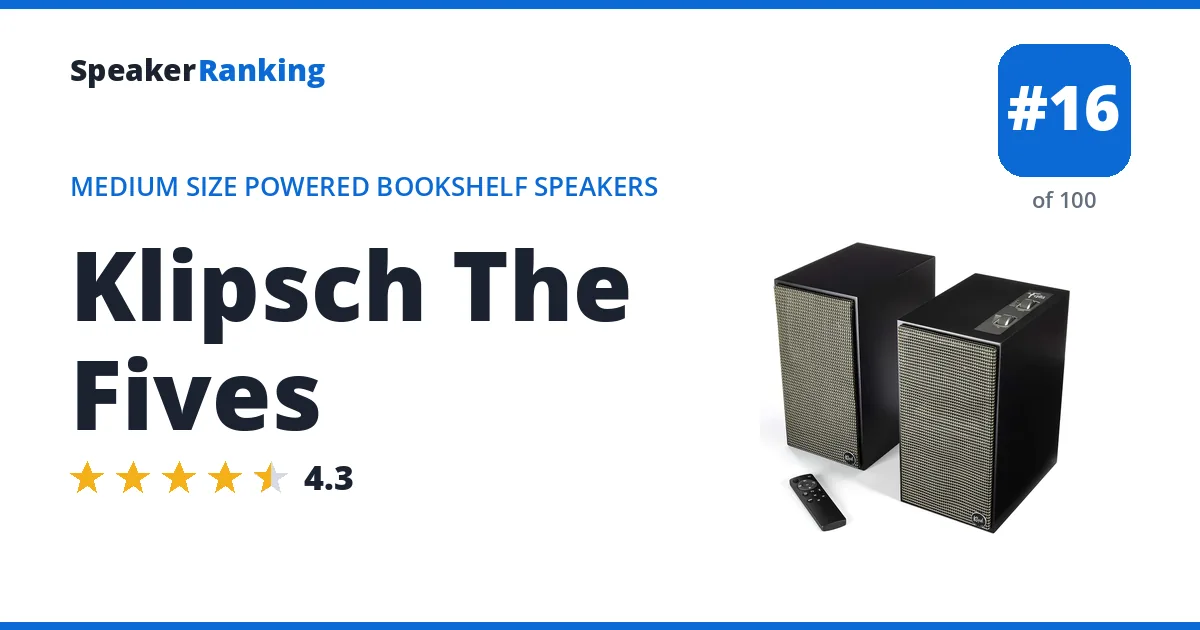
Newer model: the Klipsch The Fives II, ranked lower, estimated 4.3/5.
Same family: the Klipsch The Sevens (larger bookshelf, rated 3.7/5) and the Klipsch The Nines (larger bookshelf, rated 4.2/5).
Pros: In the tested Bass Cut mode, Erin’s Klippel data gives preference scores of 5.52 standalone and 7.89 with an ideal subwoofer, with a 2.7dB midrange response span. That mode offers considerably better tonal balance than the bass-heavy default behavior. HDMI ARC, phono/line input, digital inputs and subwoofer output make it a versatile stereo alternative to a soundbar. Measured bass extension of 57Hz (-3dB).
Cons: The favorable score specifically requires Bass Cut mode; it does not describe every firmware or bass setting. Bass reaches -3dB around 59Hz in that configuration. The review reports increasing compression around 200Hz and below 80Hz as volume rises, reducing bass dynamics. Careful placement and a subwoofer remain useful, and the horn/woofer transition is not perfectly uniform off-axis.
Full Klipsch The Fives review and specifications →
| AES Input | No |
|---|---|
| Amplifier Power | 160W total system power (320W peak) |
| Aux Input | No |
| Bass Extension (-10dB) | 47.3Hz (measured, Erin’s Audio Corner) |
| Bass Extension (-3dB) | 57Hz (measured, Erin’s Audio Corner) |
| Bluetooth | Yes |
| Bluetooth Codecs | SBC, AAC, aptX, aptX HD |
| Bluetooth Version | 5.0 |
| Coaxial Input | No |
| DSP | Dynamic Bass, Flat and Bass Cut profiles |
| Dimensions | 12”H x 6.5”W x 9.2”D (304.8 x 165.1 x 234.95 mm) |
| Drivers | 1” horn-loaded tweeter; 4.5” woofer |
| Frequency Response | 50Hz - 25kHz (Manufacturer specified) |
| HDMI Input | Yes |
| Inputs | HDMI ARC, USB, optical, Bluetooth, phono/line RCA |
| Optical Input | Yes |
| Outputs | Subwoofer |
| RCA Input | Yes |
| Spinorama Preference Score | 5.52 |
| Spinorama Preference Score with Perfect Sub | 7.89 |
| Subwoofer Output | Yes |
| TRS Input | No |
| USB Input | Yes |
| Weight | Primary 11.8 lbs (5.35 kg), Secondary 10.7 lbs (4.85 kg) |
| XLR Input | No |
- Links
- Reviews, Comparisons and Sound Samples
- Erin’s Audio Corner: Klipsch The Fives Review More from Erin’s Audio Corner →
- Erin’s Audio Corner Website: Klipsch The Fives
- Erin’s Audio Corner Measurements (spinorama.org)
- Jasper Tech: Best Bookshelf Speakers For TV & Gaming - 2025 More from Jasper Tech →
- Jasper Tech: Best Powered Bookshelf Speakers for Every Budget - 2025
- Head-to-Head Comparisons
- Klipsch The Fives vs JBL 305P MKII
- Klipsch The Fives vs KEF LS50 Wireless II
- Klipsch The Fives vs Vanatoo Transparent One Encore Plus
- Klipsch The Fives vs Genelec 8020D
- Klipsch The Fives vs Topping MA4
- Klipsch The Fives vs Klipsch The Fives II
- Klipsch The Fives vs IK Multimedia iLoud MTM MKII
- Klipsch The Fives vs Devialet Phantom II 98 dB
- See all 58 comparisons
 Dayton Audio M4: $249.98 per pair Parts Express eBay
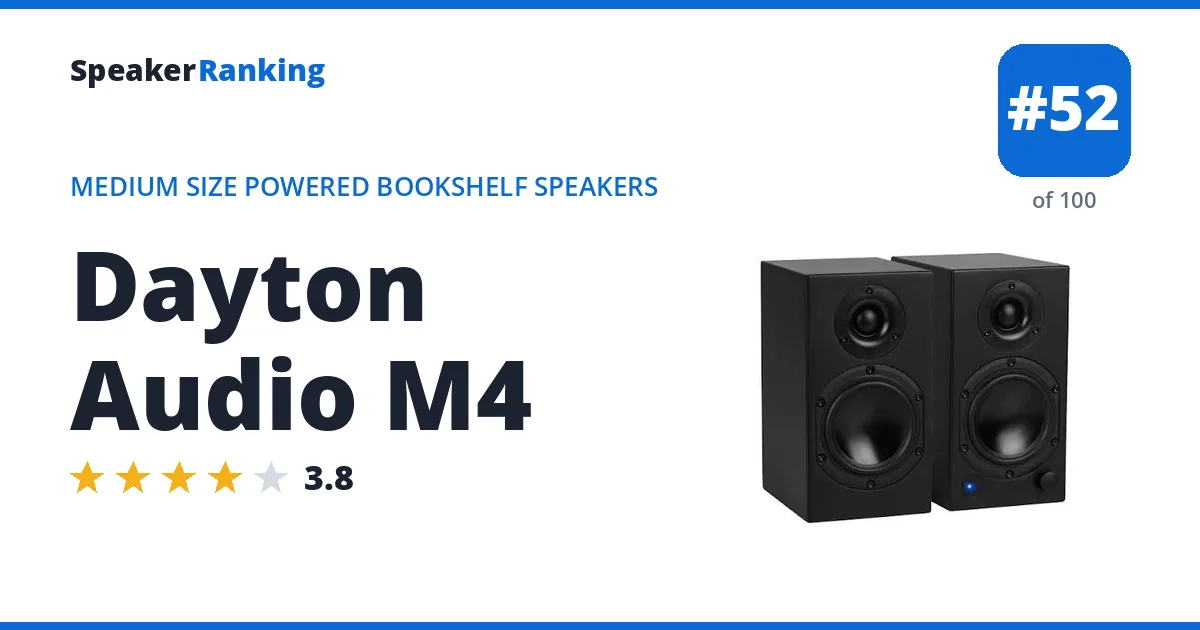
Pros: A compact powered pair with a subwoofer output, useful source connections and a solid cabinet. The existing review describes reasonable linearity for the price and a subdued upper treble that avoids an aggressively bright presentation. It is best considered for a close desktop setup. Measured bass extension of 121Hz (-3dB).
Cons: Existing listening and output notes describe limited bass, a balance that changes with distance, and distortion rising above roughly 93dB. The soft treble is a tonal preference, not evidence of reference neutrality; a subwoofer does not establish greater midrange headroom.
Full Dayton Audio M4 review and specifications →
| AES Input | No |
|---|---|
| Amplifier Power | 75W RMS (150W peak) |
| App | No |
| Aux Input | Yes (RCA) |
| Bass Extension (-10dB) | 60Hz (measured, Erin’s Audio Corner) |
| Bass Extension (-3dB) | 121Hz (measured, Erin’s Audio Corner) |
| Bluetooth | Yes |
| Bluetooth Codecs | SBC, aptX |
| Bluetooth Version | 5.0 |
| Coaxial Input | No |
| Digital Aux Input | Yes (USB-C DAC, up to 192kHz/32-bit) |
| Dimensions | 5” x 6.5” x 9.5” (127 x 165 x 241 mm) (W x D x H) |
| Drivers | 4” aluminum woofer, 1” silk dome tweeter |
| Frequency Response | 40Hz - 20kHz (Manufacturer specified) |
| HDMI Input | No |
| Inputs | RCA, USB-C, Bluetooth |
| Optical Input | No |
| Outputs | Subwoofer (20Hz-200Hz) |
| Power Input | AC Power cord |
| RCA Input | Yes |
| Stereo | Yes |
| Subwoofer Output | Yes |
| TRS Input | No |
| USB Input | Yes |
| Weight | 6.2 lbs (2.81 kg) (active), 5.1 lbs (2.31 kg) (passive) |
| XLR Input | No |
- Links
- Reviews, Comparisons and Sound Samples
- Head-to-Head Comparisons