Short answer: the Wharfedale Aura 2 if sound quality matters most, the Klipsch RP-600M II if price matters most. The Wharfedale Aura 2 ranks #13 of 203 bookshelf speakers, rated 4.6/5, at $2,799. The Klipsch RP-600M II ranks #114, rated 3.7/5, at $449.99, $2,349.01 cheaper.
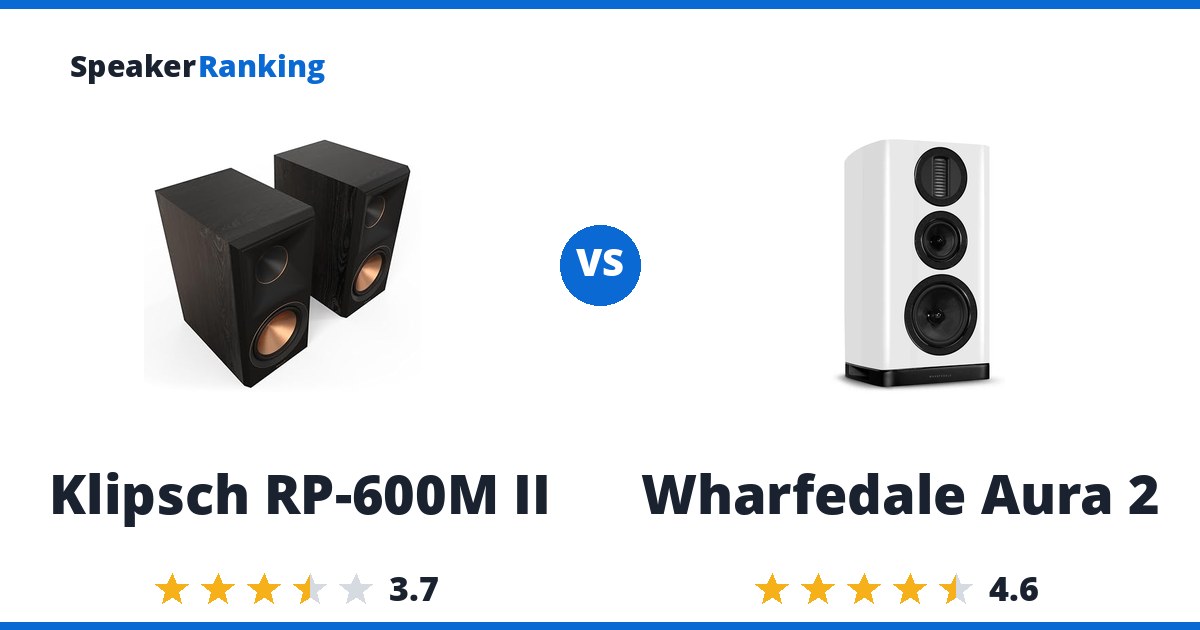
What the Klipsch RP-600M II does well: Redesigned waveguide extends flush to the baffle edge, reducing diffraction compared to the original Klipsch RP-600M. The tradeoff: On-axis, the treble runs notably hot (even hotter than the original Klipsch RP-600M in some respects) and needs about 20° of toe-out or the grille installed to sound balanced.
The Wharfedale Aura 2 is the better-sounding, deeper-bass pick. Three-way “mini tower” design with a 27x90mm AMT tweeter, 4” mid-range, and 6.5” midwoofer, using an unusual bottom-firing port. Its bass reaches about 56Hz before falling 3dB, against 70Hz for the Klipsch RP-600M II. Watch for: A breakup/peak around 13kHz can sound sharp or shrill depending on the track, the main tonal flaw noted.
Buy the Klipsch RP-600M II if the price is the priority over sound quality, or the Wharfedale Aura 2 if sound quality is the priority over the price.
Want more options? Browse the full Passive Home rankings.
Specifications Side By Side
| Klipsch RP-600M II | Wharfedale Aura 2 | |
|---|---|---|
| Price | $449.99 per pair | $2799 per pair |
| Ranked | #114 of 203 in Large Size Bookshelf Speakers | #13 of 203 in Large Size Bookshelf Speakers |
| Bass Extension (-10dB) | 41Hz (measured, Erin’s Audio Corner) | 30Hz (measured, Erin’s Audio Corner) |
| Bass Extension (-3dB) | 70Hz (measured, Erin’s Audio Corner) | 56Hz (measured, Erin’s Audio Corner) |
| Dimensions | 15.7”H x 8”W x 12.5”D (398.8 x 203.2 x 317.5 mm) | 22.1”H x 11.3”W x 15.3”D (561.3 x 287 x 388.6 mm) |
| Impedance | 8 ohms nominal (3.5 ohms minimum above 80Hz, measured by Erin’s Audio Corner) | 6 ohms nominal (3.1 ohms minimum above 80Hz, measured, Erin’s Audio Corner) |
| Sensitivity | 86dB (measured, Erin’s Audio Corner) | 87dB (measured, Erin’s Audio Corner) |
| Drivers | 6.5” Cerametallic cone woofer, 1” titanium LTS vented tweeter with Tractrix horn | 6.5” Black Glass Fibre Matrix Cone woofer, 4” Black Glass Fibre Matrix Cone midrange, 27x90mm AMT tweeter |
| Weight | 13 lbs (5.9 kg) each | 45 lbs (20.4 kg) each |
| Woofer Cabinet | ported | ported, rear |
| Spinorama Preference Score | 5.64 | 6.03 |
| Spinorama Preference Score with Perfect Sub | 7.77 | 7.65 |
| DIY Kit | No | No |
Related Speaker Comparisons
More worthwhile head-to-heads for Wharfedale Aura 2:
- Wharfedale Aura 2 vs Perlisten S4b
- KEF Reference 1 Meta vs Wharfedale Aura 2
- Wharfedale Aura 2 vs GR-Research NX-Studio
- Wharfedale Aura 2 vs March Audio Sointuva AWG
- AsciLab C6B vs Wharfedale Aura 2
Prices on this page were last checked October 9, 2026 at 8:01 AM UTC. Product prices and availability are accurate as of that date/time and are subject to change; the price and availability shown on Amazon at the time of purchase will apply to the purchase of this product.
As an eBay Partner, we may be compensated if you make a purchase.
The Two Speakers In Full
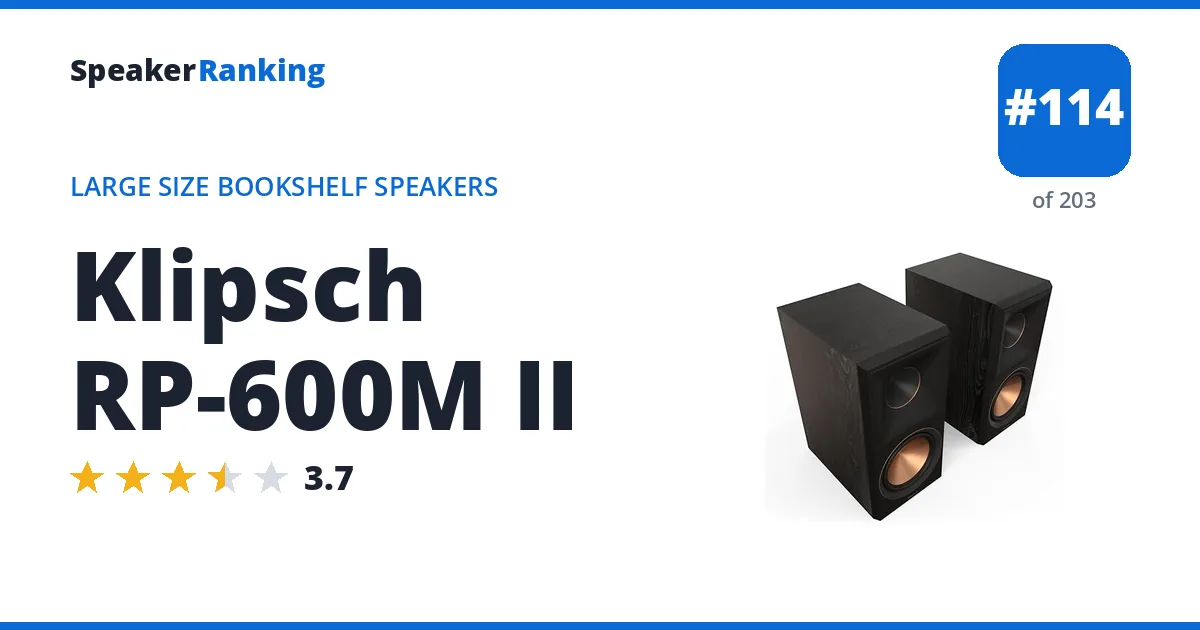
 Klipsch RP-600M II: $449.99 per pair Amazon eBay
Older model: the Klipsch RP-600M (ranked lower, rated 2.9/5).
Same family: the Klipsch RP-500M II (smaller bookshelf, rated 4/5), the Klipsch RP-5000F II (smallest floorstanding, rated 4/5), the Klipsch RP-6000F II (floorstanding, rated 3.9/5), the Klipsch RP-8000F II (largest floorstanding, rated 3.9/5), the Klipsch RP-404C II (smallest center, rated 3.7/5), the Klipsch RP-500C II (center, rated 3.9/5) and the Klipsch RP-504C II (largest center, rated 3.8/5).
Pros: Redesigned waveguide extends flush to the baffle edge, reducing diffraction compared to the original Klipsch RP-600M. Roughly 10-20° wider horizontal radiation than the original, giving more soundstage envelopment while retaining precise imaging. A major step up in overall tonal neutrality compared to the original Klipsch RP-600M, largely eliminating that model’s midrange resonance issues. Unusually, sounds better with the grille on: the grille smooths out the elevated treble rather than degrading the sound, a rare trait among speakers the reviewer has tested. More refined back-panel hardware, including anodized binding posts and jumper cables for optional bi-amping. Responds well to EQ correction (verified using measurement software and a miniDSP), letting the on-axis response be made genuinely linear. Measured bass extension of 70Hz (-3dB), with a measured sensitivity of 86dB.
Cons: On-axis, the treble runs notably hot (even hotter than the original Klipsch RP-600M in some respects) and needs about 20° of toe-out or the grille installed to sound balanced. Horizontal dispersion is very slightly less linear across angles than the original Klipsch RP-600M, a minor trade-off for the wider overall radiation pattern. Klipsch’s marketed sensitivity (about 94.5dB) is, like the original, a half-space rating roughly 9dB above the anechoic reality (closer to 85-86dB). In-room bass rolls off around 60Hz in practice, and a 120Hz boost paired with a midrange scoop gives kick drums their “tambour” without real low-end weight: a subwoofer is still recommended. Vertical listening tolerance is limited to about ±10° from the tweeter axis. Toeing the speaker out for better on-axis tonality (rather than using the grille) introduces slightly more diffuse imaging from added sidewall reflections.
Full Klipsch RP-600M II review and specifications →
| Bass Extension (-10dB) | 41Hz (measured, Erin’s Audio Corner) |
|---|---|
| Bass Extension (-3dB) | 70Hz (measured, Erin’s Audio Corner) |
| DIY Kit | No |
| Dimensions | 15.7”H x 8”W x 12.5”D (398.8 x 203.2 x 317.5 mm) |
| Drivers | 6.5” Cerametallic cone woofer, 1” titanium LTS vented tweeter with Tractrix horn |
| Impedance | 8 ohms nominal (3.5 ohms minimum above 80Hz, measured by Erin’s Audio Corner) |
| Sensitivity | 86dB (measured, Erin’s Audio Corner) |
| Spinorama Preference Score | 5.64 |
| Spinorama Preference Score with Perfect Sub | 7.77 |
| Weight | 13 lbs (5.9 kg) each |
| Woofer Cabinet | ported |
- Links
- Reviews, Comparisons and Sound Samples
- Erin’s Audio Corner: The Truth about Klipsch’s “NEW” Sound. RP-600M Update. More from Erin’s Audio Corner →
- Erin’s Audio Corner Website Klipsch RP-600M II
- GR-Research: We Bought The "NEW" RP-600M II Is KLIPSCH Listening?! More from GR-Research →
- Erin’s Audio Corner: 5 AWESOME SPEAKERS Under $1000 You Won’t Regret
- Erin’s Audio Corner Measurements (spinorama.org)
- Erin’s Audio Corner: KEF Q1 Meta vs Emotiva vs Klipsch | The Real Differences
- Head-to-Head Comparisons
- Klipsch RP-600M II vs JBL 708i
- Klipsch RP-600M II vs PS Audio Aspen FR5
- Klipsch RP-600M II vs Theory Audio sb25
- Klipsch RP-600M II vs Polk Signature Elite ES20
- Klipsch RP-600M II vs Aoshida Audio Musician Knight I V2
- Klipsch RP-600M II vs Dynaudio Emit 20
- Klipsch RP-600M II vs MoFi SourcePoint 10 Master Edition
- Klipsch RP-600M II vs Philharmonic BMR Monitor
- See all 118 comparisons
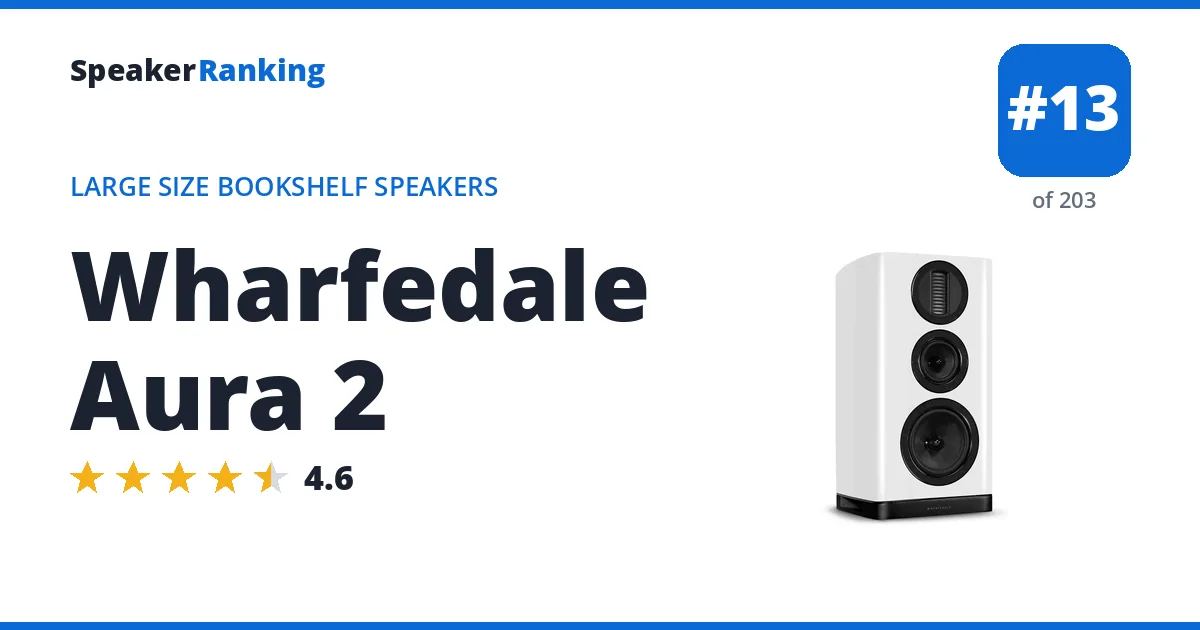
 Wharfedale Aura 2: $2799 per pair Crutchfield eBay
Same family: the Wharfedale Aura 1 (smaller bookshelf, estimated 4.2/5), the Wharfedale Aura 3 (smaller floorstanding, estimated 4.6/5), the Wharfedale Aura 4 (larger floorstanding, estimated 4.7/5), the Wharfedale Aura CS (smaller center, estimated 3.6/5) and the Wharfedale Aura C (larger center, estimated 4.1/5).
Pros: Three-way “mini tower” design with a 27x90mm AMT tweeter, 4” mid-range, and 6.5” midwoofer, using an unusual bottom-firing port. Nearly “ruler flat” on-axis linearity (within about 1.5dB for most of the range) apart from one specific breakup point. Exceptional output capability with very low distortion even at high volume: the reviewer reached about 100dB average at 10 feet with no audible strain, outperforming rivals like the KEF LS50 Meta in multitone distortion above 1kHz. Wide horizontal radiation of about ±70° combined with excellent imaging and pair matching: passed demanding stereo-separation test tracks with precise instrument placement. Bass reaches a genuine 40Hz in most rooms, potentially eliminating the need for a subwoofer for material that doesn’t demand extreme sub-bass. About 20dB of usable dynamic range with no compression issues at 96dB/1m. Considered by the reviewer one of the best speakers he’s tested, potentially challenging his personal all-time top five. Measured bass extension of 56Hz (-3dB), with a measured sensitivity of 87dB.
Cons: A breakup/peak around 13kHz can sound sharp or shrill depending on the track, the main tonal flaw noted. Minor midbase-to-midrange balance discrepancy (about 1dB), most noticeable if the speaker sits more than about 2 feet from the rear wall. Vertical listening window is narrower than typical, a consequence of the AMT ribbon tweeter’s tall physical size: staying within about ±15-20° of the tweeter reference axis (or slightly below it) is important. Impedance dips to about 3.1 ohms with a 1.4-ohm minimum EPDR, meaning a dedicated amplifier is recommended over an AVR due to potential power-supply strain. Distortion rises at the very lowest frequencies (an expected limitation of a 6.5” woofer), and the woofer audibly struggles with extreme 30-35Hz content at high volume. Horizontal directivity narrows from about ±70° to ±50° above roughly 6-7kHz as the ribbon tweeter’s pattern collapses inward.
Full Wharfedale Aura 2 review and specifications →
| Bass Extension (-10dB) | 30Hz (measured, Erin’s Audio Corner) |
|---|---|
| Bass Extension (-3dB) | 56Hz (measured, Erin’s Audio Corner) |
| DIY Kit | No |
| Dimensions | 22.1”H x 11.3”W x 15.3”D (561.3 x 287 x 388.6 mm) |
| Drivers | 6.5” Black Glass Fibre Matrix Cone woofer, 4” Black Glass Fibre Matrix Cone midrange, 27x90mm AMT tweeter |
| Impedance | 6 ohms nominal (3.1 ohms minimum above 80Hz, measured, Erin’s Audio Corner) |
| Sensitivity | 87dB (measured, Erin’s Audio Corner) |
| Spinorama Preference Score | 6.03 |
| Spinorama Preference Score with Perfect Sub | 7.65 |
| Weight | 45 lbs (20.4 kg) each |
| Woofer Cabinet | ported, rear |
- Links
- Reviews, Comparisons and Sound Samples
- Erin’s Audio Corner: Why the Wharfedale AURA 2 Will Blow Your Mind More from Erin’s Audio Corner →
- Erin’s Audio Corner Website Wharfedale Aura 2
- Erin’s Audio Corner: Upgrade Your Sound with These 6 Surprisingly Affordable Speakers!
- Erin’s Audio Corner: My Personal Favorite Speakers Under $2500
- Erin’s Audio Corner Measurements (spinorama.org)
- Head-to-Head Comparisons
- Wharfedale Aura 2 vs KEF Q Concerto Meta
- Wharfedale Aura 2 vs KEF R3
- Wharfedale Aura 2 vs KEF R3 Meta
- Wharfedale Aura 2 vs Buchardt Audio E50
- Wharfedale Aura 2 vs MoFi SourcePoint 8
- Wharfedale Aura 2 vs Revel M106
- Wharfedale Aura 2 vs Audio First Cadentia 3
- Wharfedale Aura 2 vs AsciLab C6B
- See all 52 comparisons