Short answer: the Klipsch RP-500M II. It ranks #27 of 160 bookshelf speakers by sound quality, rated 4.0/5, at $389.99. The Polk T15 ranks #146, rated 1.9/5, at $149, $240.99 cheaper, a saving that is not big enough to make up the sound-quality gap.
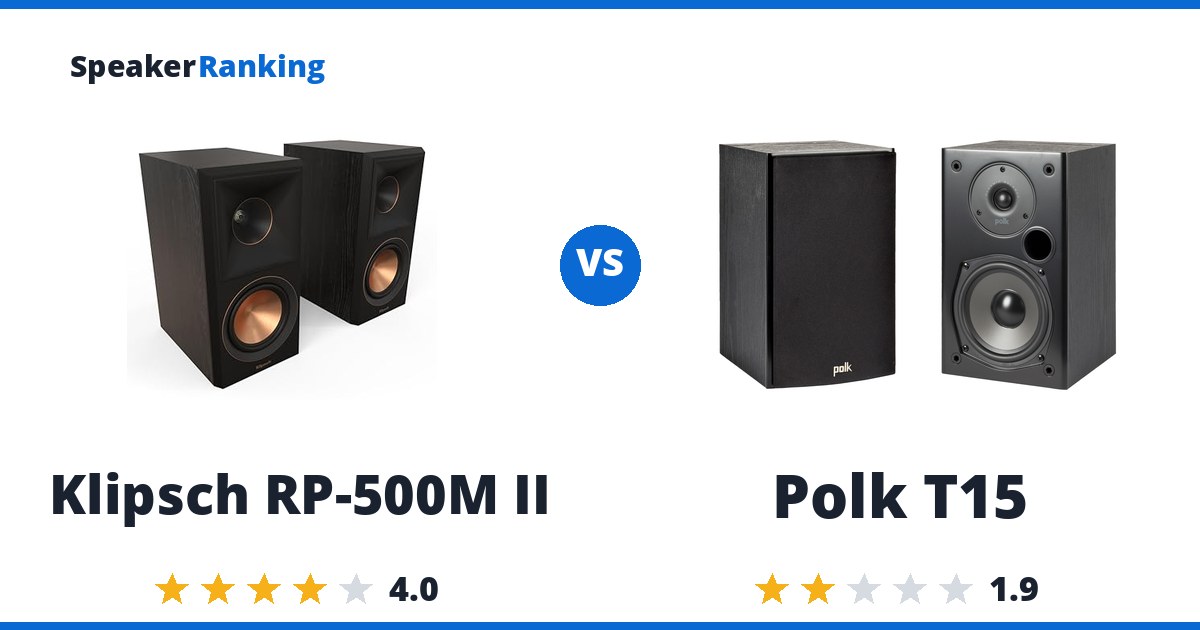
The Klipsch RP-500M II is the more accurate, deeper-bass pick. Major mid-range clarity improvement over the original Klipsch RP-500M: about a 5dB fill-in between 1-3kHz in the estimated in-room response, giving a noticeably more resolved, detailed midrange. Its measured preference score, a predictor of how neutral it sounds, is 5.22 against 0.34 for the Polk T15. Its bass reaches about 67Hz before falling 3dB, against 88.6Hz for the Polk T15. The tradeoff: Klipsch’s quoted sensitivity (around 92-93dB) uses an unconventional in-room-based rating rather than the standard anechoic measurement; on an anechoic basis it measures closer to about 85dB, in line with typical bookshelf speakers this size, so it isn’t the outlier in efficiency the spec sheet implies.
Why pick the Polk T15: Extremely affordable 2-way design that actually measured better at +/-20 degrees vertical off-axis than directly on-axis. The tradeoff: Spinorama analysis reveals what Amir called a “horrific drop in upper mids/lower treble region of 3 to 6 kHz,” likely from tweeter-woofer phase cancellation directly on-axis.
Buy the Klipsch RP-500M II. It is rated higher for sound quality, and saving $240.99 with the Polk T15 does not make up for the sound-quality gap.
Still deciding? The full Passive Home rankings cover every ranked option.
Specifications Side By Side
| Klipsch RP-500M II | Polk T15 | |
|---|---|---|
| Price | $389.99 per pair | $149.00 per pair |
| Ranked | #27 of 160 in Medium Size Bookshelf Speakers | #146 of 160 in Medium Size Bookshelf Speakers |
| Bass Extension (-10dB) | 53Hz (measured, Erin’s Audio Corner) | 58.1Hz (measured, Audio Science Review) |
| Bass Extension (-3dB) | 67Hz (measured, Erin’s Audio Corner) | 88.6Hz (measured, Audio Science Review) |
| Crossover Frequency | 1530Hz | - |
| Dimensions | 13.6”H x 6.8”W x 10.6”D (344.4 x 173 x 270.5 mm) | 10.63H x 6.5W x 7.25D in |
| Impedance | 8 ohms nominal, 3.3 ohms minimum (measured, Erin’s Audio Corner) | 8 ohms nominal |
| Sensitivity | 85dB (measured, Erin’s Audio Corner) | 89dB (manufacturer specified, 1W/1m); 88.98dB measured, spinorama.org |
| Drivers | 5.25” Cerametallic™ cone woofer with Faraday rings, 1” LTS Titanium diaphragm tweeter with Hybrid Cross-Section Expanded Tractrix® horn | 0.75” tweeter, 5.25” woofer |
| Weight | 13 lbs (5.9 kg) each | 8.2 lbs (3.74 kg) each |
| Woofer Cabinet | ported, rear | - |
| Spinorama Preference Score | 5.22 | 0.34 |
| Spinorama Preference Score with Perfect Sub | 7.84 | 3.39 |
| DIY Kit | No | No |
| Frequency Response | - | 60Hz - 24kHz (Manufacturer specified) |
Related Speaker Comparisons
More worthwhile head-to-heads for Klipsch RP-500M II:
- Klipsch RP-500M II vs Audio First Fidelia
- Ascend Sierra 1 v2 vs Klipsch RP-500M II
- KEF LS50 Meta vs Klipsch RP-500M II
- Arendal 1961 Monitor vs Klipsch RP-500M II
- Klipsch RP-500M II vs Moondrop M4P MTM
Prices on this page were last checked October 9, 2026 at 8:01 AM UTC. Product prices and availability are accurate as of that date/time and are subject to change; the price and availability shown on Amazon at the time of purchase will apply to the purchase of this product.
As an eBay Partner, we may be compensated if you make a purchase.
The Two Speakers In Full
 Klipsch RP-500M II: $389.99 per pair Amazon eBay
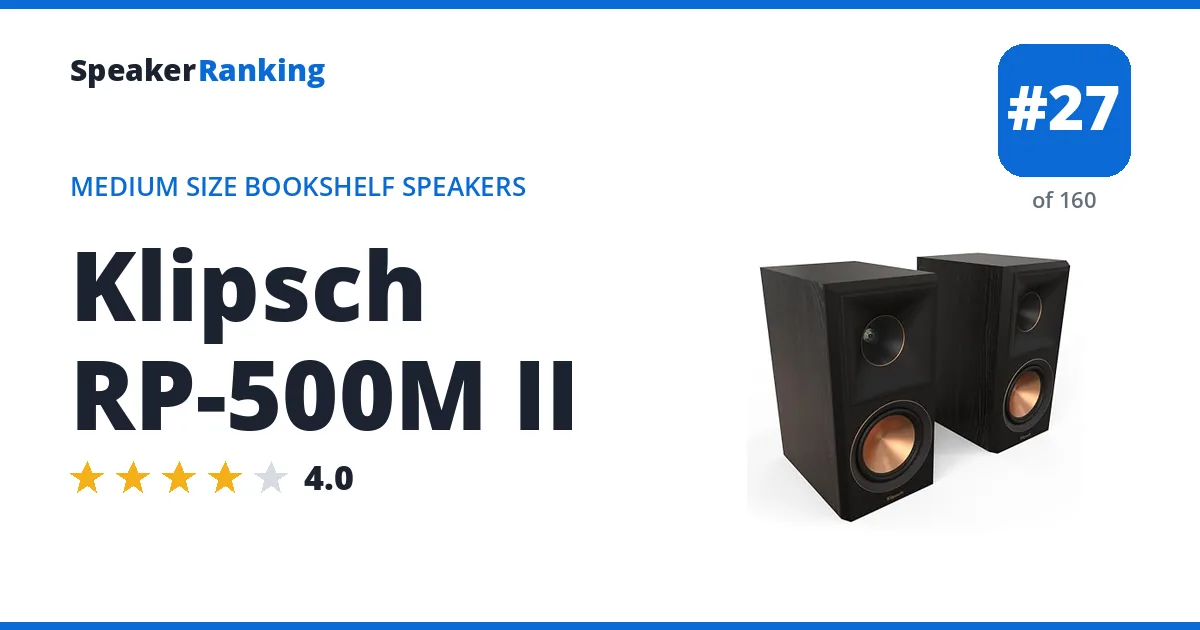
Older model: the Klipsch RP-500M (ranked lower, rated 3.4/5).
Same family: the Klipsch RP-600M II (larger bookshelf, rated 3.7/5), the Klipsch RP-5000F II (smallest floorstanding, rated 4/5), the Klipsch RP-6000F II (floorstanding, rated 3.9/5), the Klipsch RP-8000F II (largest floorstanding, rated 3.9/5), the Klipsch RP-404C II (smallest center, rated 3.7/5), the Klipsch RP-500C II (center, rated 3.9/5) and the Klipsch RP-504C II (largest center, rated 3.8/5).
Pros: Major mid-range clarity improvement over the original Klipsch RP-500M: about a 5dB fill-in between 1-3kHz in the estimated in-room response, giving a noticeably more resolved, detailed midrange. More neutral and linear overall than its sibling Klipsch RP-600M II, which carries about 2-3dB more high-frequency energy and a touch more bass but less overall balance. Very precise soundstage imaging and instrument placement. Distortion through the midrange is cleaner than the previous generation. Measured bass extension of 67Hz (-3dB), with a measured sensitivity of 85dB.
Cons: Klipsch’s quoted sensitivity (around 92-93dB) uses an unconventional in-room-based rating rather than the standard anechoic measurement; on an anechoic basis it measures closer to about 85dB, in line with typical bookshelf speakers this size, so it isn’t the outlier in efficiency the spec sheet implies. Horizontal dispersion of about ±40-50° is narrower and more directive than the reviewer’s preference for a wider, more enveloping soundstage. Toeing the speaker out to widen the soundstage or soften on-axis brightness comes at some cost to imaging precision. Slightly less clean in the tweeter region than the midrange, likely tied to crossover placement, though not considered a dealbreaker. Low-frequency output is limited: measured around 95dB at 4 meters for the pair before the woofers started to unload, so a subwoofer is recommended for anyone wanting real bass rather than stepping up to a larger model.
Full Klipsch RP-500M II review and specifications →
| Bass Extension (-10dB) | 53Hz (measured, Erin’s Audio Corner) |
|---|---|
| Bass Extension (-3dB) | 67Hz (measured, Erin’s Audio Corner) |
| Crossover Frequency | 1530Hz |
| DIY Kit | No |
| Dimensions | 13.6”H x 6.8”W x 10.6”D (344.4 x 173 x 270.5 mm) |
| Drivers | 5.25” Cerametallic™ cone woofer with Faraday rings, 1” LTS Titanium diaphragm tweeter with Hybrid Cross-Section Expanded Tractrix® horn |
| Impedance | 8 ohms nominal, 3.3 ohms minimum (measured, Erin’s Audio Corner) |
| Sensitivity | 85dB (measured, Erin’s Audio Corner) |
| Spinorama Preference Score | 5.22 |
| Spinorama Preference Score with Perfect Sub | 7.84 |
| Weight | 13 lbs (5.9 kg) each |
| Woofer Cabinet | ported, rear |
- Links
- Reviews, Comparisons and Sound Samples
- Head-to-Head Comparisons
- Klipsch RP-500M II vs Wharfedale Super Denton
- Klipsch RP-500M II vs Wharfedale Diamond 12.1
- Klipsch RP-500M II vs Monitor Audio Silver 50 7G
- Klipsch RP-500M II vs Revel M105
- Klipsch RP-500M II vs Radiant Acoustics Clarity 4.2
- Klipsch RP-500M II vs Moondrop M4P MTM
- Klipsch RP-500M II vs Arendal 1961 Monitor
- Klipsch RP-500M II vs KEF Q150
- See all 39 comparisons
 Polk T15: $149.00 per pair Amazon eBay
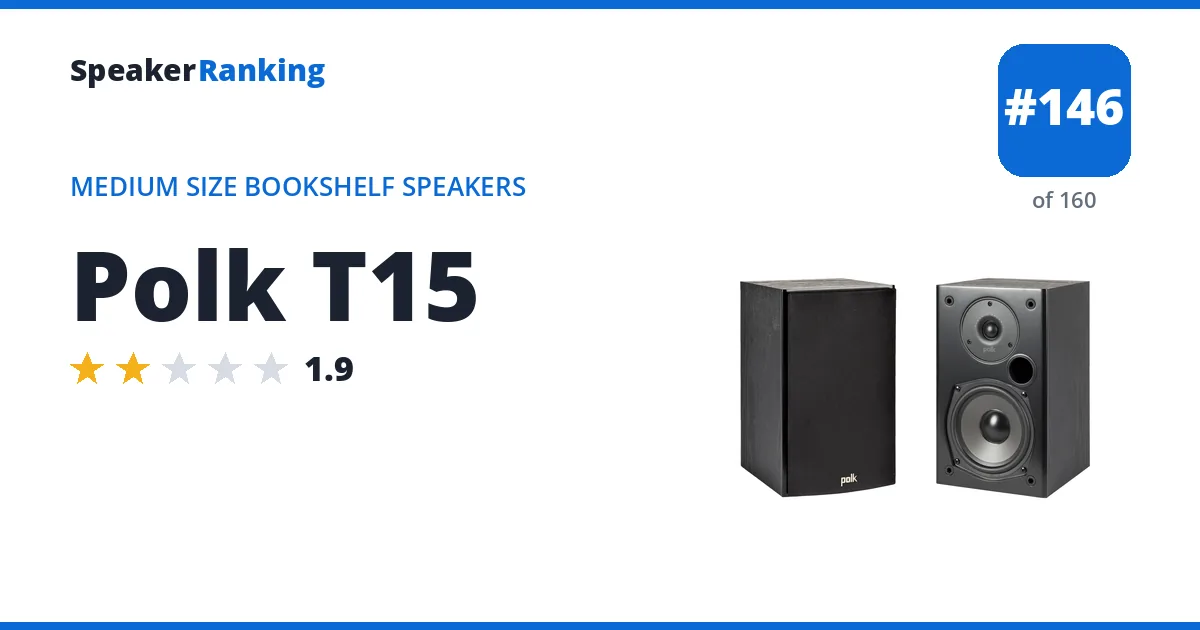
Same family: the Polk T50 (floorstanding, rated 3.8/5).
Pros: Extremely affordable 2-way design that actually measured better at +/-20 degrees vertical off-axis than directly on-axis. In near-field desktop use, the reviewer found the T15 “didn’t sound that horrible,” partly because nearby desk reflections mask the frequency response dip. Measured bass extension of 88.6Hz (-3dB), with a measured sensitivity of 89dB.
Cons: Spinorama analysis reveals what Amir called a “horrific drop in upper mids/lower treble region of 3 to 6 kHz,” likely from tweeter-woofer phase cancellation directly on-axis. Measured impedance ranges from 4-8 ohms, contradicting the specified 6-8 ohm range, and there’s a distortion peak around 400Hz. On- and off-axis response “vary a ton,” making listening position unusually important. The reviewer recommends saving up for the Pioneer SP-BS22-LR instead: “I can’t justify recommending the Polk T15 even though subjective performance was not horrible.”
Full Polk T15 review and specifications →
| Bass Extension (-10dB) | 58.1Hz (measured, Audio Science Review) |
|---|---|
| Bass Extension (-3dB) | 88.6Hz (measured, Audio Science Review) |
| DIY Kit | No |
| Dimensions | 10.63H x 6.5W x 7.25D in |
| Drivers | 0.75” tweeter, 5.25” woofer |
| Frequency Response | 60Hz - 24kHz (Manufacturer specified) |
| Impedance | 8 ohms nominal |
| Sensitivity | 89dB (manufacturer specified, 1W/1m); 88.98dB measured, spinorama.org |
| Spinorama Preference Score | 0.34 |
| Spinorama Preference Score with Perfect Sub | 3.39 |
| Weight | 8.2 lbs (3.74 kg) each |
- Links
- Reviews, Comparisons and Sound Samples
- Head-to-Head Comparisons