Short answer: the Revel F328Be for better sound quality, the Klipsch RP-5000F II for the lower price. The Revel F328Be ranks #9 of 188 floorstanding speakers, rated 4.7/5, at $19,359.90. The Klipsch RP-5000F II ranks #105, rated 4.0/5, at $859.98, $18,499.92 cheaper.
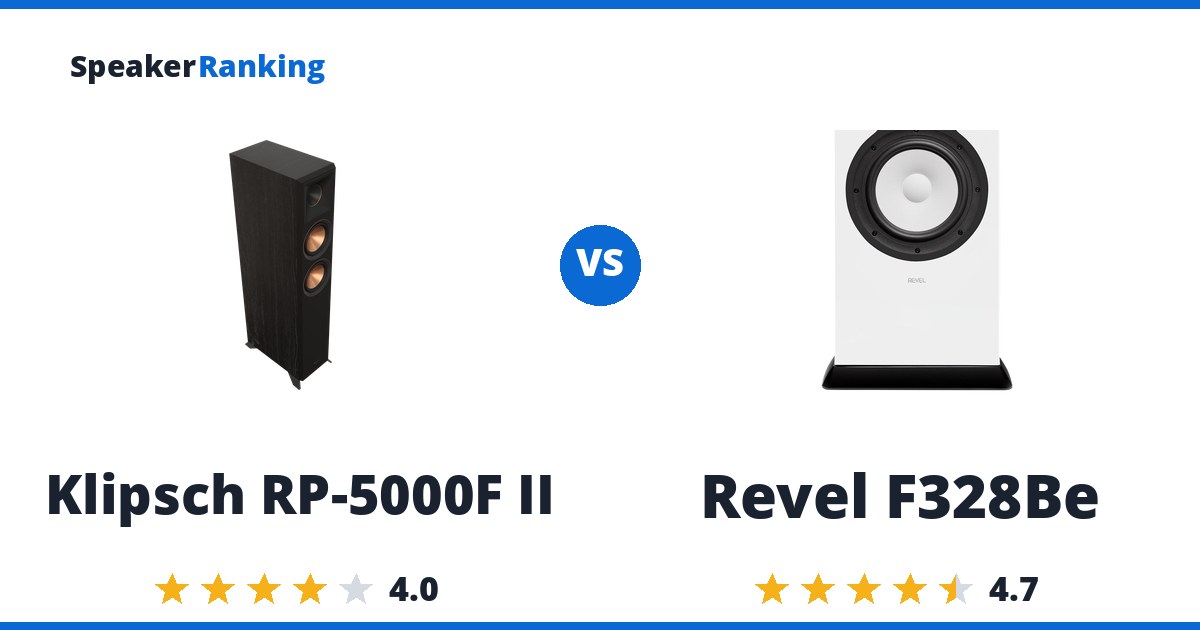
The Klipsch RP-5000F II is the deeper-bass pick. The most tonally coherent of the RP II floorstander line, with a mild baffle-step dip and treble tilt but no additional coloration issues beyond that. Its bass reaches about 55Hz before falling 3dB, against 74Hz for the Revel F328Be. The tradeoff: Bass extension is underwhelming for a floorstander (F3 at 55Hz, F10 at 41Hz) and needs a subwoofer.
The Revel F328Be is the more accurate pick. CEA2034 spinorama shows a quite flat on-axis response with superb directivity and efficiency above 90dB. Its measured preference score, a predictor of how neutral it sounds, is 6.40 against 5.24 for the Klipsch RP-5000F II. The catch: Vertical directivity is asymmetric: the reviewer recommends staying between -20 and +40 degrees relative to the tweeter axis, reflecting the driver layout of this three-way tower.
Buy the Klipsch RP-5000F II when the price outweighs sound quality for you, and the Revel F328Be when sound quality outweighs the price instead.
Want more options? Browse the full Passive Home rankings.
Specifications Side By Side
| Klipsch RP-5000F II | Revel F328Be | |
|---|---|---|
| Price | $859.98 per pair | $19,359.90 per pair |
| Ranked | #105 of 188 in Large Size Floorstanding Speakers | #9 of 188 in Large Size Floorstanding Speakers |
| Bass Extension (-10dB) | 41Hz (measured, Erin’s Audio Corner) | 39Hz (measured, Audio Science Review) |
| Bass Extension (-3dB) | 55Hz (measured, Erin’s Audio Corner) | 74Hz (measured, Audio Science Review) |
| Sensitivity | 90dB (2.83V/1m, measured by Erin’s Audio Corner) | 91dB (measured, Audio Science Review) |
| Drivers | 1” titanium tweeter with Tractrix horn, dual 5.25” cerametallic woofers | Three 8” (200mm) Deep Ceramic Composite aluminum cones, with cast frames woofer, 5-1/4” (130mm) Deep Ceramic Composite aluminum cone, with cast frame midrange, 1” (25mm) Beryllium dome, with acoustic lens waveguide tweeter |
| Weight | 38.6 lbs (17.5 kg) | 112.4 lbs (51 kg) each |
| Impedance | 8 ohms nominal, 3.3 ohms minimum (measured above 80Hz, Erin’s Audio Corner) | 8 ohms nominal (3 ohms minimum, measured by Audio Science Review) |
| Frequency Response | 40Hz - 25kHz (+-3dB, Manufacturer specified) | - |
| Crossover Frequency | 1900Hz | - |
| Power Handling | 100W continuous, 400W peak | - |
| Dimensions | 36.1” x 8.1” x 14.8” (917 x 207 x 375 mm) | 50.9”H x 13.5”W x 17.6”D (1292.9 x 342.9 x 447 mm) |
| Woofer Cabinet | ported, rear | ported, rear |
| Spinorama Preference Score | 5.24 | 6.40 |
| Spinorama Preference Score with Perfect Sub | 7.25 | 7.81 |
| DIY Kit | No | No |
Related Speaker Comparisons
More top alternatives to Revel F328Be:
- GR-Research NX-Treme vs Revel F328Be
- KEF Blade Two Meta vs Revel F328Be
- MoFi SourcePoint V10 Master Edition vs Revel F328Be
- MoFi SourcePoint 888 vs Revel F328Be
- Radiant Acoustics Clarity 66 vs Revel F328Be
Prices on this page were last checked October 9, 2026 at 8:01 AM UTC. Product prices and availability are accurate as of that date/time and are subject to change; the price and availability shown on Amazon at the time of purchase will apply to the purchase of this product.
As an eBay Partner, we may be compensated if you make a purchase.
The Two Speakers In Full
 Klipsch RP-5000F II: $859.98 per pair B&H Photo Video eBay
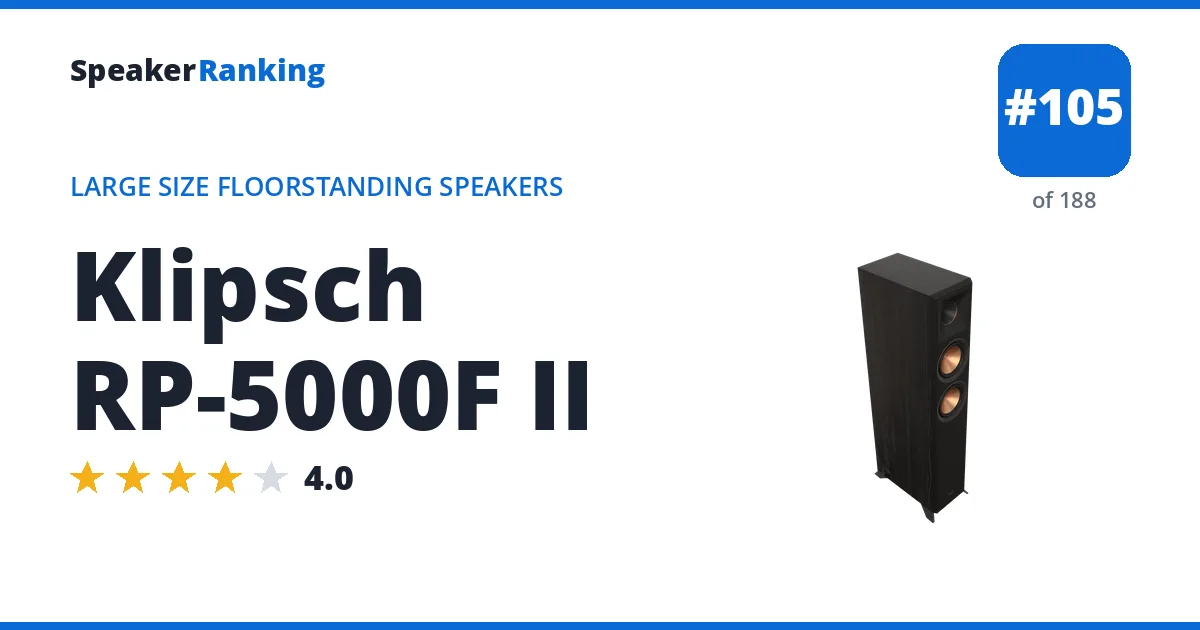
Same family: the Klipsch RP-500M II (smaller bookshelf, rated 4/5), the Klipsch RP-600M II (larger bookshelf, rated 3.7/5), the Klipsch RP-6000F II (larger floorstanding, ranked lower, rated 3.9/5), the Klipsch RP-8000F II (larger floorstanding, ranked lower, rated 3.9/5), the Klipsch RP-404C II (smallest center, rated 3.7/5), the Klipsch RP-500C II (center, rated 3.9/5) and the Klipsch RP-504C II (largest center, rated 3.8/5).
Pros: The most tonally coherent of the RP II floorstander line, with a mild baffle-step dip and treble tilt but no additional coloration issues beyond that. Precise imaging thanks to the controlled horn/waveguide directivity. Measured bass extension of 55Hz (-3dB), with a measured sensitivity of 90dB.
Cons: Bass extension is underwhelming for a floorstander (F3 at 55Hz, F10 at 41Hz) and needs a subwoofer. Narrow horizontal dispersion (~50-60 degrees) trades soundstage width for imaging precision. A mild high-frequency tilt and a slight lack of detail around 1-1.5kHz.
Full Klipsch RP-5000F II review and specifications →
| Bass Extension (-10dB) | 41Hz (measured, Erin’s Audio Corner) |
|---|---|
| Bass Extension (-3dB) | 55Hz (measured, Erin’s Audio Corner) |
| Crossover Frequency | 1900Hz |
| DIY Kit | No |
| Dimensions | 36.1” x 8.1” x 14.8” (917 x 207 x 375 mm) |
| Drivers | 1” titanium tweeter with Tractrix horn, dual 5.25” cerametallic woofers |
| Frequency Response | 40Hz - 25kHz (+-3dB, Manufacturer specified) |
| Impedance | 8 ohms nominal, 3.3 ohms minimum (measured above 80Hz, Erin’s Audio Corner) |
| Power Handling | 100W continuous, 400W peak |
| Sensitivity | 90dB (2.83V/1m, measured by Erin’s Audio Corner) |
| Spinorama Preference Score | 5.24 |
| Spinorama Preference Score with Perfect Sub | 7.25 |
| Weight | 38.6 lbs (17.5 kg) |
| Woofer Cabinet | ported, rear |
- Links
- Reviews, Comparisons and Sound Samples
- Head-to-Head Comparisons
- Klipsch RP-5000F II vs KEF Q11 Meta
- Klipsch RP-5000F II vs Klipsch Forte IV
- Klipsch RP-5000F II vs Monolith THX-365T
- Klipsch RP-5000F II vs Klipsch RP-8000F II
- Klipsch RP-5000F II vs Q Acoustics 5040
- Klipsch RP-5000F II vs Dynaudio Emit 30
- Klipsch RP-5000F II vs Klipsch RP-6000F II
- Klipsch RP-5000F II vs Definitive Technology BP-9020
- See all 44 comparisons
 Revel F328Be: $19,359.90 per pair Crutchfield eBay
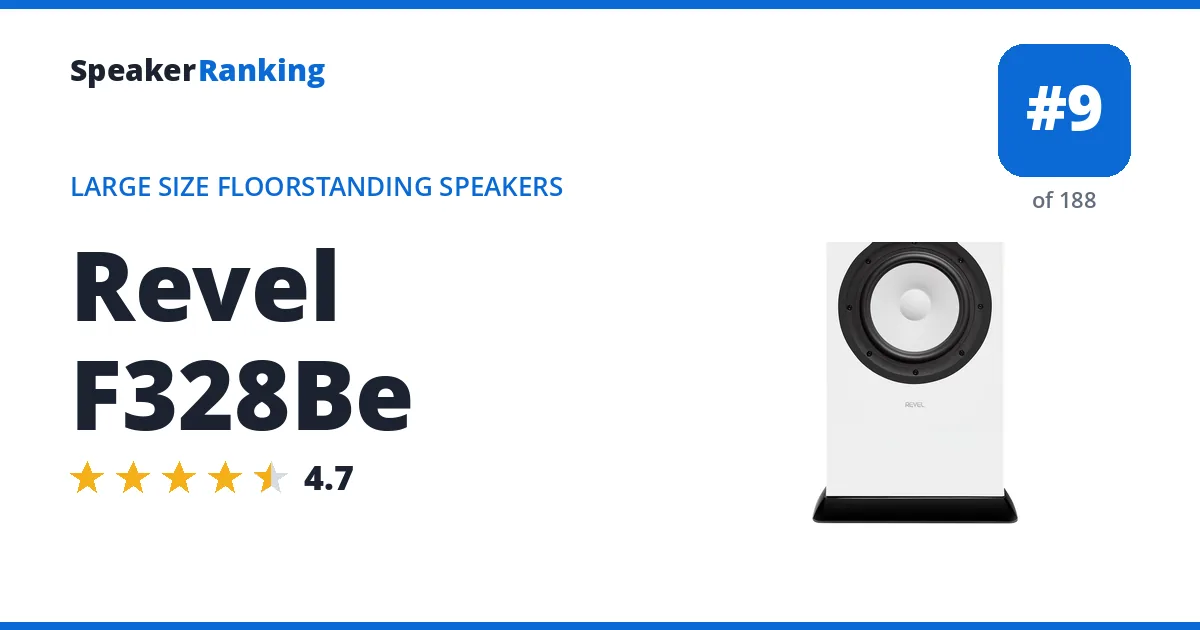
Same family: the Revel M126Be (bookshelf, rated 4.3/5), the Revel F226Be (smaller floorstanding, ranked lower, rated 4.6/5), the Revel F228Be (smaller floorstanding, ranked lower, rated 4.5/5) and the Revel C426Be (center, rated 4/5).
Pros: CEA2034 spinorama shows a quite flat on-axis response with superb directivity and efficiency above 90dB. Predicted in-room response is extremely accurate, with a smooth ~5dB downward slope from bass to treble that suits typical rooms without correction. Early reflections sum very nicely with the direct sound. Horizontal beamwidth of about ±70 degrees is wide and quite smooth. At 96dB SPL/1m distortion stays easily below the reviewer’s audibility threshold across nearly the whole range. Measured bass extension of 74Hz (-3dB), with a measured sensitivity of 91dB.
Cons: Vertical directivity is asymmetric: the reviewer recommends staying between -20 and +40 degrees relative to the tweeter axis, reflecting the driver layout of this three-way tower. Impedance dips to a minimum of 3 ohms with an additional resonance-driven phase swing, calling for an amplifier comfortable with a demanding load. Very expensive and very heavy (51 kg each).
Full Revel F328Be review and specifications →
| Bass Extension (-10dB) | 39Hz (measured, Audio Science Review) |
|---|---|
| Bass Extension (-3dB) | 74Hz (measured, Audio Science Review) |
| DIY Kit | No |
| Dimensions | 50.9”H x 13.5”W x 17.6”D (1292.9 x 342.9 x 447 mm) |
| Drivers | Three 8” (200mm) Deep Ceramic Composite aluminum cones, with cast frames woofer, 5-1/4” (130mm) Deep Ceramic Composite aluminum cone, with cast frame midrange, 1” (25mm) Beryllium dome, with acoustic lens waveguide tweeter |
| Impedance | 8 ohms nominal (3 ohms minimum, measured by Audio Science Review) |
| Sensitivity | 91dB (measured, Audio Science Review) |
| Spinorama Preference Score | 6.40 |
| Spinorama Preference Score with Perfect Sub | 7.81 |
| Weight | 112.4 lbs (51 kg) each |
| Woofer Cabinet | ported, rear |
- Links
- Reviews, Comparisons and Sound Samples
- Head-to-Head Comparisons
- Revel F328Be vs MoFi SourcePoint 888
- Revel F328Be vs Radiant Acoustics Clarity 66
- Revel F328Be vs Ascend Acoustics ELX Ribbon Tower
- Revel F328Be vs MoFi SourcePoint V10 Master Edition
- Revel F328Be vs KEF R5 Meta
- Revel F328Be vs KEF Blade Two Meta
- Revel F328Be vs Revel F226Be
- Revel F328Be vs GR-Research NX-Treme
- See all 39 comparisons