Short answer: the Klipsch Heresy IV, if you are buying new. The KEF R5 Meta ranks higher than it (#14 vs #220 of 226 floorstanding speakers, 4.6/5 vs 2.3/5) but is discontinued, so only consider it used; the Klipsch Heresy IV is still sold new at $3,599.98.
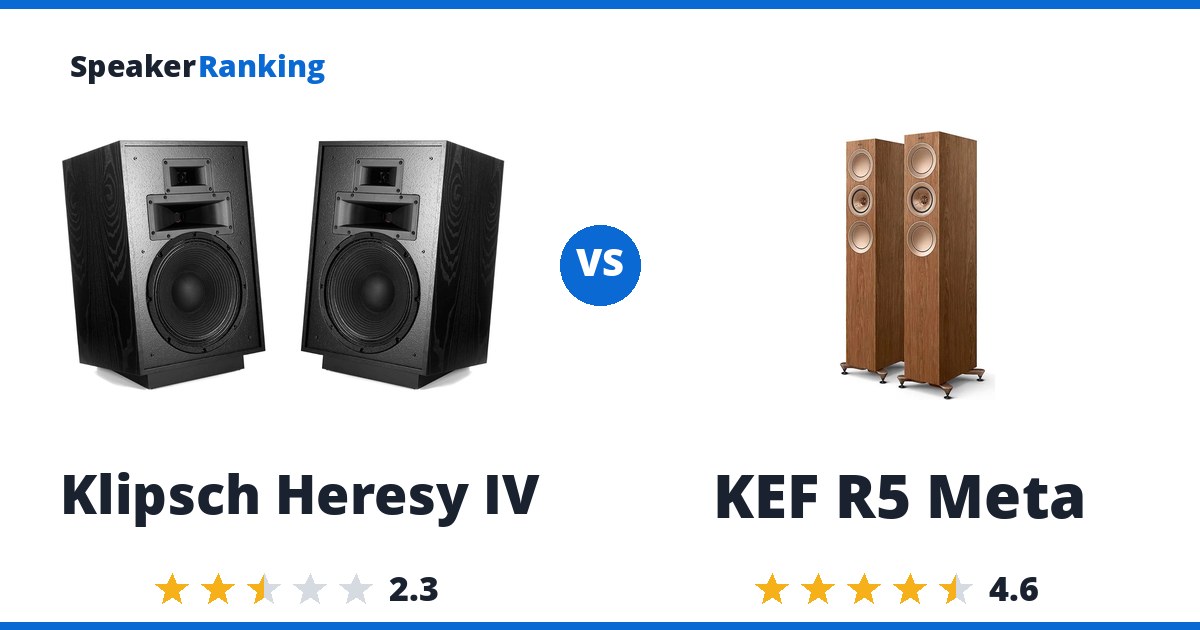
The case for the Klipsch Heresy IV: Very high 94.5dB/2.83V/1m sensitivity in Erin’s anechoic measurement (well below Klipsch’s 99dB in-room claim, but still excellent) and strong short-term output from a 12-inch woofer plus horn-loaded midrange and tweeter. The catch: Erin measured a 77Hz F3 and response rolling away near 100Hz in-room, so a subwoofer is required for modern full-range reproduction.
The KEF R5 Meta is the more accurate, deeper-bass pick. 12th generation 5” Uni-Q coaxial driver array with Metamaterial Absorption Technology (MAT) delivers remarkably smooth, controlled horizontal (±50°) and vertical directivity with near-identical off-axis tracking. Its measured preference score, a predictor of how neutral it sounds, is 6.33 against 2.27 for the Klipsch Heresy IV. Its bass reaches about 52Hz before falling 3dB, against 77Hz for the Klipsch Heresy IV. The catch: Low-frequency extension (F3 of 52Hz, F10 of 38Hz) requires pairing with a dedicated subwoofer crossed over at 80Hz for high-output home theater or bass-heavy music performance.
Buy the Klipsch Heresy IV if you want one new; the KEF R5 Meta is discontinued, so only look for it used.
Want more options? Browse the full Passive Home rankings.
Specifications Side By Side
| Klipsch Heresy IV | KEF R5 Meta | |
|---|---|---|
| Price | $3,599.98 per pair | $3,999.99 per pair Discontinued |
| Ranked | #220 of 226 in Large Size Floorstanding Speakers | #14 of 226 in Large Size Floorstanding Speakers |
| Bass Extension (-3dB) | 77Hz (measured, Erin’s Audio Corner) | 52Hz (measured, Erin’s Audio Corner) |
| Bass Extension (-10dB) | 50.0Hz (measured, Erin’s Audio Corner) | 38Hz (measured, Erin’s Audio Corner) |
| Sensitivity | 94.5dB/2.83V/1m (measured, Erin’s Audio Corner) | 86dB (measured average, Erin’s Audio Corner) |
| Impedance | Approximately 4 ohms minimum (measured, Erin’s Audio Corner) | 4 ohms nominal |
| Drivers | 1” horn-loaded tweeter; 1.75” horn-loaded midrange; 12” woofer | 1 in. vented aluminum dome tweeter with MAT, 5 in. aluminum cone midrange, two 5.25 in. hybrid aluminum cone woofers |
| Dimensions | 24.8”H x 15.6”W x 13.3”D | 42.2”H x 10.7”W x 13.6”D (1073 x 273 x 346 mm) |
| Weight | 45 lbs (20.4 kg) each | 54 lbs (24.5 kg) each |
| Woofer Cabinet | ported, rear | ported, rear |
| Spinorama Preference Score | 2.27 | 6.33 |
| Spinorama Preference Score with Perfect Sub | 5.02 | 8.07 |
| DIY Kit | No | No |
Related Speaker Comparisons
More worthwhile head-to-heads for KEF R5 Meta:
- KEF Blade Two Meta vs KEF R5 Meta
- MoFi SourcePoint 888 vs KEF R5 Meta
- Revel F328Be vs KEF R5 Meta
- Revel F226Be vs KEF R5 Meta
- KEF R5 Meta vs JBL 4367
Prices on this page were last checked October 9, 2026 at 8:01 AM UTC. Product prices and availability are accurate as of that date/time and are subject to change; the price and availability shown on Amazon at the time of purchase will apply to the purchase of this product.
As an eBay Partner, we may be compensated if you make a purchase.
The Two Speakers In Full
 Klipsch Heresy IV: $3,599.98 per pair Amazon Crutchfield eBay
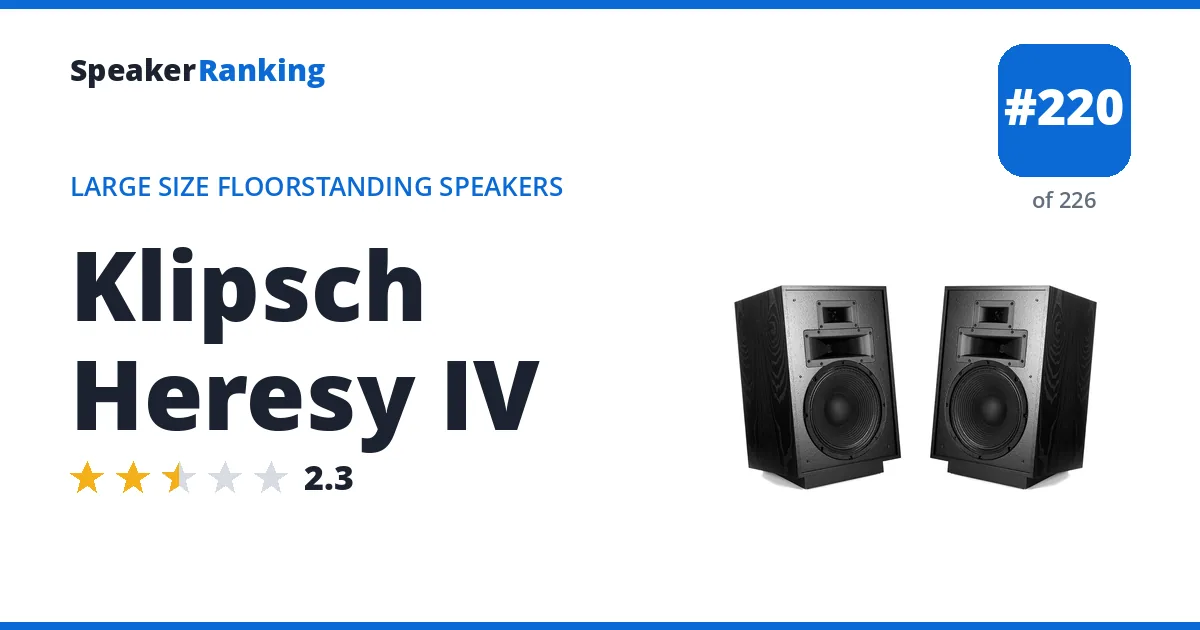
Same family: the Klipsch Forte IV (larger floorstanding, ranked higher, rated 4/5), the Klipsch Cornwall IV (larger floorstanding, ranked higher, estimated 2.8/5), the Klipsch La Scala AL6 (larger floorstanding, ranked higher, estimated 2.8/5) and the Klipsch Klipschorn AK7 (larger floorstanding, ranked higher, estimated 3/5).
Pros: Very high 94.5dB/2.83V/1m sensitivity in Erin’s anechoic measurement (well below Klipsch’s 99dB in-room claim, but still excellent) and strong short-term output from a 12-inch woofer plus horn-loaded midrange and tweeter. The compact, furniture-grade Heritage cabinet is easier to place than most high-efficiency designs, and dynamics at moderate levels can sound lively. A stable four-ohm-capable amplifier can produce substantial SPL with relatively little voltage. Measured bass extension of 77Hz (-3dB), with a measured sensitivity of 94.5dB.
Cons: Erin measured a 77Hz F3 and response rolling away near 100Hz in-room, so a subwoofer is required for modern full-range reproduction. The impedance dips to about 4 ohms, reducing the practical amplifier advantage implied by its sensitivity. Pronounced directivity mismatch at the driver transitions, impedance/response resonances and elevated distortion spikes around the crossover remain audible concerns that EQ cannot fully solve. At 102dB Erin measured roughly 1.5dB midband compression; at 96dB distortion rises around crossover. Performance is difficult to justify at the price, and Erin explicitly did not recommend it.
Full Klipsch Heresy IV review and specifications →
| Bass Extension (-10dB) | 50.0Hz (measured, Erin’s Audio Corner) |
|---|---|
| Bass Extension (-3dB) | 77Hz (measured, Erin’s Audio Corner) |
| DIY Kit | No |
| Dimensions | 24.8”H x 15.6”W x 13.3”D |
| Drivers | 1” horn-loaded tweeter; 1.75” horn-loaded midrange; 12” woofer |
| Impedance | Approximately 4 ohms minimum (measured, Erin’s Audio Corner) |
| Sensitivity | 94.5dB/2.83V/1m (measured, Erin’s Audio Corner) |
| Spinorama Preference Score | 2.27 |
| Spinorama Preference Score with Perfect Sub | 5.02 |
| Weight | 45 lbs (20.4 kg) each |
| Woofer Cabinet | ported, rear |
- Links
- Reviews, Comparisons and Sound Samples
- Head-to-Head Comparisons
- Klipsch Heresy IV vs Rockville RockTower 68B
- Klipsch Heresy IV vs Sony SS-CS3
- Klipsch Heresy IV vs Atlantic Technology 8600eLR
- Klipsch Heresy IV vs JBL Stage 2 280F
- Klipsch Heresy IV vs Magnepan LRS+
- Klipsch Heresy IV vs Infinity Reference 253
- Klipsch Heresy IV vs Polk Audio XT60
- Klipsch Heresy IV vs Focal Aria Evo X N°2
- See all 43 comparisons
 KEF R5 Meta: $3,999.99 per pair Discontinued eBay
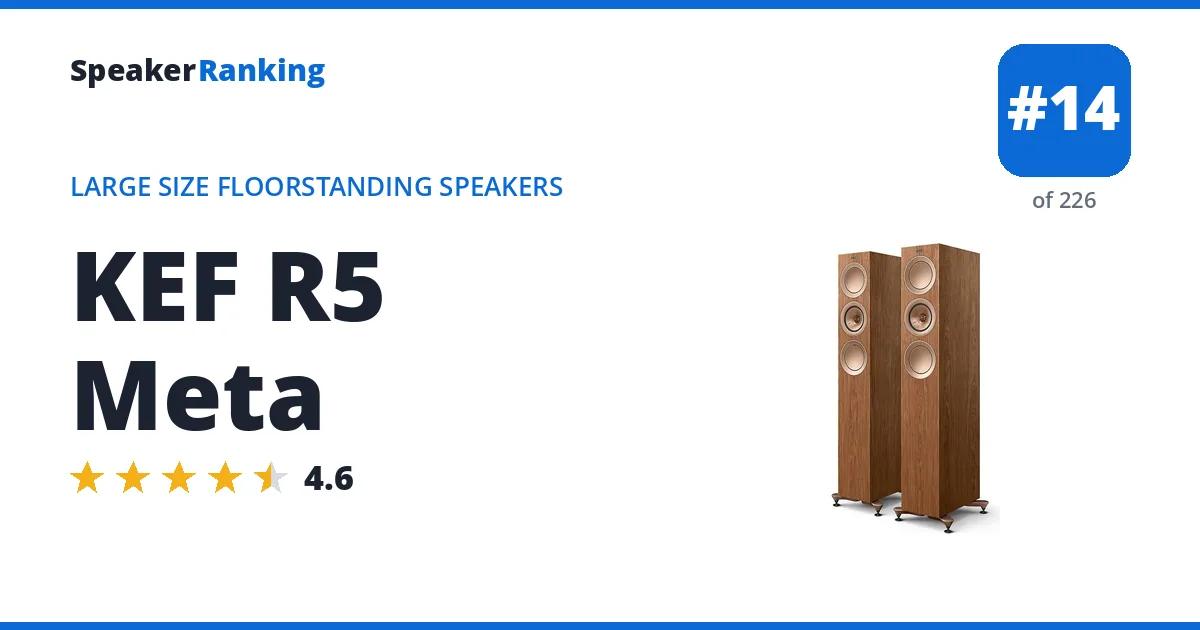
Same family: the KEF R3 Meta (bookshelf, rated 4.6/5), the KEF R7 Meta (larger floorstanding, ranked lower, estimated 4.6/5), the KEF R11 Meta (larger floorstanding, ranked lower, rated 4.4/5), the KEF R2 Meta (smaller center, rated 4.3/5) and the KEF R6 Meta (larger center, rated 4.2/5).
Pros: 12th generation 5” Uni-Q coaxial driver array with Metamaterial Absorption Technology (MAT) delivers remarkably smooth, controlled horizontal (±50°) and vertical directivity with near-identical off-axis tracking. Exceptional frequency response linearity through the midrange and treble that takes extremely well to minor parametric EQ adjustments. Constrained Layer Damping cabinet construction and flexible rear ports minimize enclosure resonances and port turbulence. Deliberately tuned low-frequency roll-off profile permits boundary-adjacent room placement near front walls without boomy acoustic buildup. Measured bass extension of 52Hz (-3dB), with a measured sensitivity of 86dB.
Cons: Low-frequency extension (F3 of 52Hz, F10 of 38Hz) requires pairing with a dedicated subwoofer crossed over at 80Hz for high-output home theater or bass-heavy music performance. High-frequency radiation above 7kHz shows a mild on-axis taper (1-2dB downward slope), performing best when listened to 10-20° off-axis. Moderate sensitivity (~86dB SPL average) requires a clean, robust 4-ohm capable amplifier to drive high dynamic peaks without clipping. Discontinued.
Full KEF R5 Meta review and specifications →
| Bass Extension (-10dB) | 38Hz (measured, Erin’s Audio Corner) |
|---|---|
| Bass Extension (-3dB) | 52Hz (measured, Erin’s Audio Corner) |
| DIY Kit | No |
| Dimensions | 42.2”H x 10.7”W x 13.6”D (1073 x 273 x 346 mm) |
| Drivers | 1 in. vented aluminum dome tweeter with MAT, 5 in. aluminum cone midrange, two 5.25 in. hybrid aluminum cone woofers |
| Impedance | 4 ohms nominal |
| Sensitivity | 86dB (measured average, Erin’s Audio Corner) |
| Spinorama Preference Score | 6.33 |
| Spinorama Preference Score with Perfect Sub | 8.07 |
| Weight | 54 lbs (24.5 kg) each |
| Woofer Cabinet | ported, rear |
- Links
- Reviews, Comparisons and Sound Samples
- Head-to-Head Comparisons