Short answer: the Kii THREE on measured sound quality, the Buchardt A500 on price. The Kii THREE ranks #3 of 68 powered bookshelf speakers, rated 4.9/5, at $16,970. The Buchardt A500 ranks #15, rated 4.6/5, at $4,150, $12,820 cheaper.
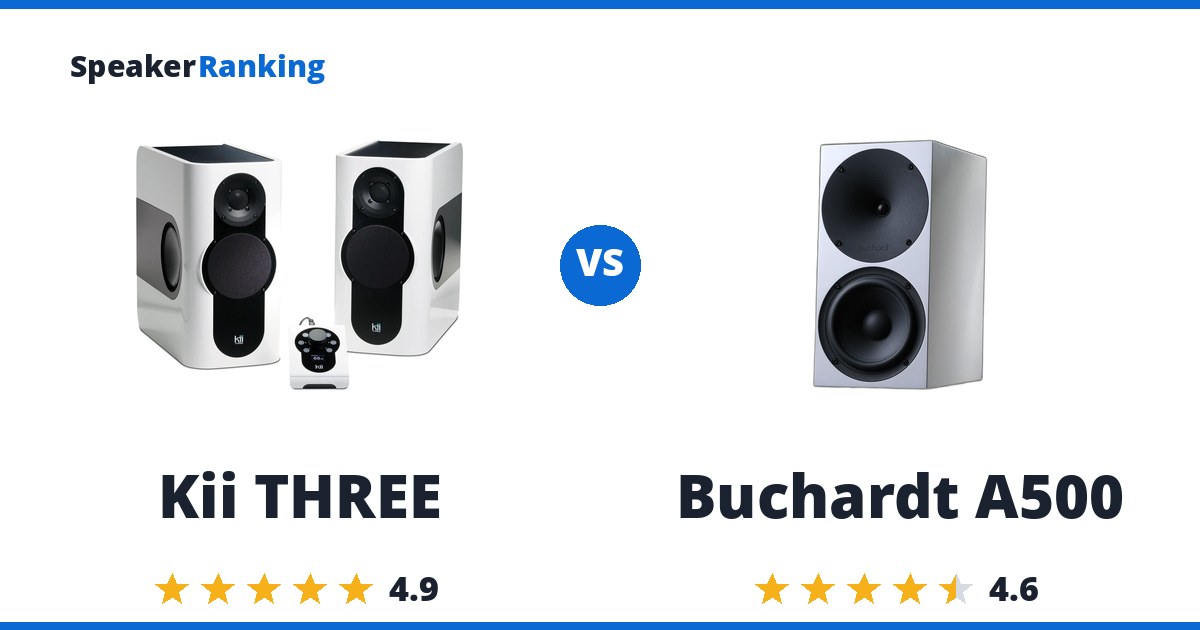
What the Kii THREE does well: Exceptionally even measured balance: the 300Hz-5kHz response spans only 1.2dB, with preference scores of 7.70 standalone and 8.35 with an ideal subwoofer. The catch: Deep-bass output has limits: demanding low-frequency material at high levels can trigger compression or audible distress.
Why pick the Buchardt A500: Erin measured unusually deep bass for the cabinet size: 24.9Hz at -3dB. The catch: Bass extension depends on the selected tuning and comes with output tradeoffs at high levels.
One note: the Buchardt A500 is discontinued, but it still ranks #15 of 68 powered bookshelf speakers by sound quality, ahead of most of what is still sold new, so it is worth considering used.
Buy the Kii THREE if sound quality is the priority over the price, or the Buchardt A500 if the price is the priority over sound quality.
Want more options? Browse the full Powered Home rankings.
Specifications Side By Side
| Kii THREE | Buchardt A500 | |
|---|---|---|
| Price | $16,970 per pair | $4,150 per pair Discontinued |
| Ranked | #3 of 68 in Large Size Powered Bookshelf Speakers | #15 of 68 in Large Size Powered Bookshelf Speakers |
| Bass Extension (-3dB) | 28Hz (measured, Erin’s Audio Corner) | 24.9Hz (measured, Erin’s Audio Corner) |
| Bass Extension (-10dB) | 20.5Hz (measured, Erin’s Audio Corner) | 23.4Hz (measured, Erin’s Audio Corner) |
| Drivers | Four 6.5” woofers; 5” midrange; 1” waveguided tweeter | 0.74-inch dome; front and rear 6-inch long-throw woofers |
| Amplifier Power | 1,500W total per speaker; Six Ncore channels | 3 x 150W per speaker |
| Coverage | DSP-controlled cardioid above approximately 70-90Hz | - |
| Dimensions | 15.7”H x 7.9”W x 15.7”D | 14.4H x 7W x 11D inches |
| Weight | 42.1 lbs (19.1 kg) each | 55.1 lbs (25kg)/pair |
| DSP | Yes; boundary, contour, phase-exact and low-latency modes | - |
| Spinorama Preference Score | 7.70 | 7.02 |
| Spinorama Preference Score with Perfect Sub | 8.35 | 7.92 |
| Inputs | XLR (analog), XLR AES/EBU (digital), proprietary KiiLink digital multi-pin | XLR, WiSA |
| XLR Input | Yes | Yes |
| RCA Input | No | No |
| TRS Input | No | No |
| Optical Input | No | No |
| Coaxial Input | No | No |
| USB Input | No | No |
| HDMI Input | No | No |
| AES Input | Yes | No |
| Aux Input | No | No |
| Bluetooth | No | No |
| Frequency Response | 20Hz - 20kHz (-6dB at 20Hz; ±0.5dB 100Hz-10kHz; ±1dB 10kHz-20kHz) (Manufacturer specified) | 25Hz - 40kHz (+/- 1.5dB) (Manufacturer specified) |
| Bass Extension | - | Master-tuning dependent; approximately 25–40Hz |
Related Speaker Comparisons
How Kii THREE compares with other leading options:
- Kii THREE vs Dutch & Dutch 8C
- Kii THREE vs Buchardt A10
- Kii THREE vs SHIVAUDYO Point Zero
- Yamaha HS8 vs Kii THREE
- Kali Audio LP-6 V2 vs Kii THREE
Prices on this page were last checked September 29, 2026 at 3:43 PM UTC. Product prices and availability are accurate as of that date/time and are subject to change; the price and availability shown on Amazon at the time of purchase will apply to the purchase of this product.
As an eBay Partner, we may be compensated if you make a purchase.
The Two Speakers In Full
 Kii THREE: $16,970 per pair Vintage King eBay
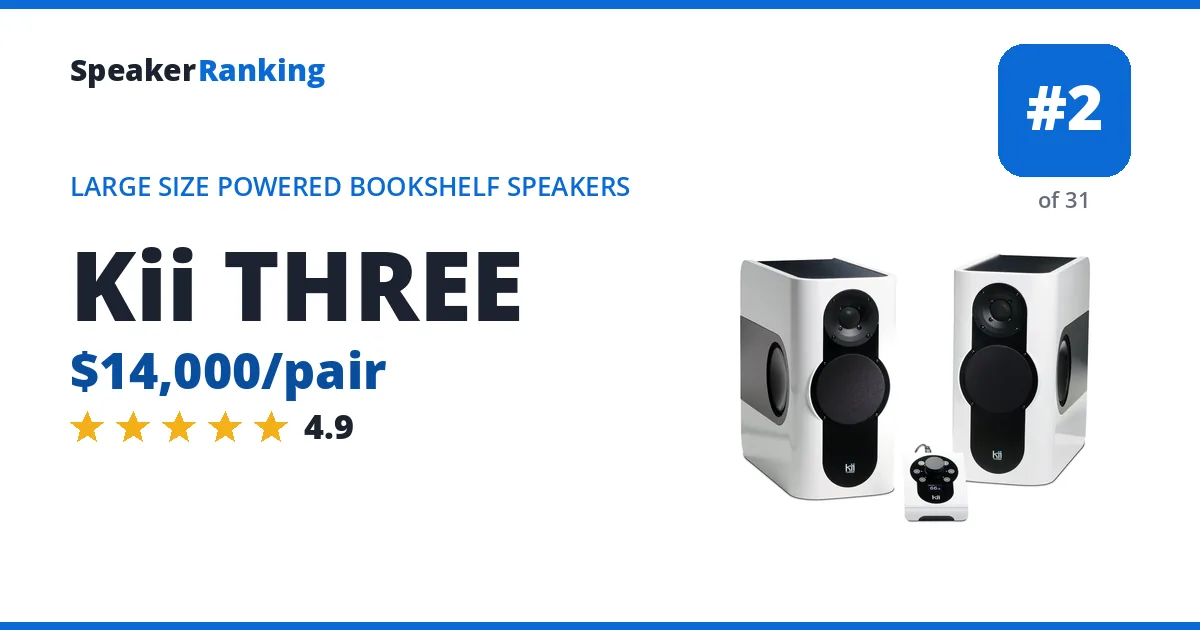
Pros: Exceptionally even measured balance: the 300Hz-5kHz response spans only 1.2dB, with preference scores of 7.70 standalone and 8.35 with an ideal subwoofer. Cardioid control reduces rearward low-midrange energy, while measured -3dB extension of 29.3Hz provides convincing full-range bass in a compact system. Measured bass extension of 28Hz (-3dB).
Cons: Deep-bass output has limits: demanding low-frequency material at high levels can trigger compression or audible distress. The reviewer preferred a small treble reduction, so the high score is not a promise of ideal tonal balance for every listener. Linear-phase operation adds latency, and the system is expensive.
Full Kii THREE review and specifications →
| AES Input | Yes |
|---|---|
| Amplifier Power | 1,500W total per speaker; Six Ncore channels |
| Aux Input | No |
| Bass Extension (-10dB) | 20.5Hz (measured, Erin’s Audio Corner) |
| Bass Extension (-3dB) | 28Hz (measured, Erin’s Audio Corner) |
| Bluetooth | No |
| Coaxial Input | No |
| Coverage | DSP-controlled cardioid above approximately 70-90Hz |
| DSP | Yes; boundary, contour, phase-exact and low-latency modes |
| Dimensions | 15.7”H x 7.9”W x 15.7”D |
| Drivers | Four 6.5” woofers; 5” midrange; 1” waveguided tweeter |
| Frequency Response | 20Hz - 20kHz (-6dB at 20Hz; ±0.5dB 100Hz-10kHz; ±1dB 10kHz-20kHz) (Manufacturer specified) |
| HDMI Input | No |
| Inputs | XLR (analog), XLR AES/EBU (digital), proprietary KiiLink digital multi-pin |
| Optical Input | No |
| RCA Input | No |
| Spinorama Preference Score | 7.70 |
| Spinorama Preference Score with Perfect Sub | 8.35 |
| TRS Input | No |
| USB Input | No |
| Weight | 42.1 lbs (19.1 kg) each |
| XLR Input | Yes |
- Links
- Reviews, Comparisons and Sound Samples
- Head-to-Head Comparisons
 Buchardt A500: $4,150 per pair Discontinued Buchardt Audio eBay
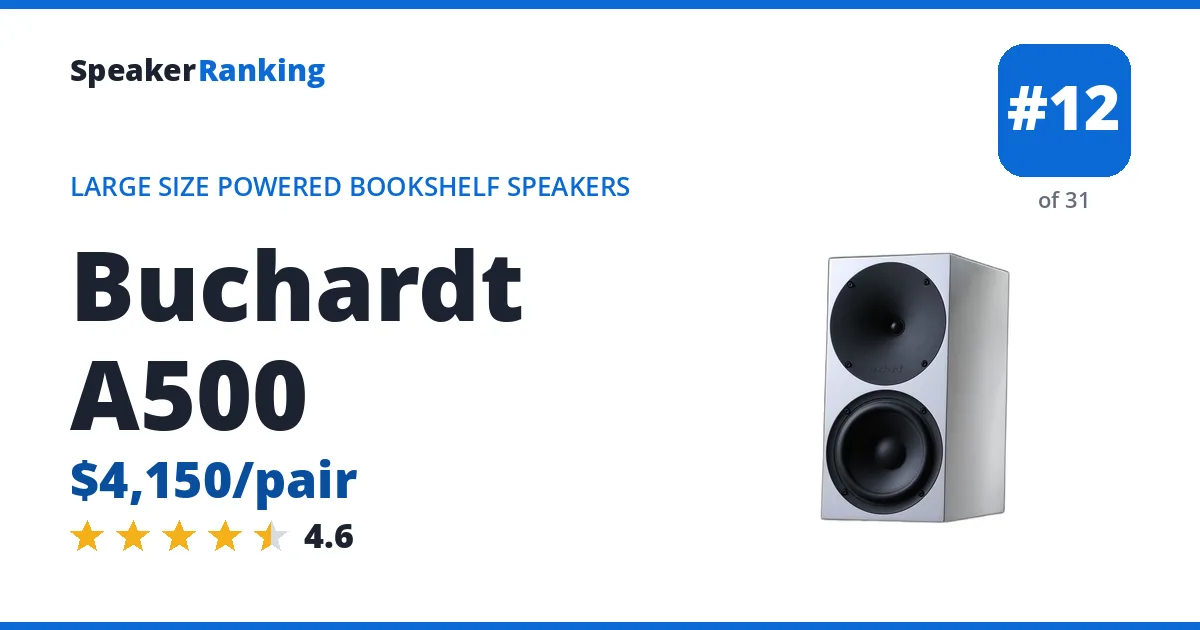
Pros: Erin measured unusually deep bass for the cabinet size: 24.9Hz at -3dB. A 1.8dB response span from 300Hz to 5kHz and 7.02 standalone preference score support balanced, full-range listening. Master Tunings and optional wireless integration provide practical flexibility. Measured bass extension of 24.9Hz (-3dB).
Cons: Bass extension depends on the selected tuning and comes with output tradeoffs at high levels. The 7.92 ideal-subwoofer score is good but not class-leading. A rear-facing woofer does not by itself establish cardioid radiation, and alternate Master Tunings should not inherit the measured configuration’s score. Discontinued.
Full Buchardt A500 review and specifications →
| AES Input | No |
|---|---|
| Amplifier Power | 3 x 150W per speaker |
| Aux Input | No |
| Bass Extension | Master-tuning dependent; approximately 25–40Hz |
| Bass Extension (-10dB) | 23.4Hz (measured, Erin’s Audio Corner) |
| Bass Extension (-3dB) | 24.9Hz (measured, Erin’s Audio Corner) |
| Bluetooth | No |
| Coaxial Input | No |
| Dimensions | 14.4H x 7W x 11D inches |
| Drivers | 0.74-inch dome; front and rear 6-inch long-throw woofers |
| Frequency Response | 25Hz - 40kHz (+/- 1.5dB) (Manufacturer specified) |
| HDMI Input | No |
| Inputs | XLR, WiSA |
| Optical Input | No |
| RCA Input | No |
| Spinorama Preference Score | 7.02 |
| Spinorama Preference Score with Perfect Sub | 7.92 |
| TRS Input | No |
| USB Input | No |
| Weight | 55.1 lbs (25kg)/pair |
| XLR Input | Yes |
- Links
- Reviews, Comparisons and Sound Samples
- Head-to-Head Comparisons