Quick answer: the Kii THREE if sound quality matters most, the Kali Audio LP-6 V2 if price matters most. The Kii THREE ranks #3 of 119 powered bookshelf speakers, rated 4.9/5, at $16,970. The Kali Audio LP-6 V2 ranks #37, rated 4.4/5, at $498, $16,472 cheaper.
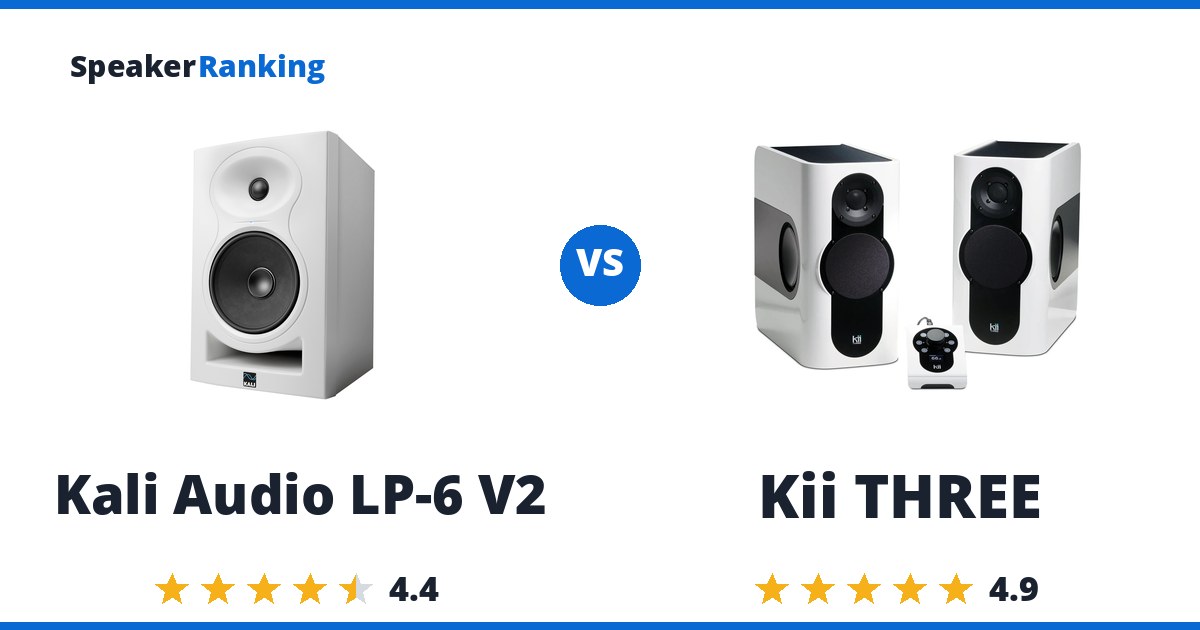
Reasons to choose the Kali Audio LP-6 V2: Affordable studio monitors with balanced sound and solid bass, plus switches to tune them for your room. Watch for: The 2.5dB response span from 300Hz to 5kHz leaves some tonal unevenness.
The Kii THREE is the more accurate, deeper-bass pick. Compact cardioid active speakers with extremely accurate sound and full range bass that walls barely color. Its measured preference score, a predictor of how neutral it sounds, is 7.70 against 5.53 for the Kali Audio LP-6 V2. Its bass reaches about 28Hz before falling 3dB, against 42Hz for the Kali Audio LP-6 V2. The tradeoff: Deep-bass output has limits: demanding low-frequency material at high levels can trigger compression or audible distress.
Buy the Kali Audio LP-6 V2 if the price matters more than sound quality. Buy the Kii THREE if sound quality matters more than the price.
Want more options? Browse the full Powered Home rankings.
Measured Differences
- Bass depth: the Kii THREE reaches 20.5 Hz (10 dB down) against 39.1 Hz for the Kali Audio LP-6 V2, about an octave deeper. Low bass that the other only hints at comes through with real weight.
- Tonal accuracy above the bass: with a subwoofer taking the low end, the Kii THREE scores 8.3 against 7.5 for the Kali Audio LP-6 V2 on the Spinorama preference scale. Its frequency response and off-axis sound are smoother, so voices and instruments sound closer to the recording.
Prices on this page were last checked November 23, 2026 at 4:51 AM UTC. Product prices and availability are accurate as of that date/time and are subject to change; the price and availability shown on Amazon at the time of purchase will apply to the purchase of this product.
As an eBay Partner, we may be compensated if you make a purchase.
Specifications Side By Side
| Kali Audio LP-6 V2 | Kii THREE | |
|---|---|---|
| Price | $498 per pair | $16,970 per pair |
| Ranked | #37 of 119 in Large Size Powered Bookshelf Speakers | #3 of 119 in Large Size Powered Bookshelf Speakers |
| Bass Extension (-3dB) | 42Hz (measured, Erin’s Audio Corner) | 28Hz (measured, Erin’s Audio Corner) |
| Bass Extension (-10dB) | 39.1Hz (measured, Erin’s Audio Corner) | 20.5Hz (measured, Erin’s Audio Corner) |
| Drivers | 1” soft-dome tweeter; 6.5” woofer | Four 6.5” woofers; 5” midrange; 1” waveguided tweeter |
| Amplifier Power | 40W LF + 40W HF per speaker; Bi-amplified Class D | 1,500W total per speaker; Six Ncore channels |
| Inputs | XLR, balanced TRS and RCA | XLR (analog), XLR AES/EBU (digital), proprietary KiiLink digital multi-pin |
| Dimensions | 14.1”H x 8.8”W x 10.2”D | 15.7”H x 7.9”W x 15.7”D |
| DSP | Yes; boundary presets and LF/HF trims | Yes; boundary, contour, phase-exact and low-latency modes |
| Maximum SPL | Approximately 102dB per pair with good measured linearity (Erin’s Audio Corner) (manufacturer specified) | - |
| Spinorama Preference Score | 5.53 | 7.70 |
| Spinorama Preference Score with Perfect Sub | 7.48 | 8.35 |
| XLR Input | Yes | Yes |
| RCA Input | Yes | No |
| TRS Input | Yes | No |
| Optical Input | No | No |
| Coaxial Input | No | No |
| USB Input | No | No |
| HDMI Input | No | No |
| AES Input | No | Yes |
| Aux Input | No | No |
| Weight | 15.5 lbs (7.05 kg) each | 42.1 lbs (19.1 kg) each |
| Bluetooth | No | No |
| Frequency Response | 47Hz - 21kHz (±3dB) (Manufacturer specified) | 20Hz - 20kHz (-6dB at 20Hz; ±0.5dB 100Hz-10kHz; ±1dB 10kHz-20kHz) (Manufacturer specified) |
| Coverage | - | DSP-controlled cardioid above approximately 70-90Hz |
Where the Ratings Come From
- Kali Audio LP-6 V2: Spinorama.org measurements and reviews by Erin’s Audio Corner and DSAUDIO.review.
- Kii THREE: Spinorama.org measurements and reviews by Erin’s Audio Corner.
This comparison is generated from the ratings, specifications and measurements on each product’s own page, and it updates when that data changes. How we rank explains how each rating is decided.
Related Speaker Comparisons
More worthwhile head-to-heads for Kii THREE: